 Yorimichi Games


How to play Smartball
Smartball is an old Japanese table game, a close cousin of bagatelle and early pinball. A wooden board lies almost flat, tilted only slightly toward you. You pull back a spring, shoot a ball up a narrow lane, and the ball swings around the curved top of the board, then wanders down through a forest of brass pins. If it rolls slowly enough over a hole, it drops in. Which hole it lands in decides your score – or, on the festival board, whether you complete a line. There are no flippers: once the ball is on its way, the only thing you control is how hard you shot it.
For decades Smartball has been a fixture at Japanese summer festivals (ennichi, the stalls set up around shrines and temples) and at old-fashioned hot spring towns. This version runs in any browser on a phone, tablet or computer, with nothing to install and no account.
The board at a glance
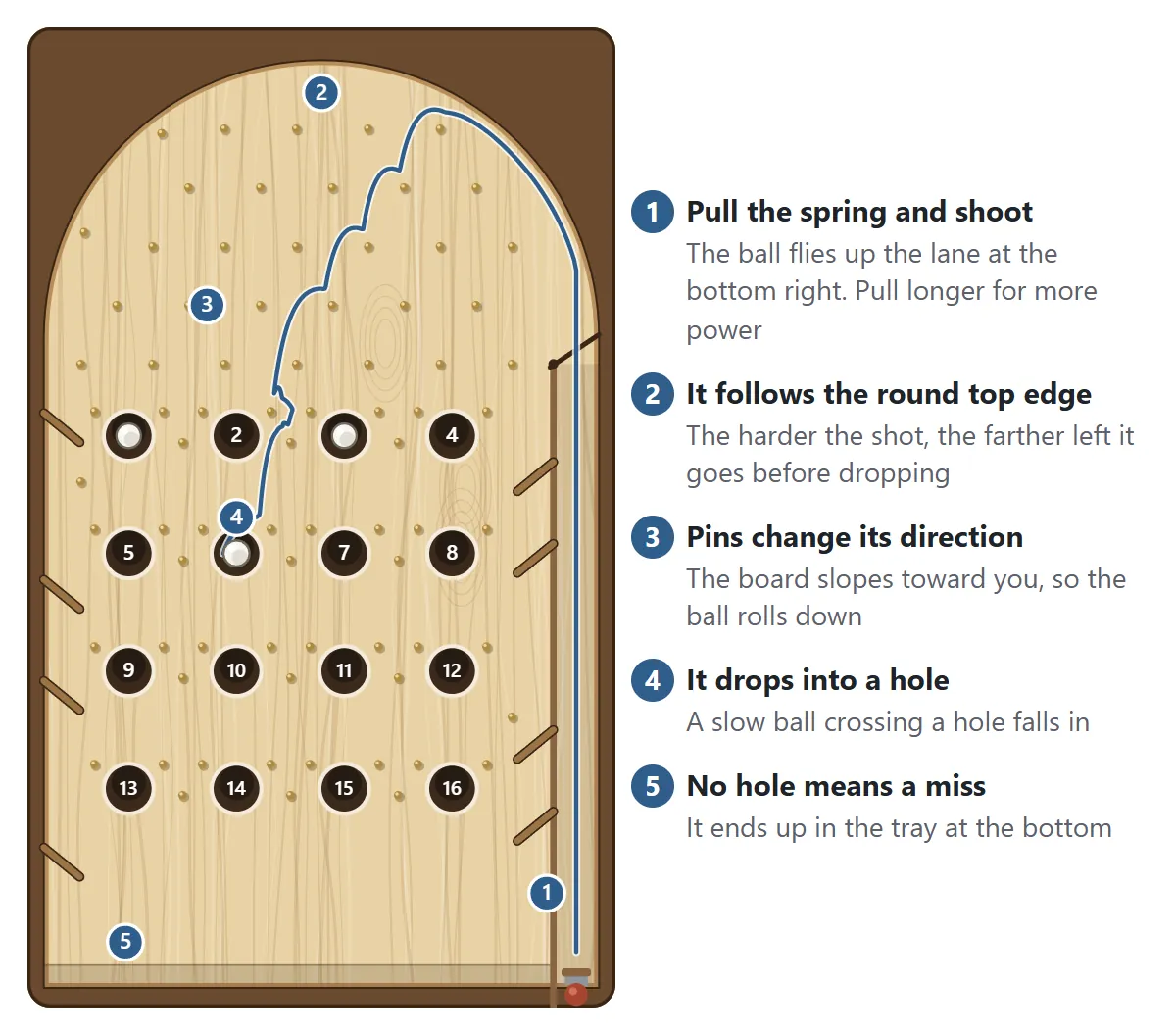
The top of the screen is the far, higher end of the board and the bottom is the near, lower end. On the right is the launch lane with the spring underneath (on the Corinth Game board it is a wooden plunger rod). The ball runs up the lane, follows the round top edge toward the left, and drops onto the playfield wherever it runs out of speed. From there it rattles off the pins, left and right, on its way down. A ball that passes slowly over a hole falls in. A ball that finds no hole rolls into the tray at the bottom and counts as a miss.
Shooting: power decides where the ball goes
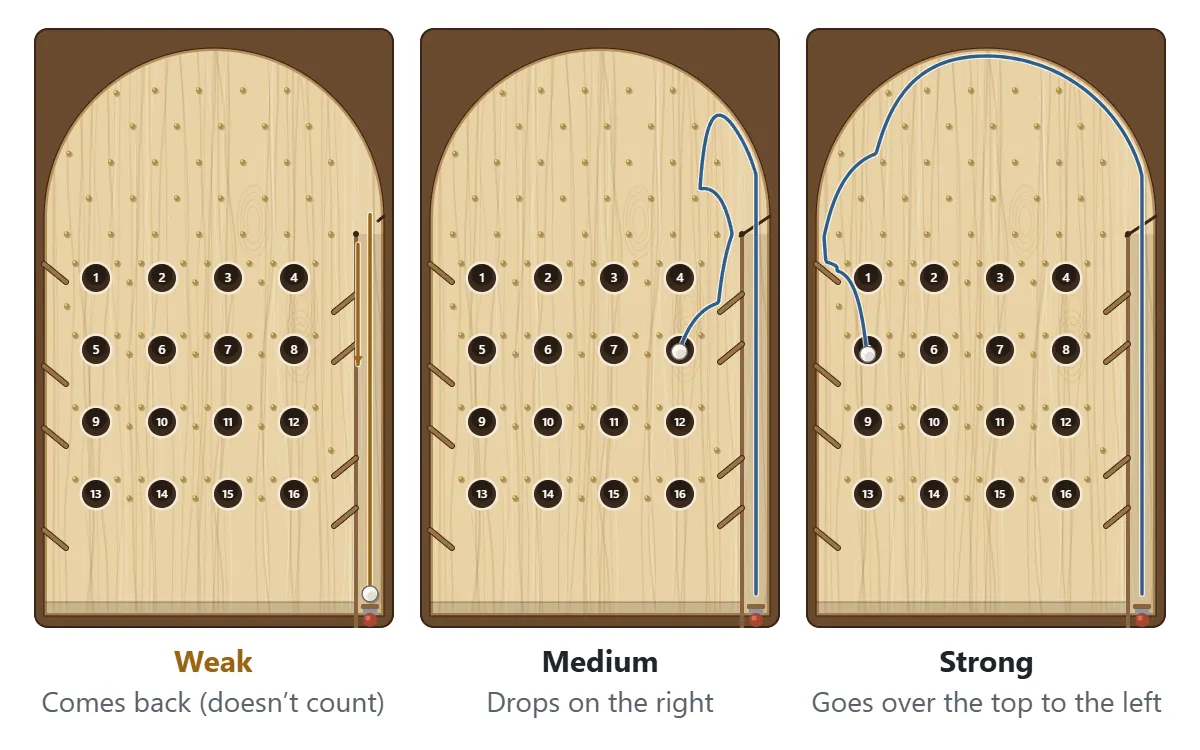
On a phone or tablet, put your finger anywhere on the board, pull down and let go. With a mouse, press on the board, drag down and release. The longer the pull, the stronger the shot. You can also set the Power slider under the board and press Shoot. On a keyboard, hold Space to pull the spring and release it to shoot, or use the arrow keys to move the slider one step at a time and press Enter.
Power is the whole game. A softer shot drops the ball on the right side of the board; a harder one carries it over the top and down the left side. If the ball is too weak to reach the top, it rolls back down the lane. That ball is not used up – just shoot it again a little harder.
When does the ball drop into a hole?
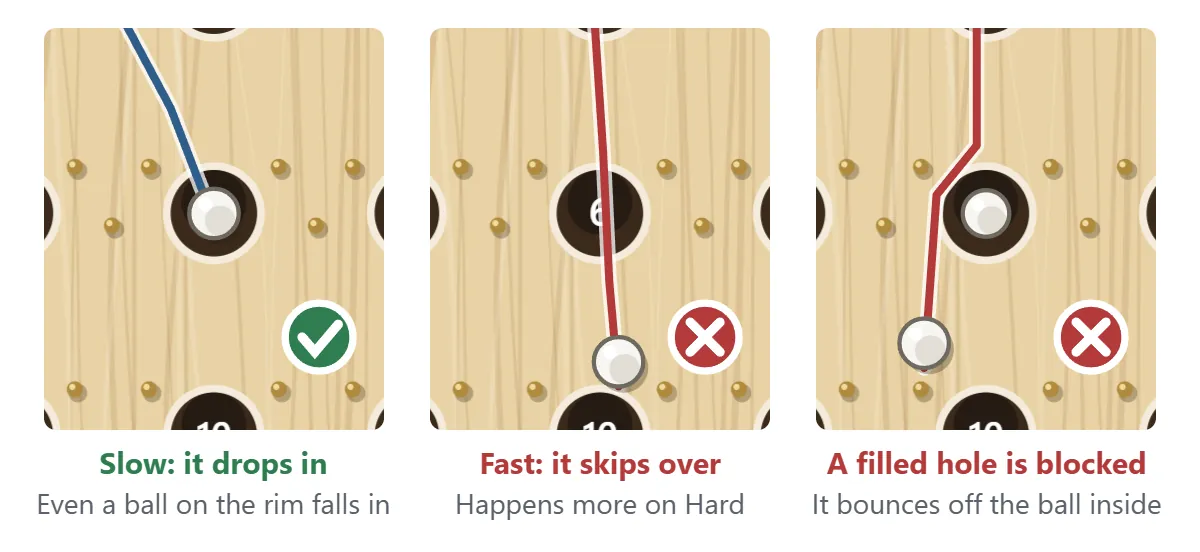
Rolling across a hole is not enough on its own. A slow ball is pulled in even when it only catches the rim, but a ball with real speed skips straight over the top. That is why holes just below a cluster of pins are good targets: the pins take the speed off the ball right before it reaches the hole. On the Festival Lines board, a hole that already holds a ball is blocked, and a new ball will bounce off the one sitting inside.
Smartball rules for each board
| Board | How you score |
|---|---|
| Festival Lines | 16 numbered holes in a 4×4 grid. Fill four in a row – across, down or diagonally – to make a line. Balls stay in their holes. Most lines wins |
| Point Holes | Holes worth 5, 10 or 15 points. The two red-ringed pair holes give 30 points when both are filled. Add up your points |
| Corinth Game | A darker wooden board with small steel balls and holes worth 10 to 100 points. The higher the points, the narrower the opening |
Festival Lines: the 16-hole grid
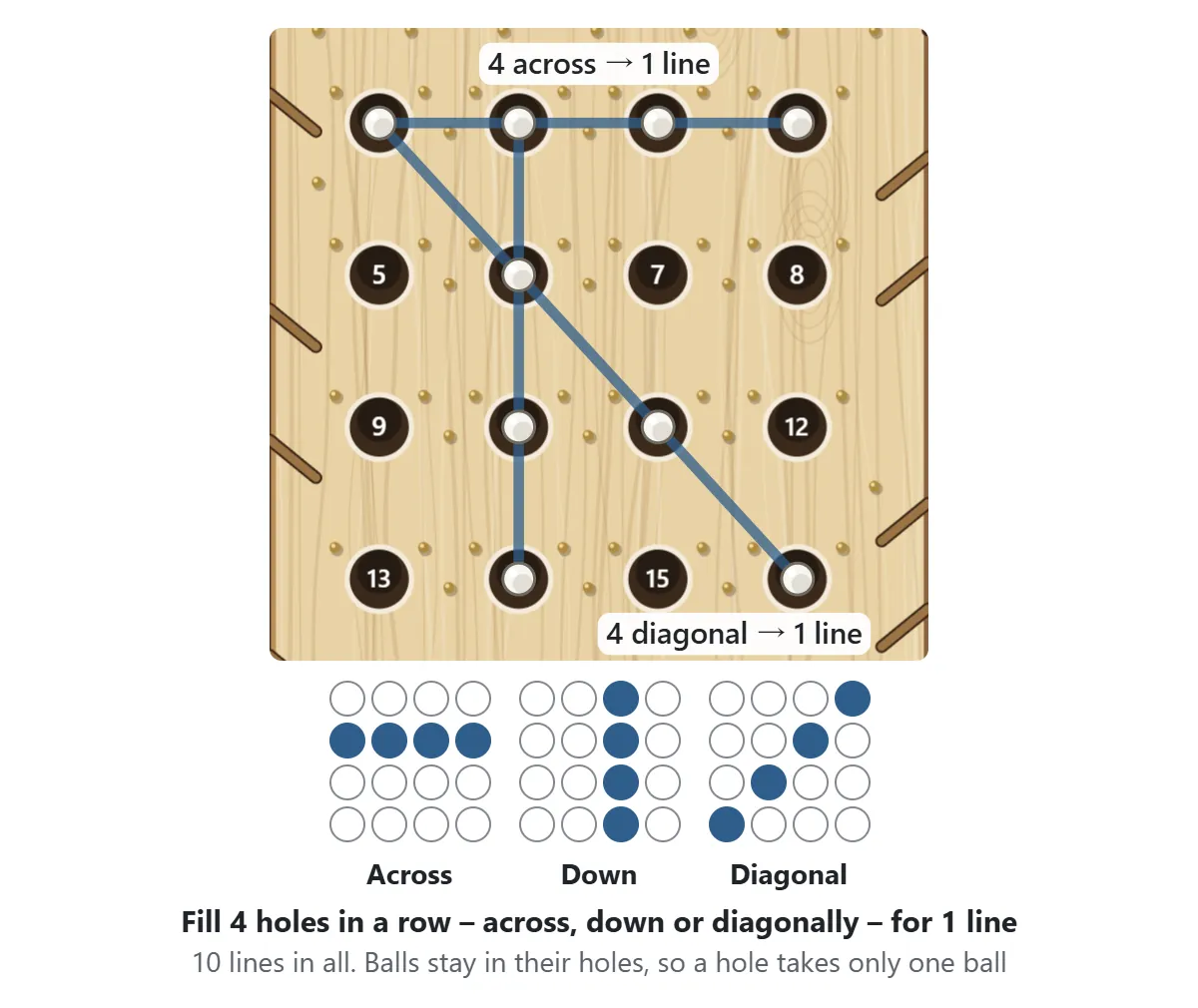
This is the board you are most likely to meet at a Japanese festival stall. Sixteen holes, numbered 1 to 16, sit in four rows of four. Every ball that drops in stays there, and four filled holes in a row make a line. There are ten lines in all: four across, four down and two diagonals. One ball can finish two lines at once. Because a filled hole is blocked, the board gets trickier as it fills up – the holes you still need are often guarded by balls you already placed.
Point Holes and the pair holes
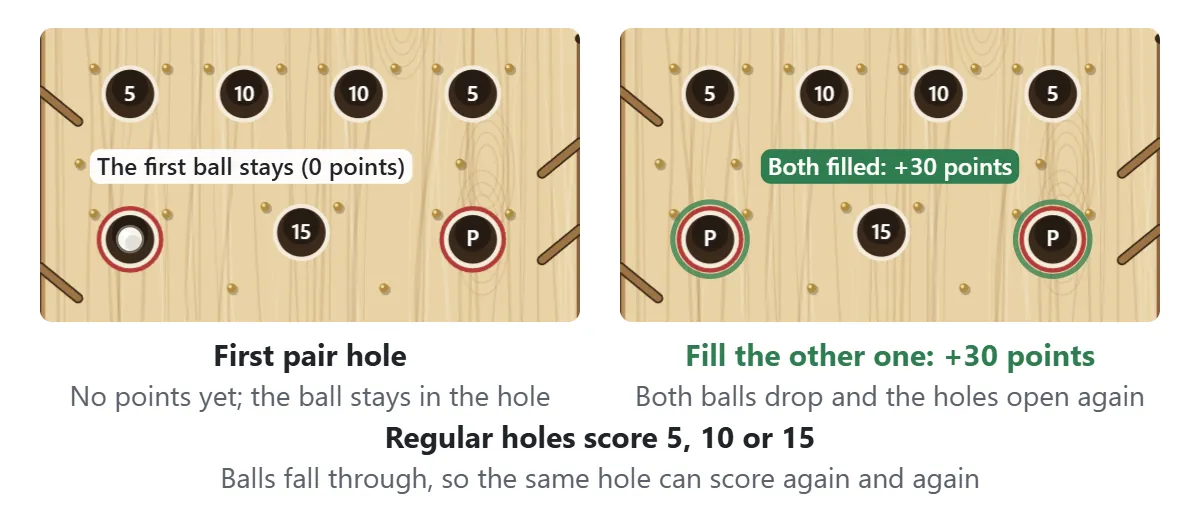
Point Holes is the simplest board to read: each hole shows what it is worth. Balls fall straight through the regular holes, so you can hit the same one as often as you like. The two red-ringed holes on the left and right are pair holes. The first ball to land in one of them scores nothing and stays put. Put a second ball in the other pair hole and both are released for 30 points, leaving the pair open for another round.
The Corinth Game board
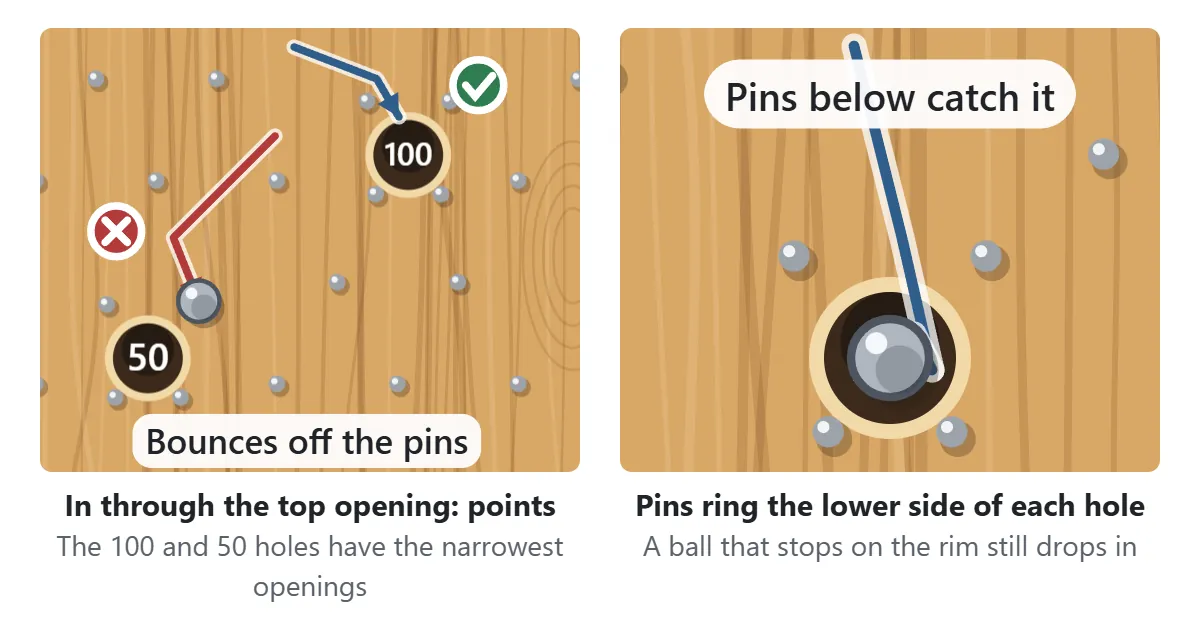
The Corinth Game (korinto gēmu in Japanese) is the home version of this kind of game: a wooden board with a rounded top, pins, numbered holes and a handful of small steel balls pushed out one at a time with a rod. Each hole is ringed by pins on its lower side, so a ball that comes down into the opening is caught and dropped in. The 100- and 50-point holes have the tightest openings, and a ball that arrives slightly off center bounces away off the pins. Balls fall through, so a good hole can be hit more than once.
Modes and difficulty
| Mode | What it is |
|---|---|
| Solo | Pick a board, the number of balls (5, 10 or 15) and the difficulty, and chase your personal best. A separate best is kept for each combination |
| Daily board | A new board every day, with its own pin layout and hole values. Everyone plays the same board on the same day, with 10 balls on Normal |
| 2 players | Two people share one device. Player 1 shoots all the balls, then Player 2 plays the same board and you compare results |
| Difficulty | How it feels |
|---|---|
| Easy | Bigger holes that catch even fairly quick balls. A marker on the slider shows your last power |
| Normal | Balls at a moderate speed drop in. The last-power marker is shown |
| Hard | Smaller holes, fast balls skip over them, and the spring is less consistent. No marker |
Smartball tips and strategy
1. Spend your first few balls learning the board
On any given board, the same power sends the ball to roughly the same area. Try a soft shot, a medium shot and a hard one early on, and note where each one ends up. That little map is worth more than any single lucky ball.
2. Remember the number that worked
When a ball lands where you wanted, remember the power reading. On Easy and Normal, a small marker above the slider shows your previous shot, which makes it easy to repeat or adjust it.
3. Make small changes
A big change in power sends the ball somewhere completely different. If you just missed, change the power by one or two points and try again. The arrow keys move the slider one step at a time, and Shift with an arrow moves it by five.
4. On Festival Lines, build lines you can actually reach
The top row is the easiest to hit, while the lower rows get crowded by balls already in place. Aim for lines that use the top row, or columns that run from the top down, before chasing the hard corners.
5. Follow up a pair hole right away
Once one pair hole is filled, go for the other. The two pair holes are usually reached with similar power, so start from the shot that worked and nudge it slightly.
6. Expect a little randomness
Just like a real spring, the same power never gives exactly the same path. Tiny differences grow each time the ball hits a pin. Some rounds simply go your way and some don’t, and that is part of the charm.
Smartball FAQ
Can I play on a phone or tablet?
Yes. The board is tall and narrow, so it fits a phone held upright. Just pull down with your finger and let go. It is also light enough to run smoothly on Chromebooks and iPads.
Does a ball that comes back down the lane count?
No. If the ball does not reach the top and rolls back, it is as if you never shot it, and you keep the ball.
How is Smartball different from pinball?
They share the same ancestor. Modern pinball added flippers so you can keep hitting the ball; Smartball never did. You shoot, then watch the ball find its way through the pins, so the skill is all in the power of the shot and in knowing the board. The board is also almost flat, so the large ball rolls slowly and you can follow every bounce.
Is it free? Are there any prizes?
It is completely free and needs no account. It is a game of skill played for lines and points only – there is nothing to buy, win or exchange.
Can I stop and continue later?
Yes. The game saves after every ball. On the same device and browser, press Continue to pick up with the same balls left and the same holes filled.
Where Smartball comes from
Rolling balls down a sloping board past pins and into holes goes back to bagatelle, a table game related to billiards that became fashionable in 18th-century France and later spread across Europe and America. Bagatelle boards with pins and scoring cups, sometimes called Corinthian bagatelle, are the common ancestor of pinball and of the Japanese games on this page.
In Japan, a home version with a wooden board, brass or steel pins, numbered holes and small steel balls went on sale in the 1930s as the “Corinth Game” and became a familiar family toy. Smartball, with its almost level board and big white balls, found its place at summer festivals and in the game corners of hot spring resorts after the war. The 16-hole grid, where you try to fill a line much like on a bingo card, is still what many people in Japan picture when they hear the name.
If you enjoy rolling and bouncing balls, try Pinball, where you keep the ball alive with flippers, or Mini Golf, where you putt the ball toward the cup, or Coin Pusher, where a moving shelf nudges wooden coins over the edge, or Shooting Gallery, the festival stall where you knock small toys off a shelf with a cork.