 Yorimichi Games

How to play the shooting gallery
A shooting gallery is one of the oldest fairground games there is: line up small objects on a shelf, give the player something that fires a soft projectile, and see how many targets they can knock down. At Japanese summer festivals the stall is called shateki, and the “ammunition” is a cork pushed out of a toy tube by a puff of compressed air. This free browser version recreates that festival stall. You get eight corks per round, the targets sit on wooden shelves, and a target only counts when it falls off the back of the shelf. It runs on computers, phones, tablets and Chromebooks, with no download and no sign-up.
Everything you knock down goes into your collection. There are twelve kinds of targets to collect, from a light paper balloon to a heavy jar of marbles. Nothing costs money, and nothing you collect leaves the screen: the fun is in the aiming and in figuring out how each target falls.
Reading the stall
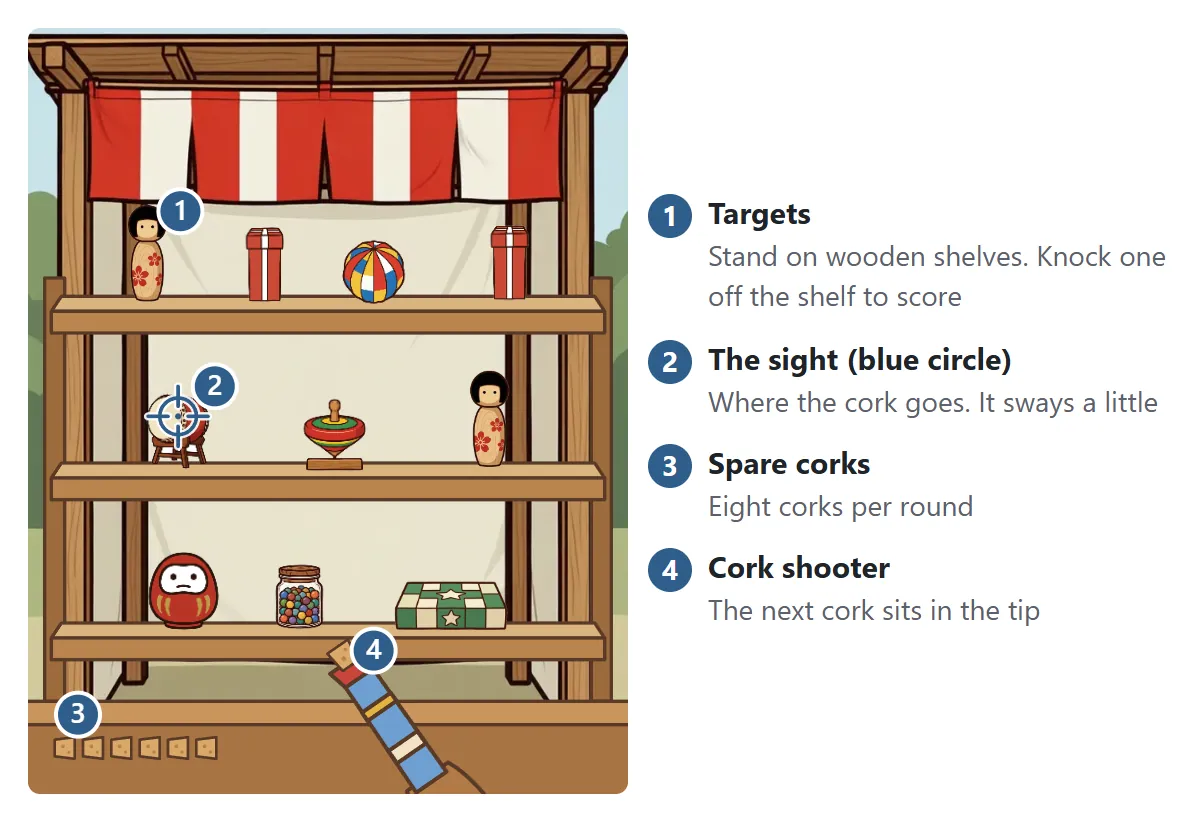
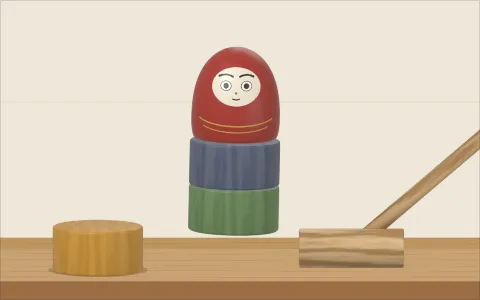
You look at the stall straight from the front. Two to four wooden shelves hold the targets: a daruma, a kokeshi doll, small and large boxes, a tin can, a spinning top, a drum, a stack of blocks and more. The blue circle is the sight. When you shoot, the cork flies to the sight, give or take a little spread. The sight never sits perfectly still – it sways gently, like a real hand holding a toy at arm’s length. Your remaining corks are lined up on the counter in front of you, and after each shot it takes a moment to load the next one.
Aiming and shooting
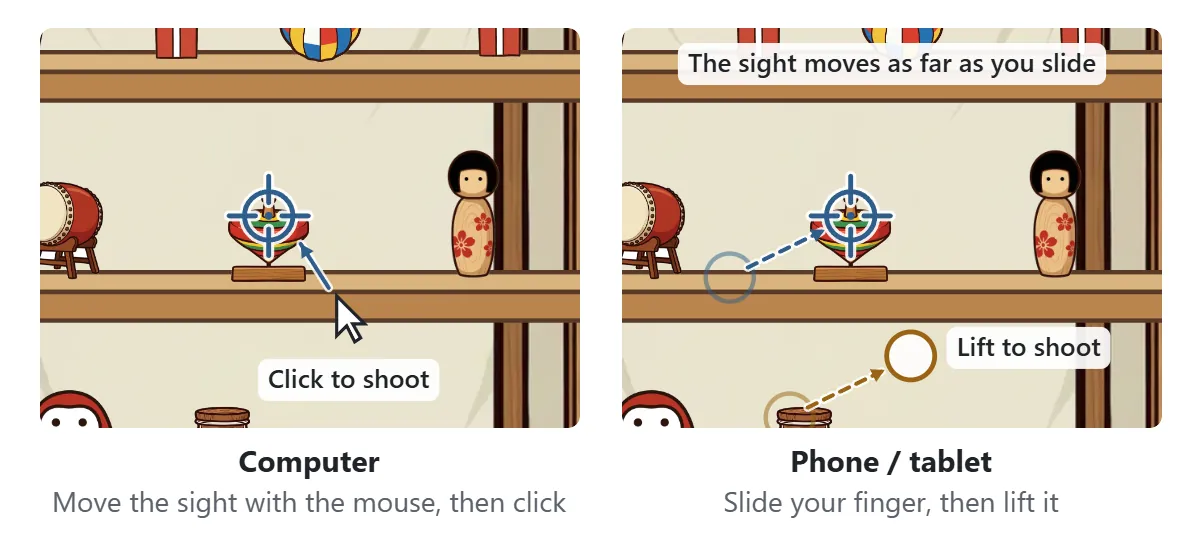
On a computer, the sight follows your mouse and a click fires a cork. On a phone or tablet, put a finger anywhere on the stall and slide it: the sight moves by the same amount, so your finger never covers the target you are aiming at. Lift your finger to shoot. You can also use the arrow buttons under the stall and the Shoot button, or the arrow keys and the space bar on a keyboard.
Because the sight sways, timing matters. Watch it for a second or two and you will see it drift back over the spot you chose. Shoot as it passes through, not while it is swinging away.
Stalls, difficulty and rules
| Stall | What it’s like |
|---|---|
| Festival stall | A daytime stall with three shelves. Light trinkets on top, heavy ones like the daruma and the big box at the bottom. Start here |
| Festival night | A stall under paper lanterns with more heavy targets. You need to think about where to hit |
| Miniature | Four shelves packed with tiny targets. They are light, but small, so a steady aim matters most |
| Difficulty | How it feels |
|---|---|
| Easy | Very little sway and strong corks. Targets stand close to the back edge, so a small push sends them over |
| Normal | Some sway. Light targets fall easily, but heavy ones only fall when you hit them high |
| Hard | Lots of sway and weaker corks. Targets stand near the front of the shelf, so you have to inch them back over several shots |
Your personal best is kept separately for each stall and difficulty. Some real stalls let small children count a target that merely tips over, but here – as at most stalls – a target only counts when it drops off the shelf. If one topples backward and stays on the shelf, hit it again to push it off.
Shooting gallery tips and tricks
1. Aim at the upper part of the target
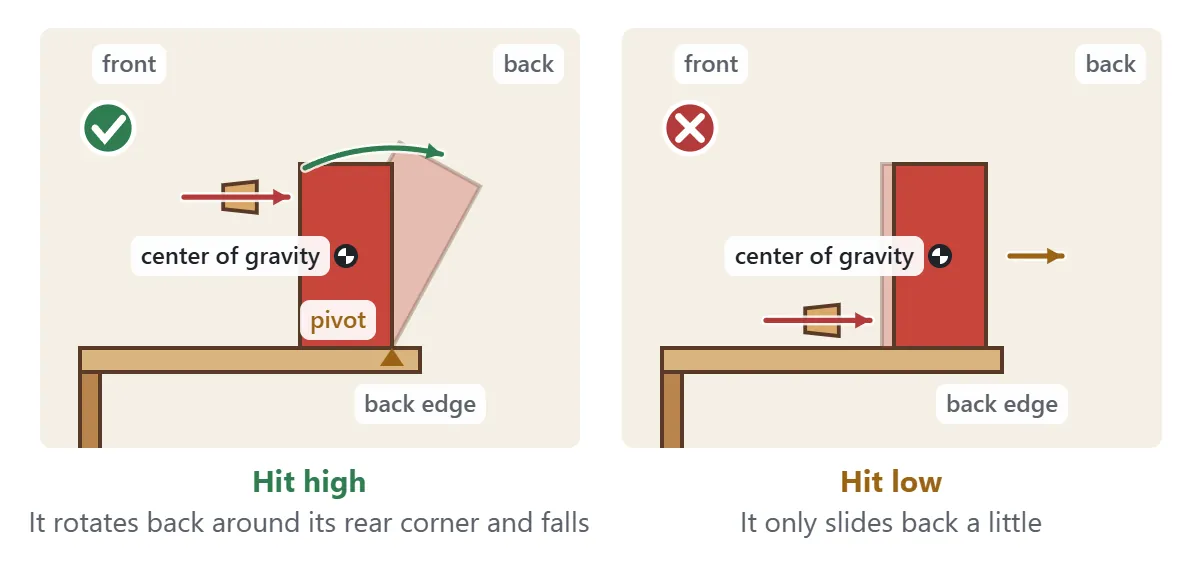
Targets leave the shelf by tipping backward. When a cork strikes a target high up, the target starts to rotate around its rear bottom corner (or around the back edge of the shelf, if it already hangs over). If its center of gravity swings past that pivot, it keeps going and drops behind the shelf. A hit near the bottom does something different: the target slides back a little without tipping. For most targets, the sweet spot is about a quarter of the way down from the top. Don’t aim at the very top edge – with the sway, that is an easy way to miss over the top.
2. Move heavy targets a little at a time
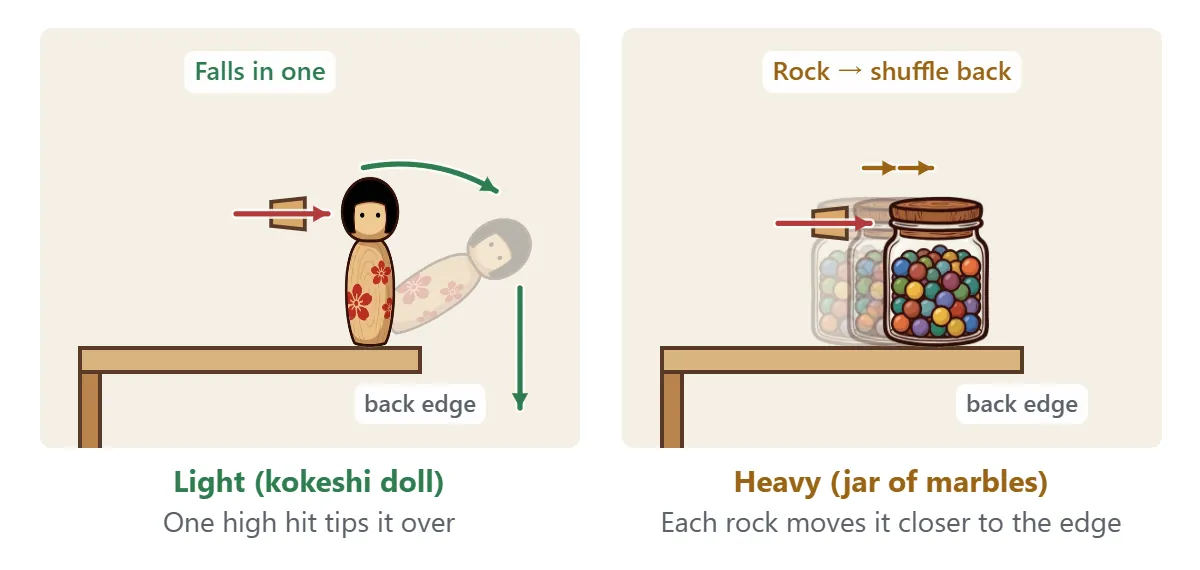
The daruma, the jar of marbles and the big box are heavy. One cork usually just rocks them, and they settle back onto the shelf. Don’t give up: every time a target rocks and lands again, it shuffles slightly backward. The closer it gets to the back edge, the less push it takes to go over. Keep hitting the same target high up and it will eventually topple. With only eight corks, deciding whether to collect easy ones or commit to a heavy one is half the strategy.
3. Hit wide boxes on a top corner
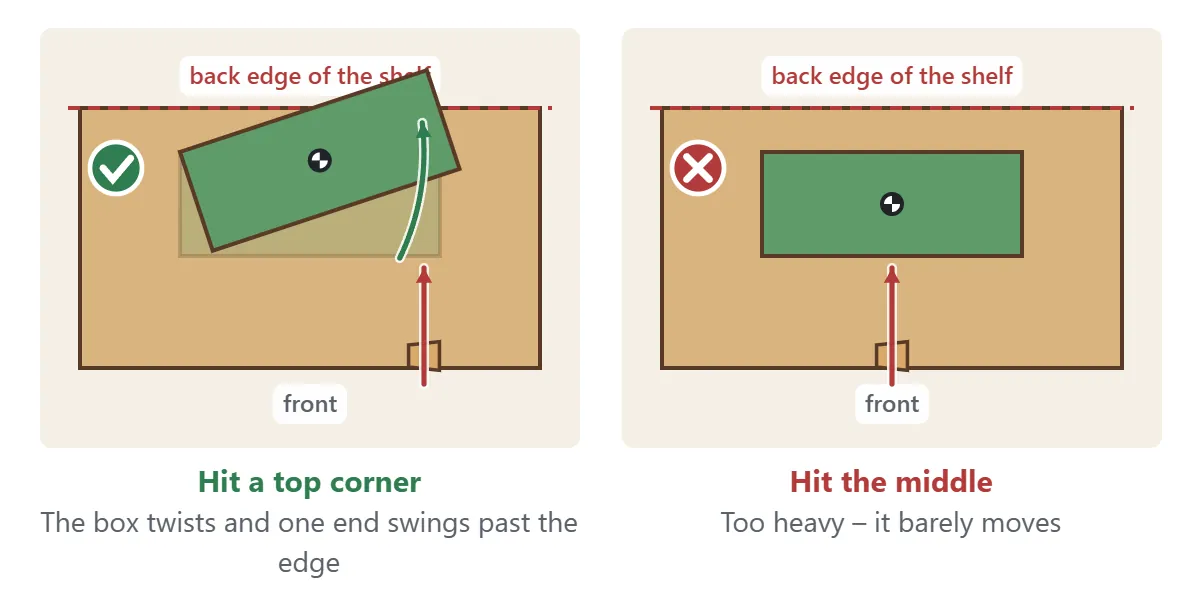
Wide targets such as the big box and the wooden train barely budge when you hit them in the middle. Hit one of the top corners instead. The box twists around its far corner, the end you hit swings backward, and its center of gravity moves back with it. Follow up with a high shot and it goes over much more easily.
4. Push the daruma, don’t try to tip it
A daruma is round and bottom-heavy, with a very low center of gravity. Hit it high and it simply rocks and stands up again, like a roly-poly toy. Hit it around the middle instead, to slide it back a little with every shot. Once its center of gravity passes the back edge of the shelf, it rolls off.
5. Watch where the cork lands
A small burst marks where each cork hits. If the target doesn’t fall, look at where the mark was and adjust: higher for heavy targets, a corner for wide boxes, the middle for the daruma. The message above the stall gives the same kind of hint after a near miss.
The science: levers and the center of gravity
Whether a target falls is a small lesson in levers. A standing target pivots around its rear bottom edge. The force of the cork, multiplied by its height above that pivot, is the turning effect (the torque, or moment) that tries to rotate the target backward. That is why the same cork does more when it hits higher up.
Gravity pushes back. To tip over, the target has to lift its center of gravity up and over the pivot. A low center of gravity, a heavy body or a wide base all make that harder – which is why the daruma is so stubborn and the tall, light kokeshi doll goes over at the first touch. When a target stands right at the back edge, the edge of the shelf becomes the pivot, the distance from the center of gravity to the pivot shrinks, and only a small push is needed.
Shooting gallery FAQ
Does it cost anything? Do I get to keep what I knock down?
It is free and there is nothing to sign up for. Targets you knock down are added to the collection on your screen, and that’s all – nothing is exchanged or sent anywhere. The goal is to see how many you can knock down with eight corks and to complete the set of twelve.
I hit the target. Why didn’t it fall?
Every target has its own weight and shape, so where you hit it matters. Light targets fall almost wherever you hit them, but heavy ones only slide or rock when you hit them low or in the middle. Keep hitting them high and they will creep toward the edge.
Can I play on a phone or tablet?
Yes. Slide your finger to aim and lift it to shoot. The game is kept light so it runs smoothly on Chromebooks, iPads and older phones.
Will my collection be saved?
Your collection and personal bests are stored in your browser on this device. Use the same browser on the same device and they will still be there next time. If you stop in the middle of a round, “Continue” picks it up where you left off.
Is it like a real festival shooting stall?
The idea is the same: fire corks at targets on a shelf and knock them off. Real stalls vary in how many corks you get and in what they count – some let small children count a target that just tips over. Here every round has eight corks so you can compare your scores fairly.
A short history of the shooting gallery
Throwing or shooting something at a row of targets is an ancient pastime. At Japanese temple fairs in the Edo period, people tried their luck with small bows at stalls known as yokyu archery shops. Cork-firing air toys became popular in Japan around the end of the Meiji era, early in the twentieth century, and the cork stall is still a familiar sight at summer festivals and in old hot-spring towns. Western fairs and amusement parks have their own shooting galleries with tin ducks and bottles. This version uses traditional Japanese trinkets – the daruma, the kokeshi doll, the spinning top and the paper balloon – drawn especially for the game, and lets you explore how they fall using a bit of everyday physics.