 Yorimichi Games


How to play Shogi Kuzushi
Shogi Kuzushi (pronounced “show-gee koo-zoo-shee”) is a dexterity game played with the pieces of shogi, the Japanese form of chess. The name means “collapsing the shogi pieces.” Instead of playing a game of shogi, players empty the box of pieces onto the board so they land in a jumbled heap, and then take turns sliding pieces out of the heap with one finger. If you can move a piece all the way off the board without making a sound, you keep it. In Japan it is also called yama-kuzushi (“collapsing the mountain”), and many people first touch a set of shogi pieces through this game long before they learn the moves of real shogi. You do not need to know anything about shogi to play.
In this online version you see the board from directly above. Pieces that sit higher in the pile cast bigger shadows. You hold a piece with the mouse (or your finger on a phone or tablet) and drag it to any edge of the board.
1. Build the pile
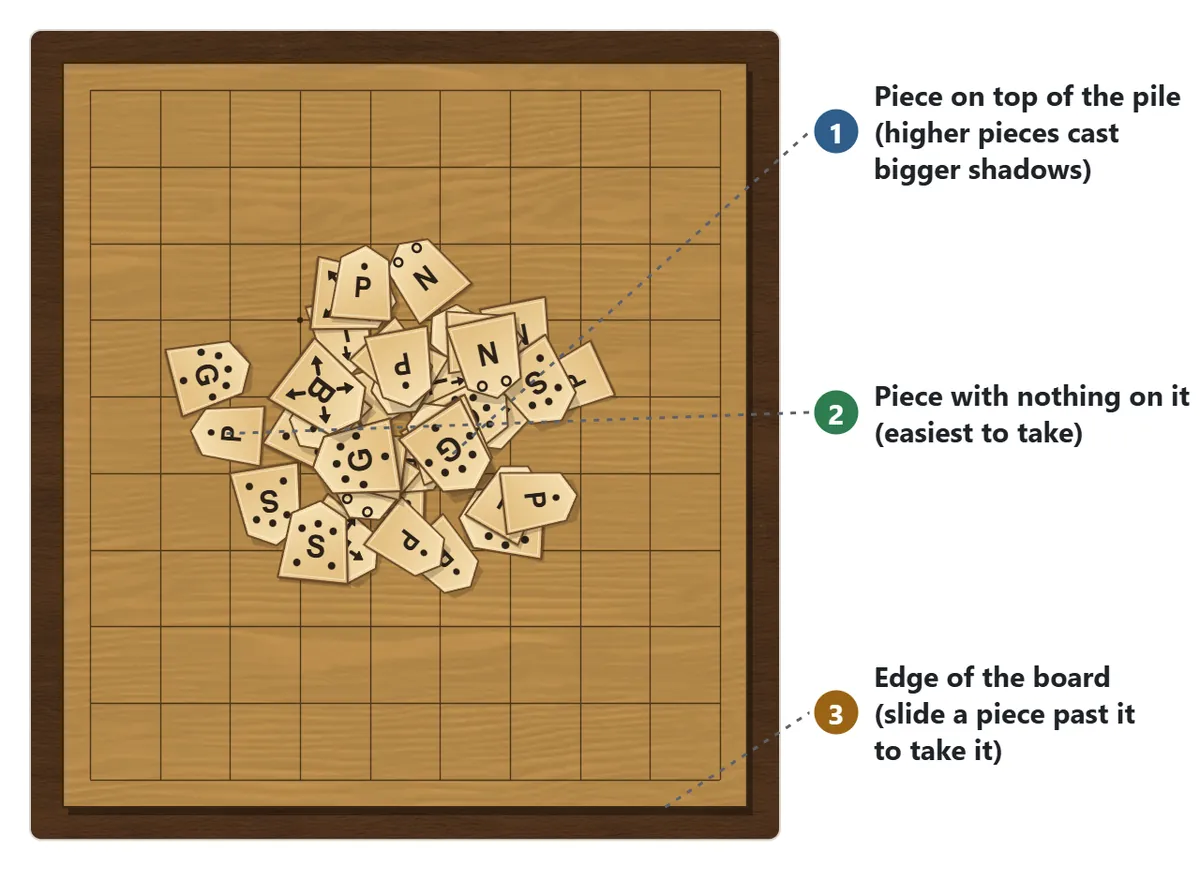
With a real set, you put all 40 pieces in their box, turn the box upside down in the middle of the board, and lift it away carefully. The pieces settle into a small mountain several layers high. This game does the same thing at the start of every round, so the pile is different every time. Rock-paper-scissors decides who goes first, and then players take turns.
2. Slide a piece off the board
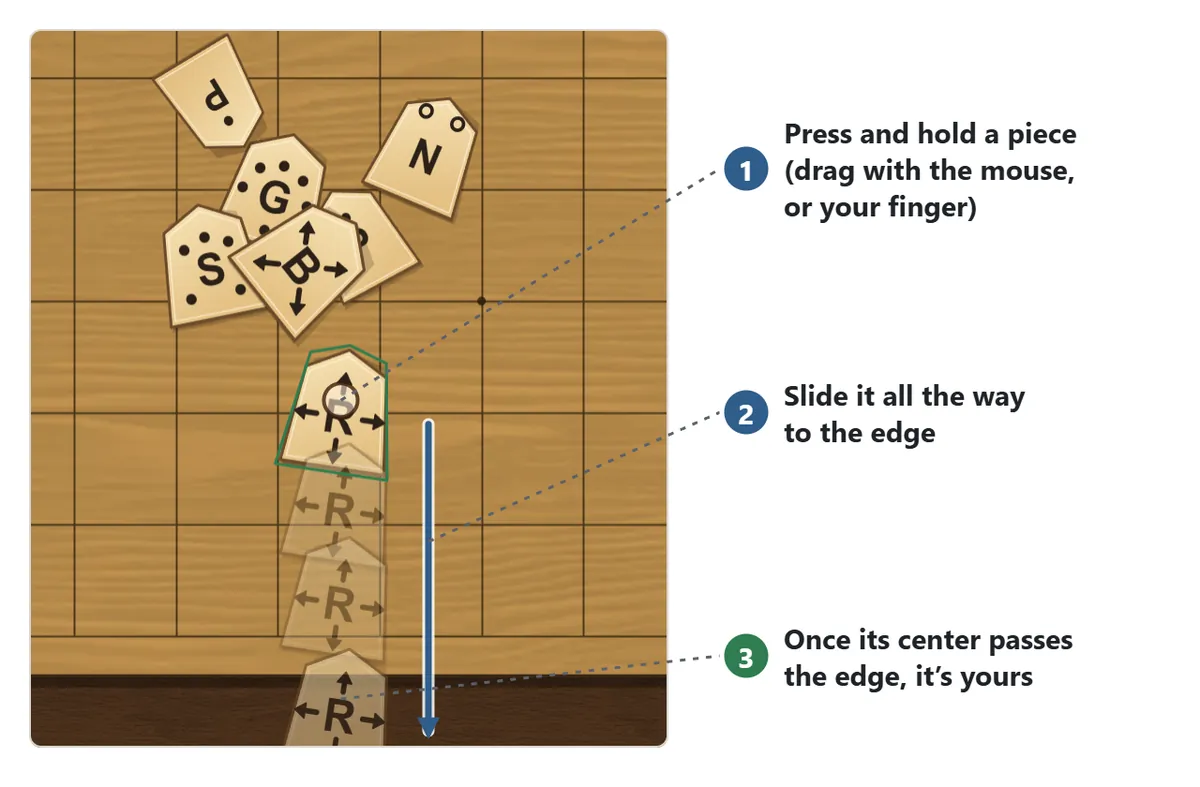
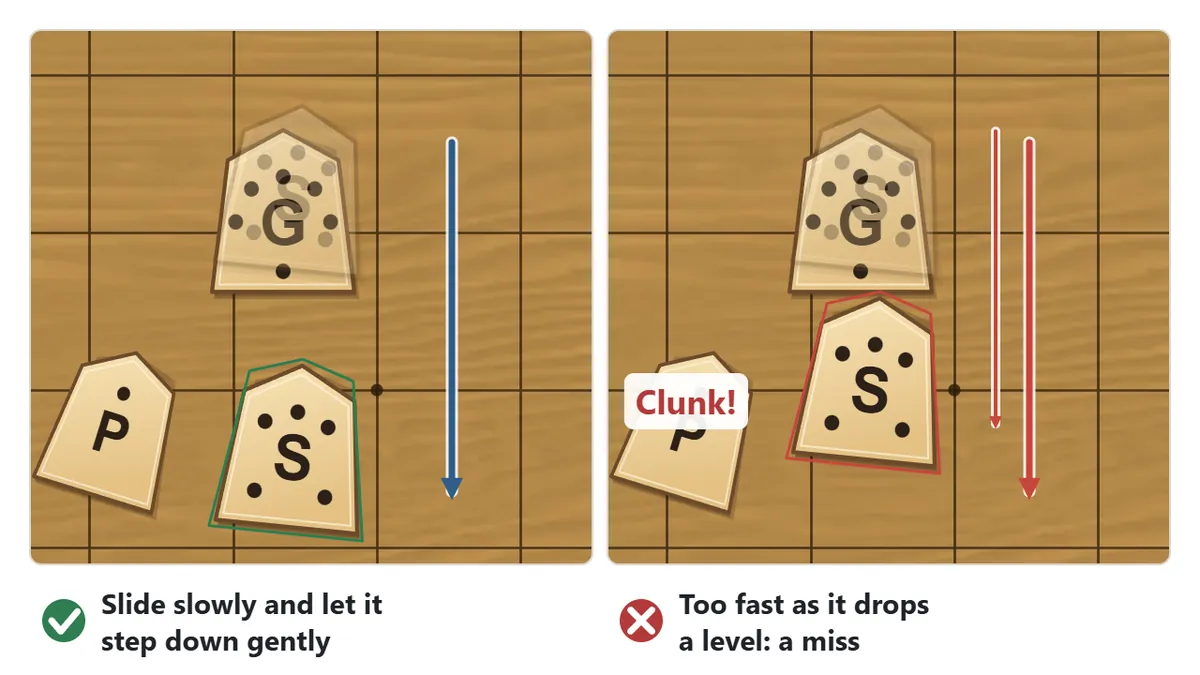
On your turn, pick any piece you can see, press on it and slide it toward an edge. Any of the four edges is fine. When the center of the piece crosses the edge, it drops into your hand and its points are added to your score. You may let go halfway and take a breath; lifting your finger is never a miss, and you can grab the piece again and carry on. The piece you are holding gets an outline that stays green while you move slowly and turns red when you move fast.
Shogi Kuzushi rules: what counts as a miss
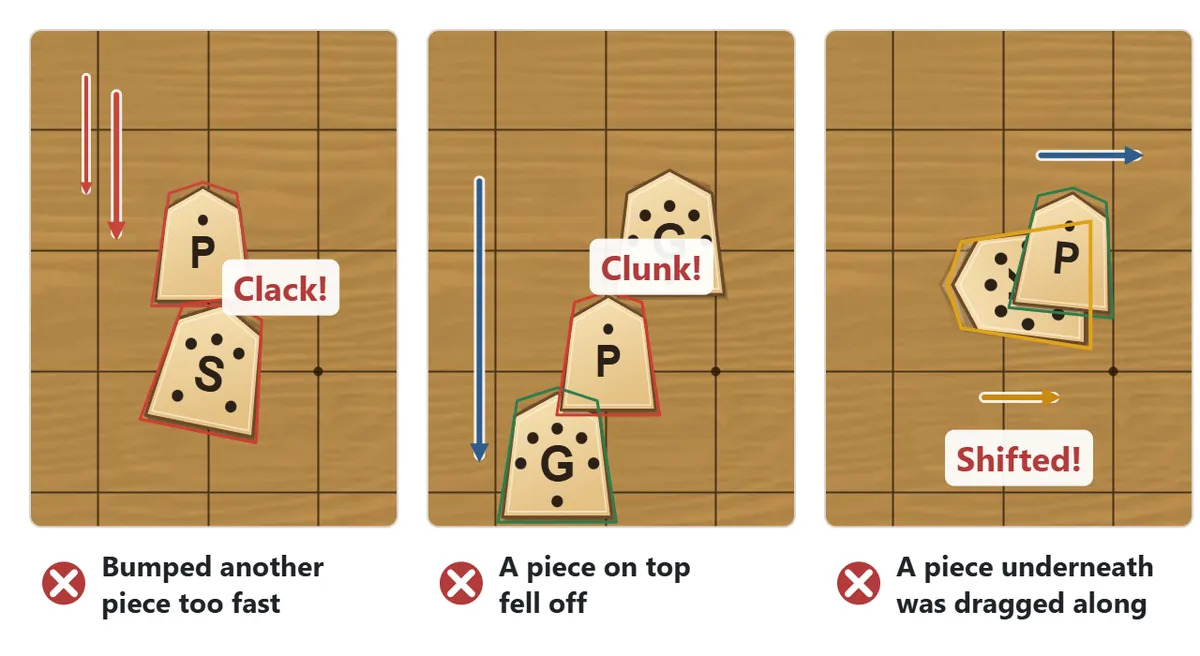
The only real rule of the traditional game is “don’t make a sound.” This version turns the three ways a real pile makes noise into three kinds of miss:
- Clack! The piece you are holding bumps into another piece too fast. A slow, gentle touch is allowed: you simply push the other piece along.
- Clunk! A piece that was resting on the one you are moving loses its support and falls. Letting the piece you hold drop down a level at speed also makes a clunk.
- Shifted! A piece that isn’t moving with yours gets dragged out of place, usually the piece underneath the one you are sliding. Pieces that start to shift get a yellow outline.
A miss ends your turn and play passes to the next player. Whatever moved stays where it ended up, so the pile keeps changing as the game goes on.
Pieces resting on top ride along
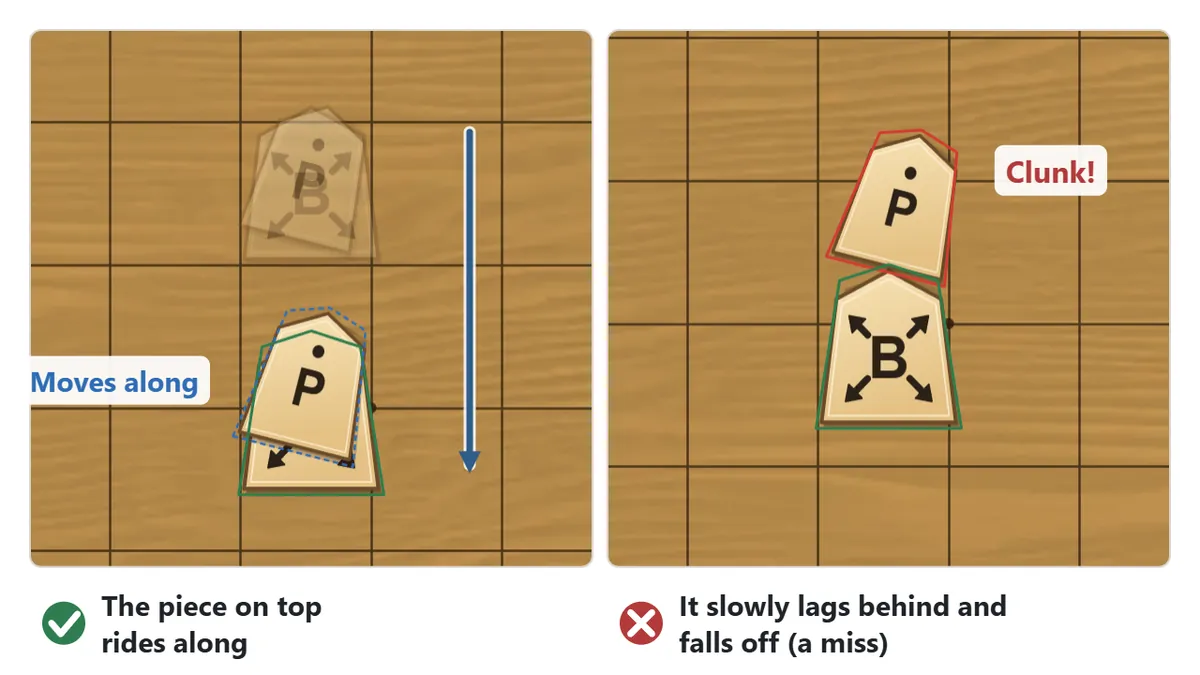
Friction is part of the game. When you pull a piece that has another piece resting on it, the top piece rides along, but it slips back a little all the time. Pull far enough and the top piece slides off its support and falls. If both pieces leave the board together, you take both. In the other direction, when you slide a top piece across the pieces below it, it drags them a little, and if you rub across the same piece for too long it shifts out of place.
Scoring
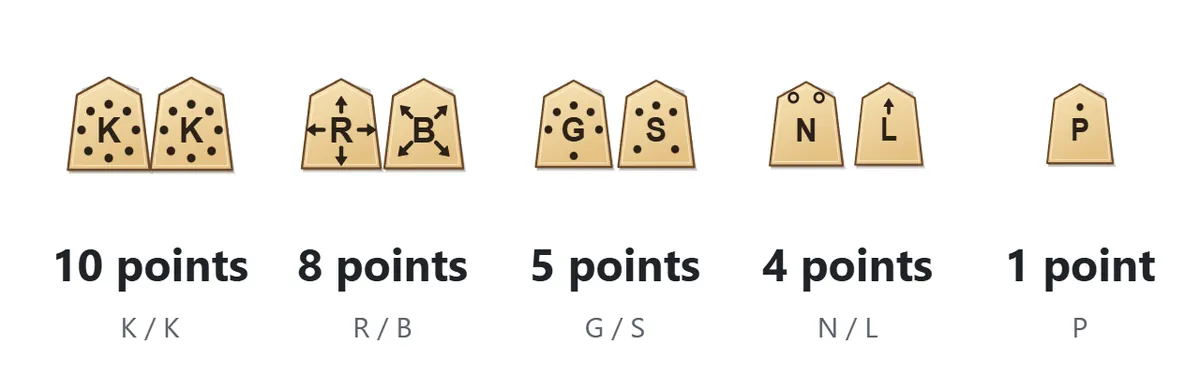
The game ends when the board is empty. In the standard rules the player with the most points wins, and equal scores are a draw. A king is worth 10 points, a rook or bishop 8, a gold or silver general 5, a knight or lance 4, and a pawn 1. The values follow how strong each piece is in shogi, so playing a few rounds is an easy way to learn the pieces. In solo mode you play until your third miss and try to beat your best score.
Rule variations
There is no official rulebook for Shogi Kuzushi, and families and schools in Japan play many house rules. This game includes the most common ones as two presets, and the Custom option lets you mix them:
| Rule | Standard | Keep going |
|---|---|---|
| After you take a piece | Turn passes | Go on until you miss |
| Pieces that move along | Taken together | Taken together |
Both presets count points. With Custom you can also choose “most pieces” (every piece counts the same), “first to take a king” (whoever slides either king off the board wins on the spot), and “one at a time” (moving any other piece at all is a miss, so stacked pieces must be taken apart from the top). A 20-piece pile makes for a quicker round. If you are new to the game, start with Standard.
CPU levels
| Level | What it feels like |
|---|---|
| Easy | Grabs whatever catches its eye and moves too fast. It often forgets that another piece is resting on top. |
| Normal | Usually picks pieces that look safe to take, but rushes from time to time. |
| Hard | Carefully goes after valuable pieces with nothing on top. Even so, its hand slips now and then. |
Shogi Kuzushi strategy and tips
1. Start with pieces that have nothing on top
The safest pieces lie flat on the board with nothing resting on them, usually around the foot of the pile. Look for those first. A piece with something on top is much more likely to cause a clunk.
2. Slow down near other pieces
Most misses come from hurrying into a neighbor. In open space you can move as fast as you like, but when you pass close to another piece, keep your outline green and creep past.
3. Take the shortest way out
The longer the path, the more chances to touch something or rub a piece underneath. Pieces on the outside of the pile usually go straight to the nearest edge. If something is in the way, curve around it.
4. Ease top pieces down slowly
A piece high in the pile has to step down before it can leave. Slide it slowly until it clears the piece below; if you are still moving fast at that moment, it lands with a clunk. Once it is down on the board, it slides like any other piece.
5. Don’t rub the same piece for long
Sliding a top piece drags the piece below it a little. If the yellow outline gets darker, you are close to a miss. Choose the direction that gets off the lower piece fastest.
6. Wait for the big pieces
A king or a rook buried in the middle of the pile is tempting but risky. Often it is better to take easy pieces around it until it is free. In the Keep going rules, a steady run of safe pieces usually beats one risky grab.
Shogi Kuzushi FAQ
Can I play on a phone or tablet?
Yes. Press and hold a piece with your finger and slide it. Holding the device upright gives you the biggest board. With a keyboard, use the arrow keys to choose a piece, Enter to hold it, and the arrow keys again to move it slowly.
Why did I miss when I was moving slowly?
Most likely a piece resting on yours lagged behind and fell, or a piece underneath was dragged too far. The reason for every miss appears above the board, and the piece that caused it is outlined in red.
Can I take two pieces at once?
In the standard rules, yes: pieces that ride on yours or that you push along gently are yours if they leave the board too. Choose “one at a time” under Custom if you prefer the stricter rule.
What do the dots and arrows on the pieces mean?
The letter pieces are designed for players who don’t read Japanese. The letter names the piece (K for King, R for Rook, B for Bishop, G for Gold, S for Silver, N for Knight, L for Lance, P for Pawn), and the dots and arrows show how it moves in shogi. You can switch to traditional kanji pieces under Piece design.
Can I stop and continue later?
Yes. The game saves after every move, so on the same device and browser you can press Continue and pick up with the same pile.
Where does Shogi Kuzushi come from?
Nobody seems to know exactly when Shogi Kuzushi began. Because all you need is a shogi set, it has long been played at home, in after-school clubs and at children’s gatherings across Japan, often by people who never play shogi itself. Wooden pieces have a slightly rough surface that holds a pile together, while smooth plastic pieces slide apart too easily. Over the years many playful house rules have appeared, such as flicking a gold general into the pile or scoring double for carrying a piece off standing upright. Many shogi teachers use the game as a first step, because it gets beginners handling the pieces and learning which ones are strong.