 Yorimichi Games


How to play Four-player Shogi
Four-player Shogi, also called Yonin Shogi, places four independent players around a nine-by-nine board. Your goal is to keep your king alive longer than the other three kings. Attacks can arrive from the sides as well as from the opposite edge, and a move against one opponent can open a line for another. Start by checking king safety, then look for captures and promotion. This page offers an individual match against three CPU opponents or a four-person match on one device. South, player one, is you in CPU mode. There are no teams and no shared hands. Every participant’s captured pieces are public information.
Board and opening setup
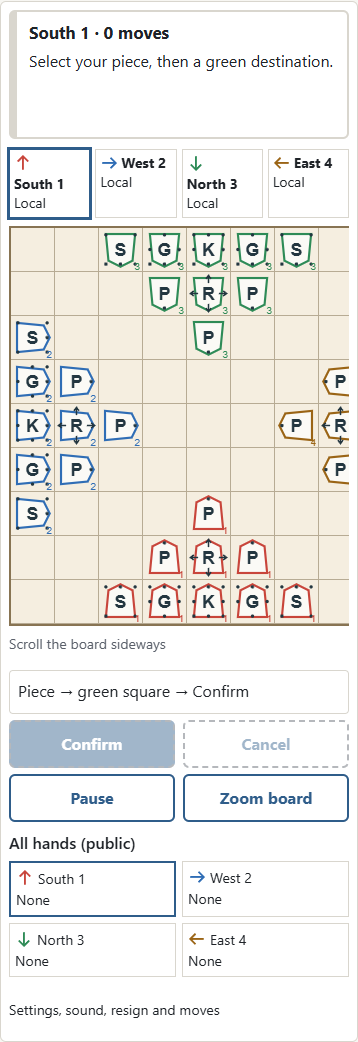
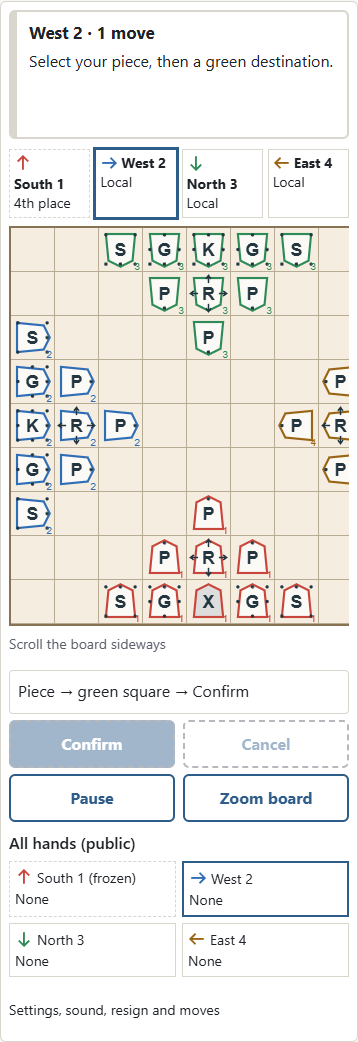
Each player begins with nine pieces: one king, one rook, two gold generals, two silver generals, and three pawns. On the home edge, place silver, gold, king, gold, silver in the central five squares. The next row has a rook in front of the king and a pawn on either side. A third pawn stands in front of the rook. Rotate this triangular setup for the other three seats. There are no bishops, knights, or lances. Each piece shows its owner number and facing direction as well as color. A west player’s pawn moves right across the screen; an east player’s pawn moves left.
Turn order and priority for check
South moves first. The usual order is South, West, North, East, clockwise around the board. Under Standard rules, a player in check takes priority over that ordinary order. If several kings are checked at once, the first checked player clockwise from the player who just moved receives the next turn. After that player responds, checked players still take priority; when no check remains, clockwise play resumes from the player who moved. Read the turn bar before selecting a piece. Giving check can skip another player’s expected turn, so do not assume that your king will always have several quiet turns before it must respond.
Piece movements and facing direction
A king moves one square in any direction. A rook travels any distance vertically or horizontally but cannot jump over another piece. A gold general moves one square forward, diagonally forward, sideways, or straight backward. It cannot move diagonally backward. A silver general moves one square forward or in any of the four diagonal directions, but not sideways or straight backward. A pawn moves one square forward. Forward is always relative to the piece owner, not the bottom of the screen. Moving onto an opposing piece captures it. You cannot move onto your own piece or onto an overturned king. The overturned king also blocks rook lines.
Promotion zones and promoted pieces
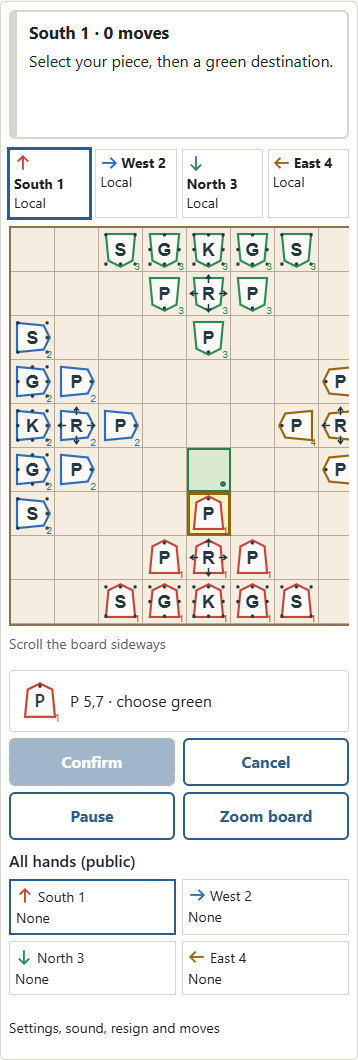
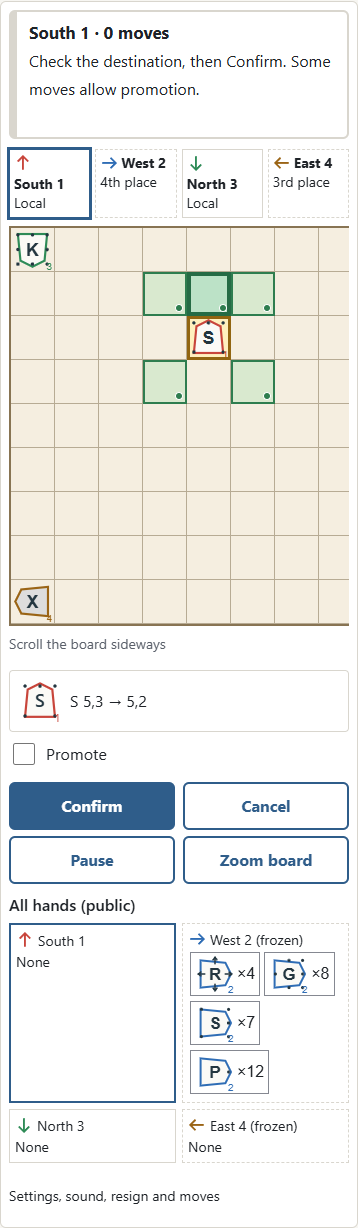
The far three rows from your own seat form your promotion zone. For South this means the top three rows; for West it means the right three columns; North and East use the opposite zones. A rook, silver, or pawn may promote when entering, moving within, or leaving that zone. Approaching a neighboring player’s home edge does not automatically make promotion available. A promoted rook adds one-square diagonal moves. Promoted silvers and pawns move as gold generals. Kings and golds never promote. A pawn moving to its last row must promote because an unpromoted pawn there would have no forward move. A dropped piece does not promote immediately.
Captures and drops from your hand
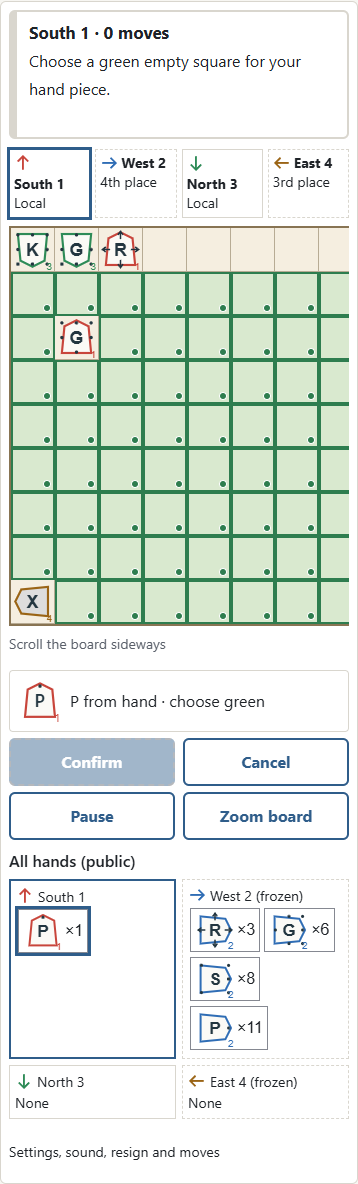
Captured pieces become pieces in your hand and can later be dropped onto an empty square instead of moving a board piece. Capturing a promoted piece returns it to its unpromoted type. Its future movement uses your facing direction. An unpromoted pawn cannot be dropped into a file that already contains another of your unpromoted pawns. South and North use vertical files; West and East use horizontal files. Promoted pawns do not count for this restriction. You also cannot drop a pawn on its last row. All hands remain visible to everyone. Select a hand piece, choose an empty destination, and press Confirm to make the drop.
Checkmate, elimination and overturned kings
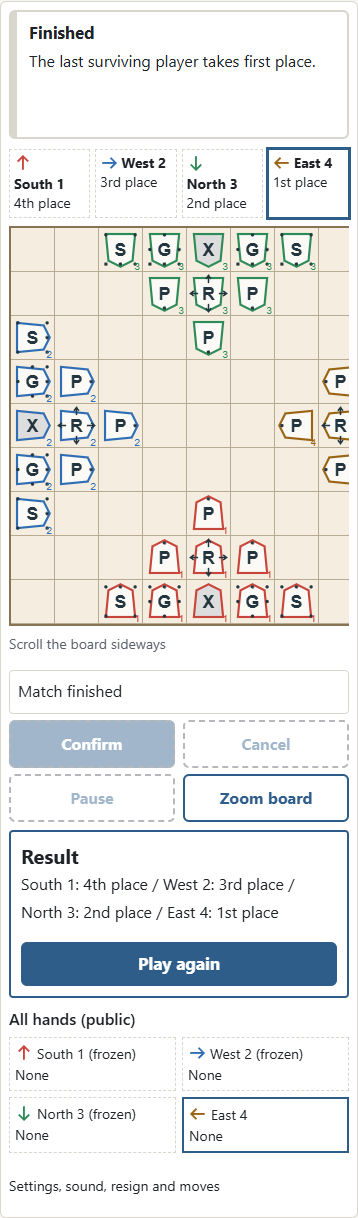
In Standard rules you cannot leave your own king exposed. Respond to check by moving the king, capturing the attacker, or blocking a rook line with another piece. If no legal response exists, the player is eliminated immediately. The king is not physically captured: it becomes an overturned king, shown as X, which stays on the board as an immovable obstacle. Other pieces belonging to that player remain where they are but stop moving and stop attacking. Surviving players may capture those inactive pieces and reuse them. The eliminated player’s hand stays frozen and is not transferred to the mating player. Having no legal move on your turn also causes elimination even without check.
Illegal moves and rule options
Standard play excludes duplicate unpromoted pawns in one file, pawn drops with no future move, exposing your own king, and pawn-drop mate. Pawn-drop mate means the pawn you drop directly delivers a mate; moving an existing pawn to deliver mate is different. You cannot drop a pawn so that it attacks an overturned king either. The pawn-drop-mate prohibition can be switched off separately. King-capture mode is a distinct simplified option: turns stay clockwise, you may leave your king exposed, and an opponent actually captures it. The captured king disappears and cannot become a hand piece. Remaining pieces freeze, and the last surviving player wins. It does not use king-capture counts as a separate victory condition.
Ranks, repetition and resignation
The first eliminated player places fourth, the next third, the next second, and the last survivor first. Standard mode examines simultaneous mates clockwise from the player who moved and checks again as eliminated pieces lose their attacks. Four appearances of the same board, hands, elimination state, and turn produce a draw. This page also draws repeated checking positions rather than declaring a perpetual checker the loser. A six-hundred-move limit ends a prolonged match as a draw, with surviving players sharing a rank. These are this page’s stopping rules, not a claim about every tournament. Resignation is available on your own turn and requires confirmation before eliminating your seat.
CPU levels and piece display
The easy CPU looks for captures and forward movement and tries to avoid repeated positions, but does not search for retaliation. The normal CPU considers material and protection, with occasional oversights of danger. The strong CPU evaluates the board after elimination and check priority, then examines legal captures and checks by the player whose turn actually comes next. It does not search deeply through every opponent’s future turns. All three choose from the same legal moves as a person. Both language pages let you choose traditional Japanese characters or international letters with direction marks. K means king, R rook, G gold, S silver, and P pawn. A plus sign identifies promotion and X identifies an overturned king. These labels do not change the rules. The owner number and facing marker remain important because the same piece type moves in four different orientations.
Phone controls, keyboard and saved matches
Scroll sideways inside the board to reach every square; Zoom board enlarges it further. Select your piece, choose a green destination, then Confirm beside the board. Choose promotion when offered. Select drops from your own hand panel. The auxiliary controls also offer destinations by coordinate. Tap the piece again, use Cancel, click a blank area or press Escape to clear a preparation. A moved or two-finger gesture cancels without making a move. P and Pause stop the match. Tab and Enter operate the native buttons. Opening Settings saves the match. Continue from the opening settings restores that board and its original options; Continue beside the board restarts the CPUs. Japanese and English pages share that save. Data stays in this browser on this device and is removed if browser storage is cleared. Switching tabs pauses play. Sound starts off and can be enabled manually.
Four-player Shogi strategy and variations
Watch both neighboring rook lines before committing to a capture. An opponent who is not your current target may still take your exposed piece on the next turn. Checks change the turn order, which can help interrupt an attack but can also bring a response sooner than expected. After elimination, review blocked lines: inactive pieces no longer attack but still occupy squares. Four-player shogi has several published rule families, including inherited armies, teams, and victories based on collected kings. This page uses the clearly described Standard and King-capture options rather than combining those incompatible endings. Learning the direction of every seat is the best first step toward understanding the board.