 Yorimichi Games
How to play Hasami Shogi
Hasami Shogi is a two-player game from Japan played on an ordinary shogi board with nothing but pawns. The name means “sandwich shogi”: hasami comes from the Japanese verb for pinching or sandwiching, and shogi is Japanese chess. Every piece moves the same way, and you capture by trapping an enemy piece between two of your own. You can learn the whole game in a couple of minutes, yet good players think several moves ahead, because a single careless step can hand your opponent a free capture.
You do not need to know shogi or chess to play. If you have ever played checkers, you already know the feeling of setting up a capture and watching your opponent walk into it. The difference is that here nothing jumps: pieces slide in straight lines and captures happen by closing a trap from both sides.
Setting up the board
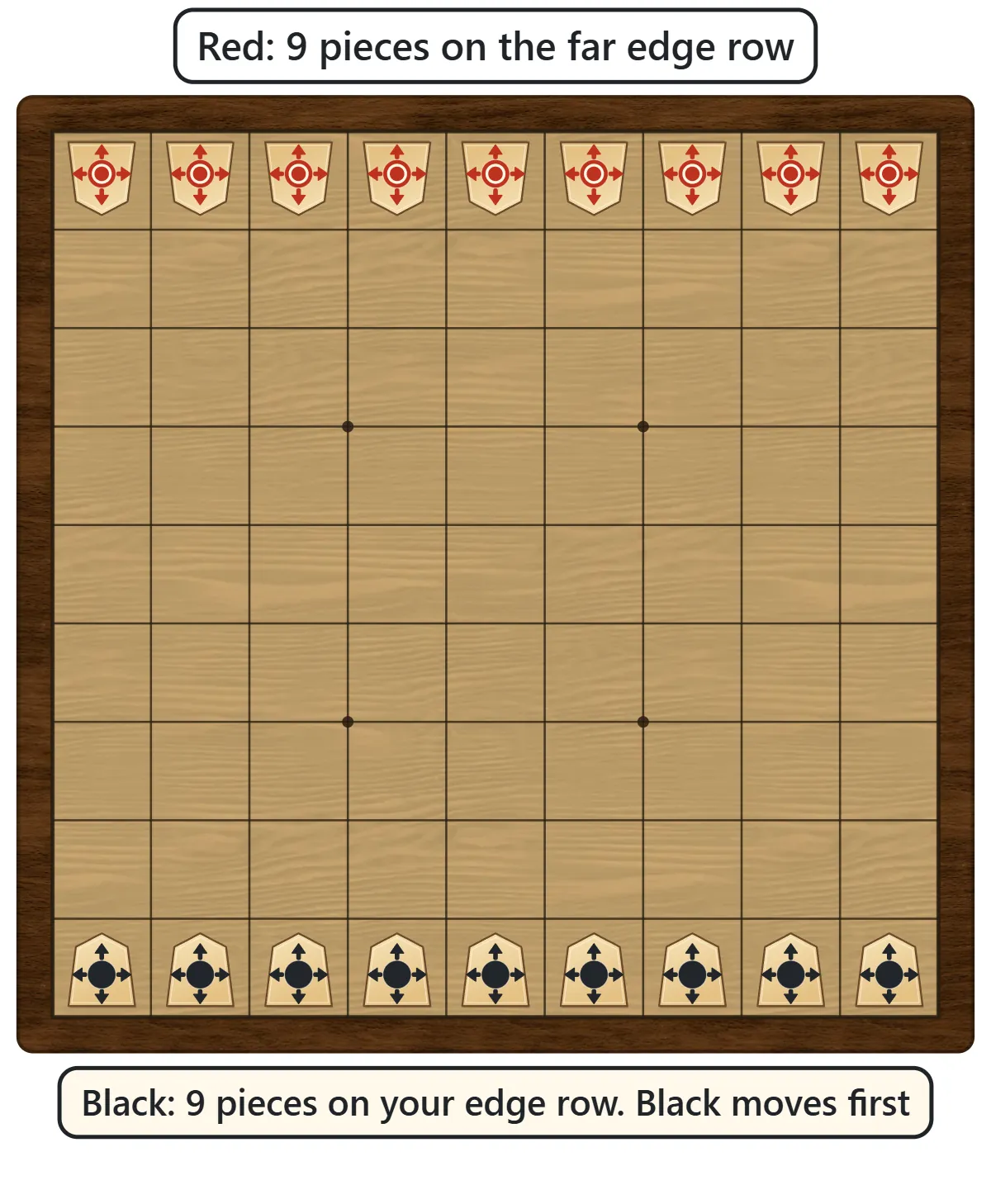
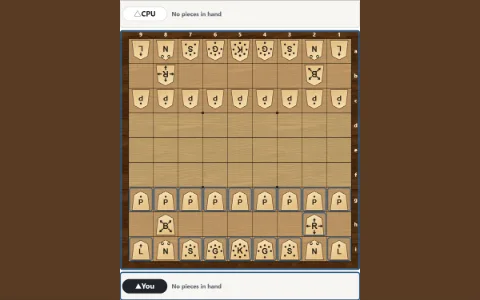
The board is the 9×9 shogi board. Each player has nine pieces and places all of them on the edge row closest to them. In a real set, both sides use shogi pawns: one player shows the pawn side (歩, fu) and the other flips the pawns over to the promoted side (と, tokin), which is written in red. On this page we call the two sides Black and Red. Black moves first, and the players then take turns moving one piece at a time. Your pieces are always at the bottom of the screen, and you can choose whether you, the computer, or a random draw goes first.
How the pieces move
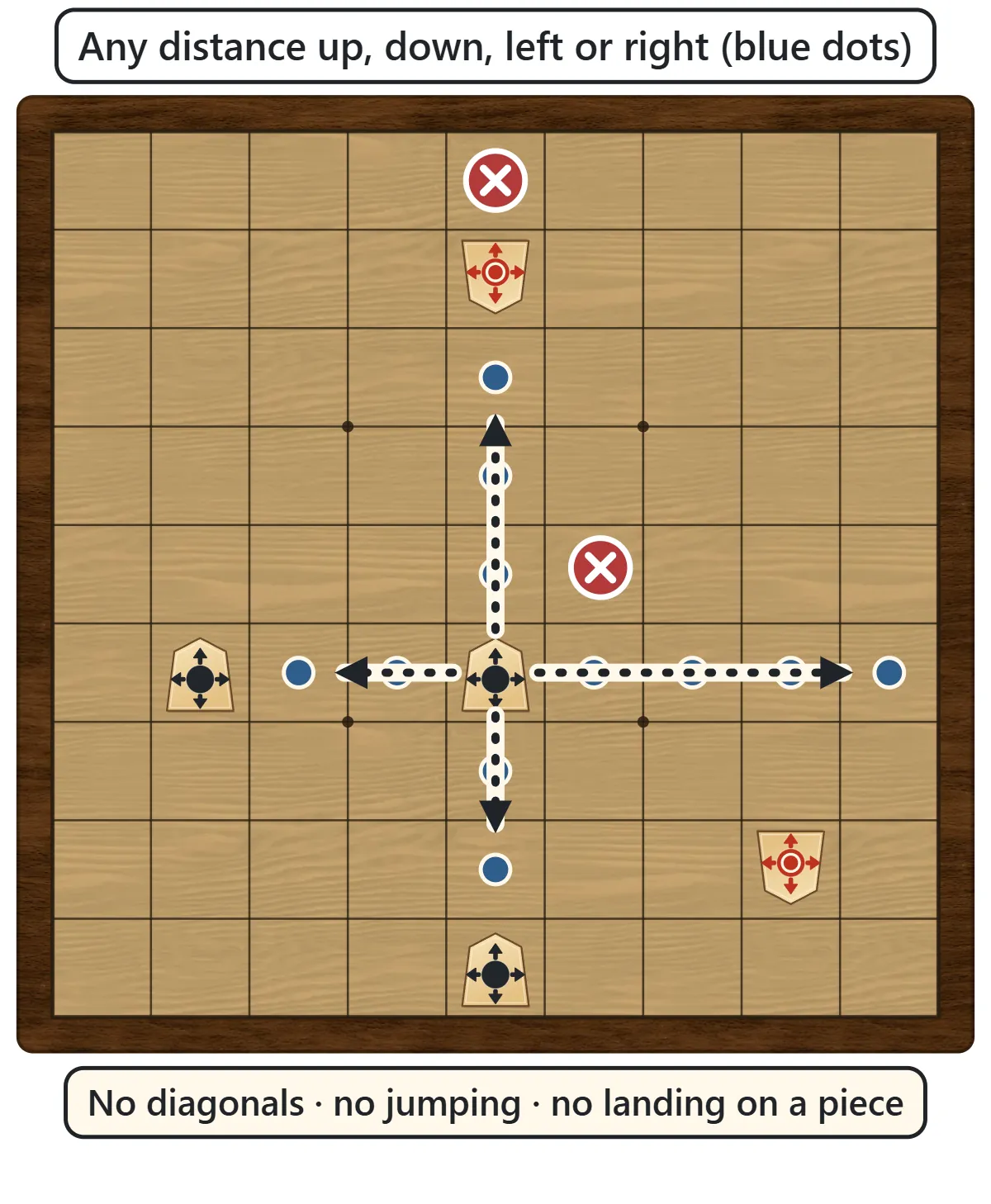
All pieces move exactly like a rook in chess (or a hisha in shogi): any number of empty squares up, down, left or right. There are no diagonal moves. A piece stops when it reaches another piece, whether it belongs to you or your opponent. It cannot jump over pieces, and it cannot move onto an occupied square. Unlike chess, you never capture by landing on an enemy piece; captures only happen by sandwiching, as described below.
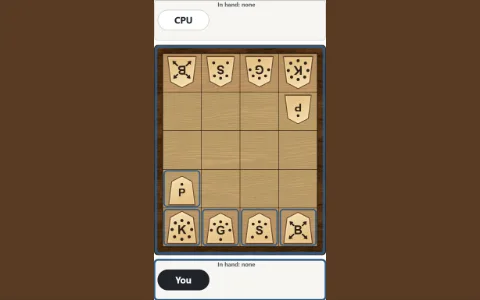
The colored pieces in this game show this with four arrows around a colored disc. If you switch to the traditional kanji pieces in the settings, the moves are exactly the same: only the look changes.
Capturing by sandwiching
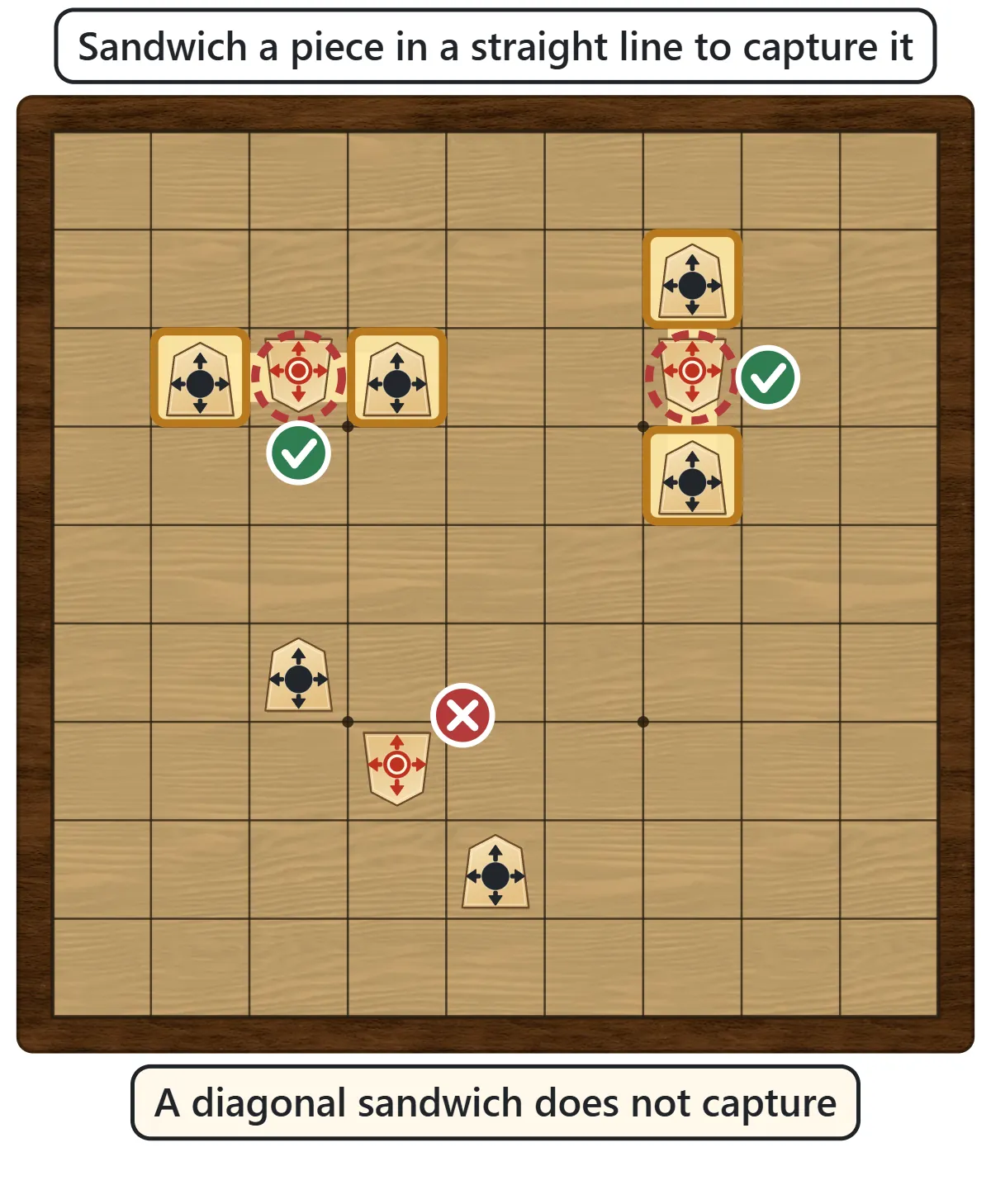
When you move a piece so that an enemy piece ends up directly between two of your pieces, in a row or in a column, the enemy piece is captured and removed from the board. Game designers call this a custodian capture. Captured pieces are simply out of the game; unlike in regular shogi, you cannot drop them back onto the board. In this game, the two trapping pieces light up with a gold frame and the captured piece gets a red dashed ring before it moves to your side of the board.
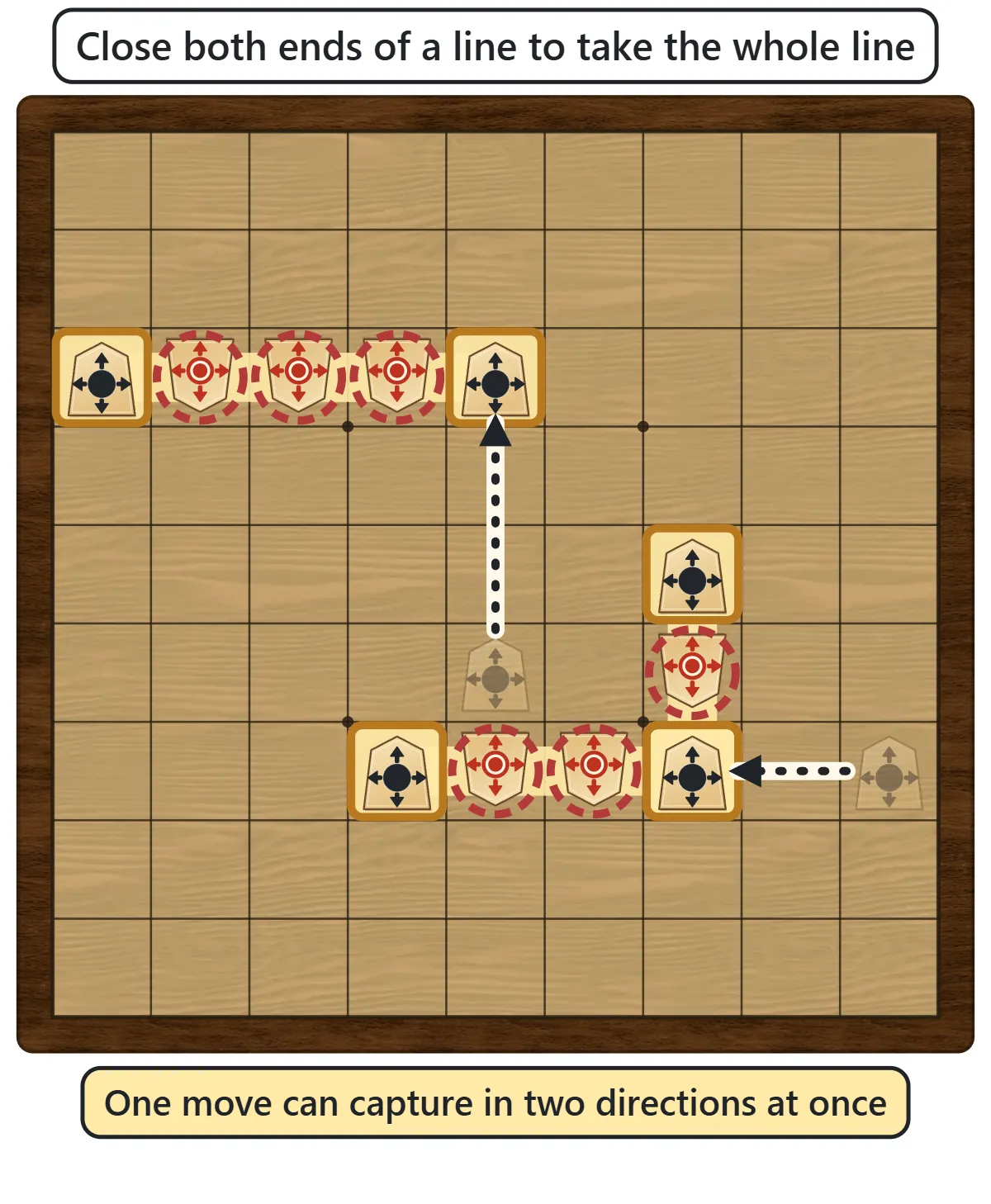
If two, three or more enemy pieces stand in an unbroken line, closing both ends of the line with your pieces captures all of them. An empty square or one of your own pieces inside the line breaks the trap. And if your move closes traps in two directions at once, for example to the left and above, you capture in both directions.
Moving between two enemy pieces is safe
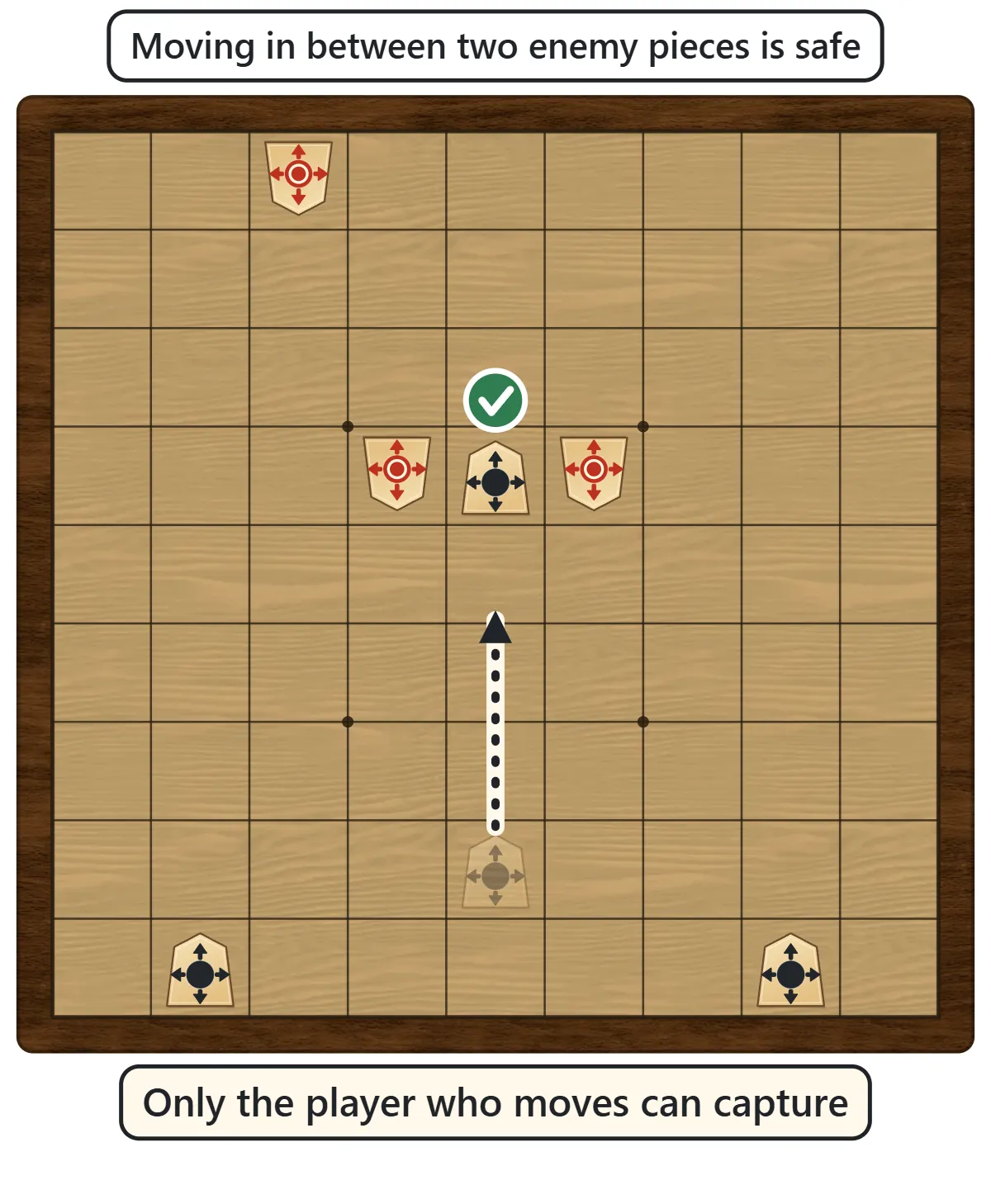
You may move a piece into the gap between two enemy pieces without losing it, because captures are only made by the player who has just moved. However, if your opponent later moves one of those two pieces away and then back again, the trap closes on their move and your piece is taken.
Corners and edges: capturing by surrounding
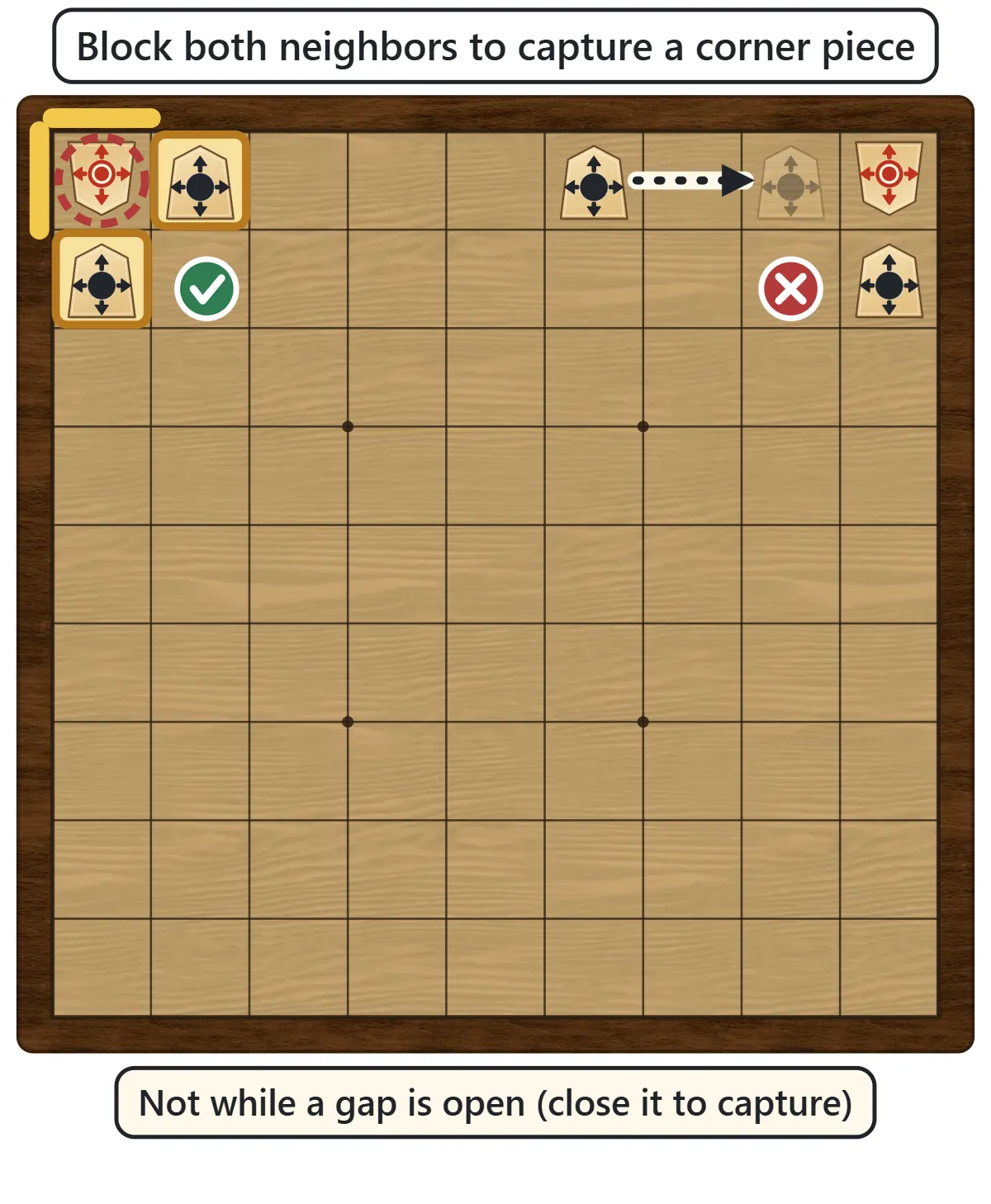
A piece sitting in a corner can never be sandwiched, so there is a special rule: block the two squares next to it and it is captured. As long as one of those squares is still open, the corner piece is safe.
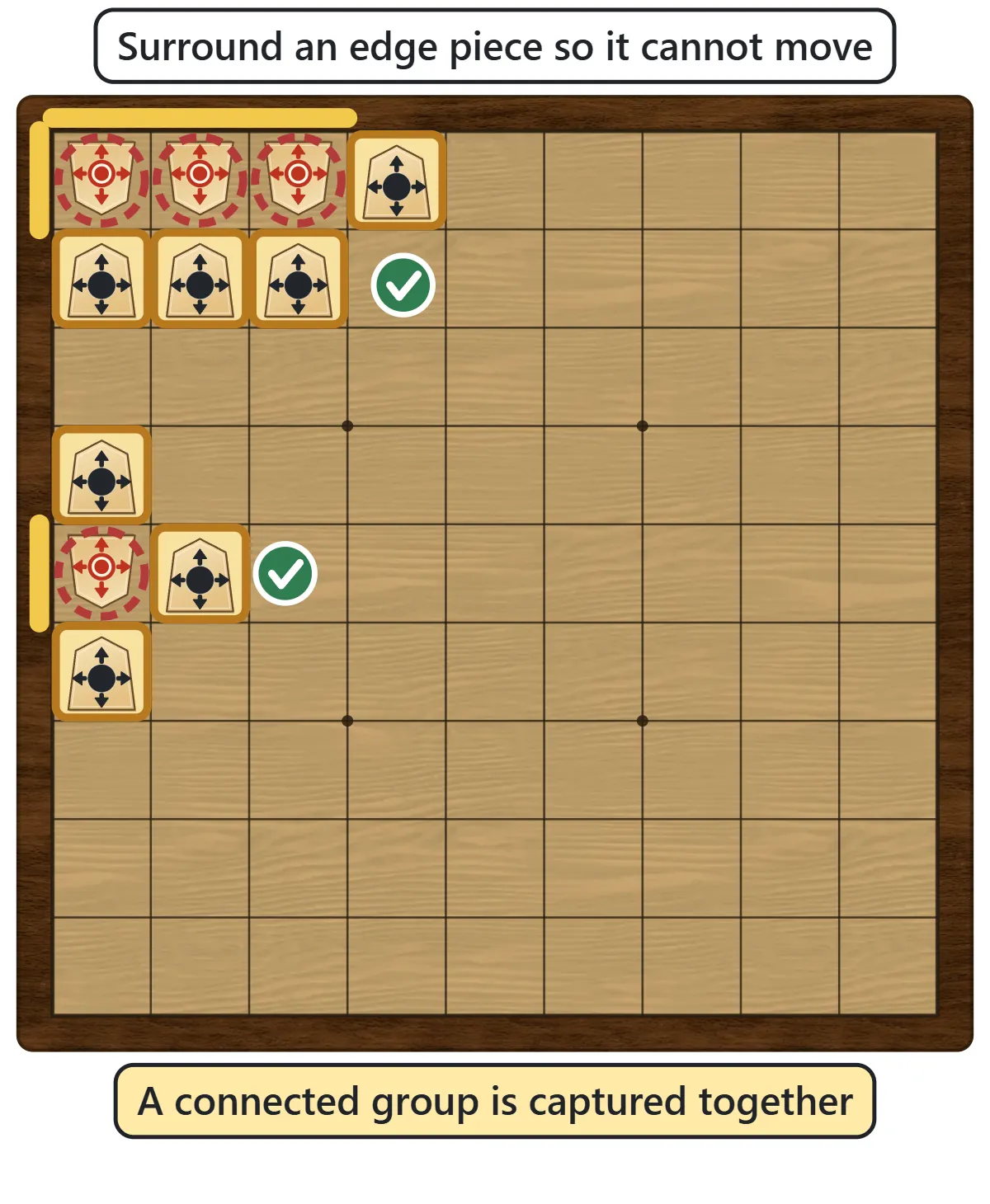
The same idea works along the edges. Treat the edge of the board as a wall and block every other square around an enemy piece so that it cannot move. A group of connected enemy pieces along the edge can be captured together in the same way. In the middle of the board you capture by sandwiching, not by surrounding, although the Custom rules let you allow surrounding captures anywhere.
How to win
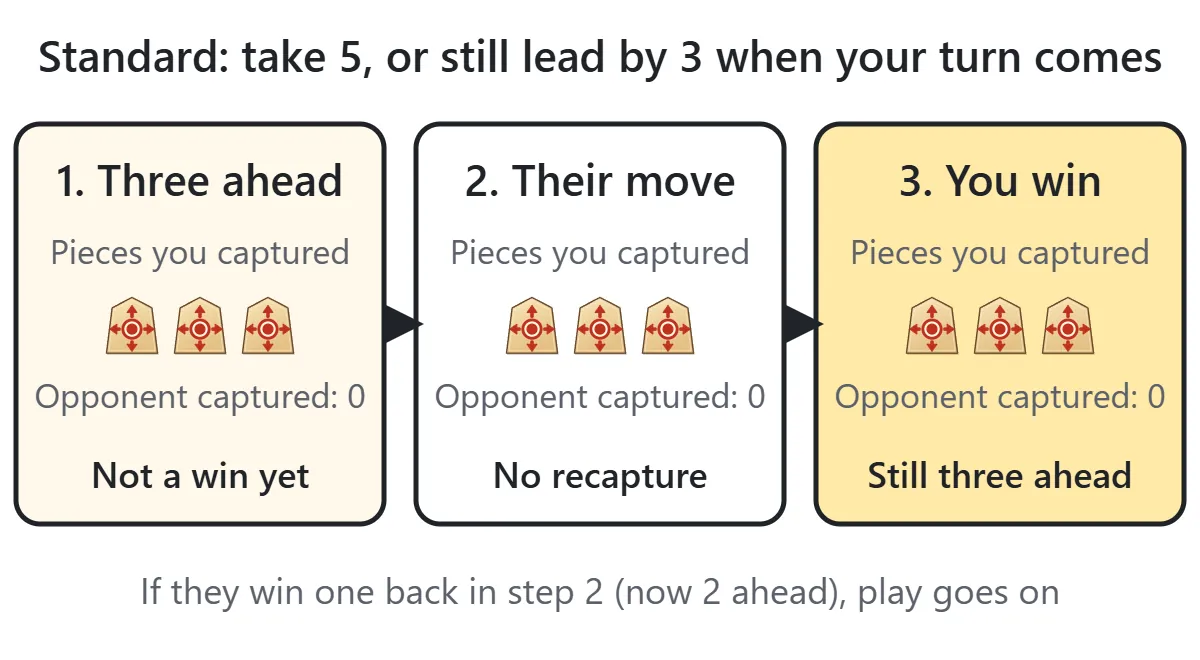
With the standard rules, the first player to capture five enemy pieces wins. You also win if you get three captures ahead of your opponent and they cannot capture back on their next move. If they win a piece back straight away and cut the lead to two, the game goes on. A game is drawn if the same position appears four times (called sennichite, or repetition) or if the game reaches 300 moves in total. A player who has no legal move on their turn loses.
Hasami Shogi rules: which version to play
Hasami Shogi has never had one official rule book, and families, schools and regions in Japan all have their own way of deciding the winner. This game offers three common versions, and the Custom option lets you change each rule yourself.
| Version | How you win | Good for |
|---|---|---|
| Standard | Capture 5, or stay 3 ahead through the reply | The version most often described. About ten minutes a game |
| First to 4 | Capture 4 pieces first | First games and quick breaks |
| Down to the last piece | Leave your opponent with one piece | A long, careful game. One piece can no longer be trapped, so that ends it |
Under Custom you can pick the number of captures needed to win (4, 5, 7, or down to one remaining piece), the lead rule (off, 2 ahead or 3 ahead), where surrounding captures are allowed (the corner piece only, pieces on the edge, or anywhere), whether diagonal sandwiches capture, and whether the game is drawn after 300 moves. If you learned the game with slightly different rules, you can probably set them up here.
Hasami Shogi strategy tips
1. Before every move, ask “can this piece be trapped?”
The most common way to lose a piece is to put it where your opponent can close a trap on the very next move. Before you move, look at the squares on either side of the destination, in the row and in the column. If an enemy piece could slide into the square on the far side, your piece is in danger. A gap of one square between two enemy pieces is a particularly risky place to stop, because your opponent only needs to move one of them away and back.
2. Keep your pieces connected
Two of your pieces standing side by side protect each other, because the enemy cannot get between them. A piece that runs far ahead on its own is much easier to trap. Advance in small groups so that each piece has a friend next to it.
3. Use bait and recapture
Sometimes the best move is to let your opponent capture one piece, because the capturing piece lands in a spot where you can immediately trap it, or even two of their pieces at once. This is a good way to break open a solid defensive line. The opposite also applies: when a capture looks free, check whether you can be captured straight back.
4. Push enemy pieces toward the edges and corners
An enemy piece on the edge needs fewer of your pieces to trap, because the edge of the board does part of the work. A piece in the corner can be captured by blocking just two squares. For the same reason, try not to leave your own pieces stuck in a corner.
5. Look for lines of enemy pieces
When your opponent has several pieces in a straight line, see whether you can reach both ends. Capturing two or three pieces in one move can decide the game. When you line up your own pieces, make sure the ends of the line are covered.
6. When you are three ahead, defend first
Under the standard rules a three-piece lead wins as soon as your opponent fails to capture back. Once you have that lead, check that none of your pieces can be taken on the next move before you think about attacking. If you are the one who is three behind, look for any capture at all, because anything that cuts the lead keeps you in the game.
Hasami Shogi FAQ
Do I need to know shogi to play?
No. Only one kind of piece is used, and every piece moves the same way. Remember two ideas, “slide in a straight line” and “trap a piece between two of yours”, and you are ready to play.
Can I capture diagonally?
Not in the standard rules. Only traps along a row or a column capture. If you grew up with a version where diagonal traps count, turn on “Diagonal sandwiches also capture” under Custom. The pieces still move only in straight lines.
How strong is the computer?
If you are new to the game, start with Easy. It takes pieces whenever it can, but it often steps into places where you can trap it. Normal makes those slips much less often, and Hard rarely leaves a piece hanging, although it still misses something now and then. At every level, the key habit is to check after each of its moves whether any of your pieces can now be sandwiched.
Can two people play on one device?
Yes. Choose “2 players on one device” as the opponent and take turns on the same screen. Player 1 moves the pieces at the bottom and Player 2 the pieces at the top.
Can I switch between the colored pieces and kanji pieces?
Yes. Pick a piece style in the settings. The colored pieces make it easy to tell the two sides apart and show how every piece moves, while the kanji pieces look like a real shogi set. The rules and the computer play the same either way, and your choice is remembered.
Is this the same as Dai Hasami Shogi?
No. Dai Hasami Shogi is a related game played with eighteen pieces each, where you can also win by making a line of five, similar to a five-in-a-row game. This page plays the more common nine-piece capture game.
Can I stop and continue later?
Yes. Open the page again on the same device and browser and press Continue to pick up where you left off. The sound is off at first; press “Sound: off” to turn it on.
Where Hasami Shogi comes from
Hasami Shogi has long been played in Japan as a simple game that uses shogi equipment, and Japanese dictionaries describe it as a game where players line up their pieces on the back row and capture by trapping. The Japan Shogi Association also introduces it as a friendly first step toward shogi. Games that capture by trapping a piece between two others have appeared in many places around the world, from the ancient Roman board game ludus latrunculorum to the Thai game mak yek, which also uses rook-like moves. Because there has never been one fixed rule set, it is normal to hear “we played to five” in one family and “we played until everything was gone” in another, and that friendly variety is part of the game’s charm.