 Yorimichi Games
How to play Juroku Musashi
Juroku Musashi is an old Japanese board game for two players in which the two sides are nothing alike. One player has a single large piece, the General (in Japanese the oya, literally “parent”). The other player has sixteen small pieces, the soldiers (ko, “children”). The name means “sixteen musashi”, after the sixteen pieces. The General hunts: it captures soldiers by slipping into the gap between two of them. The soldiers hunt too, in their own way: they win by crowding around the General until it has nowhere to move. Board games of this kind, where a lone strong piece faces a crowd of weaker ones, are called hunt games, and players who know Fox and Geese will feel at home. The rules take two minutes to learn, yet each side needs a completely different plan, which is what makes the game worth replaying from both chairs.
The board and the starting position
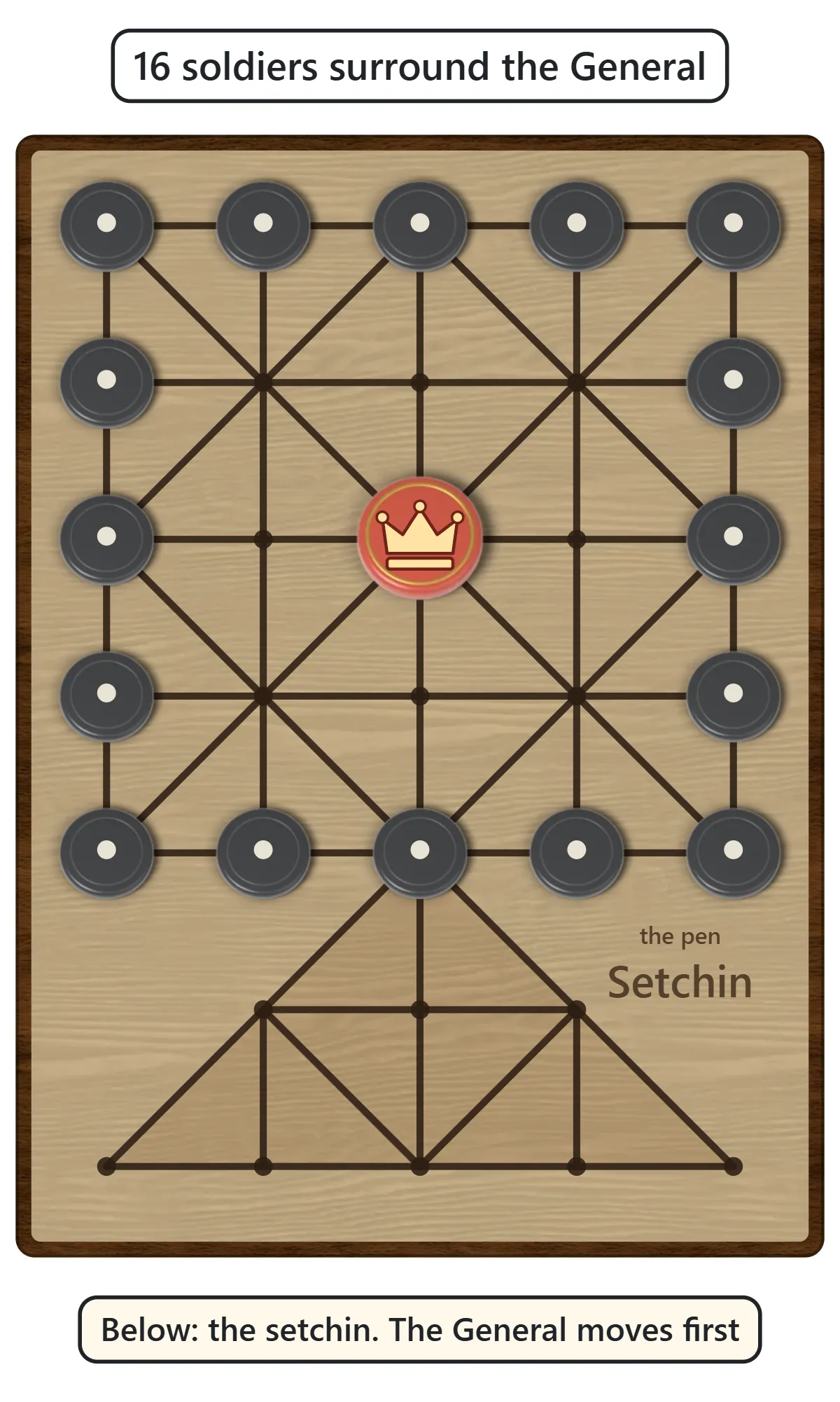
The board is a square grid of five lines by five, crossed by the two long diagonals and by a diamond that joins the midpoints of the four sides. Pieces never sit inside the squares. They stand on the points where lines cross, and there are 25 of those in the square. Attached to one side is a triangle called the setchin. The word is an old name for an outhouse, and in some regions the triangle is called the cow shed instead; in English you can simply think of it as the pen. The setchin adds eight more points, for 33 in all.
To set up, place the General on the center point and one soldier on each of the sixteen points around the outside of the square. The setchin starts empty. In the classic rules the General moves first, and after that the players take turns, one move each.
Juroku Musashi rules: moving
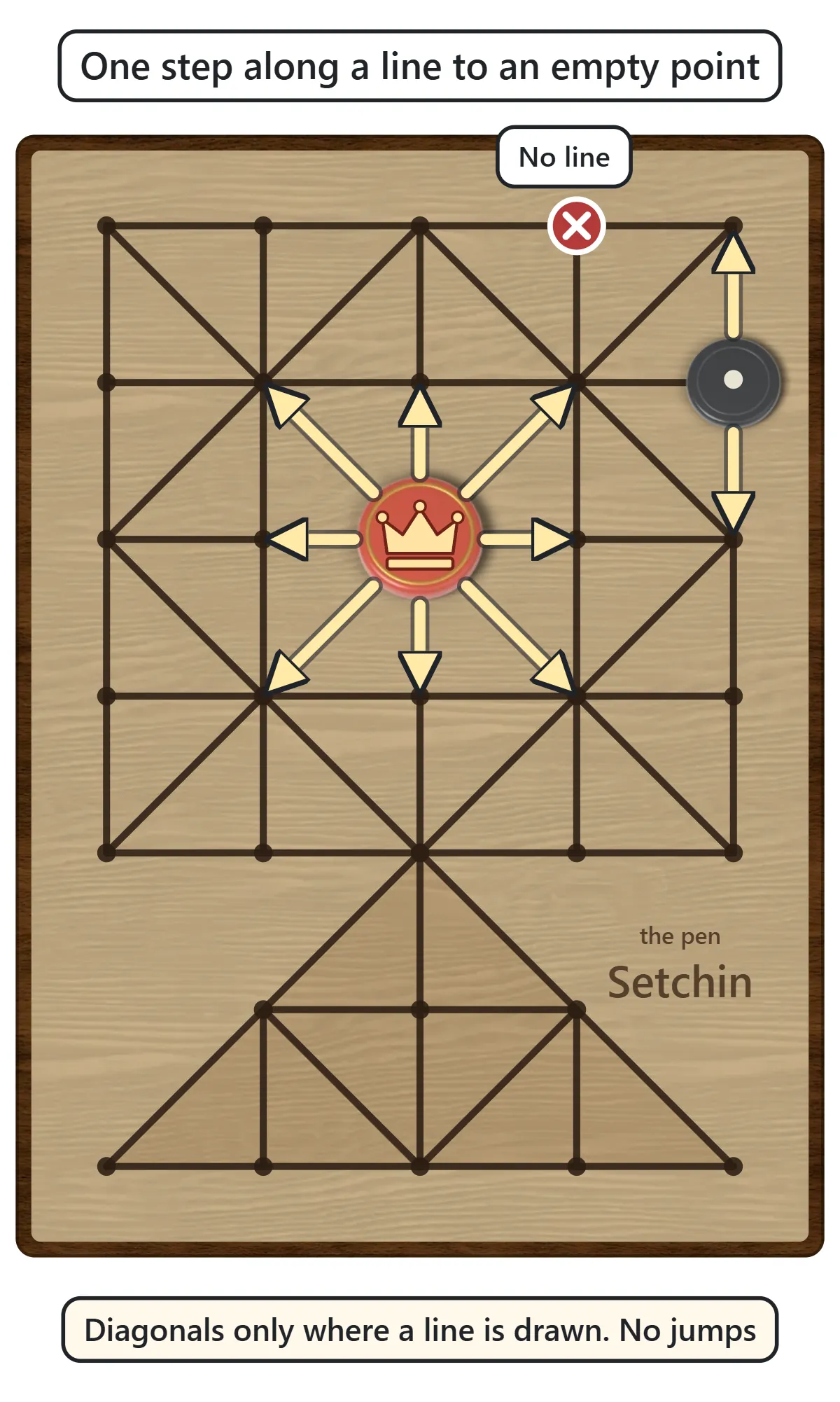
On your turn you move one piece one step along a line to the next point, as long as that point is empty. The General and the soldiers move exactly the same way: forward, backward or sideways. Diagonal steps are allowed only where a diagonal line is actually drawn, so check the board rather than assuming. Nobody jumps over anything, and a piece can never land on an occupied point. When you play the soldiers, you choose which one of your sixteen to move each turn.
How the General captures
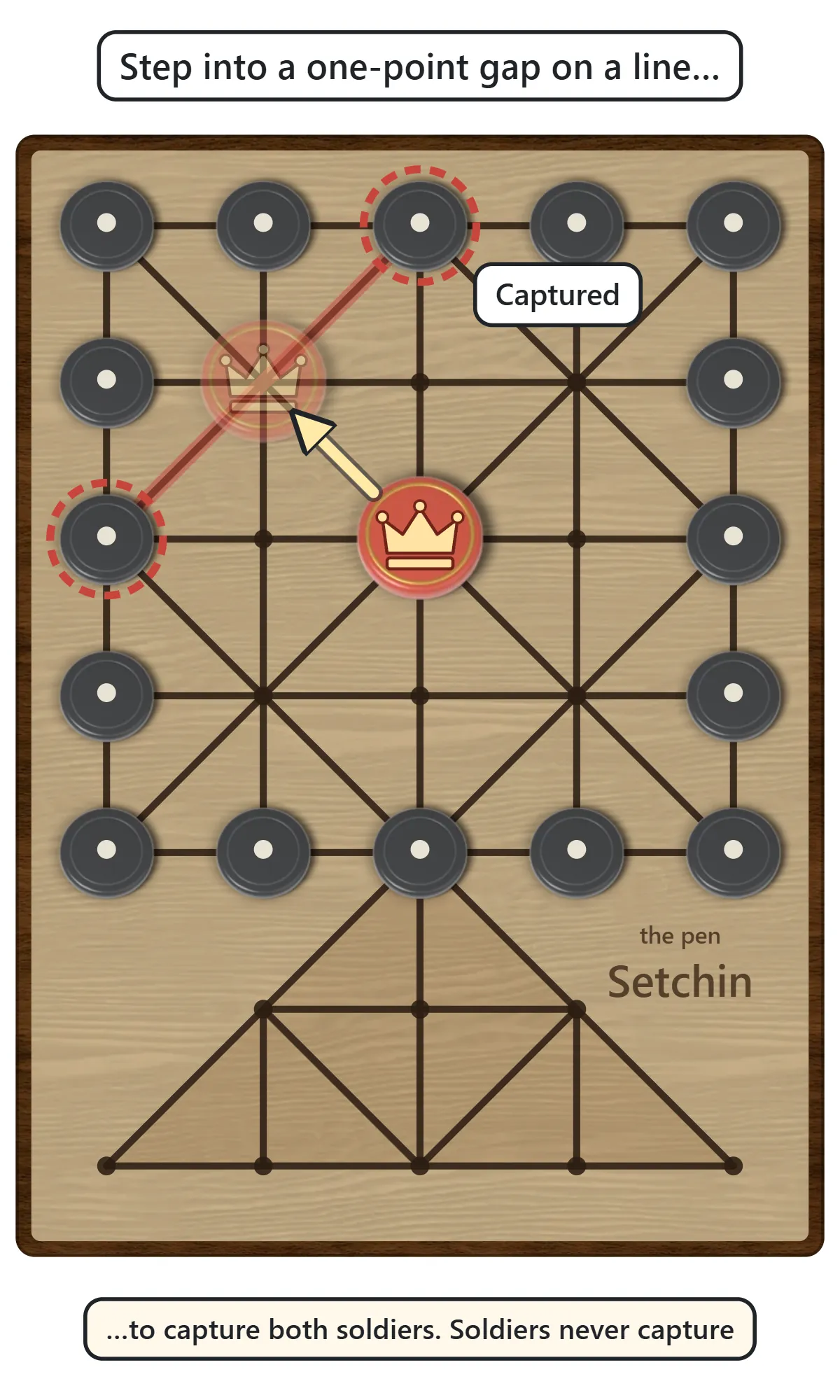
Capturing in Juroku Musashi works like a wedge rather than a jump. If two soldiers stand on the same straight line with exactly one empty point between them, the General can move into that empty point, and both soldiers are taken off the board at once. The two soldiers and the gap must lie on one unbroken line; if the line bends at the gap, there is no capture. Soldiers standing shoulder to shoulder with no gap are completely safe.
As the diagram shows, the very first move of the game can already capture: from the center, the General steps diagonally and lands between two soldiers that sit on the diamond. That is why the soldiers usually lose a pair early in the classic rules. If the point the General enters splits more than one pair on different lines, every one of those pairs is captured, so a single move can take four or even six soldiers. The soldiers can never capture the General. Surrounding the General on two sides does nothing at all; the soldiers only win by blocking every move.
How the soldiers win: trap the General
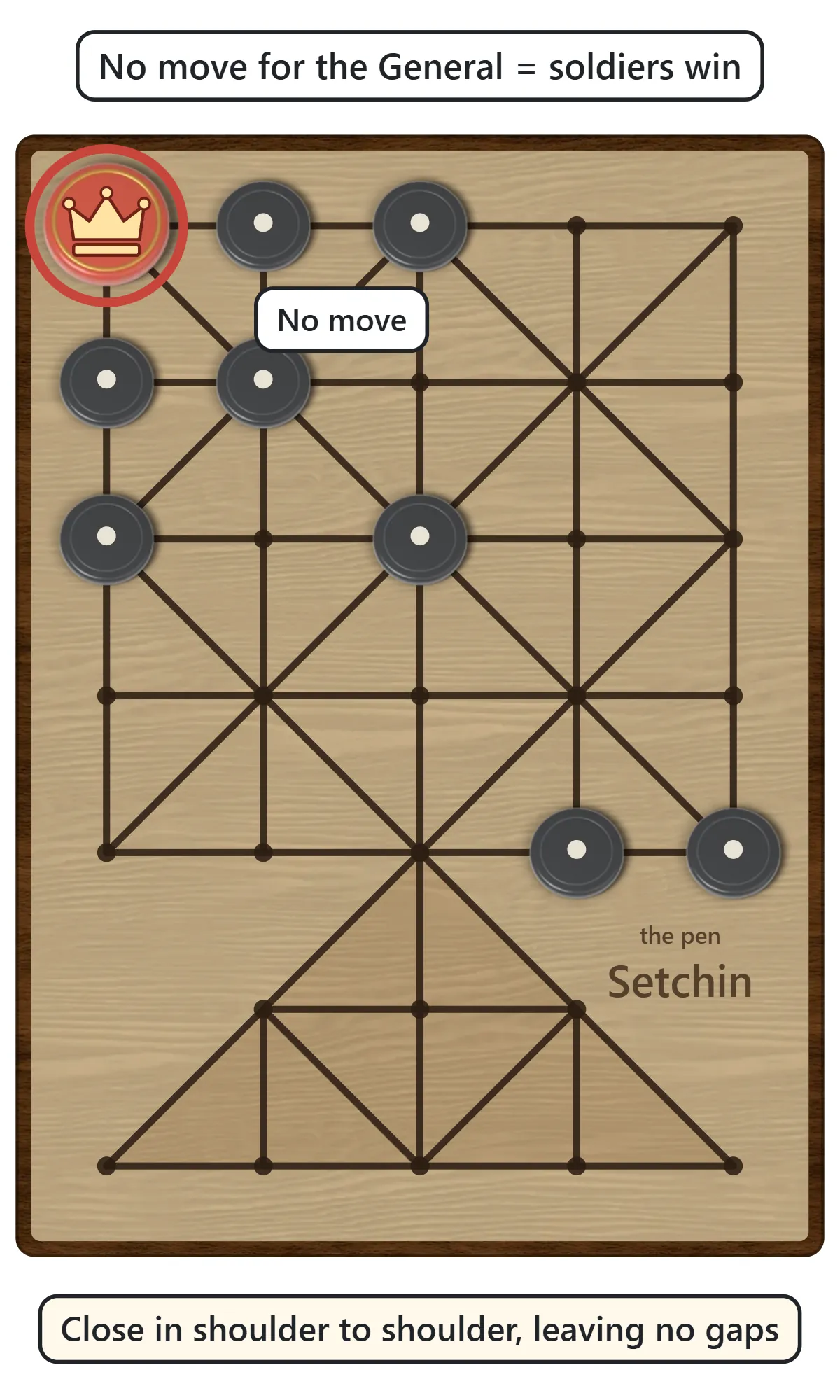
The soldiers win when it is the General’s turn and every point next to it along a line is occupied. Any gap in the ring is dangerous, because a one-point gap between two soldiers is exactly where the General wants to jump in. The soldiers therefore advance as a solid wall, each one touching the next.
The setchin: a trap inside the board

Points inside the triangle have few connections. The far corners touch only two other points, so just two soldiers are needed to lock the General in place. Trapping the General there is called setchin-zume, roughly “stuck in the outhouse”, a gentle joke that every Japanese player of the game knows. The setchin keeps the soldiers in the game even after heavy losses, and it gives the General a place it should enter only with care.
How the General wins
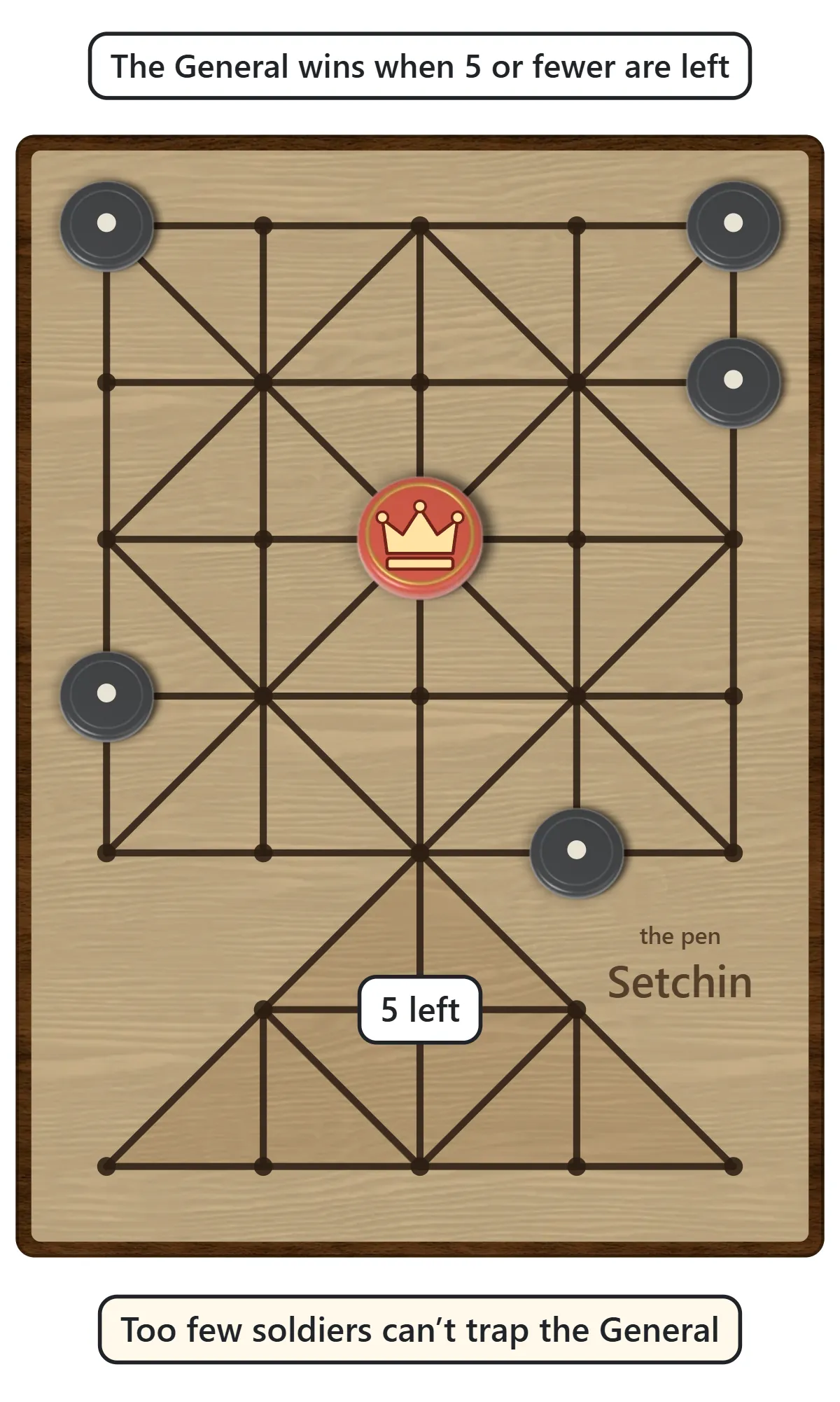
Every capture makes the soldiers’ job harder. When so few remain that they can no longer box the General in, the General wins. Where exactly that line falls has never been settled: some sources say four or fewer soldiers, others five or six. This version uses five or fewer by default, and you can change it to four, six, or “too few to trap”, which plays on until the soldiers are left without enough pieces for even the smallest trap.
To stop a game from wandering forever, the General also wins in three other cases: when the same position (the same pieces on the same points, with the same player to move) comes up for the third time, when 300 moves have been played in total, and in the rare case that the soldiers have no legal move on their turn. In each case the soldiers have failed to finish the hunt. The game warns you when a position repeats for the second time.
Rule variations
Juroku Musashi was played all over Japan for centuries, so the details differ from family to family and from book to book. The game here lets you pick one of three common versions or build your own under Custom.
| Version | Board and first move | General wins at |
|---|---|---|
| Classic | 33 points, General first | 5 or fewer soldiers |
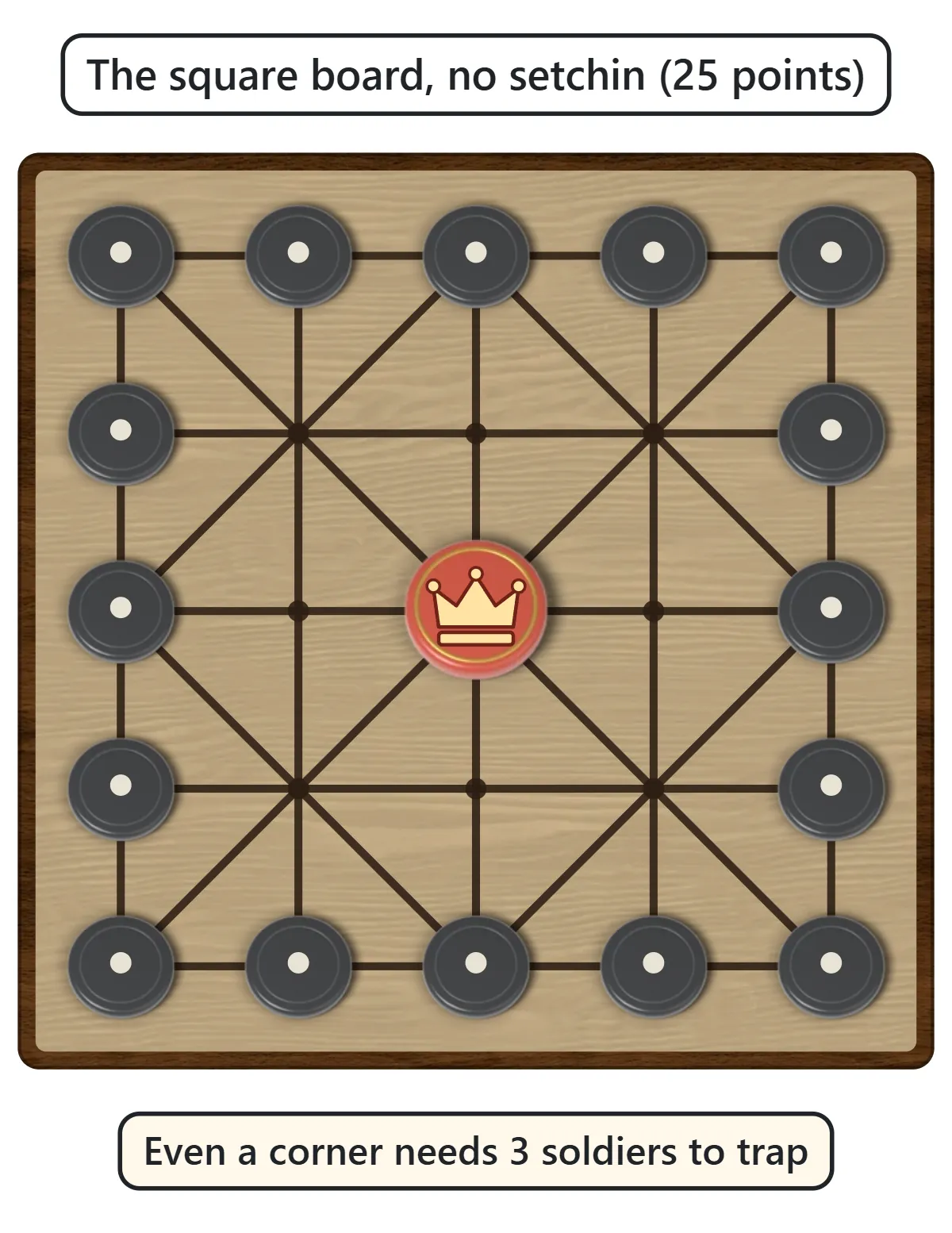
| No setchin | 25 points, General first | 5 or fewer soldiers |
| Soldiers first | 33 points, soldiers first | Too few to trap |
In every version the soldiers win by leaving the General with no move. Without the setchin, even a corner of the square needs three soldiers to seal, so the hunt is harder for the soldiers. The soldiers-first version matches the rules used when researchers worked out the game completely by computer.
Juroku Musashi strategy and tips
Soldiers: never leave a one-point gap
The General can only capture where two soldiers stand on a line with exactly one empty point between them. Before each move, ask whether the soldier you are moving will create such a gap, either at its new point or at the point it leaves behind. With the marks setting turned on, the game puts an × on moves that would let the General capture the soldier you are moving, and circles in red any soldier that is already under threat.
Soldiers: tighten the ring from the outside
The starting position is already a big ring around the General. Keep it a ring. Move soldiers inward a little at a time, starting with the ones that are backed up by neighbors, and let the General’s space shrink. A single soldier that races ahead almost always opens a gap behind it.
Soldiers: herd the General toward the setchin
As the square fills up, the General may escape into the triangle because it looks empty. Once it does, block the entrance point. Inside, two soldiers can finish the job in a far corner.
General: stay in the open
The General loses only by running out of moves, so the center of the square, where each point has up to eight neighbors, is the safest place to be. Edges, corners and the setchin are where it gets caught.
General: threaten two gaps at once
The soldiers can close one gap per turn, never two. Look for a point that, once the General stands on it, leaves two different capturing gaps open. Whichever one the soldiers fix, the General takes the other.
General: think twice before entering the setchin
The triangle often looks like a safe hiding place because few soldiers are in it. The trouble is its single doorway. If a soldier steps onto the entrance point, the General may never get out. Go in only to make a capture, and leave right after.
Juroku Musashi FAQ
Which side has the advantage?
The soldiers. A complete computer analysis of the game found that with perfect play the soldiers always win. Human players make mistakes, though, and each gap costs the soldiers two pieces, so beginners often see the General win. When two friends play, give the General to the stronger player.
Can the soldiers capture the General?
No. Only the General captures. Placing soldiers on both sides of the General has no effect; the soldiers win only by taking away every move it has.
How many soldiers can one move capture?
One pair on each line through the point the General enters. Two pairs means four soldiers, and three pairs means six. Four pairs cannot happen, because the General always arrives from one of the neighboring points, which is therefore empty.
Can the General move into a gap without capturing?
Not in this game. Entering a gap always captures the pair, just as it does in the computer analysis of the game.
Which CPU level should I choose?
Start with Easy. The Easy soldiers leave gaps often, and the Easy General wanders into corners and the setchin. Normal is careful most of the time but still slips now and then. Hard looks several moves ahead: as the General it sets up double threats, and as the soldiers it closes in without leaving openings.
Is Juroku Musashi the same game as Sixteen Soldiers?
No. The name is sometimes translated as “sixteen soldiers”, but the South Asian game known in English as Sixteen Soldiers is a different game, played with sixteen pieces on each side that capture by jumping. In Juroku Musashi one side has a single piece and captures by moving into a gap.
Can I undo, get hints or continue later?
Yes. With Undo turned on, the Undo button takes back your last move (and the CPU’s reply). Hint shows a suggested move with a dashed blue line. If you close the page mid-game, open it again on the same device and browser and press Continue. Sound is off until you turn it on.
History of the game
Nobody knows exactly how old Juroku Musashi is. Some writers link it to a hunt game named in a Japanese dictionary from the Heian period, around a thousand years ago, but whether that was the same game is uncertain. By the Edo period (1603–1868) it was clearly popular: woodblock prints show children bent over the board, and an encyclopedia of the early 1700s includes a drawing of the square board without the triangle. It was sold as a New Year’s toy well into the twentieth century, sometimes with a picture of the warrior monk Benkei on the General, and regional names such as Benkei Musashi were common. Similar hunt games turn up across the world, from Fox and Geese in Europe to the tiger games of South and Southeast Asia, which suggests that the idea of one strong piece against many weak ones is simply a good one.