 Yorimichi Games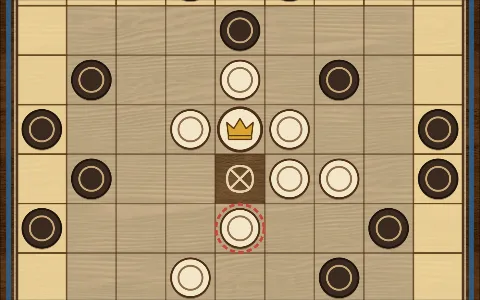
How to play Fox and Geese
Fox and Geese is a two-player board game that has been played in Europe for centuries. One player has a single piece, the Fox. The other player has a whole flock of geese – 13, 15 or 17 of them, depending on the version. The two sides are completely different: the Fox is fast and dangerous and can capture, while the geese are slow and harmless on their own but strong in numbers. The Fox tries to eat enough geese that the flock can no longer catch it; the Geese try to hem the Fox in until it can’t move at all. Games like this, where a lone hunter faces a crowd of weaker pieces, are known as hunt games.
The board and the starting position
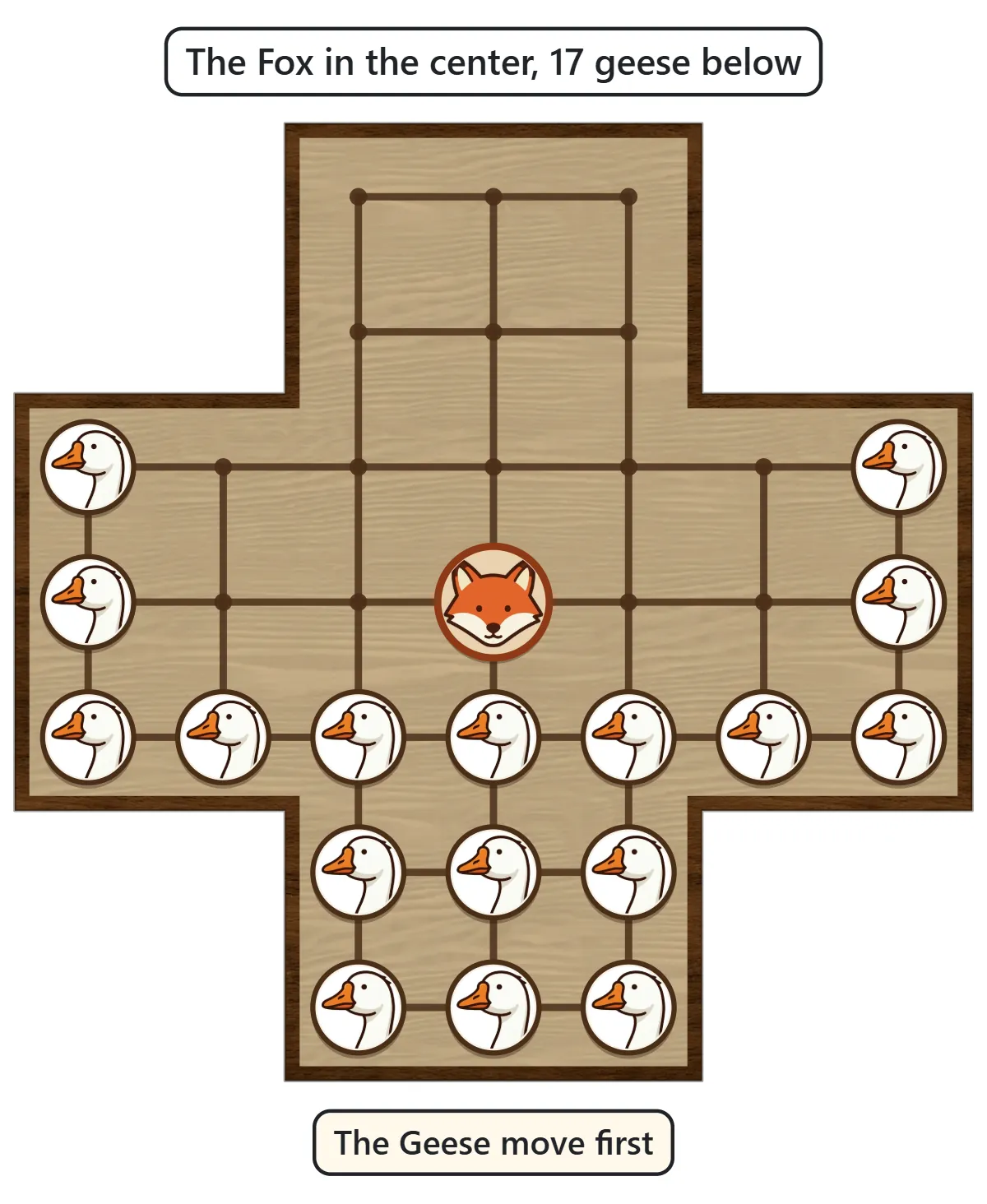
The board is a cross of 33 points – the same shape as the board used for peg solitaire, and in the past people often played Fox and Geese on a solitaire board. The points are joined by lines, and pieces always stand on points and move along lines.
The Fox starts on the center point. The geese fill the six points of the bottom arm and the full row of seven points just above it – that makes 13. For 15 geese, add one at each end of the next row up; for 17, add one more at each end of the row above that. The Geese move first, and then the players take turns.
Moving: one step along a line
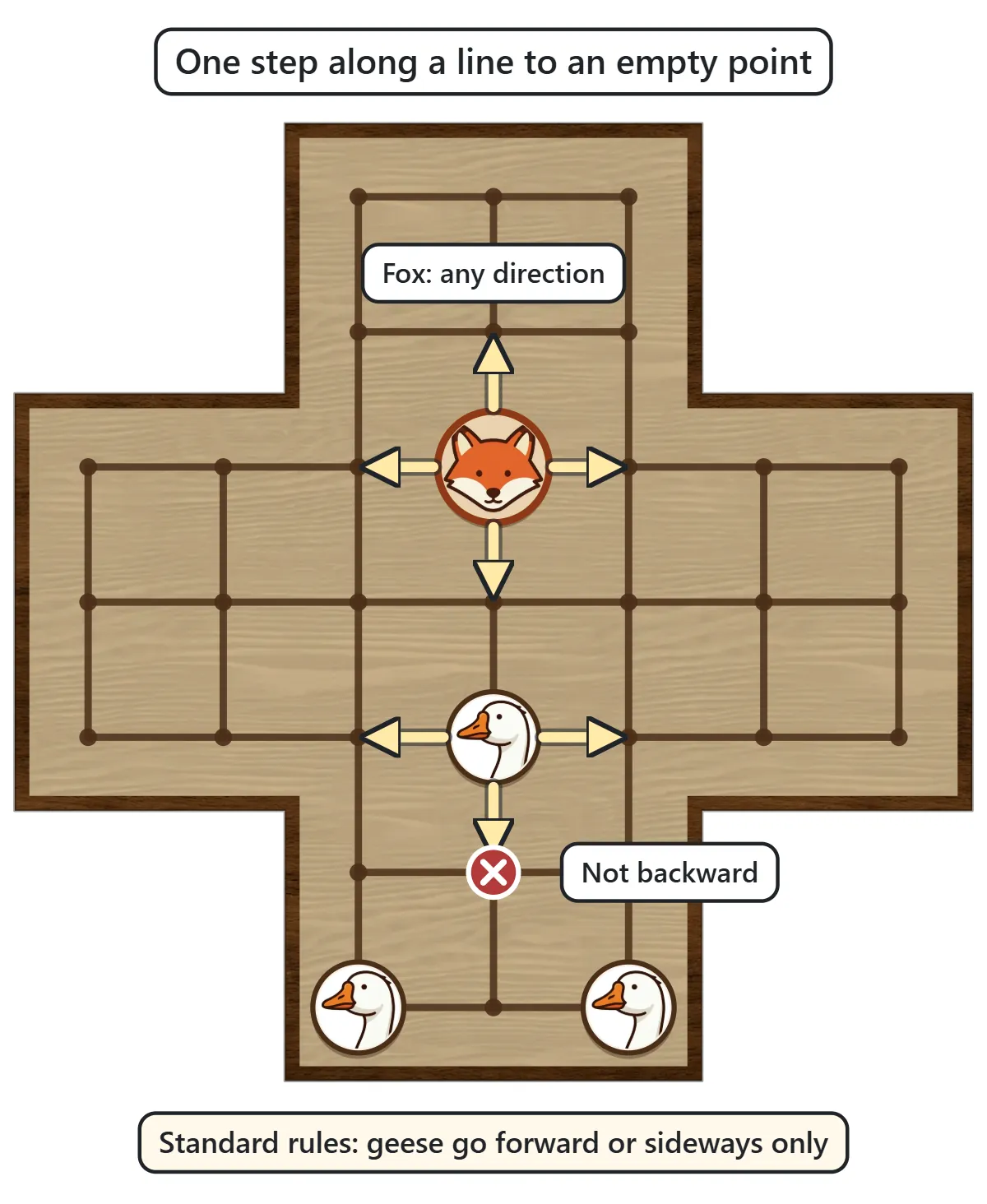
On your turn you move one piece one step along a line to a neighboring empty point. You can’t move onto a point that is already taken. When it’s the Geese’s turn, the player moves just one goose.
In the standard rules, geese may only move forward (up the board) or sideways. They can never step backward, so every forward move is a commitment. The Fox has no such limit and can move in any direction.
Capturing: the Fox jumps over a goose
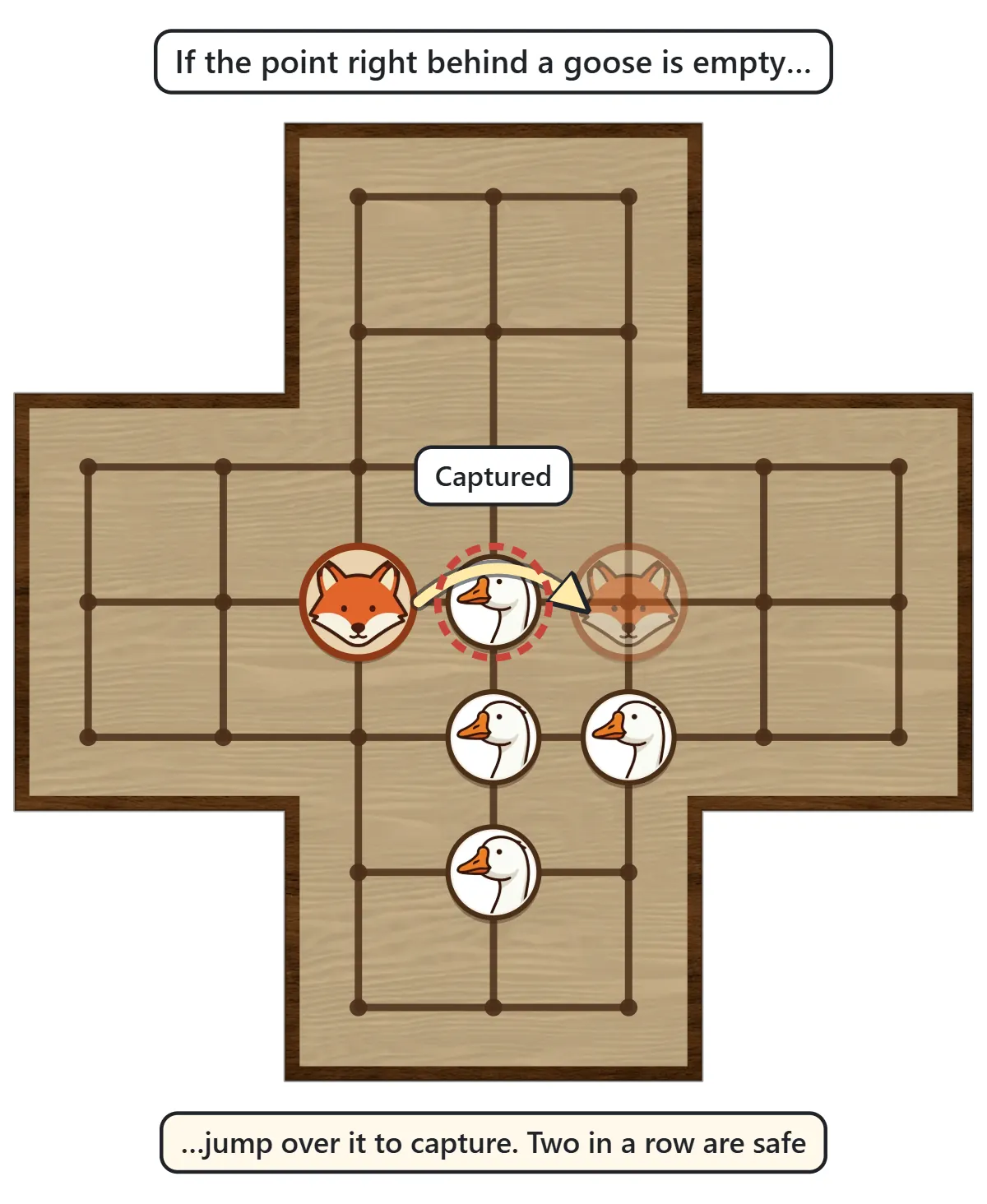
If a goose stands next to the Fox and the point right behind it, on the same line, is empty, the Fox may jump over the goose to that empty point. The jumped goose is captured and taken off the board – just like a capture in checkers. If the point behind the goose is occupied (for example by a second goose), the jump is not possible. Geese can never jump or capture the Fox.
Multiple jumps
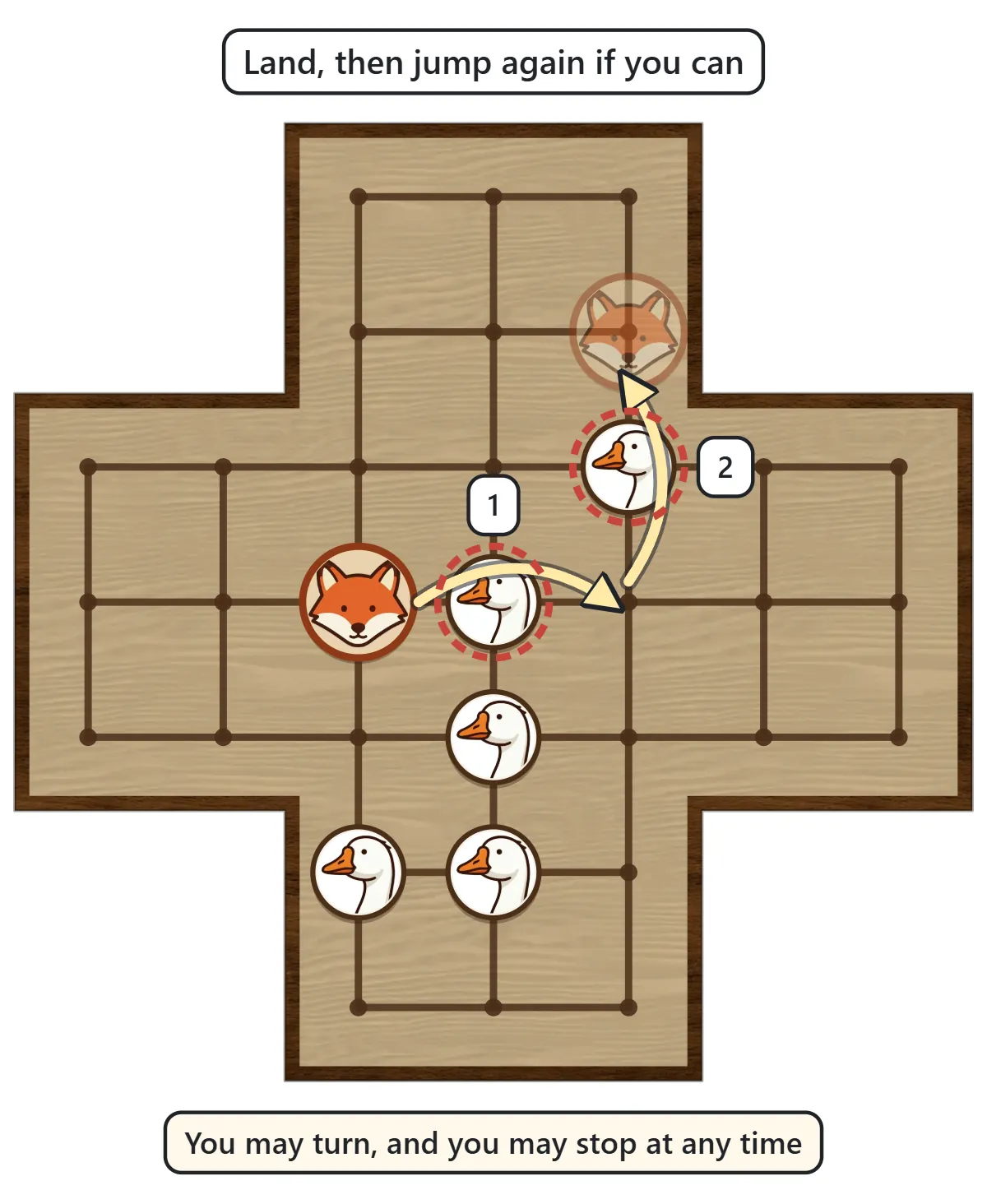
After a jump, if the Fox can jump another goose from the point where it landed, it may continue in the same turn, and it may change direction between jumps. Continuing is the Fox’s choice: it may stop at any point. In this game you keep jumping by tapping the next red dot, and you stop with the “Stop jumping” button or by tapping the Fox.
How the Geese win: trap the Fox
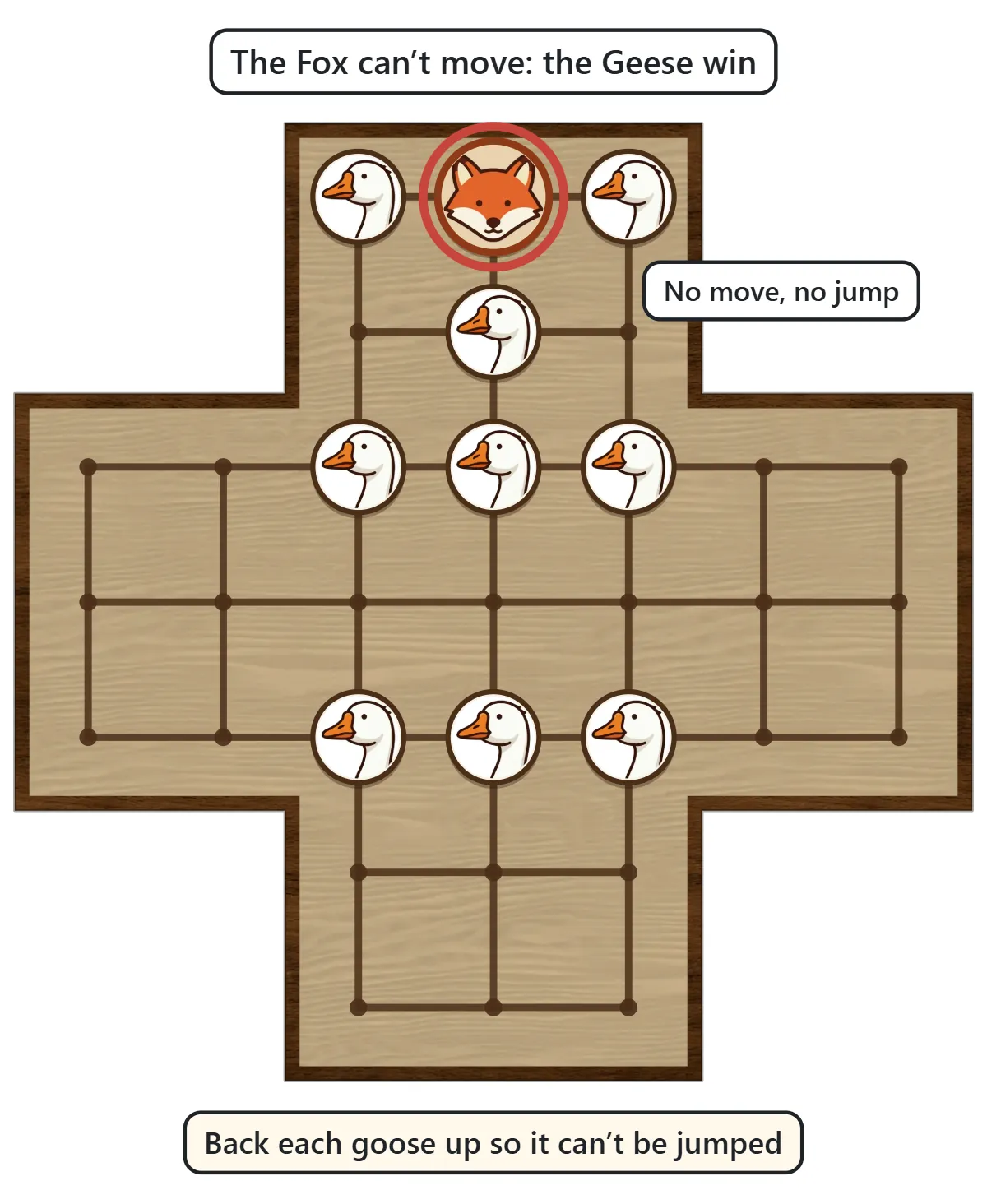
The Geese win if, on the Fox’s turn, the Fox has no legal move: every neighboring point is blocked and no goose can be jumped. Blocking alone is not enough – a goose with an empty point behind it will simply be jumped – so each goose next to the Fox needs another goose backing it up.
How the Fox wins
The Fox wins once it has captured so many geese that the rest can no longer trap it. Old rule books set this number differently. In the standard rules here, the Fox wins when only 6 geese or fewer remain; in the settings you can change this to 4 or to “too few to trap” (3 or fewer). The Fox also wins if the Geese have no move on their turn – this can happen when geese that can’t step backward run out of room.
To keep games from going on forever, the Fox also wins if the same position (same pieces on the same points, same player to move) comes up for the third time – the game warns you the second time – or if 300 moves pass without a result. In both cases the geese have failed to corner the Fox.
Fox and Geese rules: the variations
Because Fox and Geese spread all over Europe, there was never one official rule book. The number of geese, the lines on the board and the way the geese move all differ from place to place. You can choose between three common versions, or pick “Custom” and set each rule yourself.
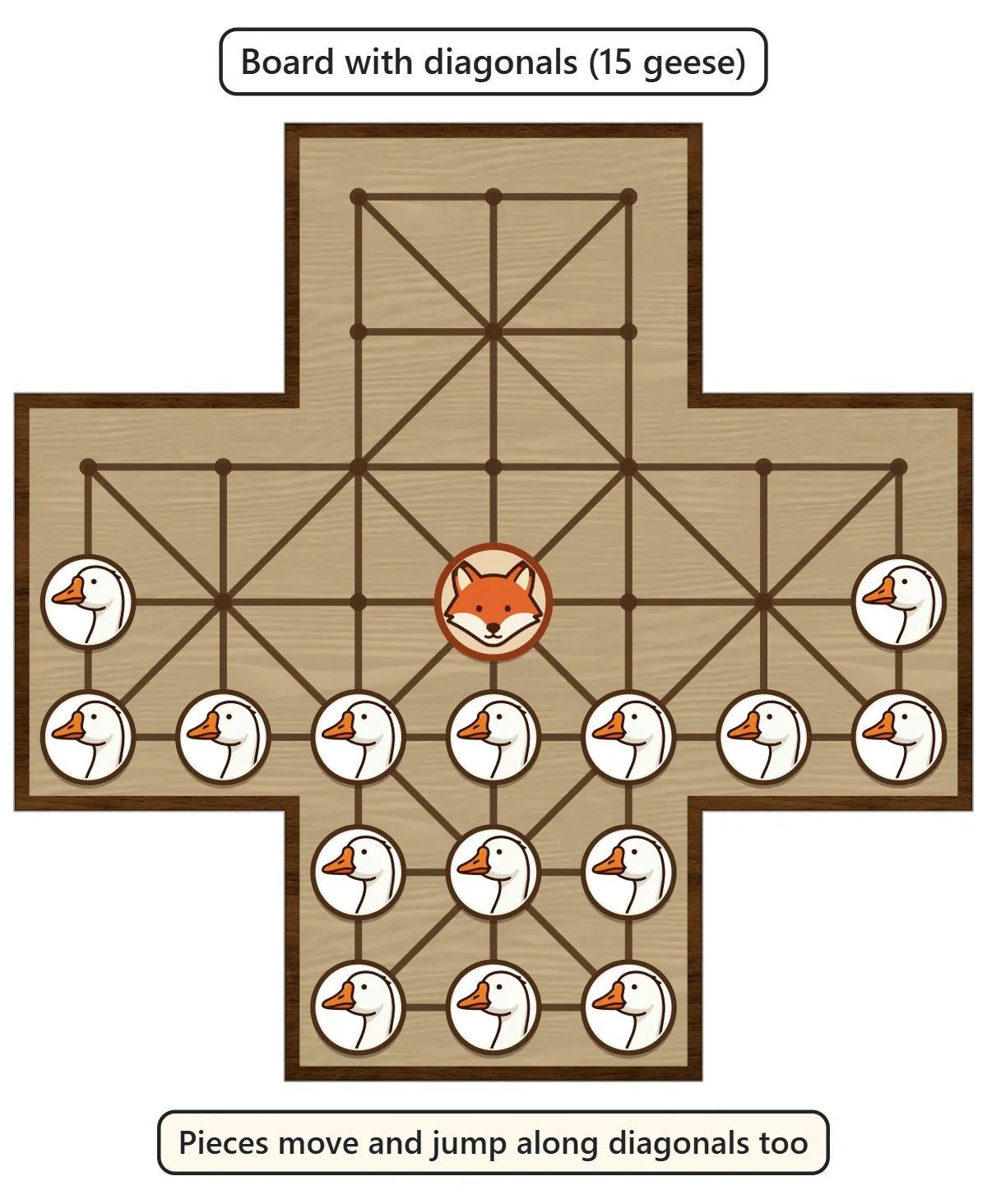
| Version | Lines and goose moves | Fox wins at |
|---|---|---|
| 17 geese (standard) | No diagonals; geese go forward or sideways | 6 geese left |
| 13 geese | No diagonals; geese go any direction | 3 left |
| 15 geese | Diagonals; geese go forward, sideways or diagonally forward | 3 left |
The 13-geese version, where geese may also move backward, is generally thought to favor the Fox. Adding geese, or allowing them to move only forward and sideways, are old ways of evening things out. Diagonal lines give the Fox more directions to jump in, so the Geese find it much harder to close every gap. Other options you can try: allowing only single jumps, or making capturing compulsory, as in the old Scandinavian form of the game.
Fox and Geese strategy and tips
Geese: advance as a double wall
A goose can only be captured when the point behind it is empty. Move up in two solid rows so that every goose in the front line has another goose right behind it. With the marks turned on, any move that would leave a goose open to a jump is shown with an ×.
Geese: squeeze from the sides and push the Fox into an arm
The arms of the cross are narrow and easy to block. Bring the geese in from the left and right arms, shrink the open area around the Fox step by step, and finally drive it into the top arm, where a handful of geese can seal it in.
Geese: don’t rush forward
When geese can’t move backward, a goose that runs ahead is stuck out there for good, and a lone goose leaves gaps around it. Keep the wall intact, and use sideways moves to pass time when there is no safe forward move.
Fox: stay in the open center
The Fox only loses when it runs out of moves. The middle of the board has the most connections, so it is the hardest place to be trapped. Go into the ends of the arms only to grab a goose, and get back out quickly.
Fox: attack two geese at once
The Geese can move only one piece per turn, so they can fix only one weakness at a time. Look for a square that threatens two jumps at once – a fork – and one of the two geese will fall.
Fox: look for a chain of jumps
When there are empty points behind the geese’s front line, a single jump can turn into two or three. Before you move, trace where you would land and whether another jump starts from there.
Fox and Geese FAQ
Which side has the advantage?
It depends on the rules. With 13 geese the Fox has the better chances; with 17 geese the Geese do. A 19th-century English book of boys’ games put it simply: properly played, the geese must always win – though, as it added, the cunning creature is often successful anyway. When two people play, swap sides each game and compare totals.
Does the Fox have to capture?
Not in the standard rules – jumping is optional. Some old Scandinavian versions made capturing compulsory; turn on “Compulsory” in the settings to try it. In that case the Fox must also keep jumping as long as it can.
How few geese are needed to trap the Fox?
At least four. On the plain board, the Fox at the corner of an arm can be held by two geese next to it, each backed up by another. That is why the “too few to trap” rule ends the game at three geese.
What is the difference between Fox and Geese and Fox and Hounds?
Fox and Hounds is a related hunt game played on the dark squares of a checkerboard. The fox tries to slip past four hounds to the other side, and nobody is ever captured. Fox and Geese uses the cross-shaped board and the Fox captures by jumping.
Is there a Japanese game like this?
Yes. In Juroku Musashi, one General faces sixteen soldiers. The General captures not by jumping but by stepping into the gap between two soldiers, which removes both. The soldiers win, just like the geese, by trapping the General.
How strong is the computer?
On Easy, the computer’s geese often leave gaps and its fox chases geese without noticing it is being boxed in. On Normal it watches for open gaps but still slips up now and then. On Hard it reads several moves ahead, builds a gap-free wall as the Geese, and sets up forks as the Fox.
Can I undo, get a hint or continue later?
Yes. With Undo on, the Undo button takes back your move together with the computer’s reply. Hint shows, with a dashed blue line, the move the game finds by looking ahead. If you close the page during a game, you can pick it up with Continue on the same device and browser. Sound starts switched off.
History of Fox and Geese
Fox and Geese probably comes from Scandinavia. In the Old Norse Grettis saga it appears under the name halatafl, “the tail board” – the tail is thought to be the fox’s. The word tafl is the same one used for the Viking-age tafl games, in which a king and a small army face a larger force, and the fox game is often described as a relative of that family.
In England, King Edward IV is recorded as buying a set with two foxes and twenty-six hounds in the fifteenth century, which is thought to have been a version of this game. Joseph Strutt’s Sports and Pastimes of the People of England (1801) describes the game with seventeen geese and notes that the board was sometimes made with holes and pegs. In the nineteenth century it was a favorite of Queen Victoria, and it appeared in many books of parlour games.
Hunt games with one strong piece against many weak ones are found around the world: bagh-chal (tigers and goats) in Nepal and Juroku Musashi in Japan are two well-known cousins. What makes all of them fun is the same tension – a lone hunter that can strike anywhere against a crowd that wins only by working together.