 Yorimichi Games
How to play Hnefatafl online
Hnefatafl is a family of northern European strategy games with an unusual contest at its centre: a king and a small bodyguard must escape a larger attacking force. The two players do not have matching armies or matching goals. One looks for a safe road out; the other tries to close every road and capture the king. You can play the defenders or attackers against the computer, or share one device with another player. No account is needed. Start with Tablut on the smaller board, then try the larger Copenhagen and Fetlar games once the basic captures feel familiar.
The board and starting position
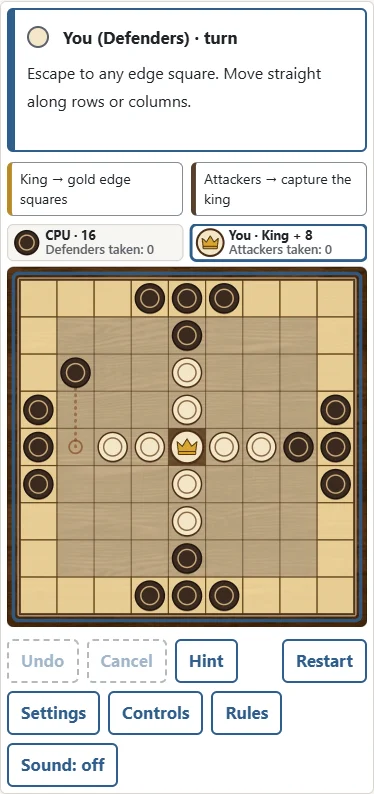
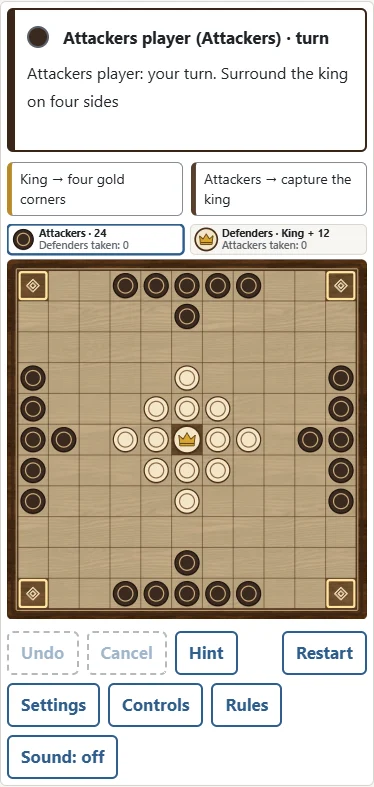
Tablut uses nine rows and nine columns. The king begins on the central throne. Eight defenders form a cross around him, with two along each arm. Sixteen attackers begin in four groups near the middle of the board edges. Each group has three pieces on the edge and one immediately behind them. Attackers always make the first move. Copenhagen and Fetlar use an eleven by eleven board with twenty-four attackers and twelve defenders around the king. The corners become special escape squares on those larger boards.
Moving your pieces
On your turn, select one of your pieces and move it through any number of empty squares in a straight row or column. Diagonal moves are not allowed. A piece cannot jump over another piece, whether friendly or hostile. Every piece, including the king, moves in the same way. Tap or click a piece to see destination dots, then choose a dot to make the move. Tap the same piece again to cancel. On a keyboard, use the arrow keys to move the yellow cursor and Enter or Space to select a piece or confirm its destination.
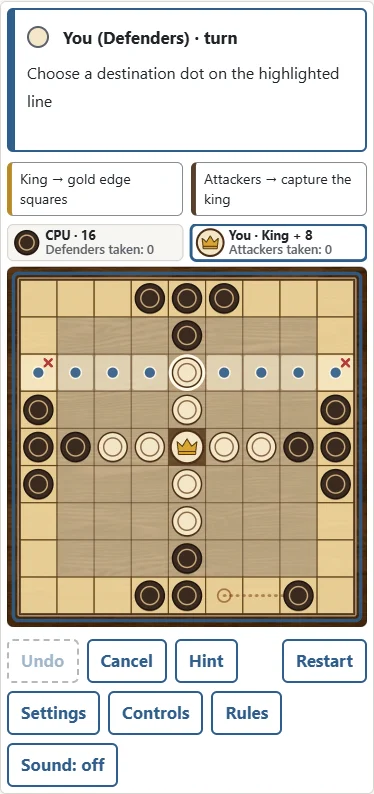
The throne is reserved for the king. Soldiers may pass through an empty throne but cannot end a move there. The king may leave it and later return. With corner escape, the four corner squares are also reserved for the king. These restrictions concern stopping places, so do not confuse an empty throne with an obstacle that blocks an entire line. A soldier beyond the throne can still reach the other side if the rest of the route is empty.
Hnefatafl capture rules
Capture an enemy soldier by moving a friendly piece so that the enemy is sandwiched between it and another friendly piece. The two friendly pieces must be immediately opposite each other across the enemy, horizontally or vertically. Remove the captured soldier. A single move can complete captures in several directions. The king can help his defenders capture attackers, and can also make a capturing move himself. There is no obligation to capture: a quieter move that protects an escape route may be more useful.
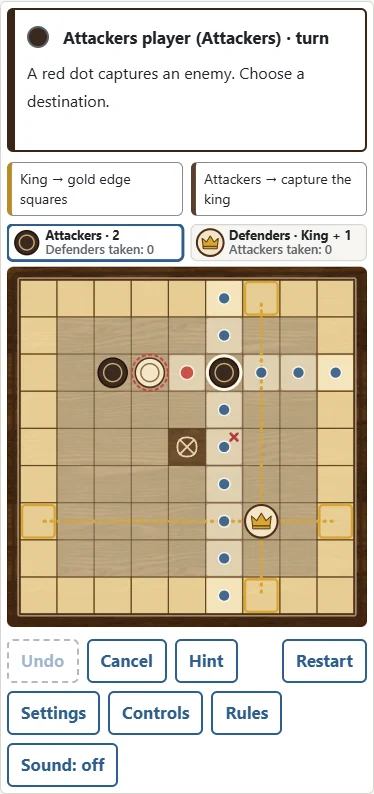
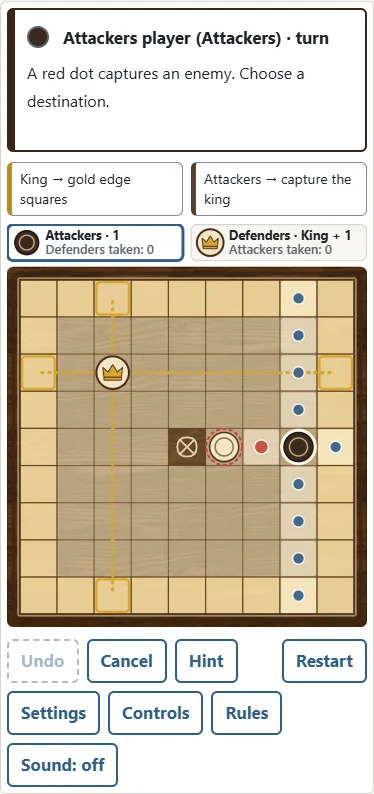
A capture happens when the opponent closes the sandwich with a move. Walking between two enemy pieces does not by itself capture the moving piece. This is a useful distinction when checking narrow gaps. However, a later enemy move might create a fresh capture against that piece. Do not assume a safe landing square will remain safe on the following turn. Red destination dots show captures available now, while crosses warn of a possible capture after the move.
The throne and hostile squares
An empty throne can serve as the other half of a capture against either side. A soldier beside it can therefore be taken by an enemy arriving on its opposite side. When the king occupies the throne, it supports captures of attackers, but it does not act against his own defenders. Restricted corners can also complete a soldier capture. An ordinary board edge never supplies the missing half of a sandwich. Pushing an enemy against the boundary is therefore different from pinning one beside an empty throne.
Capturing the king
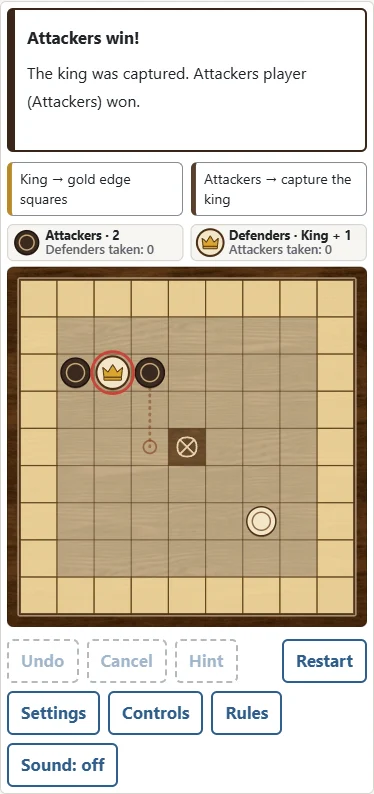
In Tablut, the king away from the throne is captured between two attackers. On the throne itself, attackers must fill all four neighbouring squares. Next to the throne, they must occupy the other three neighbours; the throne supplies the fourth side. In Copenhagen and Fetlar, the king needs four surrounding attackers even away from the throne, with the same three-attacker exception beside it. A king on an edge cannot be captured by an ordinary four-sided surround. He can still lose if his side has no legal move.
Escaping with the king
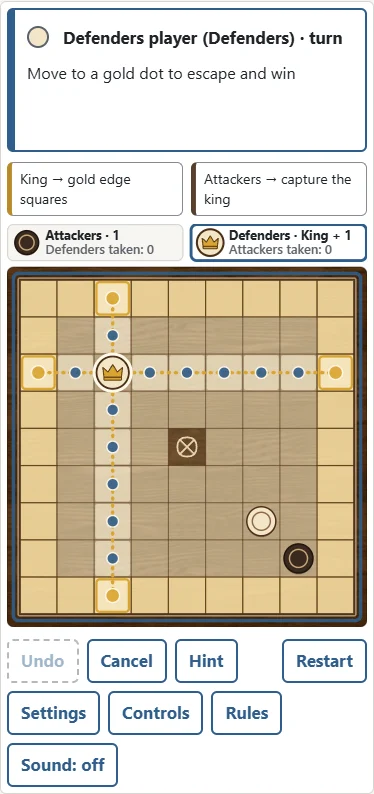
In Tablut, reaching any edge square wins immediately for the defenders. In Copenhagen and Fetlar, the king must reach one of the four corners. A soldier reaching an escape square does not win. Watch the gold dotted routes from the king: these show escape destinations he can reach with one move. Two routes are often much harder to stop than one, though an attacker may sometimes capture the king or close both routes by taking a key defender. Look at the whole position before relying on a double threat.
Tablut, Copenhagen and Fetlar differences
| Variant | Escape and king | Special rules |
|---|---|---|
| Tablut | 9×9; any edge; two-sided capture away from throne | No shieldwalls or forts |
| Copenhagen | 11×11; corners; four-sided capture | Shieldwalls and exit forts |
| Fetlar | 11×11; corners; four-sided capture | Repetition draws |
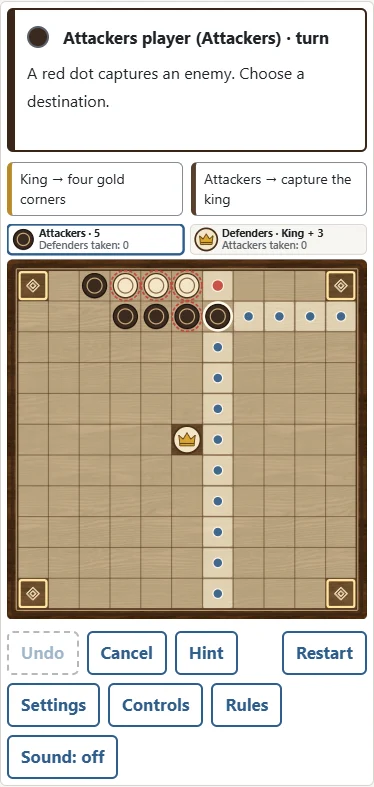
A Copenhagen shieldwall captures a line of at least two enemy pieces on an edge. Bracket both ends of the line and place a friendly piece directly in front of every member on the inner side. An empty restricted corner can replace one end bracket. The capturing move closes an end of the bracket. If the king stands in the captured line, remove the soldiers but leave the king. Defenders can capture a line of attackers in exactly the same way. Moving an inner supporting piece into place alone does not complete this capture.
An exit fort is a protected enclosure touching the edge. The king must stand on the edge and have room to move inside, while the attackers must be unable to break the enclosure. A king merely reaching an edge is not enough in Copenhagen. The soldiers forming the wall must also be secure against captures. Attackers win by encirclement if an uninterrupted ring cuts off the king and every remaining defender from the boundary. A lone defender outside the ring prevents that particular victory.
In Tablut, the player maintaining the repetition loses on the third occurrence of the same board and turn. The repeating aggressor is identified when that side repeatedly creates an immediate winning threat, the opponent removes it on every reply, and the threatening side has a different move that avoids an immediate loss. Attackers can therefore lose for maintaining a repetition. If responsibility is unclear, a complete cycle is not available within the latest thirty-two moves, or an older saved game lacks the required history, the result is a draw. Longer-term threats are outside this limited test. Copenhagen still awards a third repetition to the attackers; Fetlar draws. All games here draw after three hundred total moves. A player with no legal move loses. You can choose a different repetition convention in Custom rules.
Hnefatafl strategy: useful first habits
Open a route before moving the king
For defenders, the king is the goal of the game, but moving him every turn is rarely the best plan. First move soldiers out of a useful lane. Keep nearby protection when the king leaves the throne. A long move toward an edge can look impressive while leaving the king one move away from capture. Check the squares on both sides of his destination, especially in Tablut.
Build two threats
Try to create two different escape routes at once. They might point toward opposite edges in Tablut or toward separate corners on the larger board. The attacker then has to decide which danger matters most. Do not leave the king vulnerable while making the second route. A defender that protects the king can be worth more than one that captures a distant attacker.
Attack as a connected army
Attackers have more pieces, but their starting groups are separated. Bring them inward in a coordinated way and keep some cover near escape lanes. Chasing a single defender with several attackers can open the other side of the board. Before each move, ask where the king could go next and which of your pieces can close that road without abandoning another important square.
Count captures, then count replies
Taking a piece is useful, but it is not the purpose of every move. Look for the opponent's reply before accepting a capture. A soldier may be offered to draw your piece away from a corner or a blocking square. The red marks help you find immediate captures; the risky destination crosses help you notice the next danger. You can turn these marks off when you want to practise reading the board yourself.
Watch the throne late in the game
The throne remains important after the king leaves. An empty central square can trap soldiers beside it, and a returning king changes which captures it supports. Near the throne, the king's capture requirement is also different from an ordinary Tablut square. Count the required neighbours carefully instead of judging by how many attackers seem close.
Swap sides
The two roles teach different skills. Playing defenders shows how escape threats develop; playing attackers shows why a small gap in a ring can matter. In a two-player session, swap sides after each game and compare your plans. A single win does not tell you which role you understand better, particularly when you change variants between games.
Hnefatafl FAQ
Is Hnefatafl the same as Tablut?
Hnefatafl belongs to the wider tafl family. Tablut is the nine-square version recorded in eighteenth-century northern Scandinavia. Modern Copenhagen and Fetlar games use larger boards and different king rules. The games share straight movement and sandwich captures, but you should check the chosen escape and king-capture rules before playing.
Which difficulty should I choose?
Choose Easy while learning the two goals. Normal is better once you regularly notice escape routes and immediate captures. Hard looks further ahead and makes it harder to keep a promising route open. Hints are available on your turn at every level. A hint marks a suggested piece and destination with a blue dotted line, so you can compare it with your own plan.
Can I undo or continue later?
Enable undo in settings before starting. Against the CPU, Undo returns to the position before your last move and also removes the CPU reply. Progress is saved on this browser and device. When you reopen the page, choose Continue to return to that position. Storage can be lost if browser data is cleared or private browsing ends. Japanese and English pages share the same saved game.
How do results and sound work?
The result shows the winning side, the reason and the number of moves. CPU games also keep your wins and games on this device, with hints and undos noted. Play again starts another game with the same settings; Change settings lets you choose a different role or variant. Sound begins off. Turn it on if you want short move and capture sounds; there is no background music.
A short history of tafl
Tafl games are associated with medieval northern Europe and the Viking world. Boards and playing pieces survive from several regions, but objects alone do not provide a complete rulebook. The best-known written account is Carl Linnaeus's record of Tablut during his journey in 1732. Modern variants draw on historical evidence while setting clear conventions for present-day play. Copenhagen and Fetlar therefore belong to a continuing tradition of reconstructing and enjoying these unequal contests between a king's small guard and a larger besieging army.