 Yorimichi Games
How to play the Royal Game of Ur
The Royal Game of Ur is a race game for two players. You throw four pyramid-shaped dice, move one of your pieces that many squares along your route, and try to bear all seven pieces off the board before your opponent does. Luck decides what you roll, but you decide which piece to move – and that choice wins and loses games.
The board
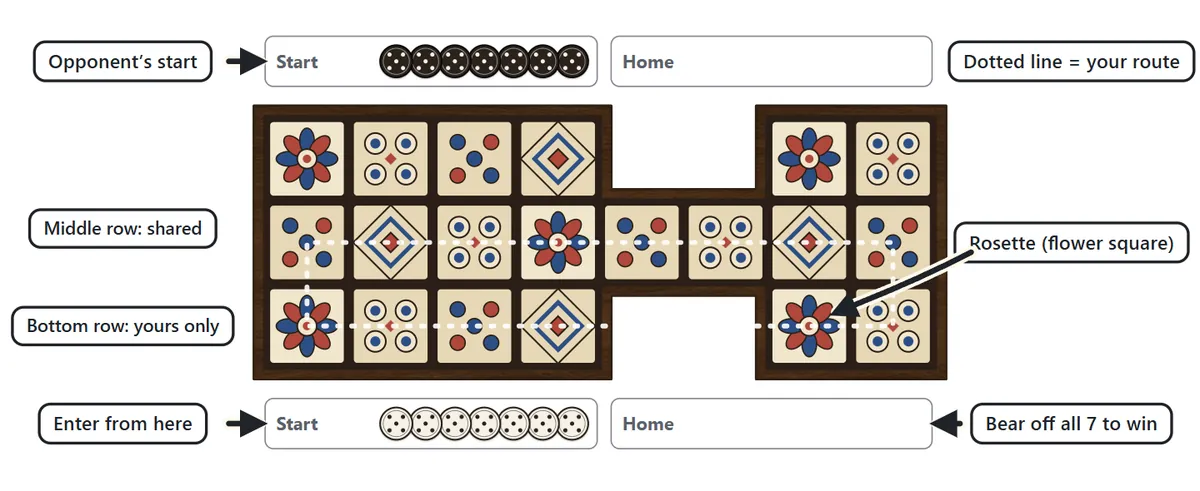
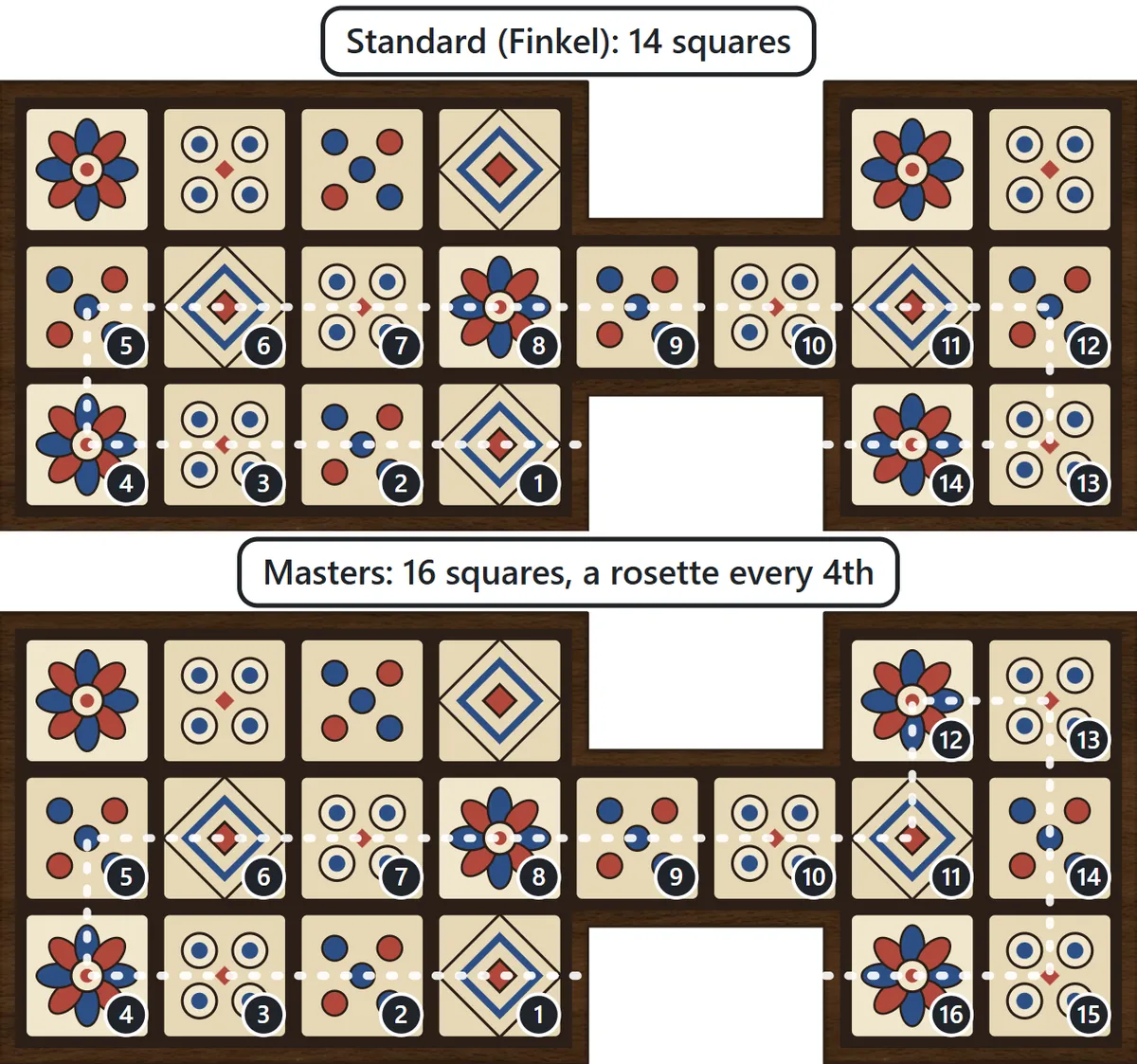
The board has twenty squares: a block of 4 × 3 on the left, a block of 2 × 3 on the right, and a narrow bridge of two squares joining them. Under the standard rules your pieces enter on your own row next to the bridge, travel four squares to the left, turn into the middle row and run all the way to the right end, then drop back into your own row for two last squares before leaving the board. That is a route of fourteen squares.
Only you ever use the six squares on your own row, so your pieces there are completely safe. The eight squares of the middle row are shared – both players race through them, and that is where pieces get captured.
Reading the pyramid dice
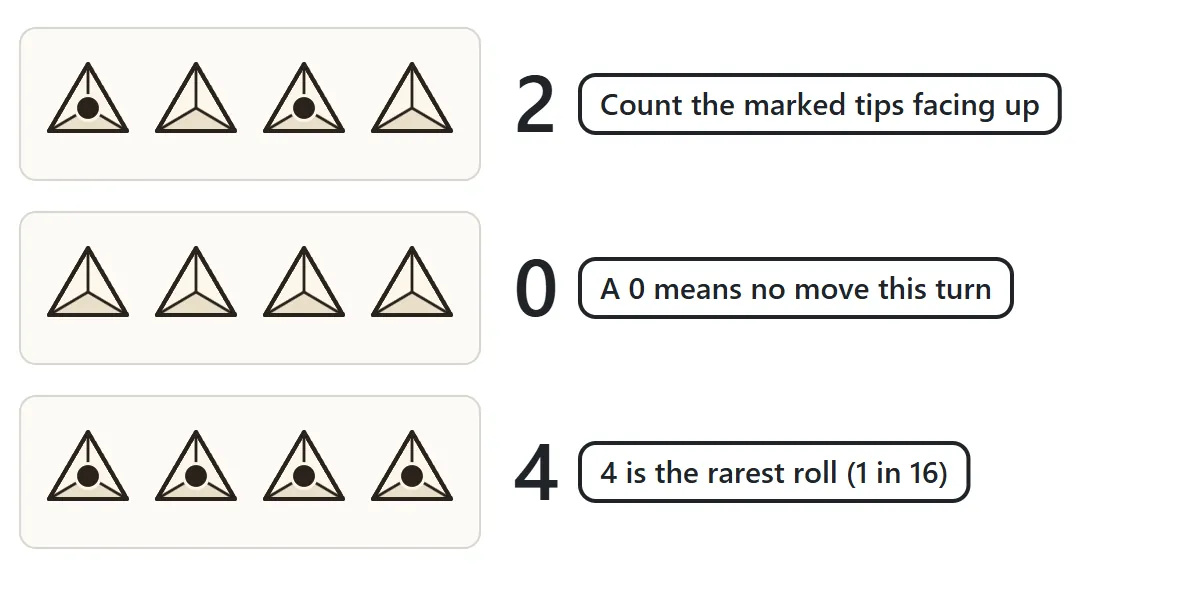
Each die is a small tetrahedron with two of its four tips marked. You throw all four together and count the marked tips facing up, so every roll is a number from 0 to 4. A 2 is the most common result (6 times in 16). A 1 or a 3 comes up 4 times in 16, while a 0 or a 4 comes up only once in 16. A 0 means you cannot move at all, and the turn passes to your opponent.
Entering and moving pieces
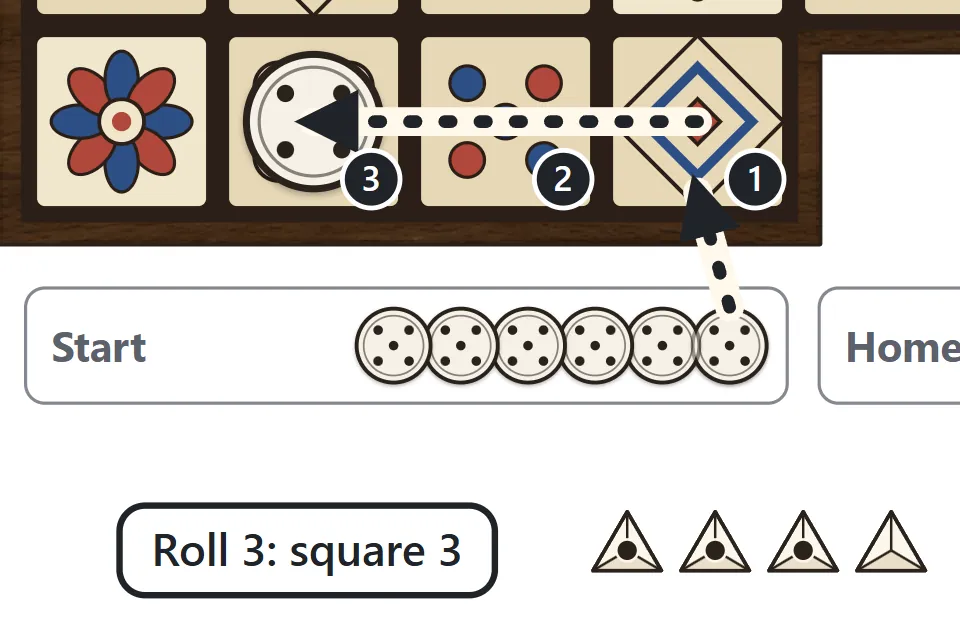
With each roll you either move one piece already on the board or bring a new piece in from the start. It is your choice. Only one piece may stand on a square, so you can never land on one of your own pieces. If any move is possible you must make one, even a bad one; the turn only passes when no piece can move.
Capturing
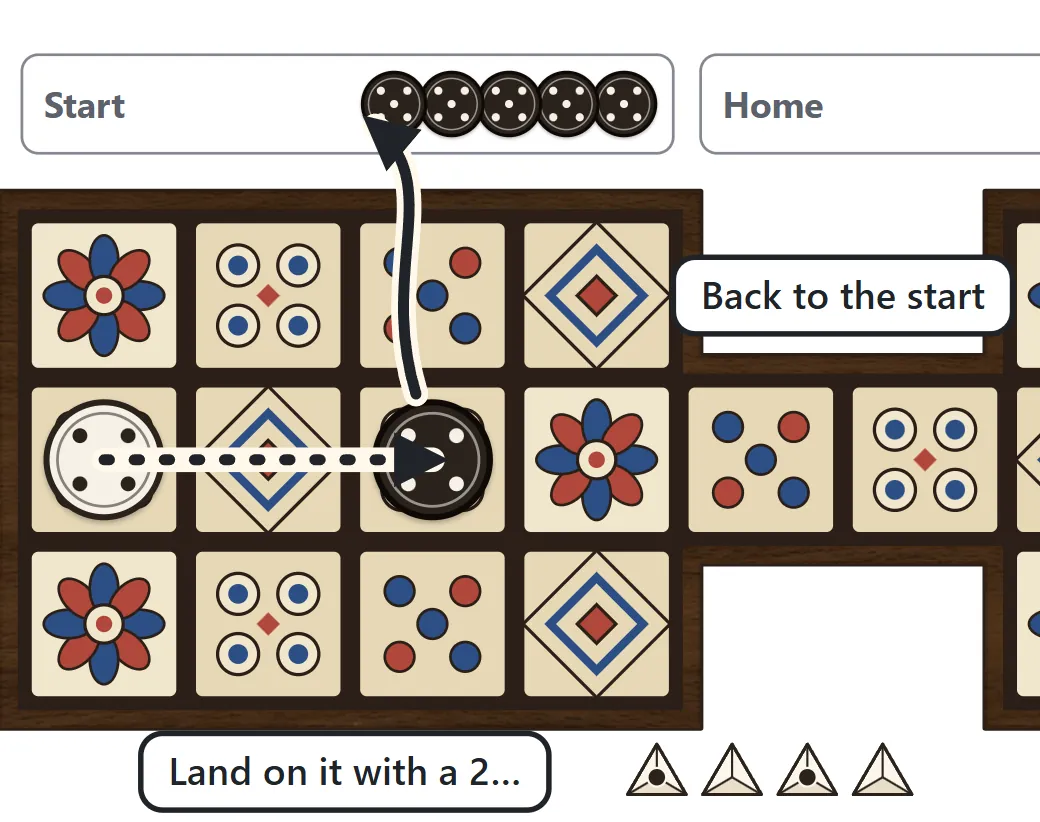
A captured piece has to begin its journey again. You never have to capture – you may move a different piece instead – but sending back a piece that has nearly finished is usually a huge swing.
Rosettes
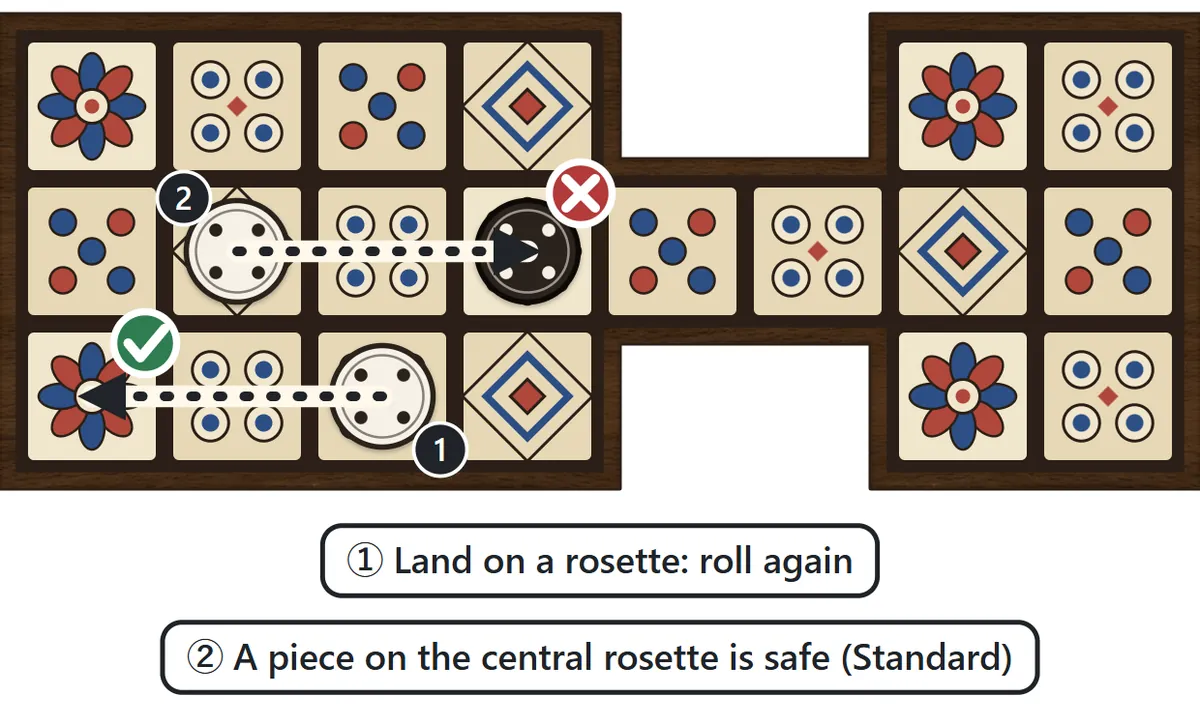
Five squares carry an eight-petal flower, the rosette. Whenever a piece lands on one, you roll again straight away. The rosette in the middle of the shared row is special: a piece standing there cannot be captured, and your opponent cannot land on it while you occupy it. That makes it the most valuable square on the board.
Bearing off needs an exact roll
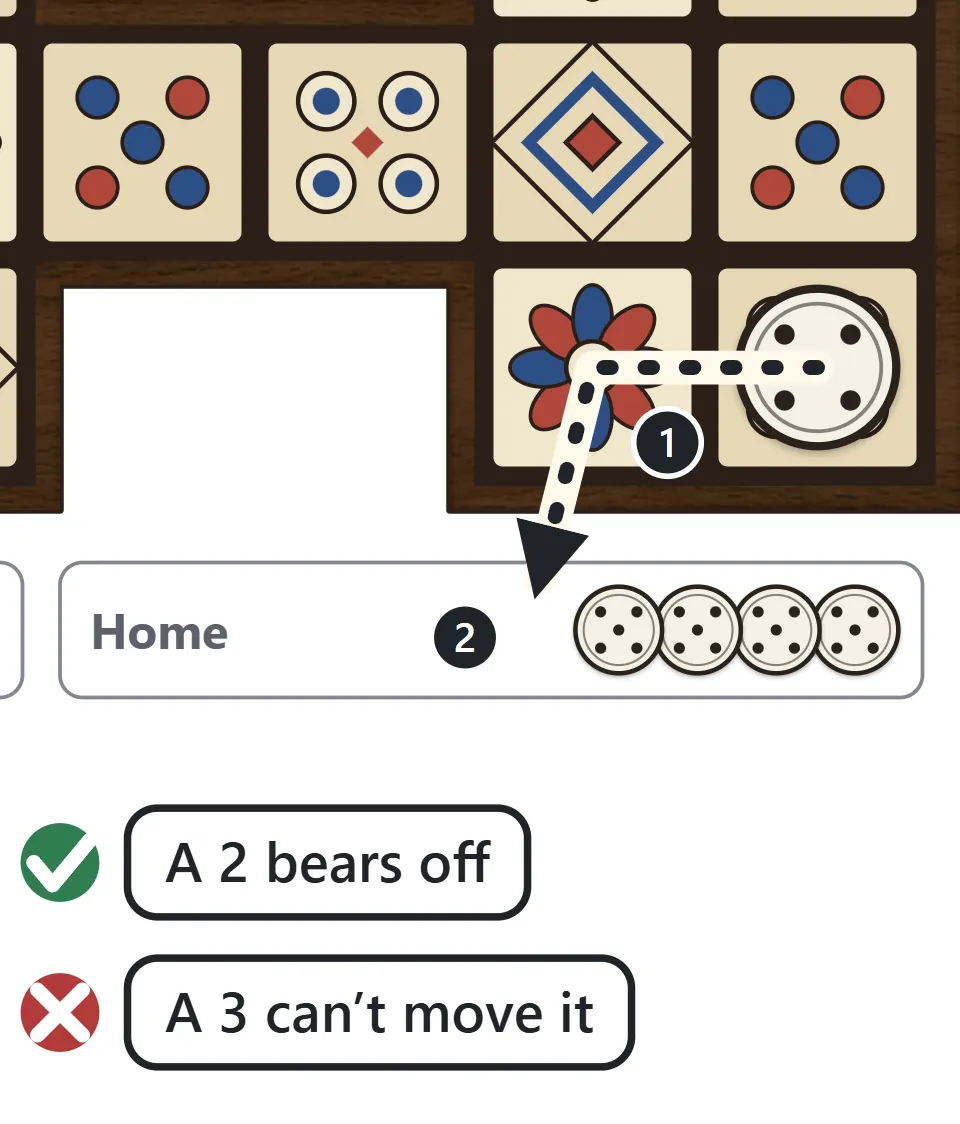
From the last square (the rosette on your own row) you need a 1; from the square before it, a 2. A roll that is too high or too low cannot take that piece off. The first player to bear off all seven pieces wins.
Who goes first
Both players throw the dice and the higher number starts; on a tie, throw again. The starting player then throws once more for the first move. In this game you can also simply choose who goes first.
Royal Game of Ur rules: Finkel, Masters and Blitz
Nobody has a complete rulebook from the time the boards were made, so modern players use reconstructions. You can choose between the three most popular ones, or switch individual rules under Custom.
| Rule | Standard | Masters |
|---|---|---|
| Pieces each | 7 | 7 (Blitz: 5) |
| Dice | 4 dice, 0–4 | 3 dice, a 0 counts as 4 (Blitz: 4 dice) |
| Route | 14 squares | 16 squares |
| Safe rosettes | Central rosette is safe | No |
| Extra roll | Rosettes | Rosettes (Blitz: captures too) |
Standard (Finkel) is the version proposed by Irving Finkel, a curator at the British Museum, and it is by far the most widely played today. Masters follows the ideas of games historian James Masters: a longer route, three dice where a zero counts as four, and no safe rosettes, which makes the game much more aggressive. Blitz was created by the Royal Game of Ur community site RoyalUr.net as a faster modern variant – it is not an ancient rule set.
Royal Game of Ur strategy and tips
1. Hold the central rosette
Under the standard rules, a piece on the central rosette is safe and blocks your opponent from landing there. Many strong players park a piece on it for as long as possible and move other pieces instead.
2. Stay out of reach
In the shared row, any square one to four steps ahead of an opposing piece can be hit. Two steps ahead is the most dangerous spot because a 2 is the most common roll. Turn on “Mark pieces that could be captured” to see the risky squares while you learn.
3. Capture the piece that has travelled furthest
If you have a choice, send back the opposing piece that is closest to home. Before you do, check whether your capturing piece will be left in danger.
4. Take the extra rolls
When your roll lets you land on a rosette, that is usually the right move – an extra roll is almost a free turn. The first rosette, four squares in, is also easy to reach when you enter a new piece with a 4.
5. Keep pieces waiting on your own row
Pieces on the first four squares of your route can’t be captured. Keeping one or two there gives you choices, so you can jump into the shared row when a safe gap opens.
6. Plan the endgame
Because bearing off needs an exact roll, several pieces queued at the end of the route can leave you waiting for a 1. Try to keep your last pieces at different distances from home.
Royal Game of Ur FAQ
Is it really the oldest board game in the world?
It is one of the oldest known board games, but not the very oldest: the Egyptian game senet, for example, is thought to be older. What makes the Royal Game of Ur remarkable is that an ancient written description of how it was played has survived.
What happens if I roll a 0?
You can’t move, and it becomes your opponent’s turn. The same happens if you roll a number but none of your pieces has a legal move.
Which computer level should I choose?
Start with Easy: it often misses captures and rosettes. Normal rarely misses an obvious capture or rosette but sometimes walks into danger. Hard holds the central rosette, plays safely and pounces on your mistakes, though it can still slip up. On every level the dice can turn the game around.
Can I stop and continue later?
Yes. Open the game again in the same browser on the same device and press Continue. Sound is off at first; press “Sound: off” to turn on the effects.
History of the Royal Game of Ur
Where was it found?
Between 1922 and 1934 the British archaeologist Sir Leonard Woolley excavated the Royal Cemetery at Ur, an ancient Sumerian city in what is now southern Iraq. He found five game boards there, and the game has been called the Royal Game of Ur ever since. The board now in the British Museum dates to about 2600–2400 BC. It is a wooden box inlaid with shell, red limestone and lapis lazuli; the museum notes that it was originally hollow and held the pieces and dice inside.
Boards of the same type have since been found across the ancient Middle East and beyond – in Iran, Syria, Egypt, Lebanon, Cyprus, Crete and Sri Lanka. Four boards very like it were found in the tomb of Tutankhamun, often with a senet board on the reverse. The game seems to have been played by people of every social class for well over a thousand years.
How were the rules discovered?
When the boards were dug up, nobody knew how the game was played. The key turned out to be a clay tablet written in cuneiform around 177 BC by a Babylonian scribe, Itti-Marduk-balāṭu. In the early 1980s Irving Finkel of the British Museum recognised that it described this game; the back of the tablet even shows a diagram of the board. He also used photographs of a second, older tablet that was destroyed during the First World War.
That tablet is more than two thousand years younger than the boards from Ur, and it describes a more complicated game involving betting and fortune-telling – landing on certain squares promised things like “You will find a friend” or “You will draw fine beer”. The standard rules played today are Finkel’s reconstruction, based on the tablet and the shape of the board, designed to be playable now. We don’t know whether the people of Ur played in exactly this way, and other historians, such as James Masters, have proposed different routes and different meanings for the rosettes.
Ur, backgammon and dice race games
The Royal Game of Ur belongs to the large family of race games in which dice move pieces towards a goal, the same family as Japanese sugoroku. Its way of sending a hit piece back to the start and bearing pieces off the board is strikingly similar to backgammon, and some historians see it as one of backgammon’s ancestors. Others think early forms of backgammon simply replaced it in popularity. Either way, the game was forgotten in the Middle East by late antiquity – except among the Jewish community of Kochi in India, who kept playing a version called Aasha until the 1950s.
Sources
- British Museum, collection object “game-board”, museum number 120834: britishmuseum.org
- Wikipedia, “Royal Game of Ur”
- RoyalUr.net, “Rules of the Royal Game of Ur” (Finkel, Masters and Blitz rule sets): royalur.net
- James Masters, “The Royal Game of Ur & The Game of 20 Squares”: tradgames.org.uk