 Yorimichi Games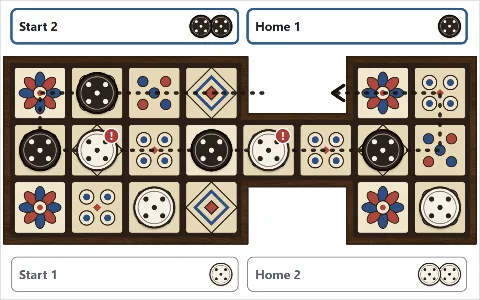
How to play senet
Senet is a two-player race game from ancient Egypt. You throw four flat sticks, move one of your pieces forward by the number shown, and try to be the first to bear all of your pieces off the board. Along the way you can swap places with an opponent’s piece, protect your own pieces by keeping them side by side, and build walls your opponent cannot pass. The throws decide a lot, but the choices you make with them decide even more.
One honest note before we start: nobody knows exactly how the Egyptians played. No rulebook has ever been found. The rules on this page are a modern reconstruction, worked out by historians from surviving boards, tomb paintings and scraps of text. They are the rules most senet sets use today, and they make a very good game.
The board and the path
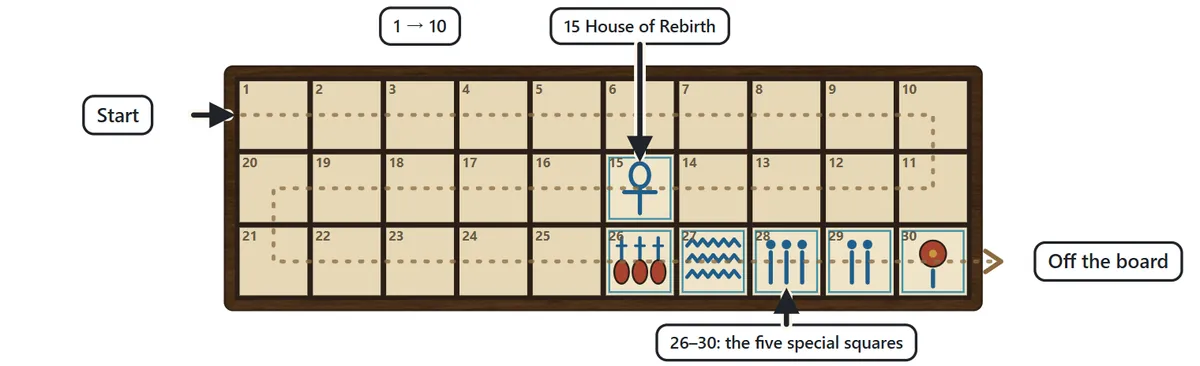
The board has 30 squares, called houses, in three rows of ten. The path snakes across it: squares 1–10 run left to right along the top row, squares 11–20 run right to left along the middle row, and squares 21–30 run left to right along the bottom row. After square 30, a piece leaves the board. Unlike the Royal Game of Ur, there are no private lanes in senet: both players share every square, so you are racing through each other from the very first move.
Six squares are marked with symbols. Square 15 is the House of Rebirth, and the last five squares (26 to 30) each have their own rule. The key under the board in the game sums them up, and they are explained in detail below.
Reading the throwing sticks

Each stick is white on one side and dark on the other. Throw all four and count the white sides facing up: that number is your move, from 1 to 4. If all four land dark side up, the throw counts as 5. The most common throw is 2 (6 times in 16), then 1 and 3 (4 times each), while 4 and 5 come up only once in 16 throws each.
A throw of 1, 4 or 5 earns another throw after you move. After a 2 or a 3, your turn ends.
Setting up and who goes first
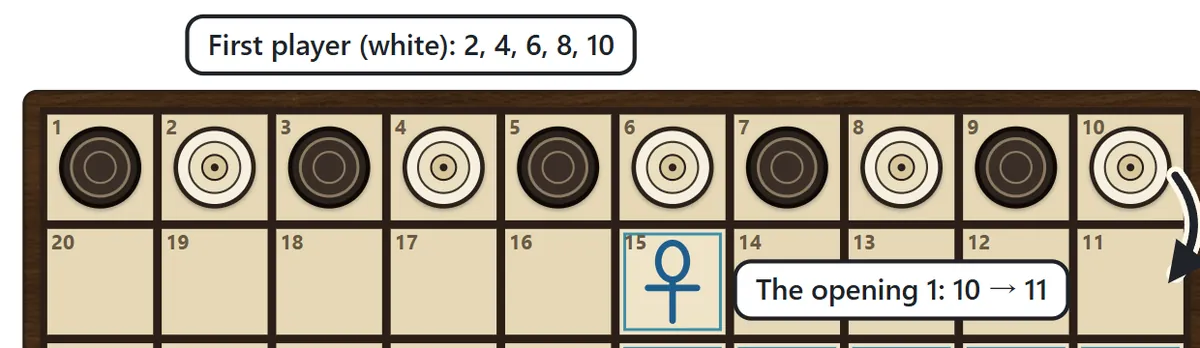
Each player has five pieces. They start on the board, alternating along squares 1 to 10. The players take turns throwing the sticks, and the first person to throw a 1 becomes the first player. Their pieces sit on squares 2, 4, 6, 8 and 10, and that opening 1 moves the front piece from square 10 to square 11. Because a 1 earns another throw, the first player then throws again and the game is under way. You can also simply choose who starts; in that case the first player begins with an ordinary throw.
Moving and swapping places
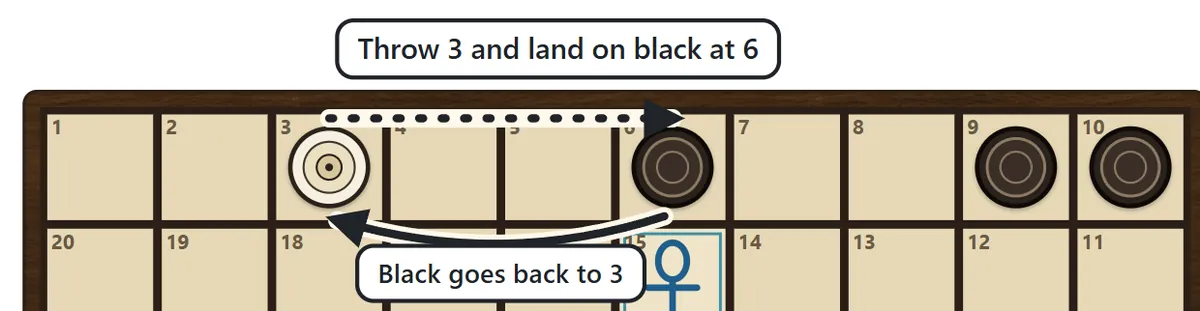
Move any one of your pieces forward by the number thrown. You can’t land on a square that already holds one of your own pieces. If you have a legal move, you must make one.
If you land exactly on a single enemy piece, the two pieces swap: your piece takes the square, and the enemy piece goes back to the square you came from. This is the senet version of capturing. It doesn’t send a piece all the way home as in backgammon, but a swap near the end of the board can still cost your opponent a lot of ground. Capturing is never compulsory.
Senet rules for protection and blocking
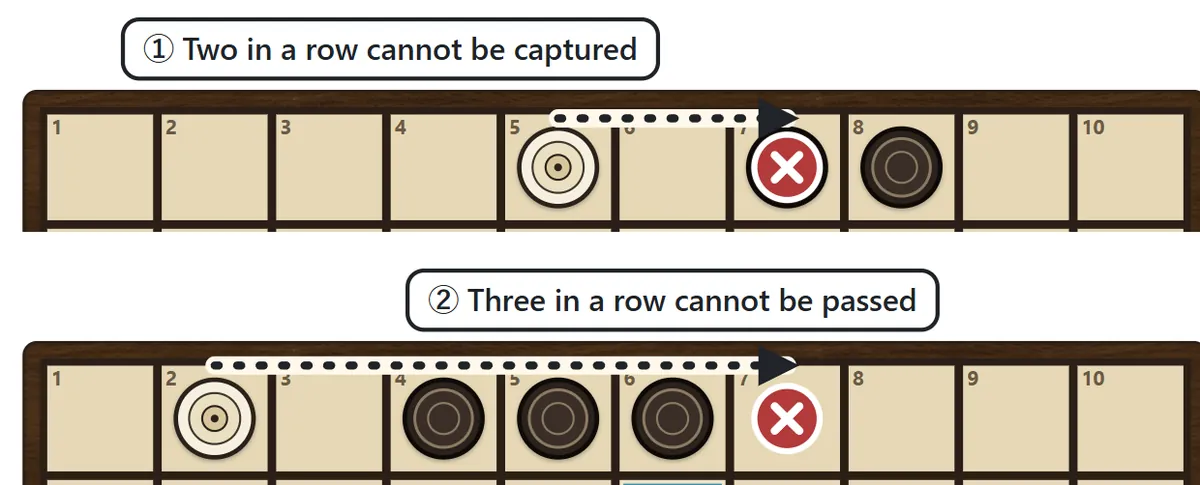
When two or more of your pieces stand on neighbouring squares along the path, none of them can be captured: your opponent may not land on them. Pairs can still be jumped over. A line of three or more is a wall, and enemy pieces cannot move past it at all. Keeping pieces together and building walls at the right moment is the heart of senet strategy.
The House of Beauty and the last five squares
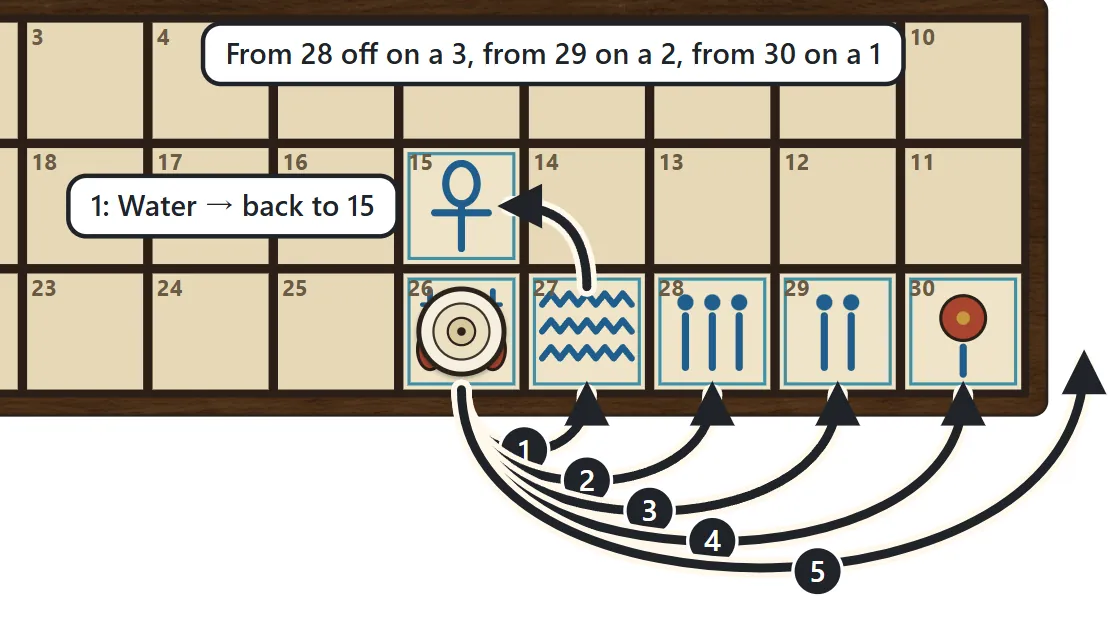
Square 26, the House of Beauty, is a gate every piece must pass through, and it must be reached with an exact throw. A throw that would carry a piece past 26 can’t be used for that piece. From 26, the throw decides what happens next:
| Throw from 26 | Result |
|---|---|
| 1 | Into the House of Water (27): back to 15, or the nearest empty square before it |
| 2 | To 28; bear off later with a 3 |
| 3 | To 29; bear off later with a 2 |
| 4 | To 30; bear off later with a 1 |
| 5 | Straight off the board |
Pieces on 28 and 29 are safe from capture. A single piece on 30 can be swapped by an enemy piece throwing a 4 from 26. Pieces on 28, 29 and 30 wait there until the right number comes up; they never move to another square.
When no piece can move forward
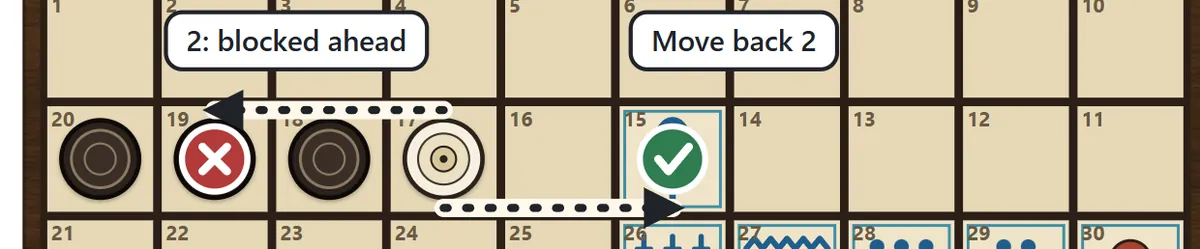
If none of your pieces can use the throw to move forward, you must move one piece backward by that number (swapping with a lone enemy piece if you land on one). If no piece can move backward either, your turn ends. Even then, a 1, 4 or 5 still gives you another throw.
Senet rules: Standard, Long and Strict
Because the original rules are lost, there are several modern versions. The best known were published in the late 1970s by the archaeologist Timothy Kendall, whose rules came with a commercial senet set, and by the board game historian R. C. Bell. This game offers three variations built on Kendall’s rules, and you can switch each detail on or off under Custom.
| Rule set | What is different |
|---|---|
| Standard | 5 pieces each. A piece on 30 leaves only on a 1. A throw that would pass 26 can’t be used. |
| Long | 7 pieces each, starting on squares 1–14. Any throw takes a piece off from 30. |
| Strict | 5 pieces each. Passing 26 drops the piece into the House of Water. No bearing off while you have a piece on 1–10. |
Long uses the seven pieces of Kendall’s first published version. Strict adds two of his optional rules: a throw that overshoots the House of Beauty drops the piece into the House of Water, and nobody may bear off while they still have a piece in the first row. Bell’s version is quite different: ten pieces each, a four-sided die, captured pieces removed from play, and a winner decided by how many pieces each player bore off.
Senet strategy and tips
1. Travel in pairs
Two pieces side by side cannot be captured, while a lone runner can be swapped back by any enemy piece behind it. Moving your pieces in pairs keeps them safe while they advance.
2. Build a wall at the right time
Three pieces in a row are a wall. If your opponent has pieces stuck behind it, they may run out of forward moves and be forced to move backward. A well-timed wall can win the race on its own.
3. Don’t stand alone one to three squares ahead of an enemy
Throws of 1, 2 and 3 are common. A single piece just ahead of an enemy piece is an easy swap. Turn on “Mark pieces that could be captured” and the game will put a warning sign on pieces at risk.
4. Plan your bonus throws
A 1, 4 or 5 means you move again. Use the first move to set something up, such as closing a pair with a 1, knowing you will get another throw to push a front piece ahead.
5. Line up pieces in front of the House of Beauty
Square 26 must be hit exactly. With pieces spread over squares 21 to 25, almost any throw lets one of them land on 26, so you waste fewer turns near the end.
6. Beware of the 1 on the House of Beauty
A piece sitting on 26 that has to use a 1 falls into the water and goes back to 15. When you throw a 1, move a different piece if you can.
Senet FAQ
Do we know the real rules of senet?
No. Many boards, pieces and paintings survive, but no ancient description of the rules has been found. Modern rules are educated guesses based on the board markings and on texts spread over more than a thousand years. They are good games, but we can’t say the Egyptians played exactly this way.
What happens when a piece is captured?
It swaps places with the piece that landed on it, moving back to the square that piece came from. Nothing is sent back to the start, so pieces can trade places many times during a game.
What if I can’t use my throw?
If no piece can move forward, one piece must move backward. If that is impossible too, your turn ends, though a 1, 4 or 5 still gives you another throw.
Which computer level should I choose?
Start with Easy if you are new to the game: it often misses swaps and chances to bear off. Normal plays sensible moves but doesn’t think much about what comes next. Hard looks ahead at your next throws, keeps its pieces paired and builds walls. The sticks still matter a lot, so upsets happen at every level.
Can I stop and continue later?
Yes. Open the page again on the same device and browser and press Continue. Sound is off by default; press “Sound: off” to turn on the sound effects.
History of senet
When and where was senet played?
Senet is one of the oldest board games known. Fragments of what may be senet boards come from First Dynasty burials in Egypt, around 3100 BCE, and the earliest clear picture of the game is a painting in the tomb of the official Hesy-Re from the Third Dynasty, in the 2600s BCE. Egyptians kept playing it for more than two thousand years, until Roman times, and boards have also been found in the Levant and on Cyprus.
New Kingdom boards (about 1550–1070 BCE) were made of wood, ivory or blue-glazed faience, often as boxes with a drawer for the pieces. Many had senet on one side and the Game of Twenty, a relative of the Royal Game of Ur, on the other. The Metropolitan Museum of Art in New York, for example, holds a faience senet board from a tomb at Abydos dating to the reign of Thutmose III, and a two-sided game box made for a man named Taia and his family.
Tutankhamun, Nefertari and the journey of the soul
Several senet boxes were buried with the young king Tutankhamun in the 14th century BCE. In the tomb of Queen Nefertari, wife of Ramesses II, a wall painting shows the queen playing senet, with no opponent in sight.
By the New Kingdom, the game had taken on a religious meaning: moving across the board was linked with the soul’s passage through the underworld. Chapter 17 of the Book of the Dead mentions the dead person playing senet against an unseen opponent. The name itself is usually translated as “passing”. The markings on the last squares, a sign for “good” or “beautiful” and a sign for water, fit this idea of a journey with hazards and a happy ending.
How were the modern rules worked out?
After the game died out, its rules were forgotten. In the twentieth century the Swiss archaeologist Gustave Jéquier proposed the first reconstruction from boards and paintings. In the late 1970s Timothy Kendall and R. C. Bell published their own versions, and most senet played today follows one of them. Both stitch together clues from many centuries, so the details, such as how many pieces were used or what each marked square meant, are still debated by historians.
Senet, race games and backgammon
Senet belongs to the family of race games, where dice or sticks move pieces toward a goal, alongside the Japanese board sugoroku and backgammon. Some ideas will feel familiar to backgammon players, such as two pieces together being safe. Whether senet was a direct ancestor of these games, however, is not known.
Sources
- Wikipedia, “Senet” (English) and the Japanese article
- The Metropolitan Museum of Art: “Gameboard and Gaming Pieces” (01.4.1a): metmuseum.org; “Game Box Inscribed for Taia and His Family” (12.182.72): metmuseum.org; “Queen Nefertari Playing Senet” (facsimile): metmuseum.org
- Ludii, Digital Ludeme Project (Maastricht University), “Senet” (Kendall, Bell and other rule sets): ludii.games
- Catherine Soubeyrand, “The Game of Senet”, The Game Cabinet: gamecabinet.com