 Yorimichi Games
How to play backgammon
Backgammon is a two-player race game played with two dice and fifteen checkers each. The two players move in opposite directions around the board, which means their checkers keep meeting on the way. A checker standing alone can be hit and sent back to the start, so the game is a mix of luck and judgment: the dice decide how far you can go, and you decide which checkers go where. The first player to bring all fifteen checkers home and bear them off wins.
On this page you can play backgammon online against the computer at three levels, or against a friend on the same screen. Legal moves are highlighted, and you can ask for a hint or undo a move until you end your turn, so it is a comfortable place to learn the rules below.
The backgammon board and setup
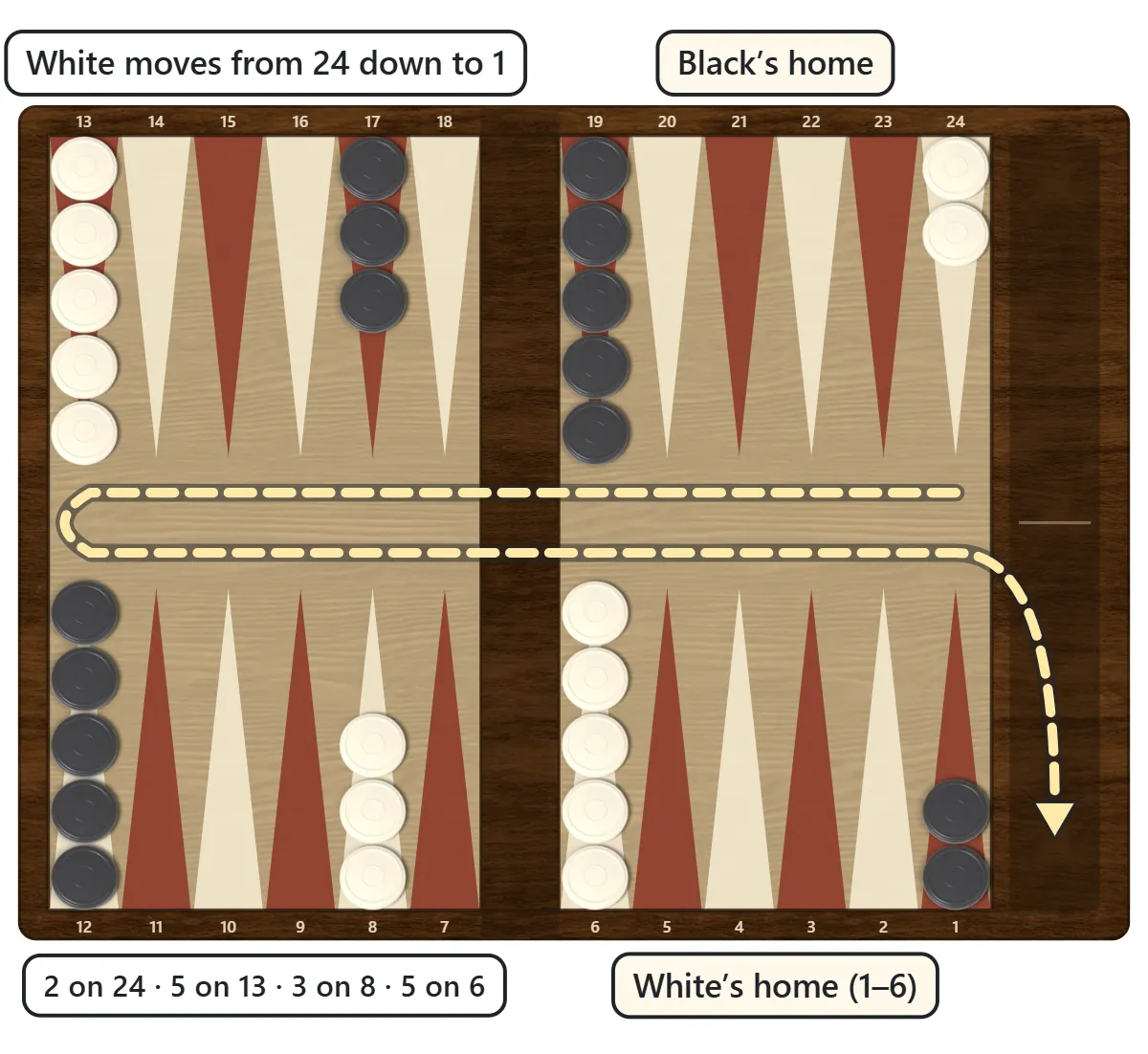
The board has 24 narrow triangles called points. Each point is one step on the track. The raised strip in the middle is the bar, where checkers that have been hit wait. The six points in your bottom-right quarter are your home board, and each player numbers the points from their own side: your 1-point is the one closest to the finish and your 24-point is the furthest away.
Each player starts with two checkers on their 24-point, five on the 13-point, three on the 8-point and five on the 6-point. Your opponent sets up the same way, counted from their side, so the two armies mirror each other and travel around the board in a horseshoe shape in opposite directions.
Who goes first
Each player rolls one die. The higher number goes first and plays the two numbers just rolled as the opening move. If both dice show the same number, you roll again. After that, players take turns rolling both dice.
Moving your checkers
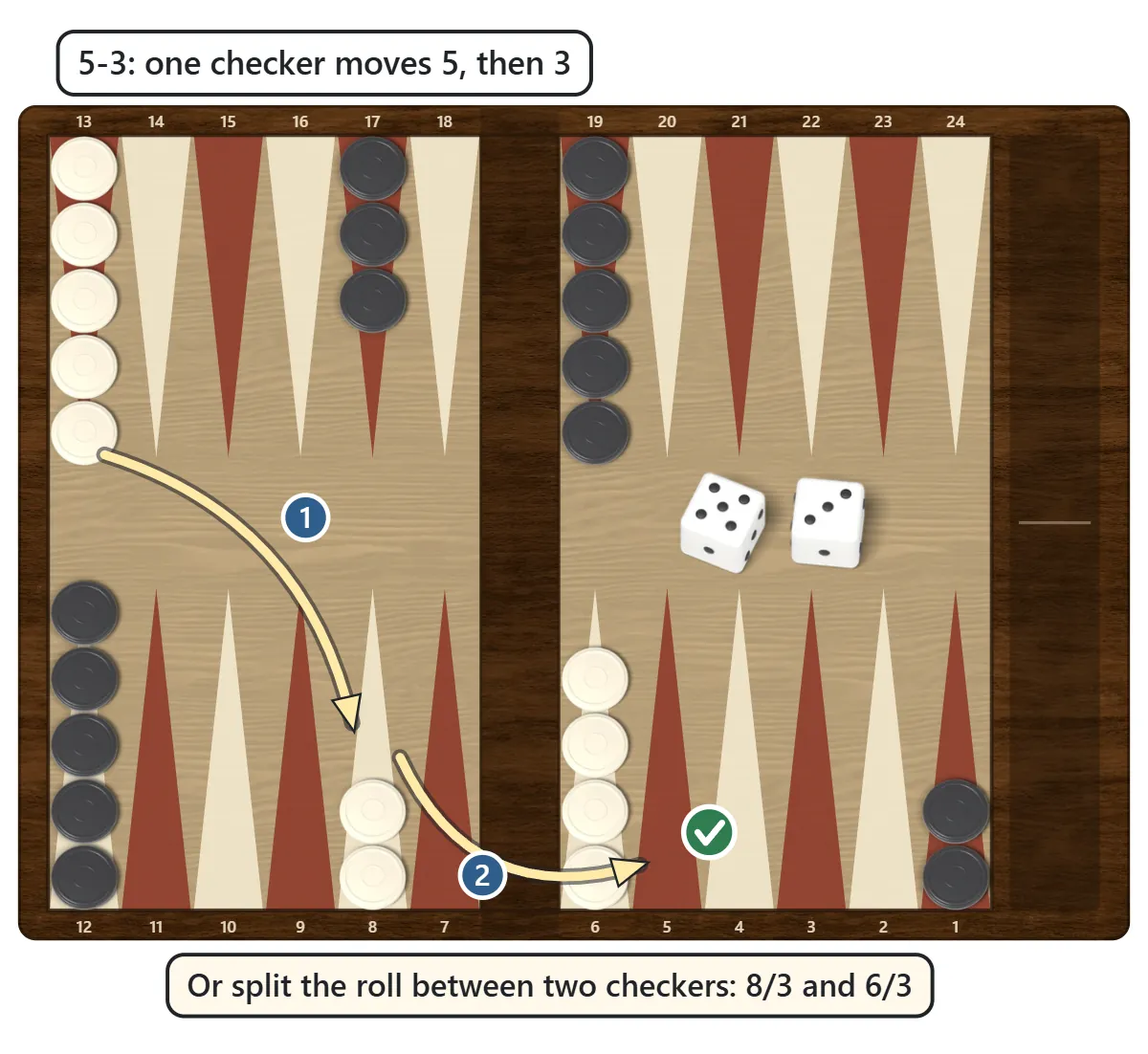
The two dice are played as two separate moves. With a 5-3 you can move one checker five points and another three points, or move the same checker five and then three more. If you roll a double, such as 4-4, you play that number four times.
A checker can land on an empty point or on a point where you already have checkers. It can never land on a point held by two or more of your opponent’s checkers. You may jump over such points, but when one checker uses both dice, the point where it stops in between must be open too.
You must use as much of the roll as possible
If you can move, you must. When there is a way to play both numbers, you have to play both. If only one of them can be played, you must play the larger one when possible. Any number that can’t be used is forfeited, and if nothing can move, your turn simply ends. In this game only legal moves can be selected, and dice that can’t be used are dropped automatically.
Hitting a blot
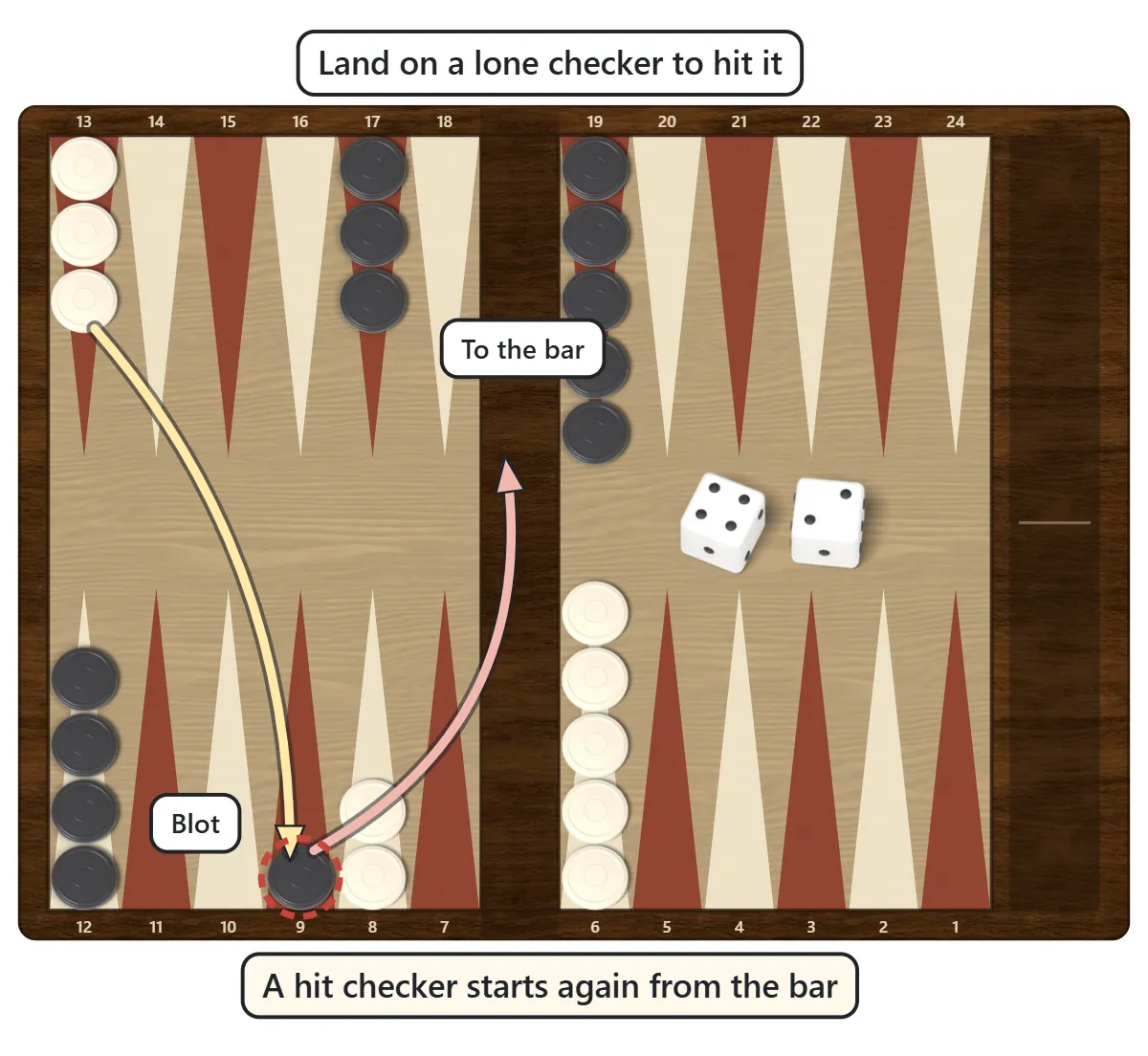
A single checker on a point is called a blot. If you land on your opponent’s blot, you hit it and it goes to the bar. From there it has to start its journey again from the very beginning. The same can happen to you, which is why experienced players try to move their checkers in pairs and leave as few blots as they can.
Entering from the bar
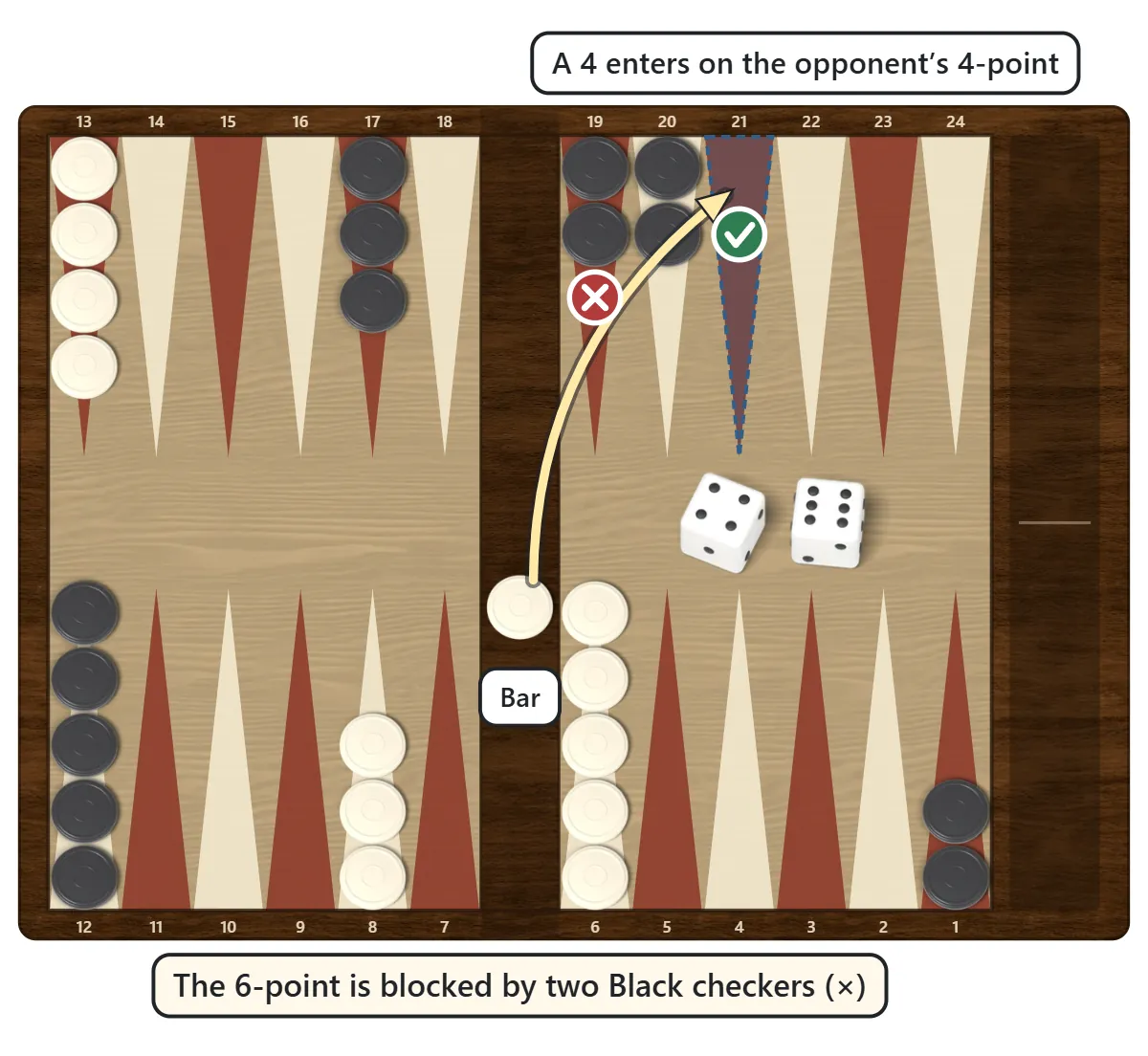
While you have a checker on the bar, you must bring it back into play before moving anything else. It enters in your opponent’s home board: a 1 enters on their 1-point, a 6 on their 6-point, and so on. If that point is held by two or more of their checkers, you can’t enter there. When neither die lets you enter, you lose the whole turn.
Bearing off
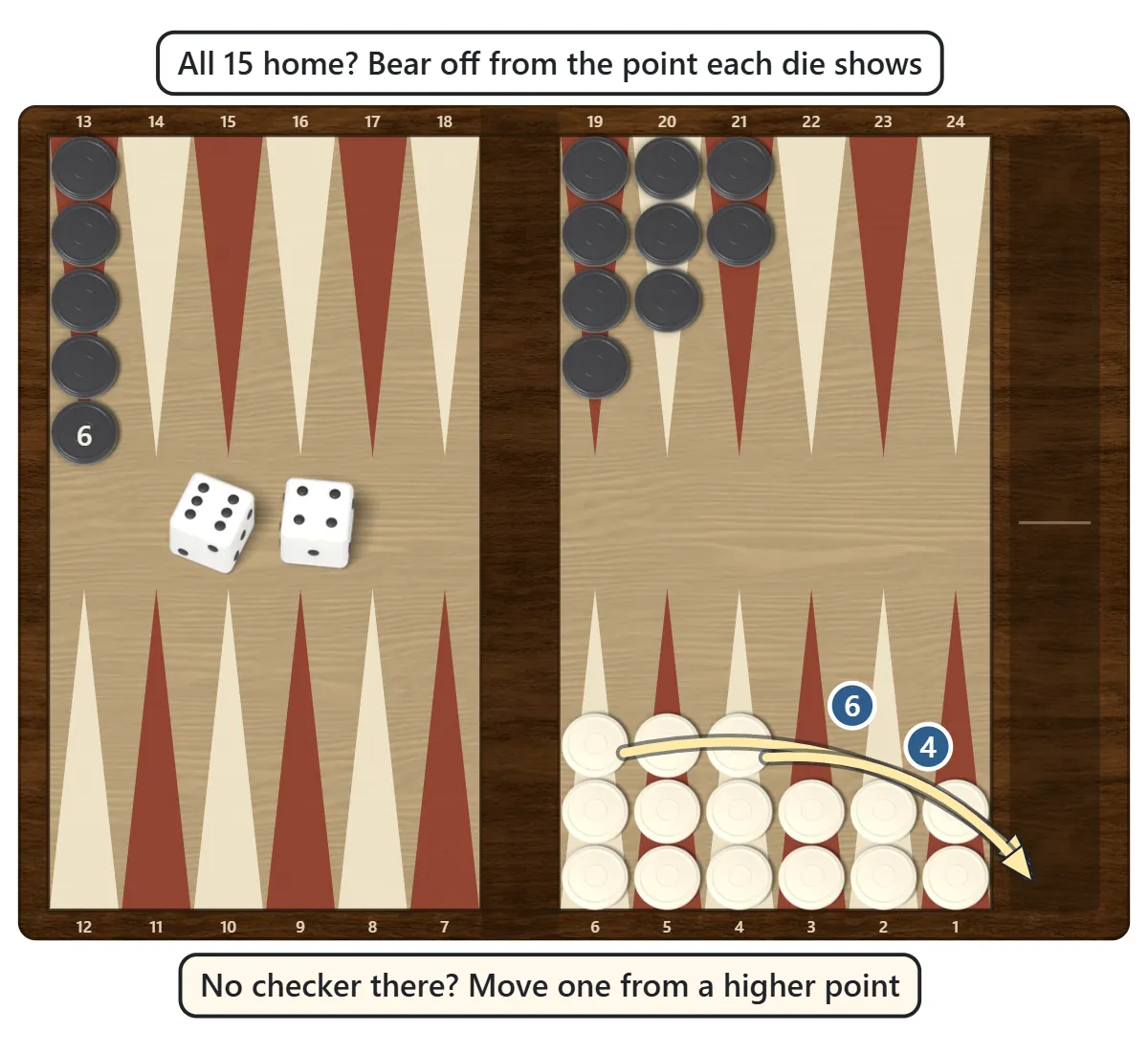
When all fifteen of your checkers are inside your home board, you may start removing them, which is called bearing off. A 4 removes a checker from the 4-point. If that point is empty, you must use the number to move a checker from a higher point instead. Only when no checker is on a higher point can you bear off from the highest occupied point below it. If one of your checkers is hit while you are bearing off, you have to bring it back home before you can continue.
Scoring: how much a win is worth
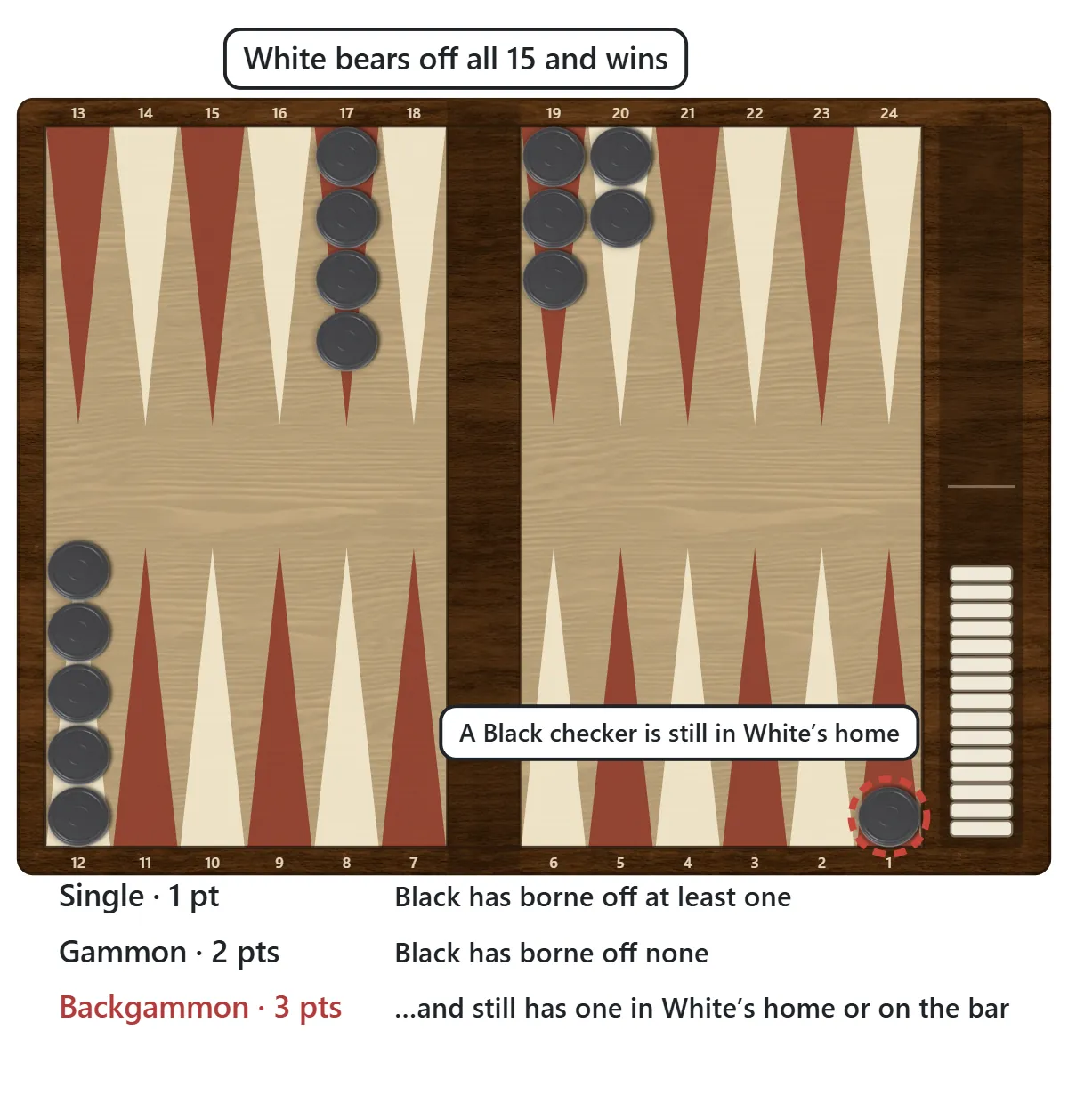
The first player to bear off all fifteen checkers wins. If the loser has borne off at least one checker, it is a single game worth 1 point. If the loser hasn’t borne off any, it is a gammon worth 2 points. If the loser still has a checker on the bar or in the winner’s home board, it is a backgammon worth 3 points. Serious games are usually played as a match: whoever first reaches an agreed score, such as 3 or 5 points, wins.
The doubling cube
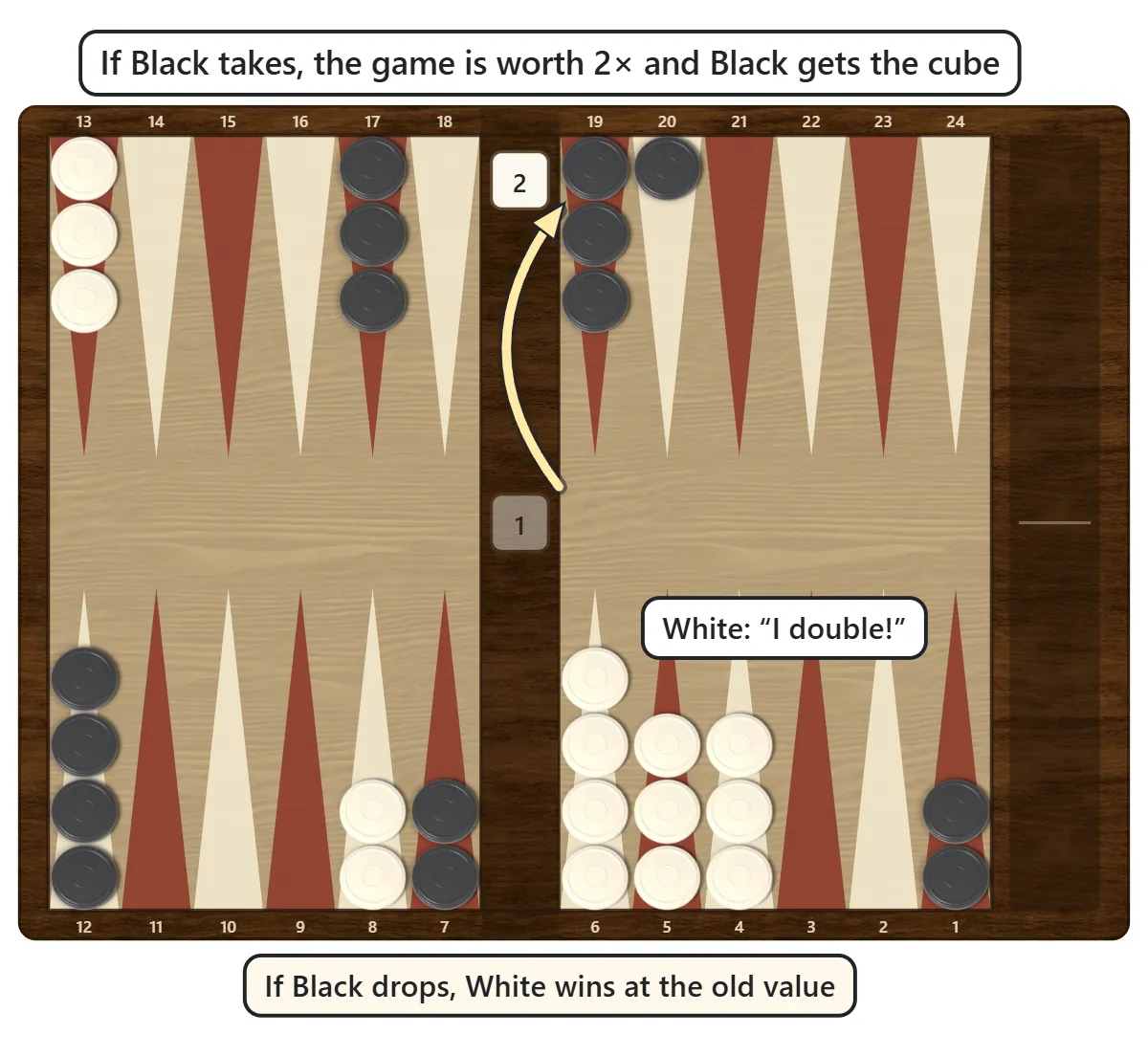
The doubling cube is a die marked 2, 4, 8, 16, 32 and 64. At the start of your turn, before you roll, you may offer to double the value of the game. Your opponent can take, and play on for twice the points, or drop, and lose the game at its current value. Whoever takes owns the cube, and from then on only they can offer the next double. A strong double often makes the opponent drop, which ends one-sided games quickly.
In a match, when one player gets within one point of winning, the next game is played without the cube. This is known as the Crawford rule, and the game uses it automatically.
Backgammon rules you can choose
Pick one of three presets in the settings, or choose Custom to set the match length, the cube and gammon scoring separately.
| Preset | Match | Doubling cube |
|---|---|---|
| Standard | First to 3 | Yes, with the Crawford rule |
| No cube | First to 3 | No |
| Quick | Single games | No |
Gammons and backgammons score 2 and 3 points in every preset. Some players also use house rules, such as automatic doubles when the opening roll is a tie or an immediate redouble after taking. They are not part of tournament rules, so this game leaves them out.
Backgammon strategy: tips to win
1. Leave as few blots as possible
A lone checker can be hit, and every pip it has travelled is lost when it goes back. Move checkers in pairs where you can. When a blot can’t be avoided, try to leave it seven or more pips away from your opponent’s checkers, where a single die can’t reach it.
2. Make points in your home board
A point with two or more of your checkers is a wall your opponent can’t land on. Points in your home board, especially your 5-point, 4-point and 6-point, are the most valuable. With an opening 3-1, the classic play is 8/5 and 6/5, making your 5-point straight away.
3. Build a prime
Several points in a row form a barrier called a prime. Six in a row completely traps any opposing checker behind it. Lining up four or five points in front of your opponent’s back checkers is one of the strongest plans in the game.
4. Hit when it helps you
Hitting a blot sends your opponent back to the start and costs them the whole distance that checker had covered. It hurts even more when your home board is full of points, because the hit checker will find it hard to come back in.
5. Know your pip count
The total number of pips you still need to bear off is your pip count, shown as “Pips” next to each player in this game. If yours is lower, you are ahead in the race, and it often pays to break contact and simply run. If you are behind, keeping two checkers back in your opponent’s home board gives you chances to hit a late blot.
6. Double when you are clearly ahead
Offer a double once your position is clearly better but before it is hopeless for your opponent. When you are doubled, a traditional guide is to take if you expect to win at least about one game in four from that position, and to drop if your chances are lower.
Backgammon FAQ
Why can’t I move a checker even though the die fits?
Usually because that move would make your other die impossible to use. When both numbers can be played, the rules require you to play both. Also remember that a checker on the bar must enter before anything else can move.
Can I take back a move?
Yes, until you press “End turn,” the Undo button takes back your moves one at a time. Over a real board, players may also change their move until they pick up their dice. Once the turn is over, it can’t be undone.
Should I take a double?
Take if you think you can still win roughly one game in four or more; drop if your chances look worse. Dropping loses the game, but only at its value before the double.
Which CPU level should I choose?
Easy is a good choice for your first games. It pays attention to blots and the number of checkers, but it often hesitates and makes loose moves, so beginners can beat it. Normal weighs how many rolls could hit it and how its points line up; it still slips now and then, and new players who know the rules will find it an even match. Hard thinks about which numbers you are likely to roll next and is meant for experienced players. Thanks to the dice, you can beat any level on a good day.
Can two people play on one device?
Yes. Choose “A friend” as your opponent and take turns on the same screen. The point numbers flip to face whoever’s turn it is.
Can I stop and finish later?
Yes. Your game is saved in this browser, so you can close the page and press Continue next time. Sound is off at first; press “Sound: off” to hear the dice and checkers.
History of backgammon
Race games played with dice on a board of two rows of points are among the oldest board games known, with relatives played in western Asia and around the Mediterranean for many centuries. The modern game took shape in England around the seventeenth and eighteenth centuries, and a similar game called ban-sugoroku was even played in old Japan. The doubling cube was introduced in the United States in the 1920s and made the game far more strategic. Today backgammon is played everywhere from cafés to online servers, and there is an annual world championship.
You can also play the Royal Game of Ur, a 4,500-year-old race game from Mesopotamia that is often mentioned among the distant relatives of backgammon.