 Yorimichi Games
How to play Crokinole online
Crokinole is a two-player flicking game on a circular board. Send a disc toward the centre, leave it in a valuable scoring area, and move your opponent into a less useful position. A disc that drops fully into the centre hole is worth 20 points. A well-judged shot can remove an opposing disc and leave your own on the board, but a powerful shot can also carry both discs into the ditch.
Choose the CPU or two players on the same device, select a scoring format, and press Start. The lower player uses blue discs marked with a small circle. The upper player uses red discs marked with a triangle. The marks help you tell the sides apart without relying on colour. For a local two-player game, keep the board in the same orientation and take turns using the appropriate side. Check the name and remaining discs above the board before you shoot.
Place, aim and flick a disc
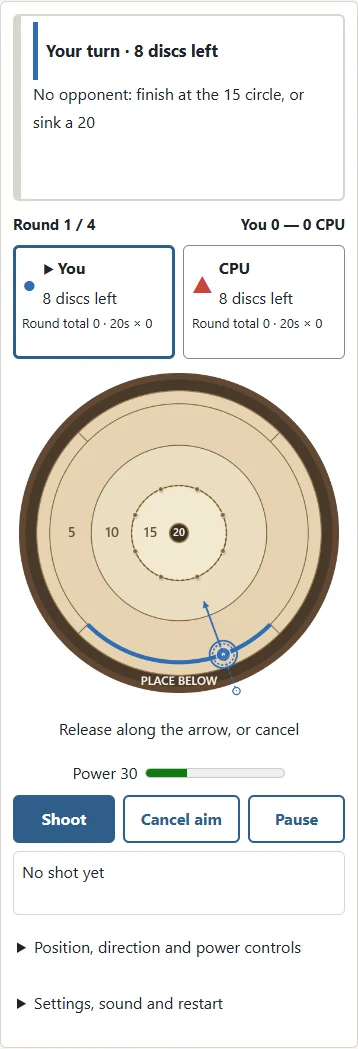
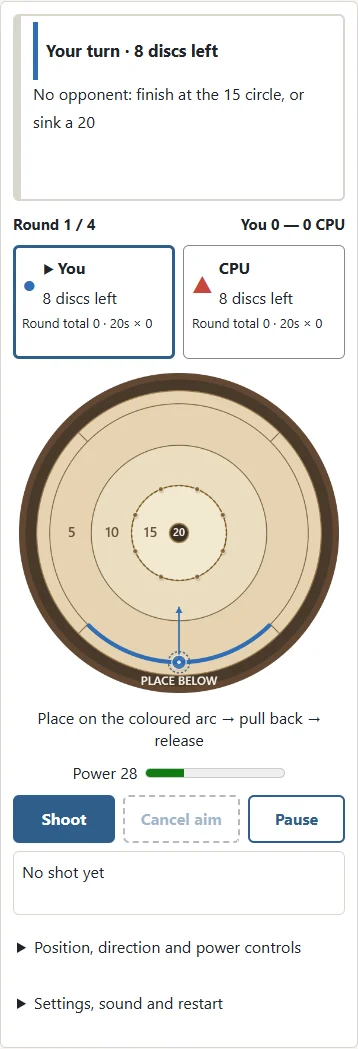
Tap an empty part of your coloured shooting arc to place the next disc. You cannot place it on top of another disc. Starting slightly to the left or right may give you a clear path past the eight centre pegs. Those pegs rebound a disc, but hitting a peg does not satisfy the requirement to contact an opposing disc.
Hold the selected disc, pull back away from the intended direction, then release. The arrow shows where the disc will travel. A longer pull gives a stronger shot. Use a finger on a touchscreen or a mouse drag on a computer. A short tap changes the position without taking a shot, and a cancelled touch does not fire the disc. Wait for all discs to stop before taking the next turn.
If dragging precisely is difficult, use the Position, Direction and Power controls followed by Shoot. Position 0° is the middle of your side of the board. Direction 0° points from the selected position toward the centre. On a keyboard, A and D adjust position, Left and Right adjust direction, and Up and Down adjust power. Press Enter or Space to shoot. These controls give you another way to make a small correction without repeating a long drag.
The contact rule: hit an opposing disc
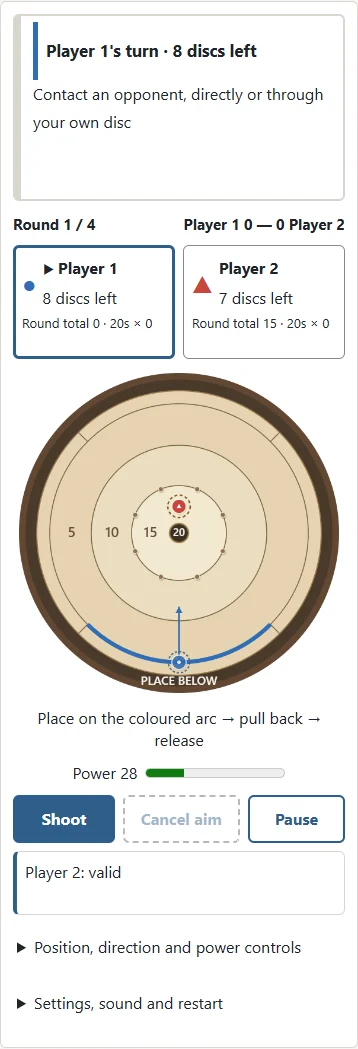
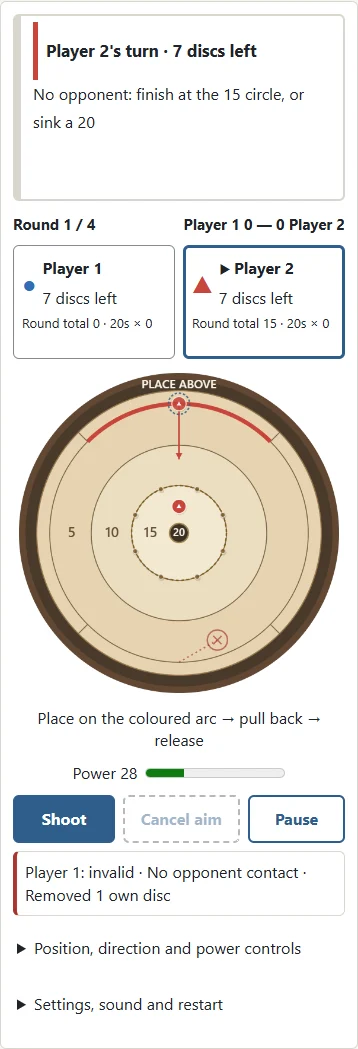
Whenever an opposing disc is on the board at the start of your turn, one of your discs must contact an opposing disc during that shot. You may choose any opposing disc; it does not have to be the nearest one. Your shooter may make the contact directly, or it may move one of your existing discs into an opponent. A rebound off a peg can also be part of a valid path.
You do not have to knock the opposing disc off the board. Once contact has occurred, your shooter can stay in a scoring area or drop into the centre hole. Without contact, even a beautiful shot into the hole is invalid. An invalid shot removes the shooter and your other discs involved in that shot, including any new 20s. Previously earned 20s are safe. Before you think about a high score, find the opposing disc you intend to contact.
An open board: play toward the middle
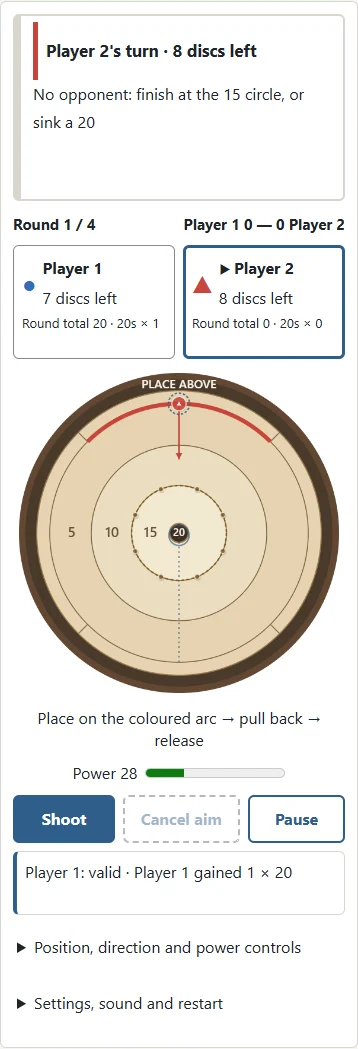
If no opposing disc is in play, at least one of your discs involved in the shot must finish touching or inside the 15-point circle. A valid disc in the centre hole also meets this condition. You can send your shooter into that area or promote another one of your discs. An existing disc already near the middle does not make an unrelated shot valid: the qualifying disc must be involved in the current shot.
The final position matters. Passing through the middle and then stopping outside it is not enough. Notice that touching the 15-point line makes an open-board shot valid, although the same disc would score only 10 if it still touched that line at the end of the round. Validity and scoring answer different questions. One checks whether you played a legal turn; the other measures where your discs remain after both players have finished.
The 20 hole, the ditch and scoring lines
A disc fully in the centre hole is set aside for 20 points. It no longer sits on the board, so your opponent cannot knock it away. A fast disc or a shot that catches the edge of the hole may travel past it. To practise an open 20, start with a modest amount of power and change it a little at a time. Look at whether the disc stops short, passes through, or reaches the hole calmly.
Discs that leave the raised surface are out. A disc resting on the outer boundary line is also removed. This browser game uses a flat board: there are no airborne, stacked or edge-standing discs, and discs in the ditch do not bounce back. A disc that crosses the outer line during movement can still remain in play if it returns under its own momentum, touches no other disc or peg while touching or outside the line, and stops fully inside.
The board has areas worth 15, 10 and 5. A disc touching a line receives the lower adjacent value. For example, a disc reaching the line between the 10 and 5 areas is worth 5. Judge the edge of the disc, not just its centre. A position that looks comfortably inside a region can still touch the boundary with the disc’s rim.
Crokinole scoring: two formats
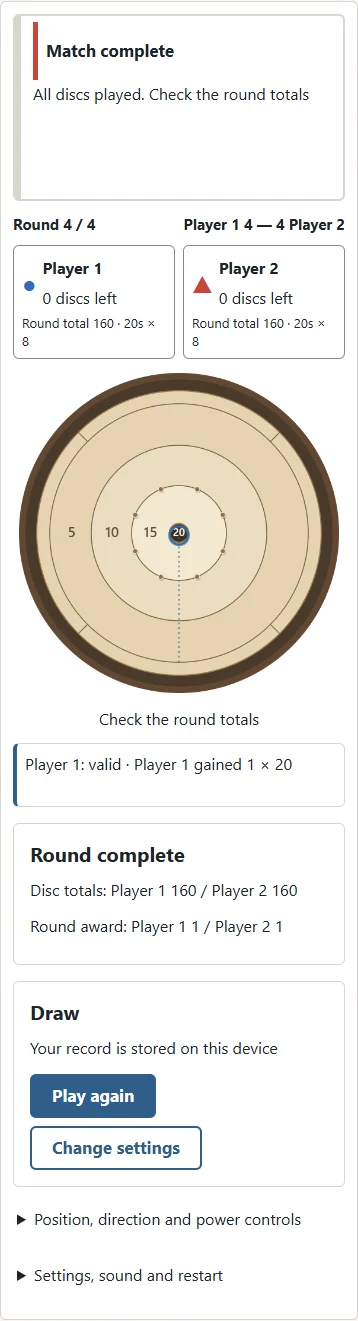
Disc positions are scored only after every disc for the round has been played. Add the remaining discs and all valid 20s set aside. An early disc in the 15 area is not guaranteed to keep that value: a later shot might move it outward or remove it. The 20 count above the board is separate from the final disc totals shown when a round ends.
In Four rounds, each player shoots eight discs per round. The higher disc total earns two game points. A tied round gives one game point to each side. After four rounds, the greater number of game points wins; this page allows the game to end in a draw. A very large disc-total margin still earns only two points for that round. The starting player alternates between rounds.
In First to 100, each player shoots twelve discs per round. Only the higher-scoring player receives the difference between the disc totals. A total of 65 against 45 therefore adds 20 game points. Keep playing until someone reaches or exceeds 100; an exact total is not required. A tied round adds nothing. This page also alternates the starting player in this format. Choose a format before starting rather than combining the two systems.
Crokinole tips and strategy
1. Learn distance before complicated angles. Start with a straight shot toward the centre and adjust only power. Changing position, angle and strength all at once makes it hard to understand what went wrong. A small, repeatable correction is more useful than trying an entirely different shot after every miss.
2. Find contact before aiming at the hole. With an opposing disc in play, first look for a clear line to it. If a peg blocks that route, move the starting position along your arc. Once you have a route, decide whether you need a gentle contact that leaves your shooter inside or a firmer takeout that reduces the opponent’s score.
3. Decide where both discs should finish. A straight hit transfers much of your movement to the target. A glancing hit can send your shooter sideways. Try aiming at different parts of the target according to whether you want to clear the opponent, move your shooter inward, or avoid sending the opposing disc into the 20 hole.
4. Use power with a purpose. Maximum power is not always useful. A disc that travels too far may leave the board after a successful hit. A softer shot can protect an already favourable score, while extra power may be needed to move a dangerous disc out of the inner area. Watch the entire path instead of judging only the first collision.
5. Be careful with combinations. Moving one of your discs into an opponent can open an otherwise blocked route. It also places more of your discs at risk if contact fails. When a valuable disc is already safely on the board, a simple direct hit may be a better choice than involving it in a difficult combination.
6. Read the format and the remaining shots. In a four-round game, winning a round by a small amount earns the same two game points as winning by a large amount. In the 100-point format, every extra point of margin matters. On the last turn, compare the likely final totals and aim for the result you actually need.
CPU difficulty and local play
Easy varies its direction and strength more widely. Normal uses basic contact shots, while Hard compares possible shots before choosing a position. Every level can miss. Start with Easy while learning the controls, then move up when you can predict how the two discs will separate after contact. Two players on the same device lets you practise those ideas against another person without an account.
Sound starts off. Use Pause whenever you need to stop. Settings lets you change the opponent or scoring format before starting a new game. A saved game stays on this browser and device. If you close the page while a disc is moving, Continue retries that shot from its previous stationary position. Finishing a CPU game updates your local record for that difficulty and scoring format.
Crokinole FAQ
Can I hit my own disc first? Yes. When an opponent is on the board, one of your discs must contact an opposing disc during that same shot. On an open board, an involved disc must finish touching or inside the inner circle.
Why does a disc touching the 15 line qualify but score 10? The valid-shot condition requires reaching that circle. The scoring rule awards the lower value when a disc touches a dividing line. A shot can be legal without earning 15 points.
Who receives a 20 if I knock an opposing disc into the hole? The owner of that disc. You may have made the shot, but the disc’s colour determines which player keeps the points. Be cautious with an opponent close to the hole.
Do earlier 20s disappear after an invalid shot? No. Only 20s made as part of that invalid shot are cancelled. The 20s you earned on previous valid turns remain set aside for the round.
Can we play with one phone? Yes. Select two players on the same device and take turns using the upper and lower shooting arcs. Watch the turn name before placing a disc. The direction control always measures from the current shooter toward the centre, so Direction 0° is useful from either side.
Does a tied game need a shootout? This page ends a tied four-round game as a draw. Real tournaments may specify extra rounds or other tie-break procedures. Agree on those procedures separately when playing on a physical board.
About this traditional board game
Crokinole became popular in Canada and the northern United States around the end of the nineteenth century. It remains a game for social play as well as organised competition. Families and clubs may use different disc counts or ways of adding a round’s score. This page combines the basic contact and scoring principles with a choice of two clearly separated formats. It does not recreate tournament seating rules or timed event administration. Play a round, learn what makes a shot valid, and enjoy the balance between accurate flicking and protecting a useful position.
Rules and credits
National Crokinole Association, World Crokinole Championship, Mayday Games
The board, discs and diagrams are original drawings. Sound effects were created for this site.
Cancel aim, Escape, a retap or blank space clears your preparation without spending a disc. A cancelled touch restores the aim from before the pull. Pause keeps a moving shot at the same position; Settings or reloading during motion resumes from the saved position before that shot.