 Yorimichi Games

How to play pool (billiards)
Pool is the pocket version of billiards: you use a long stick called a cue to strike the white cue ball, and the cue ball knocks the numbered object balls into the six pockets around the table. This game gives you the two most popular pool games, 9-ball and 8-ball, on a table viewed straight from above. You pick a direction and a power, press Shoot, and the balls roll, bounce off the cushions and collide the way real balls do. Play against the computer at three levels, or pass one phone, tablet or computer back and forth for a two-player match.
The pool table and ball names
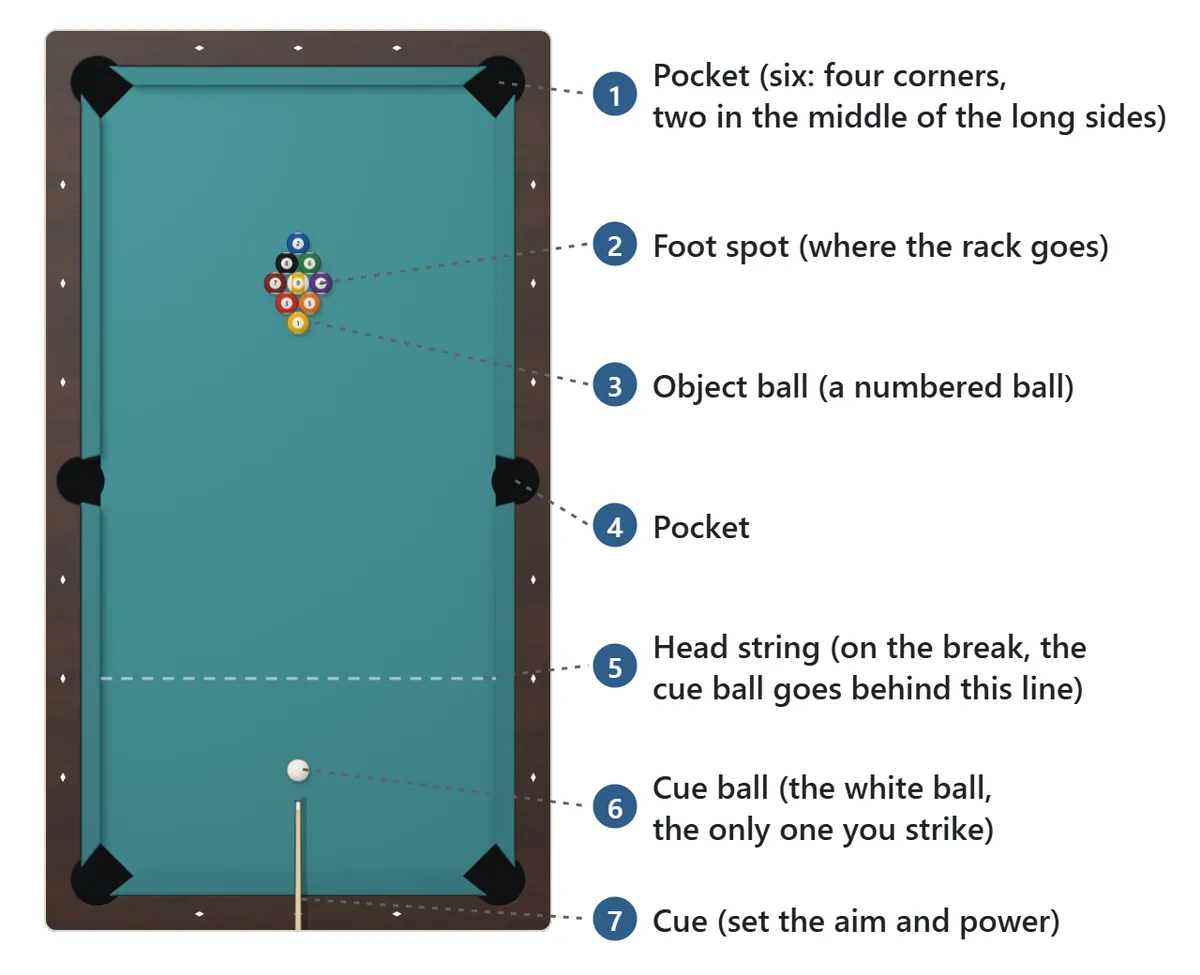
The rubber rails around the playing surface are the cushions, and the balls rebound off them. There are six pockets: four in the corners and two in the middle of the long sides. The small mark near the top of the table is the foot spot, where the front ball of the rack sits at the start. Near the bottom end is an imaginary line called the head string. On the opening shot, the break, you must place the cue ball behind that line, in the area players call the kitchen. The game only draws the head string as a dotted line while you are placing the cue ball, so the table stays clean the rest of the time.
How to aim: direction and power
On a computer, move the mouse over the table and the line from the cue ball turns to follow it; click once to lock the aim so you can reach the power slider without disturbing it. On a phone or tablet, swipe across the table instead. For fine adjustments, tap the < and > buttons or use the left and right arrow keys, which turn the cue a fraction of a degree at a time. Set the strength with the power slider under the table, then press Shoot.
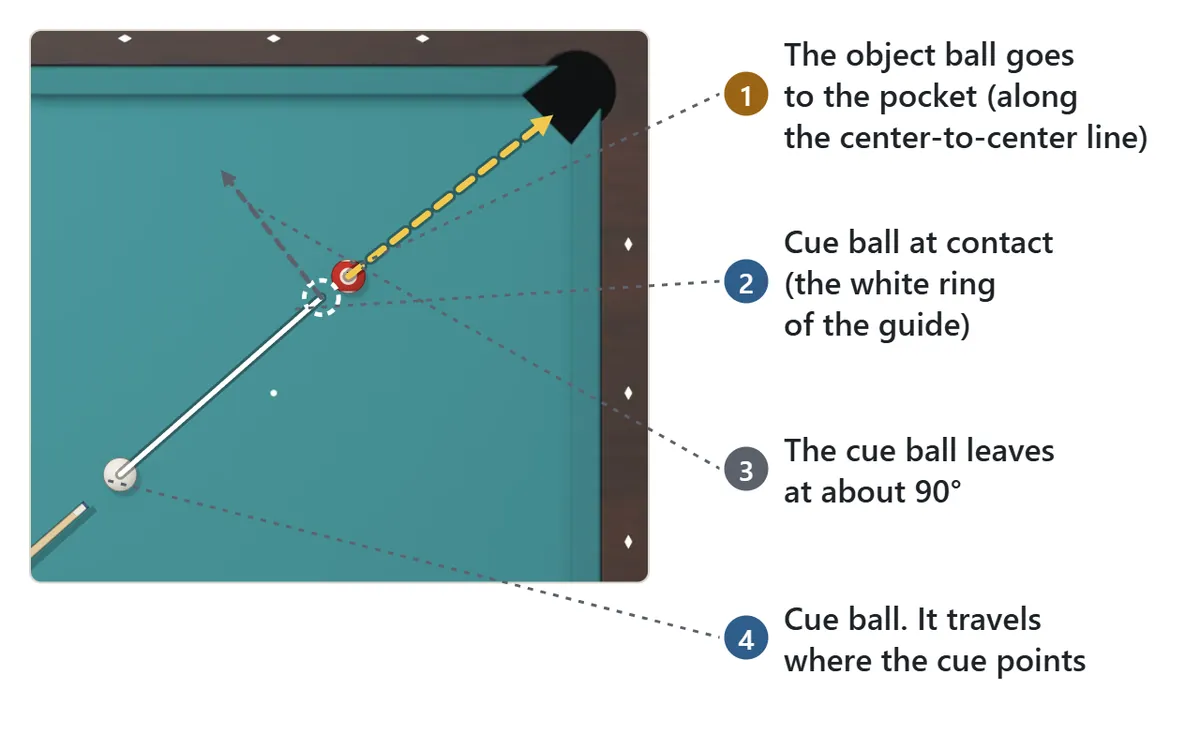
The secret to aiming is to think backwards from the pocket. An object ball always travels along the line that joins the centers of the two balls at the moment they touch. So picture where the cue ball needs to be when it meets the object ball, then send the cue ball to that spot. With the aiming guide set to Full, the game draws that spot as a white ring, shows which ball you will hit first, and extends a line in the direction the object ball will travel. Line that up with a pocket and you have a make. Without follow or draw, the cue ball splits off at close to a right angle after contact, and the dotted line shows that path too. Once you feel confident, switch the guide to Short or Off and aim by eye, the way you would at a real table.
9-ball rules
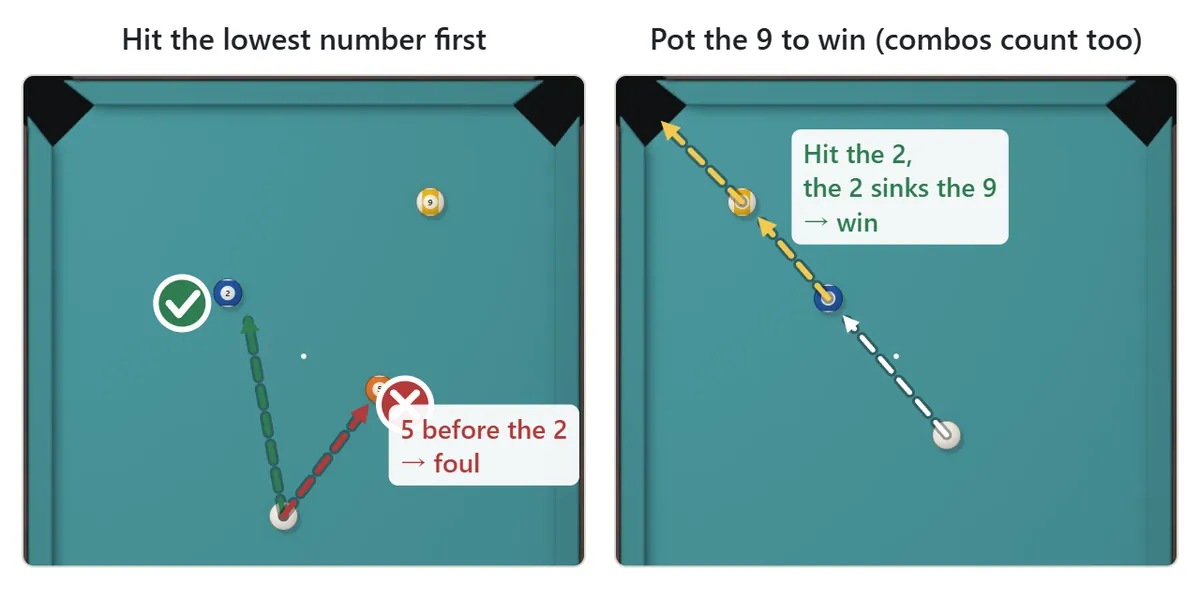
9-ball uses the balls numbered 1 to 9. On every shot, the first ball the cue ball touches must be the lowest-numbered ball still on the table. After that legal first contact, it does not matter which balls drop or which pockets they fall into. If at least one ball goes in, you keep shooting; if nothing drops, your opponent comes to the table. Whoever pockets the 9-ball wins the rack. That means a combination counts: if you hit the lowest ball and it knocks the 9 in, you win, and a 9 that drops on a legal break wins on the spot. If the 9 goes in on a foul, it is placed back on the foot spot and play continues. The status bar above the table always tells you which ball is next.
8-ball rules

8-ball uses all fifteen object balls. Balls 1 to 7 are solids and balls 9 to 15 are stripes. The table is open after the break: the first player to pocket a ball on a normal shot claims that group, and the opponent takes the other one. Balls that drop on the break do not decide the groups. Once the groups are set, you must hit one of your own balls first, and you stay at the table as long as you keep pocketing your own balls. When your group is cleared, you go for the 8-ball, and sinking it wins the game. Be careful, though. If the 8-ball drops while you still have balls left, or if you scratch while pocketing it, you lose the rack immediately. While the table is still open, hitting the 8-ball first is a foul.
Fouls and ball in hand
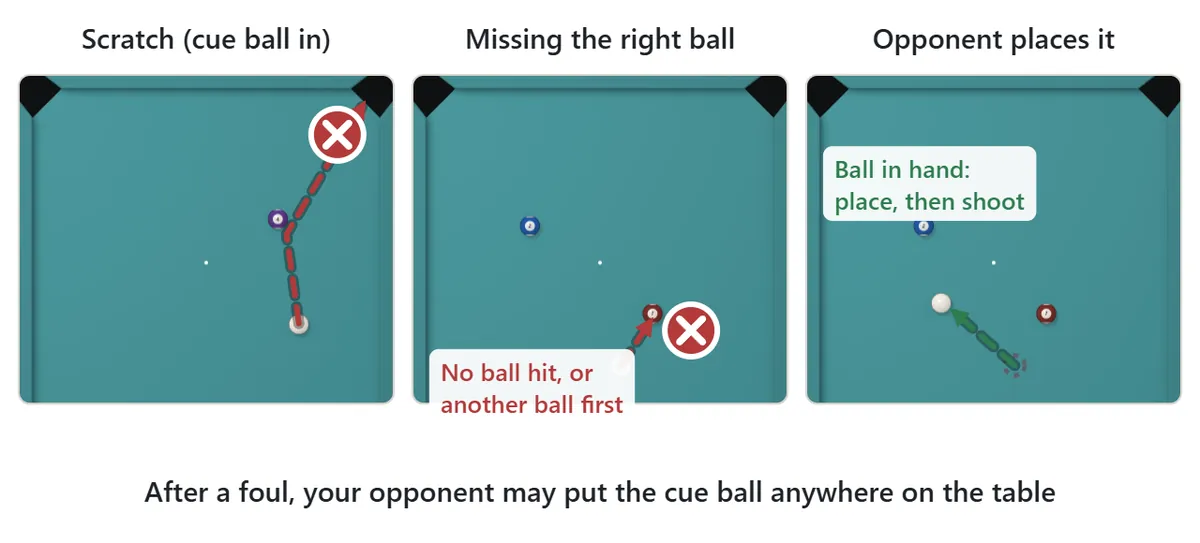
These are fouls in every rule set: the cue ball falls into a pocket, which players call a scratch; the cue ball does not touch any ball; or the cue ball hits some other ball before the one it was supposed to hit (the lowest number in 9-ball, your own group in 8-ball). After a foul, the turn passes and the incoming player gets ball in hand, which means they can pick up the cue ball and put it anywhere on the table before shooting. In this game you simply drag the cue ball to the spot you want. A good ball-in-hand placement can turn a hard layout into an easy run, so it is worth a moment of thought.
The break and how to rack the balls
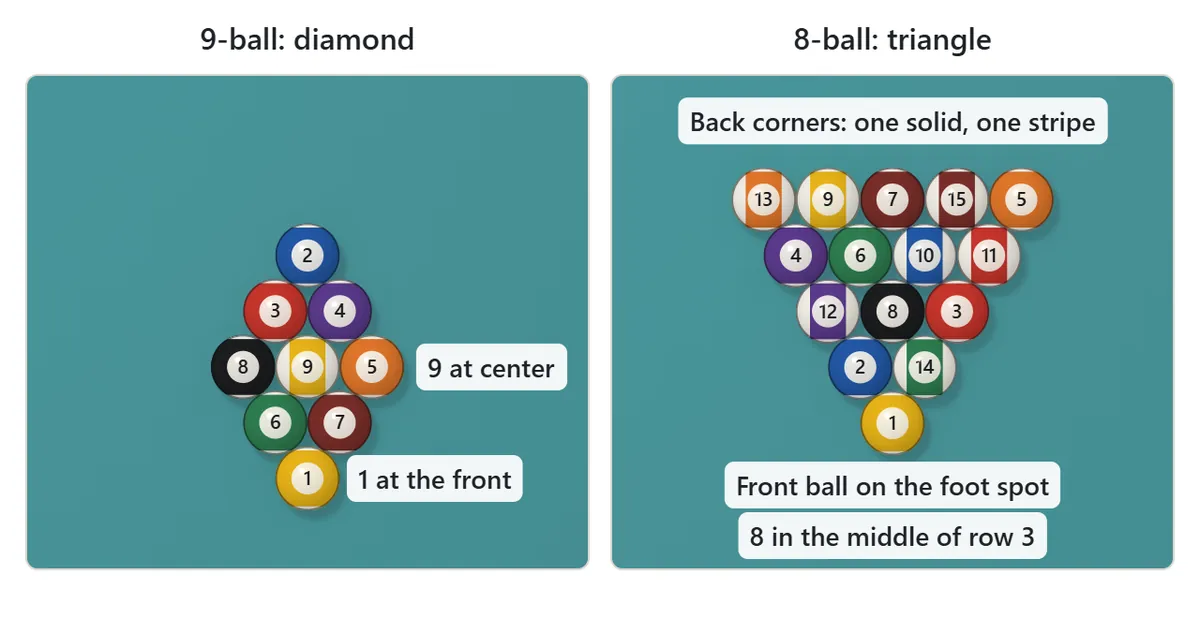
Each rack starts with the break, a hard shot into the pack that spreads the balls around the table. In 9-ball the break must still hit the 1-ball first. In the first rack of a match, the breaker is chosen at random; after that, the players take turns breaking. The game racks the balls automatically in the standard patterns shown above, with a slightly different arrangement of the other balls each time.
Follow and draw
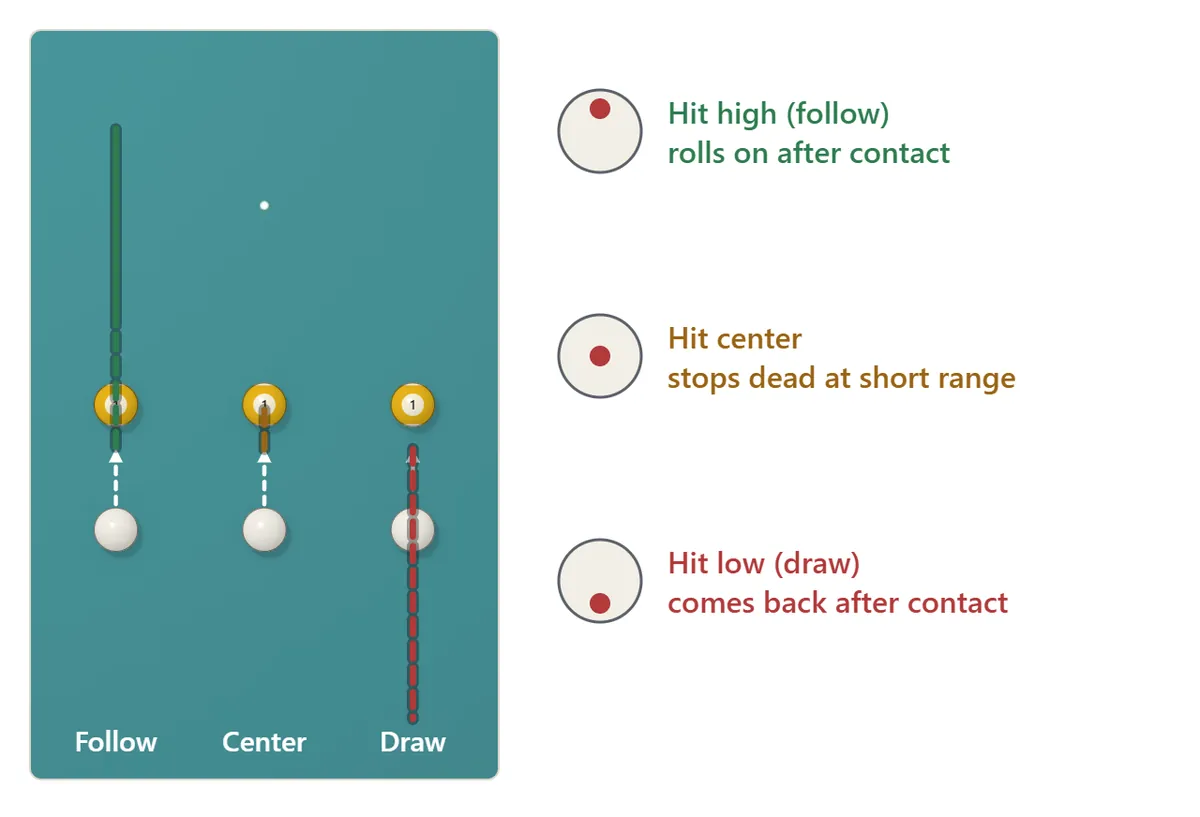
Next to the Shoot button is a picture of the cue ball. Tap or click it to choose where the cue tip strikes. A high hit, called follow, keeps the cue ball rolling forward after it meets the object ball. A low hit, called draw, makes the cue ball spin backwards and come back toward you. A center hit on a short straight shot stops the cue ball dead, which players call a stop shot. You will not need these to make balls, but they are how good players leave the cue ball in the right place for the next shot.
Pool rules compared: Simple or Tournament
| Rule | Simple | Tournament |
|---|---|---|
| Fouls | Scratch, no ball hit, wrong ball hit first | All of those, plus no ball reaching a cushion after contact when nothing drops |
| Legal break | No requirement | If nothing drops, at least four balls must reach a cushion |
| Push out (9-ball) | Not used | Allowed on the shot after the break |
| Three fouls (9-ball) | No penalty | Loss of the rack |
| The 8-ball | Any pocket | Call the pocket first; any other pocket loses |
Beginners should start with Simple, which keeps only the three basic fouls. Tournament rules bring the game close to the way it is played in leagues and competitions. A shot that makes no ball must still drive some ball to a cushion, an illegal break in 9-ball is a foul while in 8-ball the other player re-racks and breaks, and three fouls in a row in 9-ball lose the rack. The push out is a tactical option in 9-ball: on the shot right after the break, you may roll the cue ball anywhere without having to hit a ball, and your opponent then decides whether to play from that position or hand the shot back to you. You can also choose how long a match lasts, from a single rack to a race to 3 or 5 racks.
Computer levels
| Level | What it plays like | Good for |
|---|---|---|
| Easy | Misses often, sometimes leaves shots short, and picks hard shots when easier ones are available | New players learning the rules |
| Normal | Makes most straight-in shots, but now and then chooses a tough ball or misjudges the speed | Players who are getting the hang of aiming |
| Hard | Aims accurately, plays position for the next ball and plays safe when there is no good shot | Players who can already run a few balls |
Every level still misses a shot or scratches once in a while, so do not give up when you fall behind. Take the easy balls one at a time and wait for your chance.
Pool tips and strategy
1. Start with the straightest shots
The closer the cue ball, object ball and pocket are to a straight line, the more room for error you have. Thin cuts, where you graze the side of the object ball, are much harder, so leave them until you have more practice.
2. Do not hit too hard
A ball that arrives too fast is more likely to rattle in the jaws of the pocket and stay out, and a fast cue ball races around the table and is more likely to scratch. The best speed is usually just enough for the object ball to reach the pocket with a little to spare.
3. Check where the cue ball goes next
After contact, the cue ball leaves at about a right angle to the object ball's path. If that line points into a pocket, you are about to scratch. Look at the dotted line before you shoot and change the angle or add follow or draw if you need to.
4. Make the most of ball in hand
When your opponent fouls, you can place the cue ball anywhere. Put it directly behind the object ball on a straight line to the pocket and you give yourself an almost straight shot.
5. In 9-ball, always know where the 9 is
Because a 9-ball made on any legal shot wins, look for chances to play the lowest ball into the 9. When the 9 sits near a pocket, a simple combination or carom can end the rack early.
6. In 8-ball, do not rush to claim a group
While the table is open, you may shoot at either group. Choose the group that has more balls near the pockets and fewer clusters, and the rest of the rack becomes much easier. Leave the 8-ball in a spot you can reach, too.
Billiards FAQ
Can I play on a phone?
Yes. The table stands upright on the screen, so you can hold your phone in portrait mode, swipe to aim and use the slider and buttons below the table to shoot.
Does the aiming guide make the game too easy?
The guide only shows the direction each ball will take right after contact. You still have to choose the speed, control the cue ball and plan the next shot. If you want more of a challenge, set it to Short or Off.
The balls take a long time to stop. Can I speed it up?
While the balls are rolling, a Fast button replaces the Shoot button. Press it, or press F on the keyboard, to fast-forward.
Can I stop and continue later?
Yes. The game saves at the start of every turn. On the same device and browser, press Continue to pick up from the same layout.
How is this different from real pool?
A few things are simplified to suit a screen. The table is a 7-foot size, the kind often found in bars. There is no side spin (English) and no jump shots, and balls never leave the table. In 8-ball you only call the pocket for the 8-ball, not for every shot.
A short history of billiards
Billiards grew out of outdoor lawn games in which players pushed balls toward targets with sticks, something like croquet. By the 15th century there are records in France of a version played indoors on a stone table covered with cloth, and over the following centuries the table gained cushions, the mace was replaced by the cue, and the leather cue tip made spin possible. Pocket billiards became hugely popular in the United States, where 8-ball and later 9-ball developed into the games played in bars and on the professional tour today. Because accuracy and planning matter more than strength, players of any age can enjoy the game on equal terms.