 Yorimichi Games

How to play this tennis game
This is a free tennis game you can play right in your browser – on a phone, a tablet or a computer, with no download and no sign-up. You play a singles match against the computer on a court seen from above and behind. You are the player in red at the near end; the CPU wears blue at the far end. Land the ball in the CPU’s court, and if it can’t send the ball back, the point is yours. Win points to win games, and win games to take the match. The ball always casts a shadow on the ground, so watch the shadow to judge how high the ball is and where it will bounce.
The court and its lines

The net divides the court into two halves. The line at the very back is the baseline, the lines down each side are the sidelines, and the line parallel to the net, about halfway back, is the service line. Between the service line and the net, the center service line splits each half into two service boxes. During a rally the ball must land inside your opponent’s baseline and sidelines. If any part of the ball touches a line, it counts as in.
Tennis serve rules: into the diagonal box
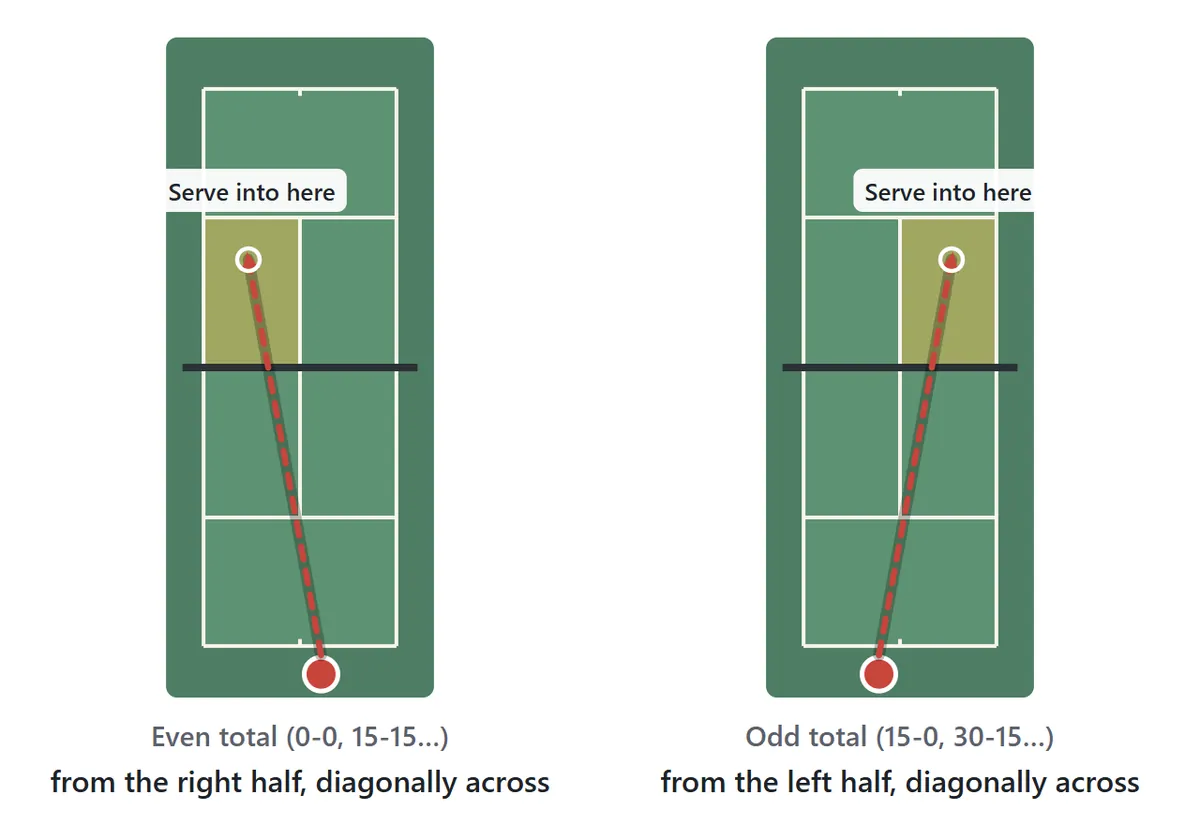
Every point starts with a serve. The server stands behind the baseline and hits the ball into the service box diagonally across the net. The first point of each game is served from the right half of the court, the next from the left, and so on, switching sides after every point. The same player serves for a whole game, and the serve passes to the other player when the game ends.
In this game, press “Hit” once to toss the ball up and press it again to strike. Hit the ball at the very top of the toss for your fastest serve; hit it lower for a slower, safer one. Faster serves also stray a little more from where you aimed. Choose your target with the left and right arrow keys, the ◀ ▶ buttons, or by pointing at the box with the mouse or your finger. If your first serve misses the box, it is a fault and you get a second serve. Miss both and it is a double fault – the point goes to your opponent. If a serve clips the net and still lands in the correct box, it is a let: that serve is simply replayed.
Timing your swing: crosscourt or down the line
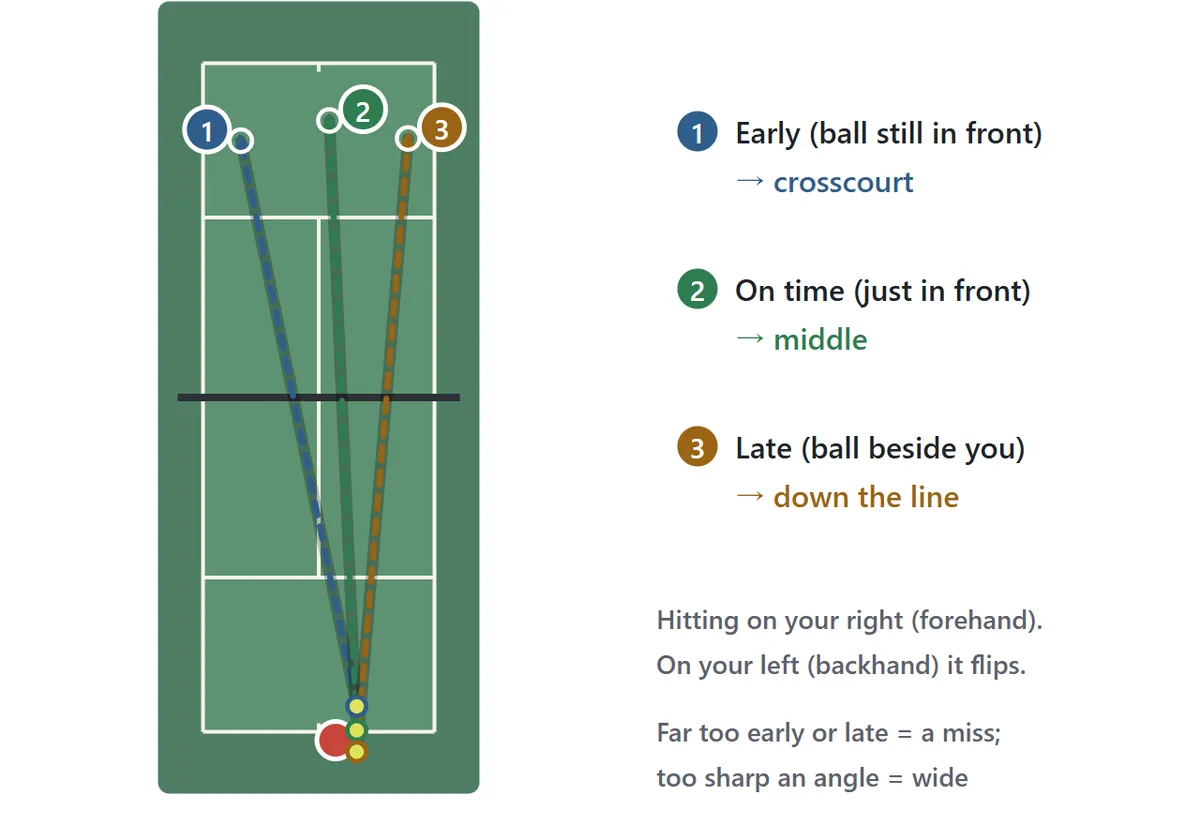
When the ball comes toward you, press “Hit” as it arrives just in front of your body. There is a short moment between pressing the button and the racket meeting the ball, so press slightly before the ball reaches you. Swing early and you meet the ball out in front, which pulls it crosscourt. Swing late and you meet it beside you, which sends it straight down the line. Swing far too early or too late and you miss completely. A very early swing can also give the ball so much angle that it lands wide of the sideline.
Groundstrokes, volleys, lobs and smashes
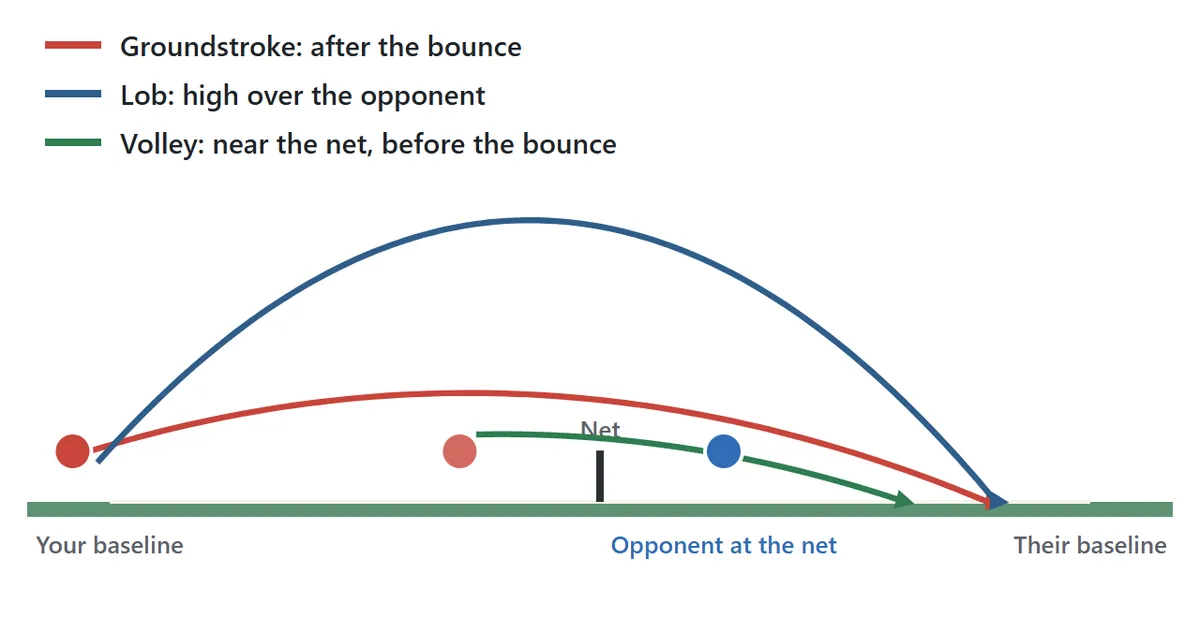
A normal “Hit” after the ball has bounced is a groundstroke. Run up close to the net and hit the ball before it bounces, and you play a volley – a great way to take time away from your opponent, although low volleys often end up in the net. The “Lob” button sends a high, deep ball, perfect for going over an opponent who has come to the net. When a ball comes to you above head height, your shot automatically becomes a smash. The one ball you must never hit before it bounces is the serve: if the receiver does that, the receiver loses the point.
How points are won

If your shot first bounces outside your opponent’s court, it is out. If it fails to clear the net, it is a net. Either way, your opponent wins the point. If your shot lands in and your opponent cannot hit it back before it bounces a second time, you win the point. During a rally, a ball that clips the top of the net and drops into the court is still in play.
Tennis scoring explained: 15, 30, 40, deuce
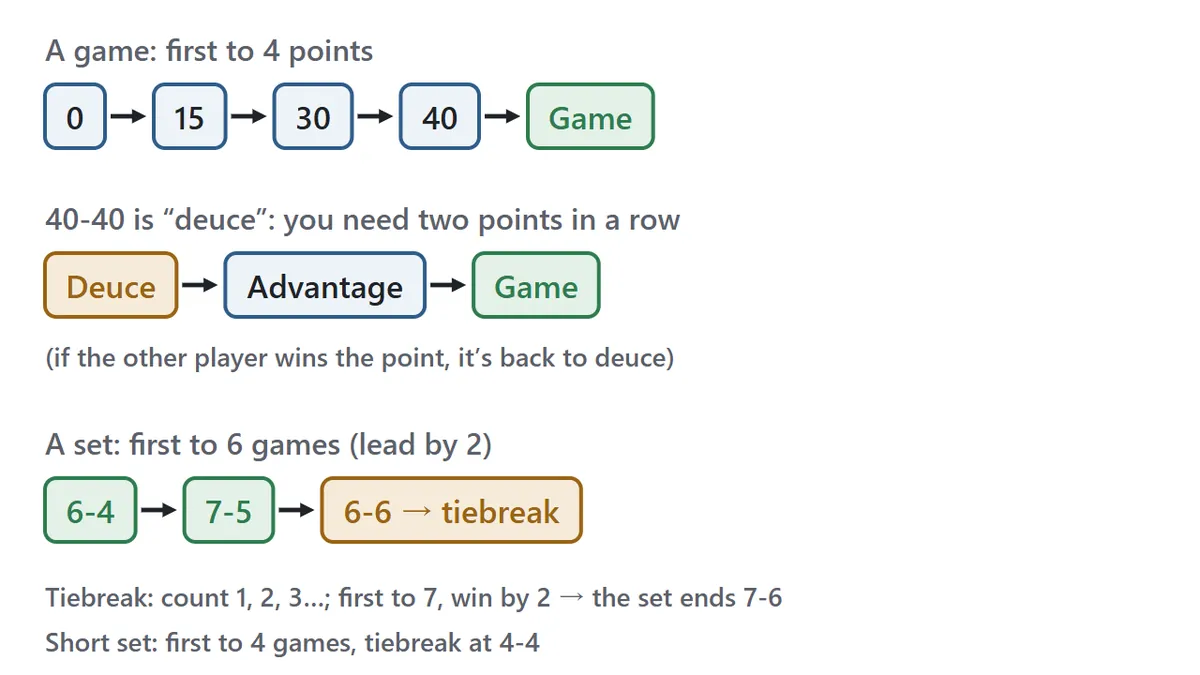
Tennis points are counted 0 (called “love”), 15, 30 and 40, and the next point wins the game. The server’s score is always said first, so if you win the first point on your own serve it is 15-0, and if you win the first point on the CPU’s serve it is 0-15. At 40-40 the score is deuce. Win the next point and you have the advantage; win the one after that and the game is yours. If you lose the point while you have the advantage, the score goes back to deuce.
The first player to win six games takes the set, but only with a lead of two games – at 5-5, the set goes on to 7-5. At six games all, a tiebreak decides the set. In a tiebreak the points are counted 1, 2, 3 and so on, and the first player to seven points wins the set, again by two clear points. The player whose turn it is serves the first point of the tiebreak; after that the serve changes every two points. If you choose “No tiebreak”, the set simply continues until someone leads by two games.
Game settings
| Setting | Options |
|---|---|
| CPU level | Easy: slow to react and error-prone; a ring at your feet lights up when the ball is in range. Normal: moves you from side to side. Hard: fast serves, sharp angles and lobs. |
| Match length | 1 game (1–2 minutes). Short set: first to 4 games, tiebreak at 4-4 (about 10 minutes). 1 set: first to 6 games (15–20 minutes). |
| Tiebreak | On: a tiebreak to 7 points at 6-6 (4-4 in a short set). Off: play on until someone leads by two games. |
| Movement | Move yourself: run with the court, the ◀ ▶ buttons, the keyboard or the mouse, and rush the net if you like. Auto-run: your player runs to the ball automatically and you only time your shots. |
At every level the CPU sometimes reacts late, goes for too much and hits the ball out, or puts it into the net. Keep the ball in play and it will hand you points. If you are new to the game, start with Easy and Auto-run to get a feel for the timing, then switch to moving yourself.
Tennis tips and strategy
1. Follow the shadow
The higher the ball, the farther it is from its shadow, and the two meet where the ball bounces. Follow the shadow with your eyes and you can tell where the ball will land and where it is heading. Getting to the spot early makes the timing much easier.
2. Stand beside the ball, not in front of it
A ball coming straight at your body is awkward to hit. Leave a little space so the ball passes on your right (forehand) or your left (backhand). Remember that the direction rule flips between the two sides.
3. Start with on-time shots to the middle
Meeting the ball just in front of you sends it deep into the middle of the court. That shot rarely goes out, so use it to build long rallies while you learn.
4. Move your opponent from side to side
Once the timing feels natural, hit early for a crosscourt ball and late for a shot down the line, and aim for the side where the CPU isn’t. Make it run and its returns get weaker – or never arrive.
5. Go for it on the first serve, play safe on the second
Hit your first serve at the top of the toss to chase an ace. On the second serve, strike a little earlier (lower) for a slower ball that lands in, and you will avoid most double faults. Mixing up your targets helps too.
6. Volley short balls, lob the net rusher
A short ball is your invitation to move forward and finish the point with a volley. When the CPU charges the net, a lob over its head sends it scrambling back.
Tennis game FAQ
I keep missing the ball. What am I doing wrong?
You are pressing either too early or too late. After a miss, a short label – “Too early”, “Too late” or “Out of reach” – tells you which. The sweet spot is to press just before the ball reaches the space slightly in front of you. On Easy, the ring at your feet lights up when a swing would connect.
What is the difference between Auto-run and Move yourself?
With Auto-run, your player runs to the ball on its own, so you can focus purely on timing. When you move yourself, you decide where to stand, which lets you come to the net to volley or get into position early.
What comes after 40-0?
If the player on 40 wins one more point, they win the game. A game is normally won by the first player to four points; only at 40-40 (deuce) do you need to win two points in a row.
Can I stop and continue later?
Yes. On the same device and browser, “Continue” picks up the match with the same games and points. Play resumes with the serve for that point.
How is this different from real tennis?
A few things are simplified so the game works well on a screen. There is no spin, and the ball moves more slowly than in real life. Players do not change ends after odd games – you are always at the near end. There is no doubles.
A short history of tennis
Tennis grew out of a game played in medieval France, in which players struck a ball back and forth with the palm of the hand. Over time gloves and then rackets came into use, and the game was played on special indoor courts with walls and sloping roofs. The version most of us know today – two players hitting over a net on grass or a flat court – took shape in England in the second half of the 19th century and spread around the world remarkably quickly.
No one knows for certain where the unusual 15-30-40 scoring comes from. One popular theory says points were once marked on a clock face in quarters, and that 45 was later shortened to the easier-to-say 40. The word “love” for zero may come from the French word for egg, whose shape looks like a zero, though that too is only one of several explanations. The tiebreak, invented to stop sets from going on for hours, is a much newer rule that appeared in the second half of the 20th century.