 Yorimichi Games

How to play darts online: 301 and 501
In 301 and 501 darts, the aim is to count down to exactly zero before your opponent. You do not win simply by collecting the highest total. Each player begins a leg with the selected starting score, and every scoring dart subtracts points from that player’s remaining total. A leg is one complete contest. Choose 501 for the standard starting point, or 301 for a shorter game. Play against a computer or share the same device with another person. Choose one leg, or a best-of-three match in which the first player to win two legs wins the match.


Aiming with a mouse, touch screen or keyboard
Tap the board or drag across it to place the yellow aim ring. The white crosshair moves around that circle. Selecting Throw uses the visible crosshair position at the moment you press the button, so placing the aim circle on a treble does not guarantee a treble. Watch the crosshair and release when it reaches the area you want. Zoom enlarges the region near your chosen aim point; it does not change scoring or widen a scoring ring. With a keyboard, use the arrow keys to move your aim, hold Shift for larger steps, and press Enter or Space to throw or continue. P pauses and Z changes the view.
Darts scoring: singles, doubles and trebles
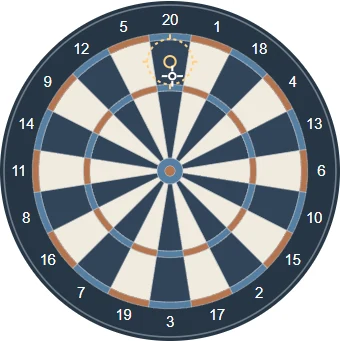
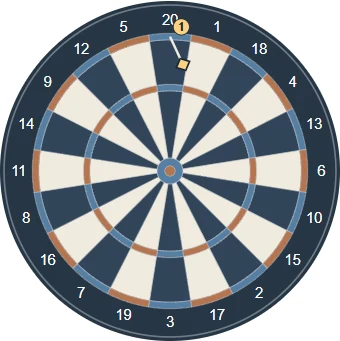
The board contains numbered sectors from 1 to 20. The broad areas inside each sector are singles and score the printed number. The narrow outer scoring ring is a double, worth twice the number. The narrow ring farther inside is a treble, worth three times the number. Treble 20 scores 60, double 20 scores 40, and single 20 scores 20. Three treble 20s make the maximum visit score of 180. The numbers are deliberately not arranged in numerical order: 5 and 1 sit beside 20. A landing outside the outer double ring scores zero, but it still uses one of your darts.
The bull and a three-dart visit
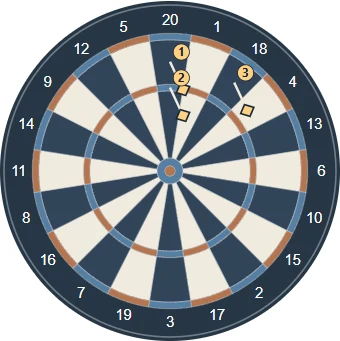
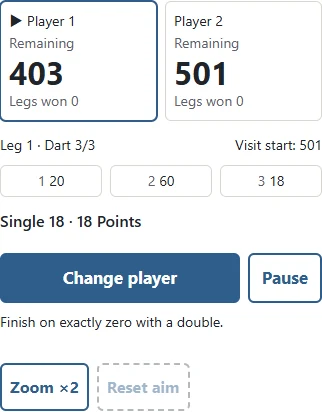
The small inner bull scores 50 and counts as double 25 for finishing. The surrounding outer bull scores 25 and is not a double in the standard split-bull setting. A visit gives a player up to three darts. Review each landing, then select Next dart to continue with the same player. After the third dart, select Change player to change players. A miss is still a thrown dart and cannot be replaced. Finishing or busting ends the visit immediately, even if one or two darts remain unused. The visit-start score helps you compare your current total with the position at the beginning of this turn.
Double out: finish on exactly zero
Standard double out requires the last dart to land in a double and bring the remaining score to exactly zero. From 40, double 20 finishes; from 32, double 16 finishes; from 50, the inner bull finishes. A treble cannot replace the required double, however valuable its score may be. From 20, single 20 reaches zero numerically but is a bust because the final dart was not a double. Double 10 from the same score is a valid finish. When an odd number remains, a single can leave a useful even total. Leaving one is a bust because no double can remove that final point.

Bust rules: restore the whole visit
A bust cancels the entire visit and restores the score held before its first dart. It does not merely cancel the dart that caused the problem. Suppose you begin at 60, score single 20 to leave 40, and then hit treble 20 for 60. That overshoot restores 60, not 40, and ends your turn immediately. In double out, leaving one or reaching zero without a double also causes a bust. In open out, overshooting still busts, but leaving one is allowed and any scoring area may produce a valid exact-zero finish. Check both the remaining score and the finishing rule before choosing an aggressive target.


Standard rules and available variations
The default is 501, straight in, double out and a split bull worth 25 or 50. Straight in means scoring begins with any scoring dart; you do not need an opening double. Choosing 301 changes the starting total while keeping the other selected rules. Open out allows a single, double or treble to finish on exactly zero. The full-bull option scores both bull areas as 50 and uses open out. Selecting double out restores the split bull; selecting full bull changes the finish to open out. Electronic darts associations and individual competitions use different combinations, including double in. This version does not include double in, cricket, or team freeze rules.

| Setting | Standard | Variation |
|---|---|---|
| Starting total | 501 | 301 |
| Finish | Double out | Open out |
| Bull | 25 / 50 | 50 / 50 + Open out |
Match length and computer difficulty
In a single-leg match, the first valid finish wins. In best of three, each new leg resets both remaining scores to the selected starting total, and the first player to take two legs wins. The opening player is selected at the start of a match, and the starter alternates for later legs. The darts column records cumulative throws across the match; it is not a tie breaker. Easy makes more aiming mistakes, Normal provides a steadier challenge, and Hard is more accurate on narrow rings and finishing targets. None is guaranteed to hit. There is no special turn limit that awards a leg to whichever player has fewer points remaining.
Tip 1: learn the broad scoring areas
You do not have to aim for treble 20 on every throw. Begin with a broad single and watch how the crosshair moves around your chosen point. This gives you time to learn the timing without relying on a narrow band. Compared with a double near the edge, a broad single gives you more room before a miss lands outside the scoring area. Notice which numbers surround your favourite target. Reviewing your last landing is useful feedback: it can show whether you tend to throw while the crosshair is above, below, or beside the intended point.
Tip 2: change targets as the score falls
A high-scoring target is useful when much of the starting total remains, but it may become dangerous near the finish. With 32 remaining, hitting treble 20 would overshoot and bust. Look for a double that matches the current total, or use a single to leave a workable even number. Reconsider after every dart rather than repeating the target chosen at the start of the visit. A surprising single or neighbouring treble may change the best route. The remaining-score display is the important number for your next dart; the visit-start score explains what you would lose if this visit busts.
Tips 3–6: practise finishes and keep a steady rhythm
Learn a few useful finishes such as 40 on double 20, 32 on double 16, and 20 on double 10. The inner bull can finish 50, but it is a small target and need not be your default choice. Zoom if a narrow ring is difficult to see, then wait for the white crosshair to enter it. Distinguish the moving crosshair from the stationary aim circle. If you feel rushed, pause and reconsider the remaining score and finish setting. In shared-device play, check the player name before taking a turn. A consistent routine makes both aiming mistakes and accidental player changes less likely.
Frequently asked questions
Why did zero not win? In double out, a final single, treble or outer bull is invalid. The inner bull counts as double 25 and can finish 50. Why did earlier points disappear? A bust restores the entire visit, including successful darts thrown before the bust. Can I replace a miss? No: a zero-scoring landing still counts as one dart. Does the computer always aim at the same place? Its target changes with the remaining total, so a high-scoring approach and a finishing attempt are different. Do two local players need hidden screens? No: remaining totals and thrown darts are public information, so simply pass the device at each change of visit.
Saving, sound and taking a break
An unfinished match and your settings are saved in this browser when local storage is available. Reopen the page and select Continue to return to that match. The Japanese and English pages share the same save on the same browser and origin. Restricted or private browsing may prevent a save from remaining after the page closes, but you can still play. Pause stops both the moving crosshair and a pending computer throw. Opening Settings also stops play and lets you choose between continuing the saved match and starting with new settings. Restart asks for confirmation before beginning again. Sound starts off; turn it on only if you want short scoring effects.
Darts as a sport and this browser version
Modern darts includes steel-tip competition and electronic scoring formats. Starting totals, bull values and finishing requirements vary between events and venues. Double-out 501 is a widely used format, but it is not the only ruleset played everywhere. This browser game uses an original flat board and a timing-based crosshair. It does not reproduce the weight of physical darts, a throwing stance, measured throwing distance, wires, or bounce-outs. For a real session, check the venue’s safety arrangements and agreed scoring rules. Here, the useful challenge is recognising scoring areas, adjusting targets as the total falls, and finding a valid finish. The actual game screens explain those decisions without requiring special equipment.