 Yorimichi Games
How to play the penalty kick game
This is a soccer penalty shootout you can play in one screen, right in your browser. The camera sits just behind the penalty taker, looking at the goal: the keeper is on the goal line, and the ball waits on the penalty spot in front of you. When it’s your team’s turn you take the kick. When it’s the other side’s turn you become the goalkeeper and try to stop the shot. You take turns, five kicks each, and whoever scores more wins. If it’s still level after five, the shootout goes to sudden death.
Pick your spot and shoot
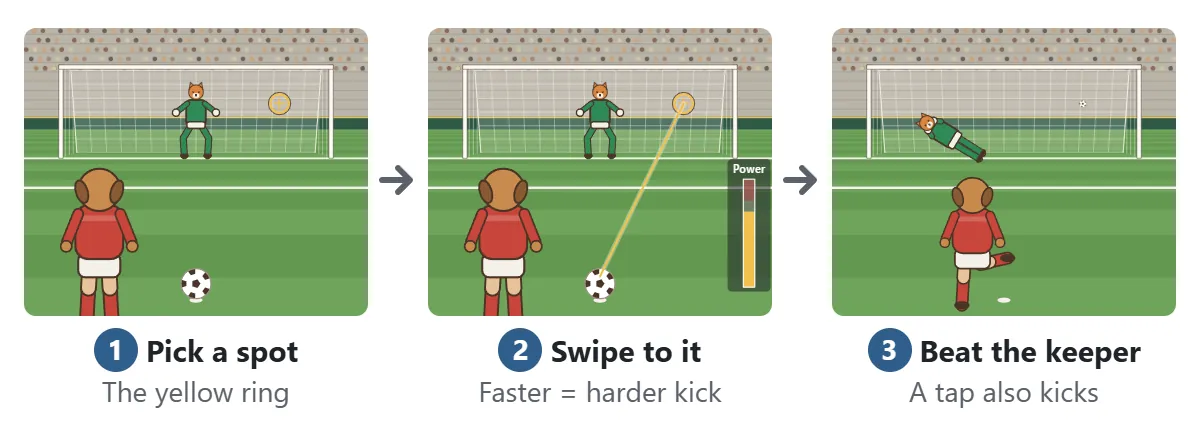
On your kick, decide where in the goal you want the ball to go. On a phone or tablet, put your finger near the ball, swipe up to the spot you are aiming at and let go. The end of your swipe is the target, and the speed of the swipe sets the power. On a computer you can drag with the mouse in the same way, or simply click the spot. A tap or a click on its own shoots at medium power, which is a sensible choice while you learn. With a keyboard, move the yellow ring with the arrow keys, then hold Space: a power meter rises and falls while you hold it, and the kick is taken the moment you let go. Press Enter instead for a quick medium-power kick.
Power: speed against accuracy
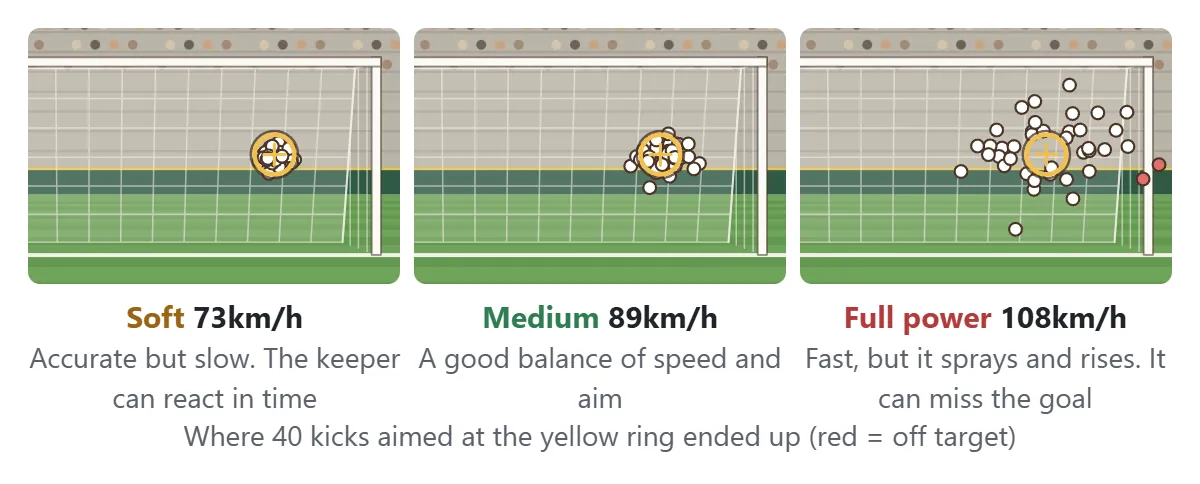
A hard shot is fast, so a keeper who waits to see the ball simply can’t get across in time. The catch is accuracy. The harder you hit it, the further the ball tends to drift from your target, and at full power it also rises, sometimes clearing the crossbar. A soft shot goes exactly where you aimed, but it is slow enough for the keeper to react and reach it. The red band at the top of the power meter marks the zone where kicks start to spray.
Curve the ball to fool the keeper

Swipe in a curve and the kick bends in the air. You can also switch curve on with the Curve left and Curve right buttons, or with the Z and X keys. A bending shot starts off heading the other way, so a keeper who reads the first few meters of flight will usually dive the wrong way. The price is a little accuracy: a curled shot is harder to place than a straight one, so aim a touch inside the post rather than right on it.
In goal: guess early or react late
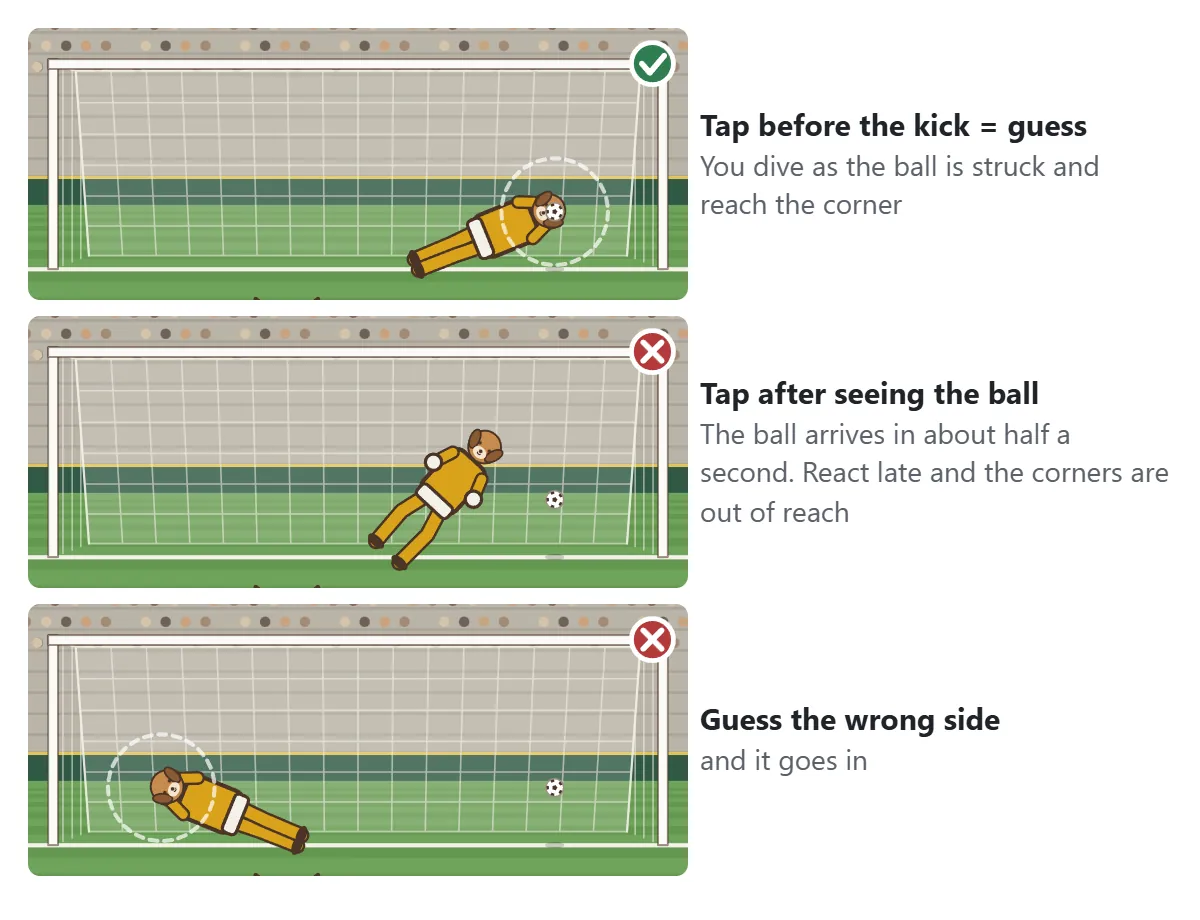
When the other side shoots, you are the goalkeeper. Tap or click where the ball is going and the keeper dives there. On a keyboard, Q, W and E dive to the top left, jump up in the middle and dive to the top right, while A, S and D dive low left, stay central and dive low right. The arrow keys also work. The spot is only 11 meters from goal, and a firm penalty takes well under half a second to arrive, so reacting after the ball is struck is only good enough for soft or central kicks. The alternative is to guess: tap before the kick and your keeper leans that way, then dives the instant the ball is struck. Guess right and you can reach even a shot in the corner. Guess wrong and the kicker rolls it into the other side. The kicker’s body shape in the last stride of the run-up can give you a hint, but some kickers disguise it.
When does it count as a goal?
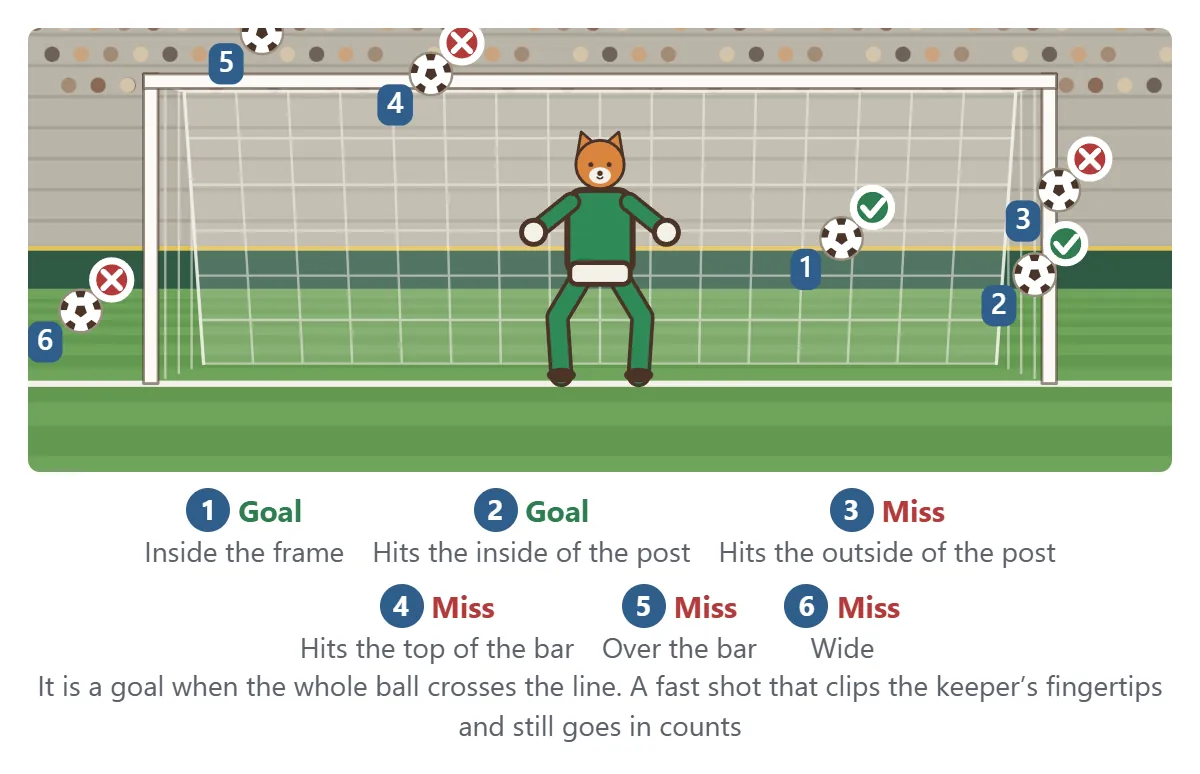
A kick scores when the whole ball crosses the goal line between the posts and under the crossbar. Shots that clip the inside of the post or the underside of the bar and go in still count. So does a fast shot that brushes the keeper’s fingertips and carries on into the net. What you can’t do in a shootout is follow up: once the keeper or the woodwork has stopped the ball, the kick is over.
Penalty shootout rules
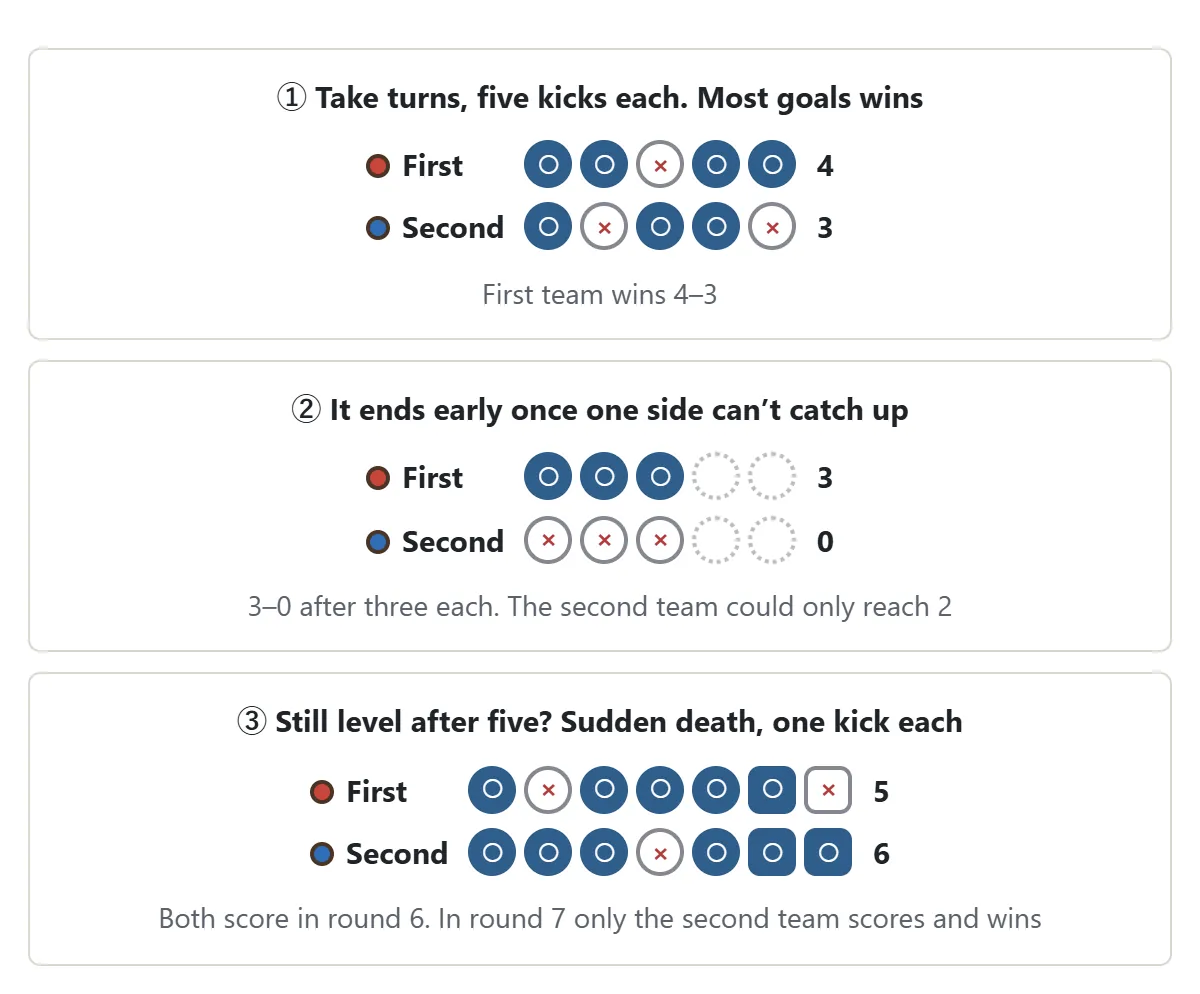
A penalty shootout is used when a soccer match has to produce a winner but ends level. The rules in this game follow the procedure in the Laws of the Game.
| Rule | In this game |
|---|---|
| Who shoots first | A coin toss. The winner chooses to shoot first or keep goal first (the CPU always chooses to shoot) |
| Order | The teams alternate one kick at a time, in the same order even in sudden death |
| Five each | Each side takes five kicks, and more goals wins |
| Early finish | It ends as soon as one side can no longer catch up, even with all its remaining kicks (the shortest is 3–0 after three each) |
| Sudden death | If it’s level after five, the teams take one kick each until one side leads after the same number of kicks |
| Rebounds | The kicker can’t play the ball again. A shot that goes in off the keeper or the post still counts |
Game modes and CPU levels
| Mode | What happens |
|---|---|
| vs CPU | You and the CPU alternate. You shoot on your kicks and keep goal on the CPU’s. Wins, losses and your win streak are kept for each level |
| 2 players | Two people share one device. The keeper secretly picks one of six zones, then hands over the device and the kicker shoots |
| Daily challenge | Five kicks each against a new opponent every day. Goals scored plus kicks stopped, out of 10. Everyone gets the same opponent’s kicks on the same day |
| Level | What it feels like |
|---|---|
| Easy | Mostly softer kicks toward the middle, and a keeper who usually waits to react. Aim for the corners and you will score plenty |
| Normal | Goes for the corners, and the keeper often guesses. Mix up your spots and you should come out ahead |
| Hard | Firm kicks into the corners, sometimes with curve, and it may shoot the other way if your keeper moves too early. A real battle of nerves |
Playing with two players on one device
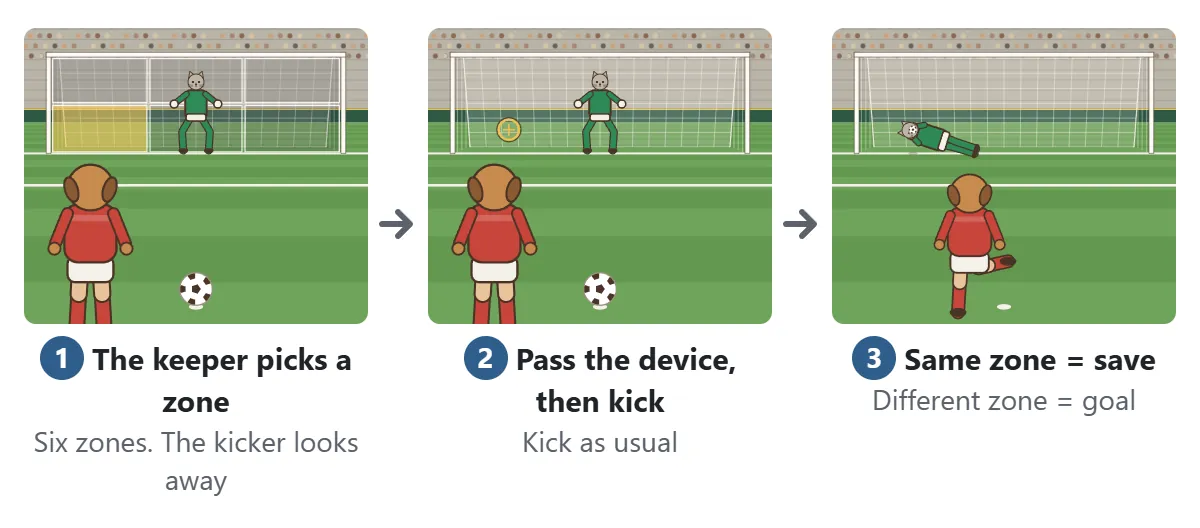
In two-player mode, the goalkeeper goes first: the goal is split into six zones (top left, top middle, top right, bottom left, middle and bottom right) and the keeper taps one. The choice isn’t shown on screen, so the kicker should look away. Press Ready, hand the device over, and the kicker shoots as normal. A shot near the chosen zone is saved; anywhere else goes in.
Penalty kick tips and strategy
1. Go for the corners
A low shot just inside the post is almost impossible to stop unless the keeper has guessed that side. The top corners are even harder for a keeper to reach, but a firm shot aimed up there can easily clear the bar. Start with the low corners, then add the top corners once you have a feel for the power.
2. Stay out of the red
Full power makes the ball spray and rise. When you aim for a corner, a kick just below the red band on the power meter is the most reliable choice.
3. Don’t be predictable
Shoot to the same corner every time and the keeper will start to read you. Switch sides and heights, and now and then go straight down the middle.
4. As the keeper, don’t move too soon
Guessing is powerful, but a good kicker watches the keeper and may shoot the other way if you commit early. If you are going to guess, decide late in the run-up.
5. React to the slow ones
A soft kick takes long enough to arrive that you can wait, see it, and still get there. Watch the ball as the run-up begins and tap the moment you see where it is heading.
6. Save the curve for the mind game
Because a curled shot starts off in the wrong direction, it beats keepers who react to the flight. It is a little less accurate, so aim slightly inside the post rather than right on it.
Penalty shootout FAQ
Can I play on a phone and on a computer?
Yes. On phones and tablets you swipe or tap; on a computer you use the mouse or the keyboard. There is nothing to download and no sign-up.
Why can’t my keeper reach the ball?
A firm penalty arrives in under half a second, which is too fast to react to if it’s heading for a corner. Try guessing by tapping before the kick. Slower shots can still be saved by reacting.
Can I stop and continue later?
Yes. On the same device and browser, Continue picks the shootout up where you left it. A daily challenge can only be continued on the same day.
Can I pause?
Use the Pause button, or press P or Esc. If you pause while the other side is shooting, that kick is taken again when you resume.
How is this different from a real shootout?
In a real shootout each kick is taken by a different player; here the same player shoots every time. Finer points of the laws, such as a keeper stepping off the line too early, are left out.
A short history of the penalty shootout
The penalty kick is taken from a spot 11 meters (12 yards) from goal, one on one against the keeper. Before shootouts existed, drawn cup ties were usually replayed, and some were even settled by tossing a coin or drawing lots. Kicks from the penalty mark spread through the 1970s and became the standard way to settle knockout matches, from the European Championship to the World Cup. People still argue that a shootout is too much like a lottery, yet few moments in sport are as tense as the duel between a kicker and a keeper.