 Yorimichi Games
How to play Sugoroku
Sugoroku is a Japanese roll-and-move board game. Every player starts on the same square, takes turns rolling one die and moves forward that many squares along a winding path. Some squares are marked with an instruction, and whoever gets to the goal first wins. There are no decisions to make and nothing to memorize, so anyone who can count to six can join in, which is exactly why it has been a favorite family game in Japan for a very long time, especially around New Year.
This online version lets 1 to 4 people play. You can pass one phone, tablet or computer around the table, add computer players to fill empty seats, or play on your own and try to reach the goal in as few rolls as possible.
The board
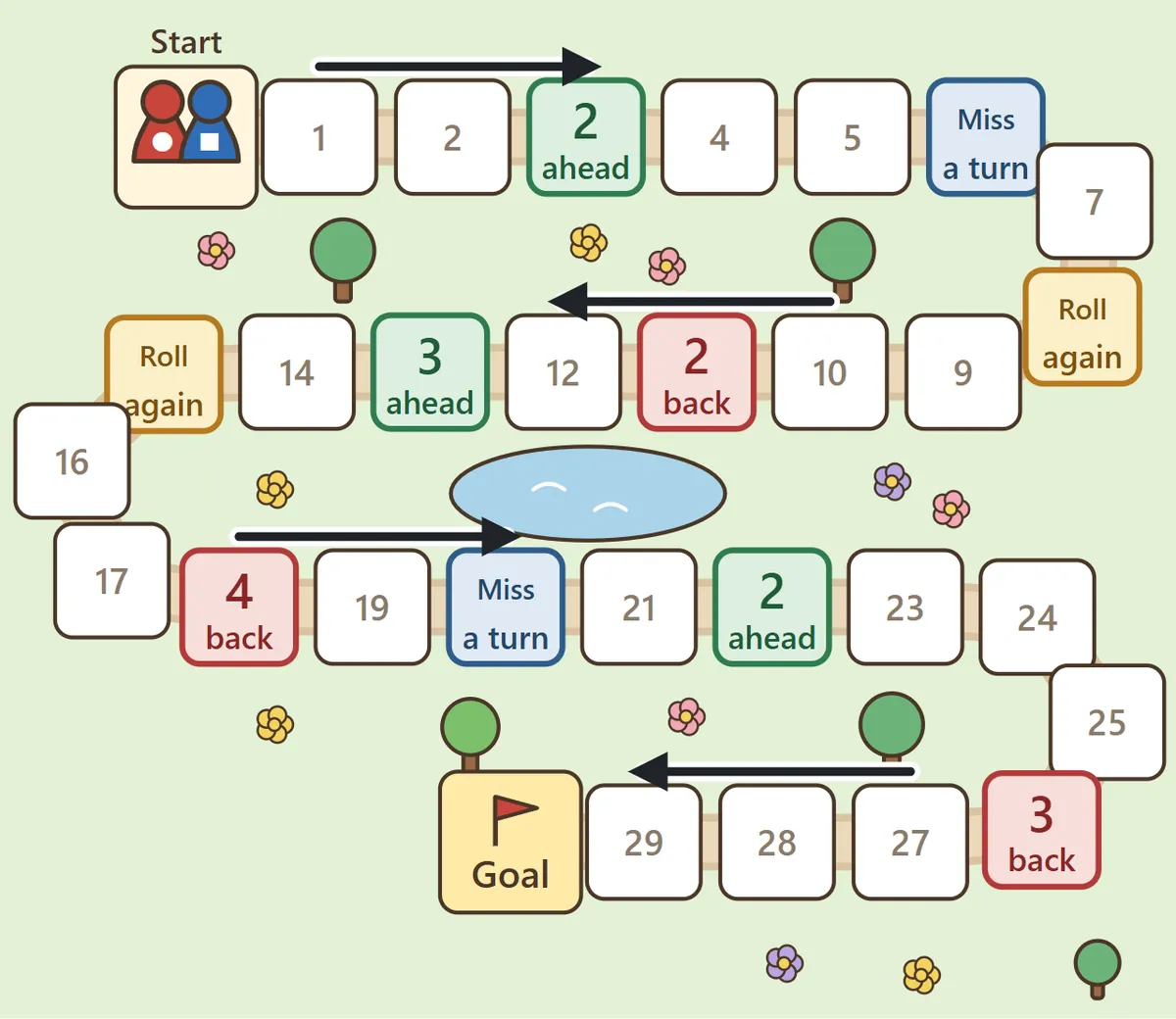
Everyone begins on the Start square in the top left corner. The path runs left to right, turns, runs back the other way and keeps snaking down the board until it reaches the Goal square with the red flag. Plain white squares are numbered, so you can always see how far along you are and how many squares are left.
Roll the die and move
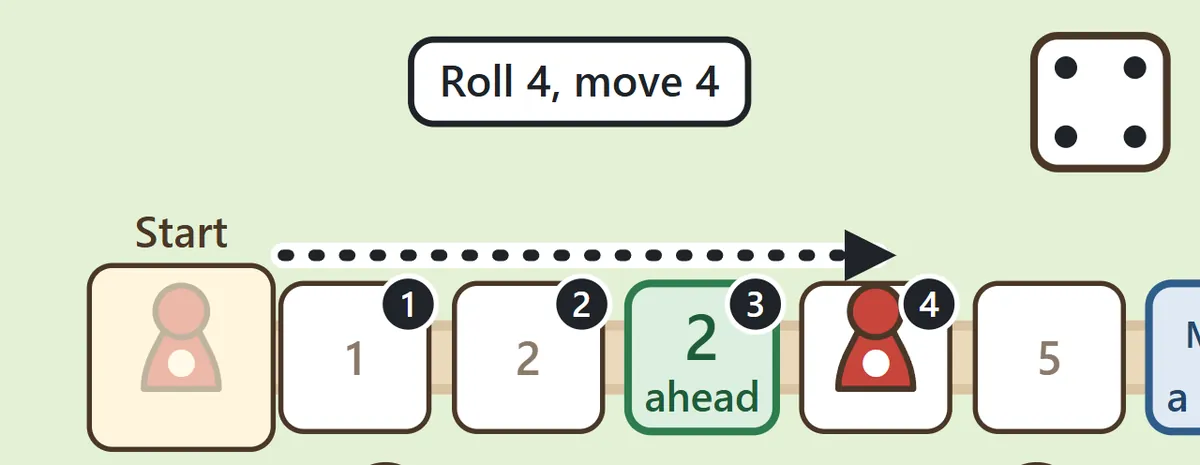
When it is your turn, press Roll the die or tap the die on the board. Your piece hops forward one square at a time, as many squares as the number rolled. Landing on the same square as another player is completely fine: pieces simply share the square. Nobody gets knocked back.
At the start of a game with two or more players, everyone rolls once and the highest roll goes first (players who tie roll again). After that, turns go round in the order shown above the board.
Special squares
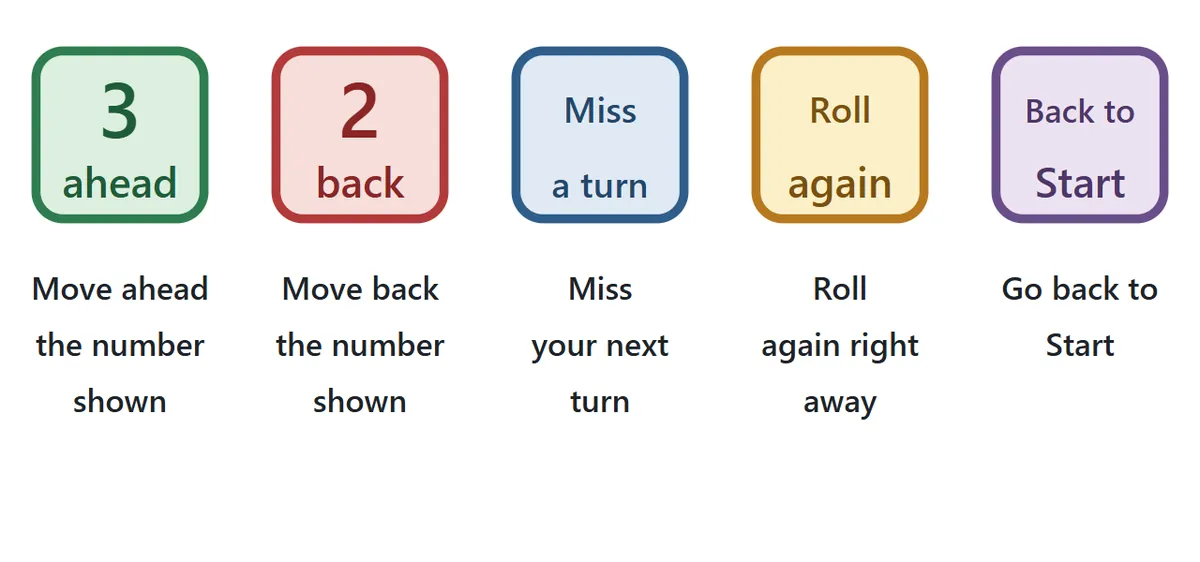
- Move ahead (green): move forward the number of squares shown.
- Move back (red): move back the number of squares shown.
- Miss a turn (blue): skip your next turn.
- Roll again (yellow): take another roll straight away.
- Back to Start (purple): return all the way to the Start square. There is only one of these, on the 60-square board.
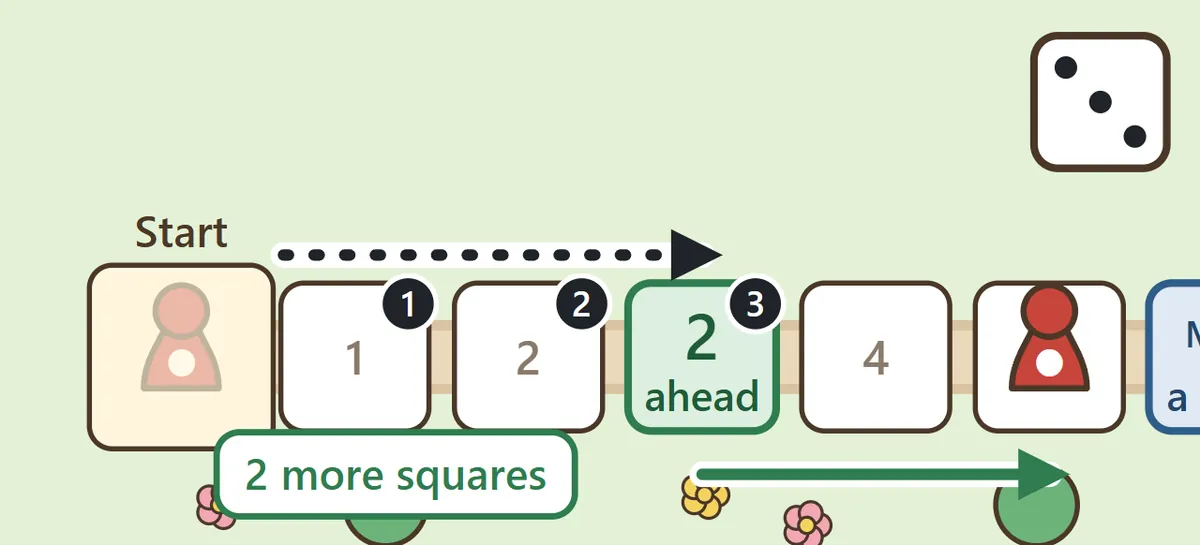
An instruction only happens on the square where your roll ends. If a Move ahead or Move back square sends you somewhere else, that is the end of your move. The boards are designed so that you are always sent to a plain square, so there are no chains of instructions to argue about.
Sugoroku rules for reaching the goal
Families in Japan play the finish in two different ways, and neither one is more "correct" than the other. In this game you pick one before you start.
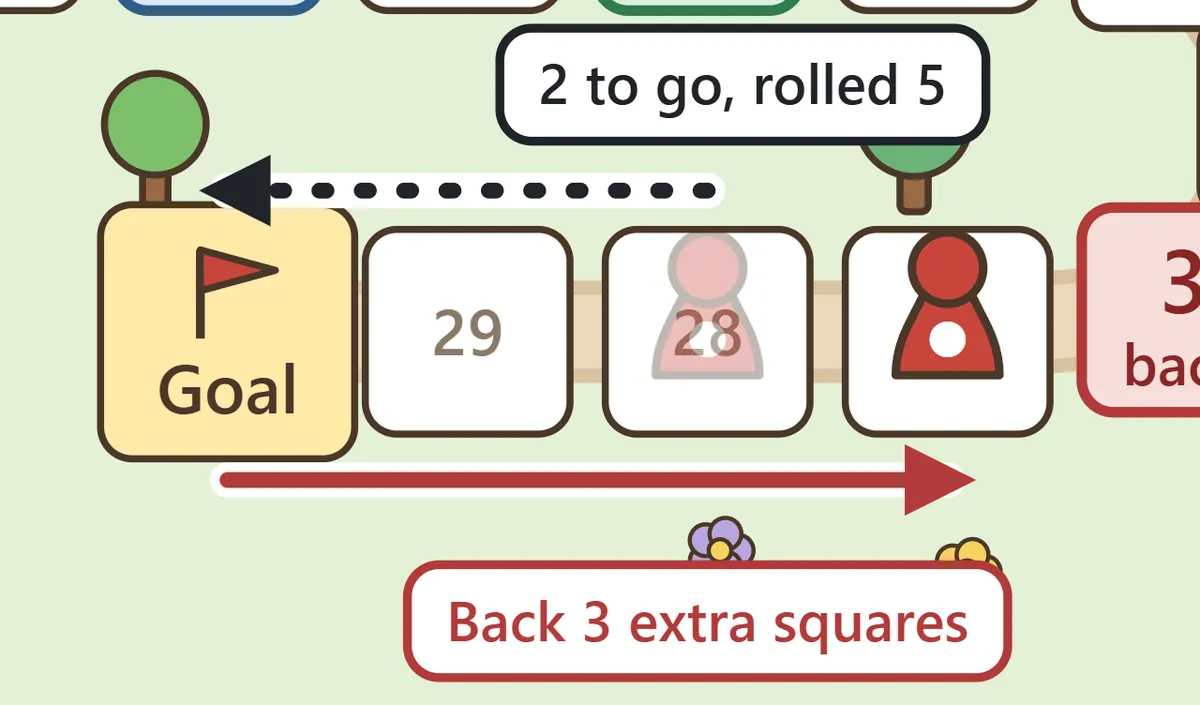
Exact roll means you need the exact number of squares that are left. If you roll higher, you move up to the goal, turn around and move back the extra squares. If you end on a special square after bouncing back, it takes effect as usual. This is the more exciting way to play, because a leader can get stuck right in front of the goal for several turns while everyone else catches up.
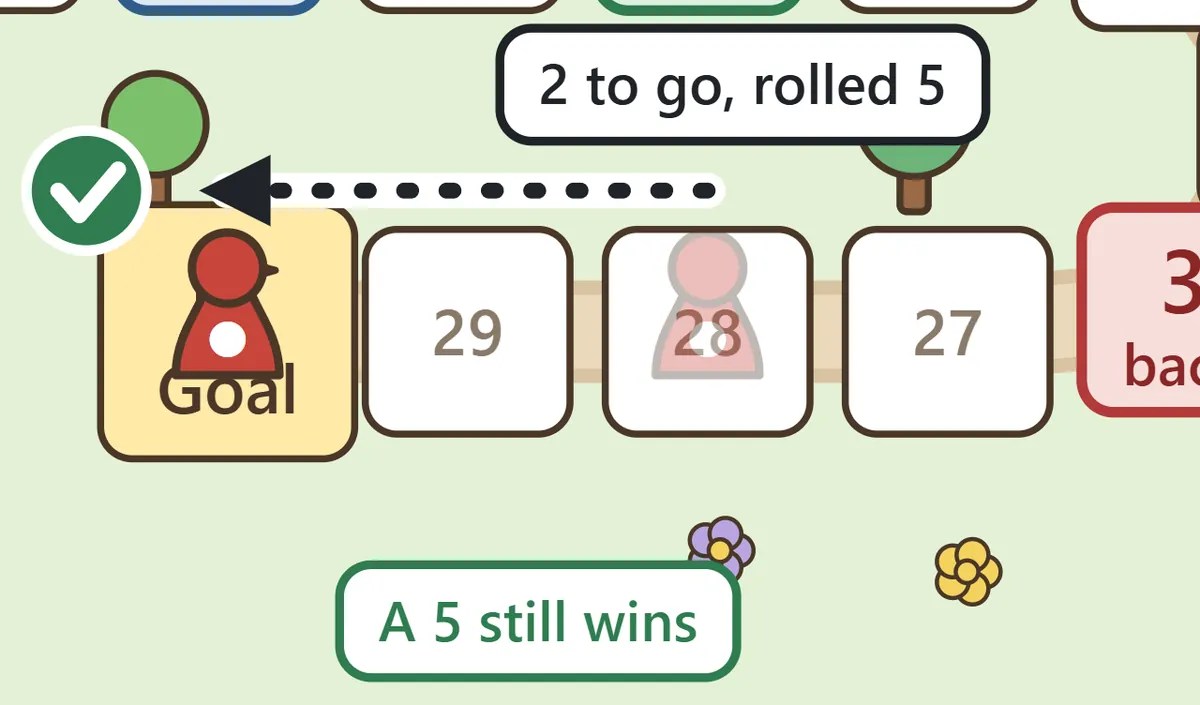
Any roll that reaches it means a roll that reaches or passes the goal is enough. Games are shorter, which makes this a good choice for small children or when you only have a few minutes.
The game ends as soon as one player reaches the goal. Everyone else is ranked by how close they are to the goal at that moment.
The two boards
| Park | Four Seasons | |
|---|---|---|
| Squares | 30 | 60 |
| Time (2 players) | 2–3 minutes | About 5 minutes |
| Special squares | 10 (four kinds) | 21 (all five kinds) |
| Good for | First games, young children | Longer family games |
The Four Seasons board takes you on a trip through spring, summer, autumn and winter scenery. It has the Back to Start square, so even a player close to the finish cannot relax.
Sugoroku tips for more fun
1. Count the squares out loud
Pieces move one square at a time, so counting "one, two, three" together as they hop is a natural bit of number practice for young players, and it keeps everyone watching the board.
2. Look for the squares you want to hit
You cannot choose your roll, but you can look ahead: "a 3 would land me on Move ahead", "please, not a 2". Picking a number to hope for before each roll turns a simple race into a lot of cheering and groaning.
3. With the exact roll, never give up
Under the exact-roll rule the leader still needs precisely the right number to finish. Players further back get plenty of chances to catch up, so the game is rarely over until it is over.
4. Match the board to the time you have
For a quick game, choose the Park board and let any roll reach the goal. For a longer game with more ups and downs, choose Four Seasons with the exact roll.
5. Playing alone? Chase your best score
When you play solo, the game records how many rolls you needed to reach the goal. Your best score is kept for each board and finishing rule, so you can try to beat it next time.
Sugoroku FAQ
Do you need an exact roll to finish?
There is no single official answer. Some families play that you must land exactly on the goal and move back the extra squares; others let any roll that reaches the goal count. Agree on one before you start and nobody will argue at the end. Here you choose it in the settings.
What happens if I land on another player's square?
Nothing. Any number of pieces can share a square, and no one is sent back.
How long does Miss a turn last?
Just one turn. You skip your very next turn and then roll normally again.
Which CPU level should I choose?
Sugoroku is pure luck, so on Normal anyone can win. If you are playing with young children, or simply like to win more often, choose Easy: the computer players tend to have worse luck.
Can I stop and continue later?
Yes. Open the page again on the same device and browser and press Continue to pick up where you left off.
Is there sound?
Sound is off at first. Press Sound: off to turn on the sounds of the die and the pieces.
What is Sugoroku? A short history
The word sugoroku has been used in Japan for two quite different games. The older one, ban-sugoroku ("board sugoroku"), was a two-player game from the backgammon family that arrived from China many centuries ago. The one most people mean today is e-sugoroku ("picture sugoroku"): a race along a path printed on a large sheet of paper, from the starting point to the finish, driven by the roll of a die.
Picture sugoroku became a popular children's pastime in the Edo period (1603–1868), when colorful woodblock-printed boards were sold in huge numbers. Many were themed journeys, such as trips along the Tokaido road between Edo and Kyoto with one post town per square, while others showed actors, famous places or lessons in good manners. Magazines later gave away paper boards as New Year gifts, and sugoroku is still closely linked with the New Year holidays in Japan. The boards in this game are original designs, but they follow the same idea: a winding road, simple instructions and a race to the finish.
Race games played with dice are very old. You can also play the Royal Game of Ur, a board found in Mesopotamia and about 4,500 years old.