 Yorimichi Games
How to play shogi (Japanese chess)
Shogi is the Japanese member of the chess family. Two players take turns moving pieces on a board of 9 by 9 squares, and the goal is the same as in Western chess: trap the opposing king so that it cannot escape. What makes shogi different is that a piece you capture does not leave the game. It joins your side, and on a later turn you can drop it back onto the board almost anywhere. Pieces also promote to stronger forms when they reach the far side of the board. Because material keeps coming back, games stay sharp until the very end, and a lost position can turn around with a single well-placed drop.
You can play here against the computer at three levels or with a friend on one device. For beginners there is a move guide that draws arrows for the piece you pick, red rings on pieces that are under attack, hints and undo. If the Japanese characters on traditional pieces are new to you, choose the letter pieces in the settings: each one shows its moves with small marks, so you can play right away and learn the kanji later if you like.
The shogi board and starting setup
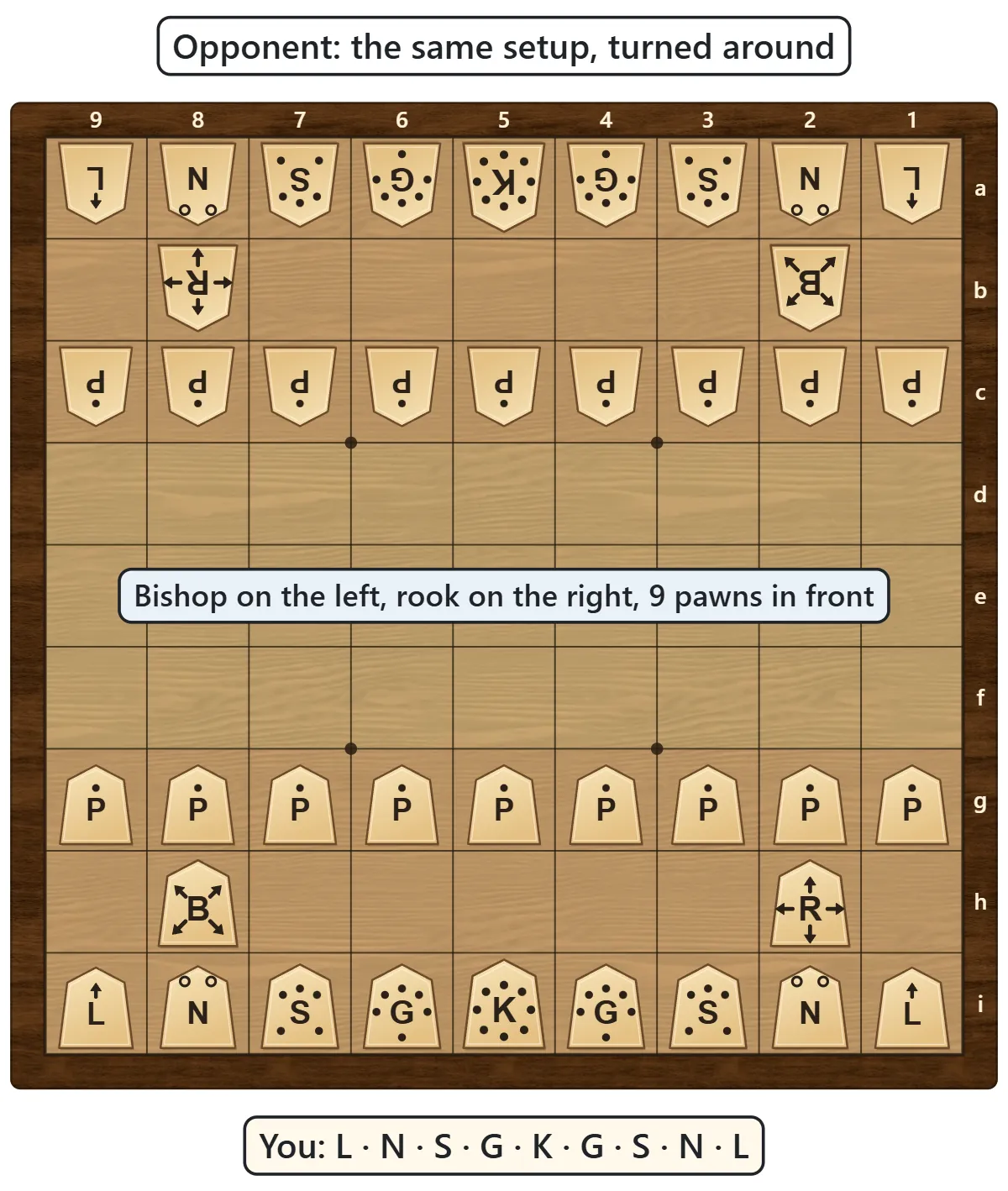
Each player starts with 20 pieces. Your back rank holds, from left to right, a lance, a knight, a silver general, a gold general, the king, another gold, silver, knight and lance. On the rank in front, the bishop sits on the second file from the left and the rook on the second file from the right. Your nine pawns fill the third rank. Your opponent sets up the same way from the other side, so the two bishops face each other along a diagonal and the two rooks face each other along a file.
All pieces are the same color. Ownership is shown by direction: the pointed end of a piece faces the opponent. On this screen, your pieces point up and the CPU’s pieces point down. The player who moves first is called sente (in English books also “Black”), and the second player is gote (“White”).
How the shogi pieces move
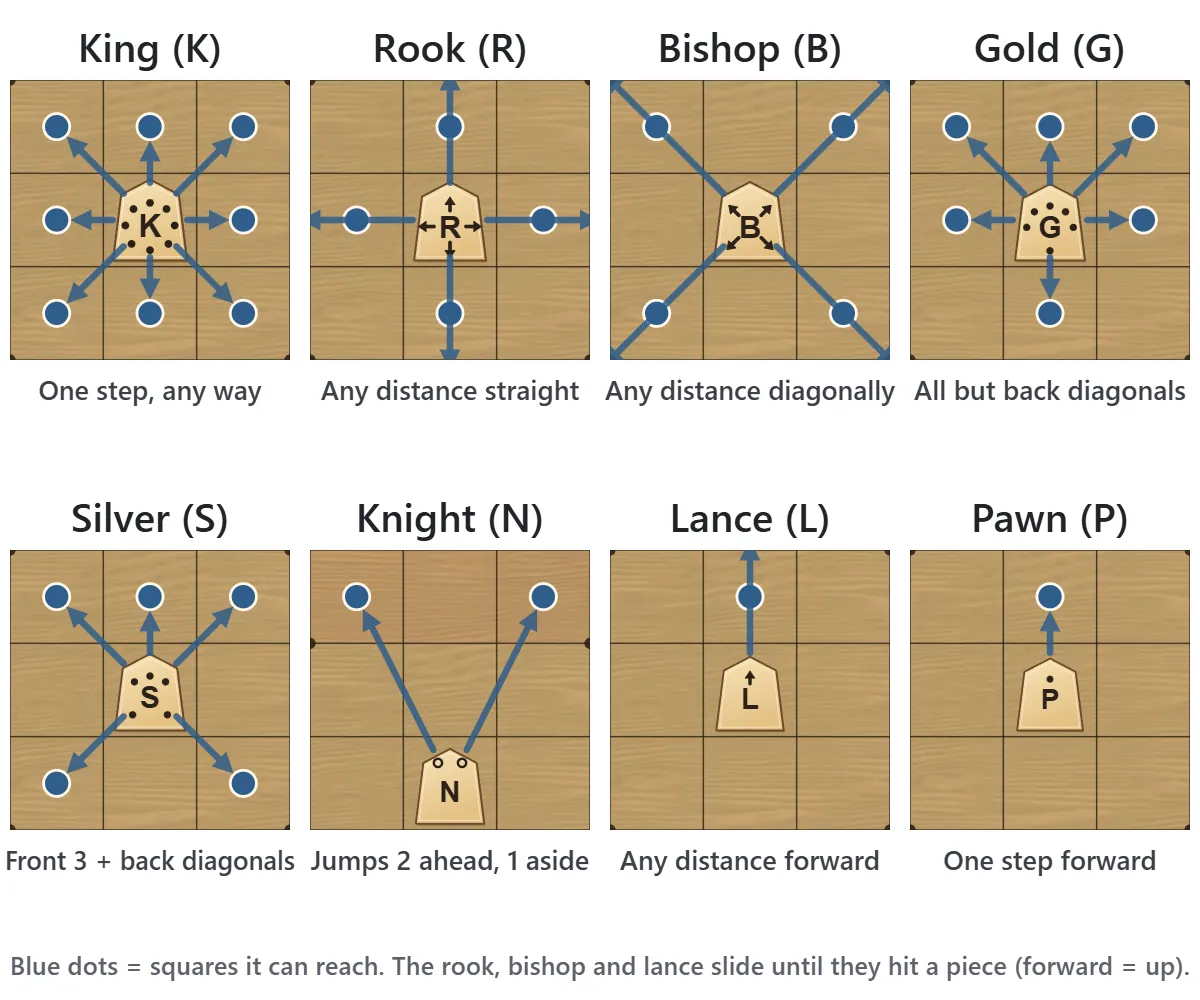
On your turn you either move one piece on the board or drop one piece from your hand. Passing is not allowed. A piece may not land on a square occupied by your own piece; if it lands on an enemy piece, it captures it. Only the knight can jump over other pieces.
| Piece (letter) | How it moves |
|---|---|
| King (K) | One square in any of the eight directions |
| Rook (R) | Any distance forward, backward or sideways |
| Bishop (B) | Any distance diagonally |
| Gold General (G) | One square forward, diagonally forward, sideways or straight back – six directions, never diagonally back |
| Silver General (S) | One square forward, diagonally forward or diagonally back – five directions, never sideways or straight back |
| Knight (N) | Jumps two squares forward and one to the side; it only moves forward |
| Lance (L) | Any distance straight forward, never back or sideways |
| Pawn (P) | One square straight forward, and it captures the same way |
If you know Western chess, note the differences: the shogi knight has only two forward jumps, the pawn captures straight ahead rather than diagonally, and there is no queen. The gold and silver generals are the pieces chess players find new. A handy way to remember them: the gold covers everything except the two back diagonals, while the silver covers the three squares in front plus the two back diagonals.
Promotion: pieces get stronger in the enemy camp
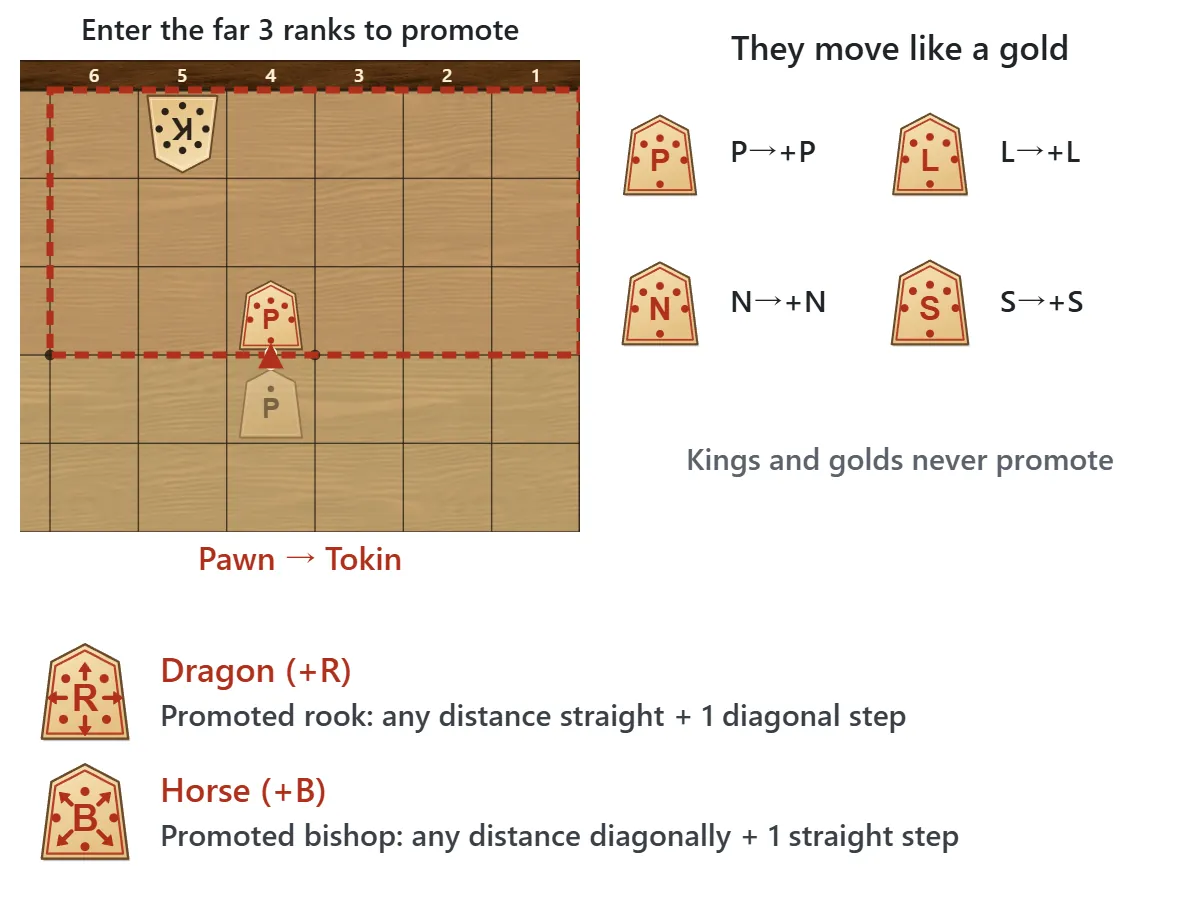
The three ranks nearest your opponent form the enemy camp (slightly tinted on the board). When one of your pieces moves into the camp, moves within it or moves out of it, you may promote it. In a real set the piece is turned over; with the letter pieces it turns red. The pawn, lance, knight and silver all promote to pieces that move like a gold general. The promoted pawn has its own name, tokin. The rook promotes to the dragon (+R), which keeps its long straight moves and adds one step diagonally. The bishop promotes to the horse (+B), which keeps its long diagonals and adds one step straight. Kings and golds never promote.
Promotion is usually your choice, and this game asks “Promote?” when you have one. It is forced only when the piece would otherwise have no legal move ever again: a pawn or lance reaching the last rank, or a knight reaching either of the last two ranks, must promote. Declining can be useful – a silver keeps its backward diagonals, and a knight keeps its jump.
Drops: using the pieces you capture
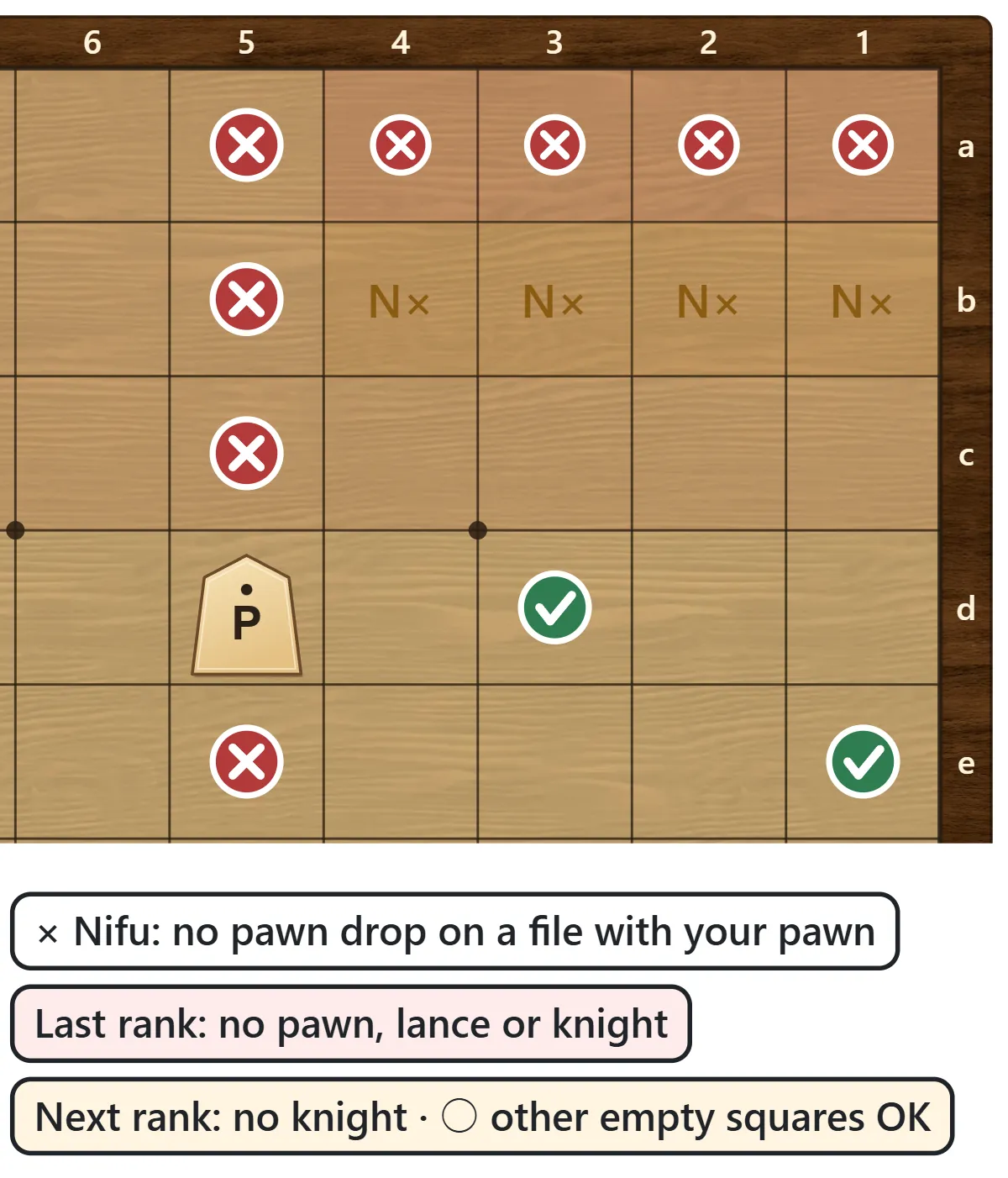
Every piece you capture goes into your hand, shown on the tray below the board. Instead of moving a piece, you may take one piece from your hand and drop it on any empty square. It always enters unpromoted, even inside the enemy camp, but it can promote on a later move. A captured promoted piece goes back to its original form when it joins your hand.
Three restrictions apply. First, nifu (“two pawns”): you may not drop a pawn on a file that already contains one of your own unpromoted pawns. Second, you may not drop a piece where it could never move again, so no pawn or lance on the last rank and no knight on the last two ranks. Third, uchifuzume: you may not give checkmate by dropping a pawn (more below). When you tap a square where a drop is not allowed, the game tells you why.
Check and checkmate
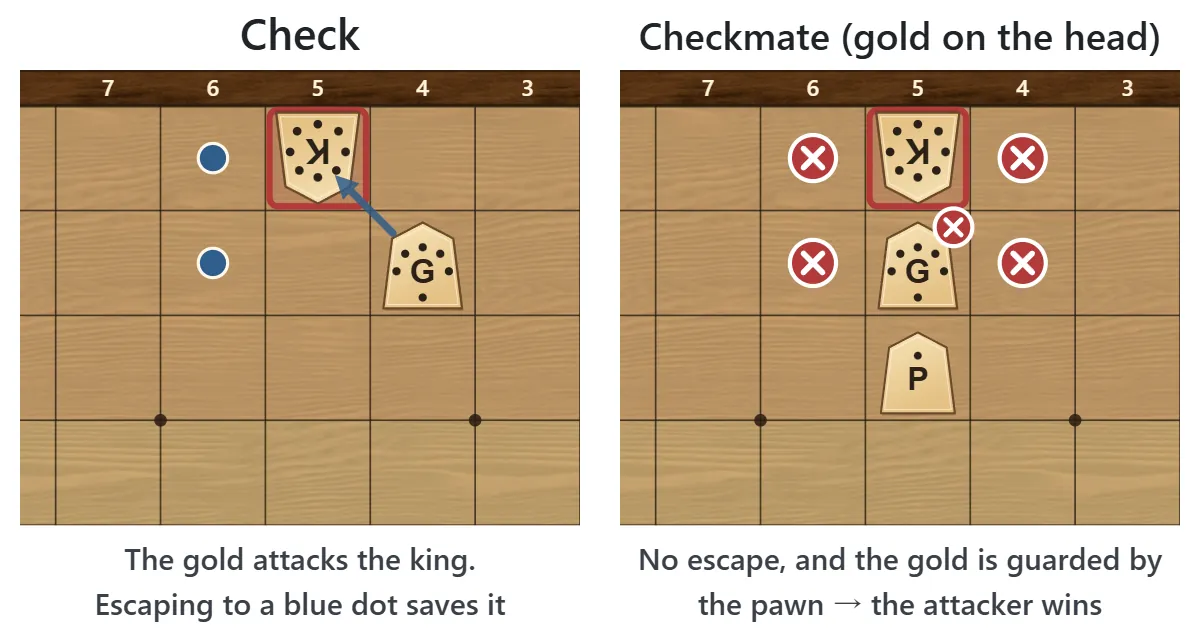
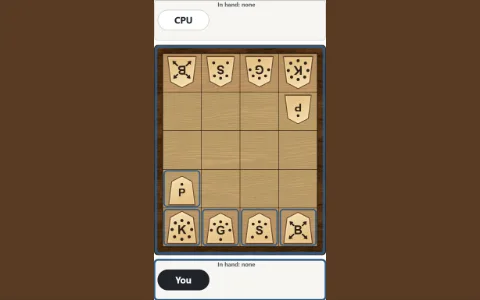
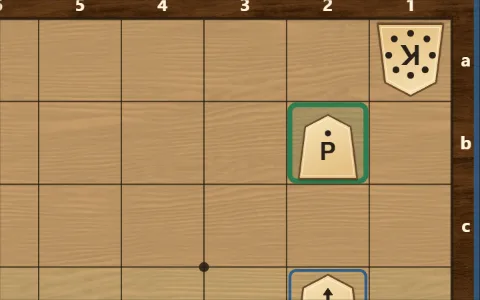
A move that attacks the enemy king is a check. The player in check must answer it by moving the king, capturing the checking piece, or blocking the line with a piece – and in shogi a drop is a perfectly good block. You may never leave your king in check or move it into check; the game only offers legal moves, so those simply will not appear. When there is no way to escape, the king is checkmated and the player who delivered mate wins. A classic finish is shown above: a gold dropped right in front of the king and protected by a pawn.
Other shogi rules: pawn-drop mate, repetition and perpetual check
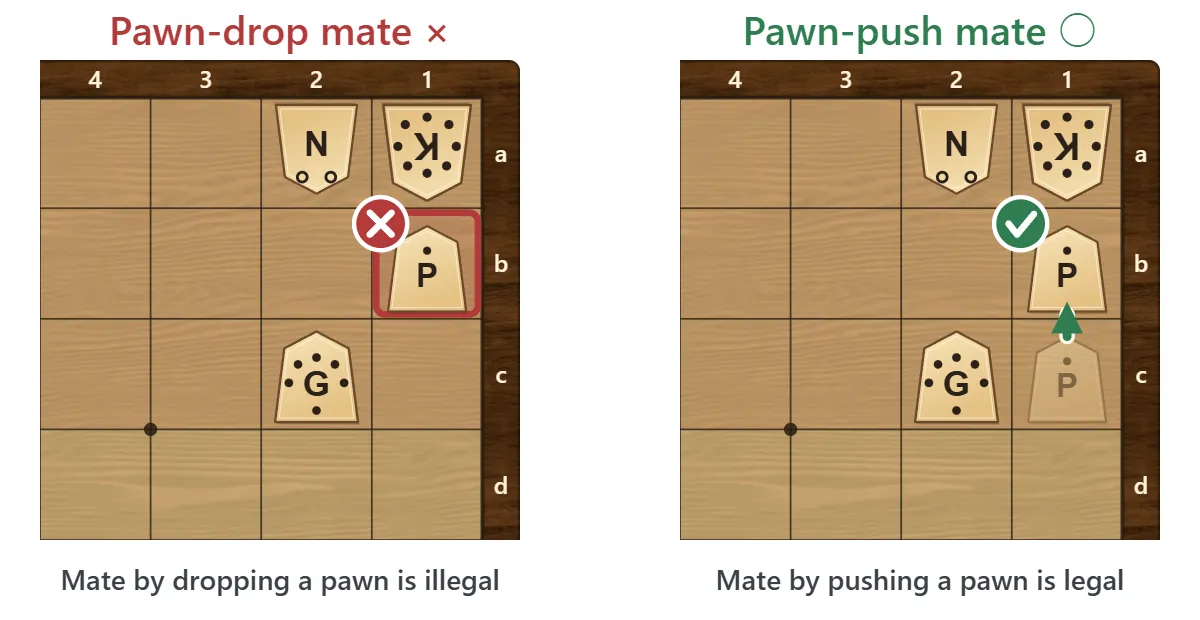
Dropping a pawn to deliver immediate checkmate is illegal. You may drop a pawn to give check if the king has a way out, and you may checkmate by moving a pawn that is already on the board. If the same position – the same pieces on the same squares, the same pieces in hand and the same player to move – occurs four times, the game is a draw by repetition, called sennichite. In professional play the game would be replayed with colors reversed; here it simply ends as a draw. The exception is perpetual check: if one player gave check on every move of the repetition, that player loses.
Entering king and impasse
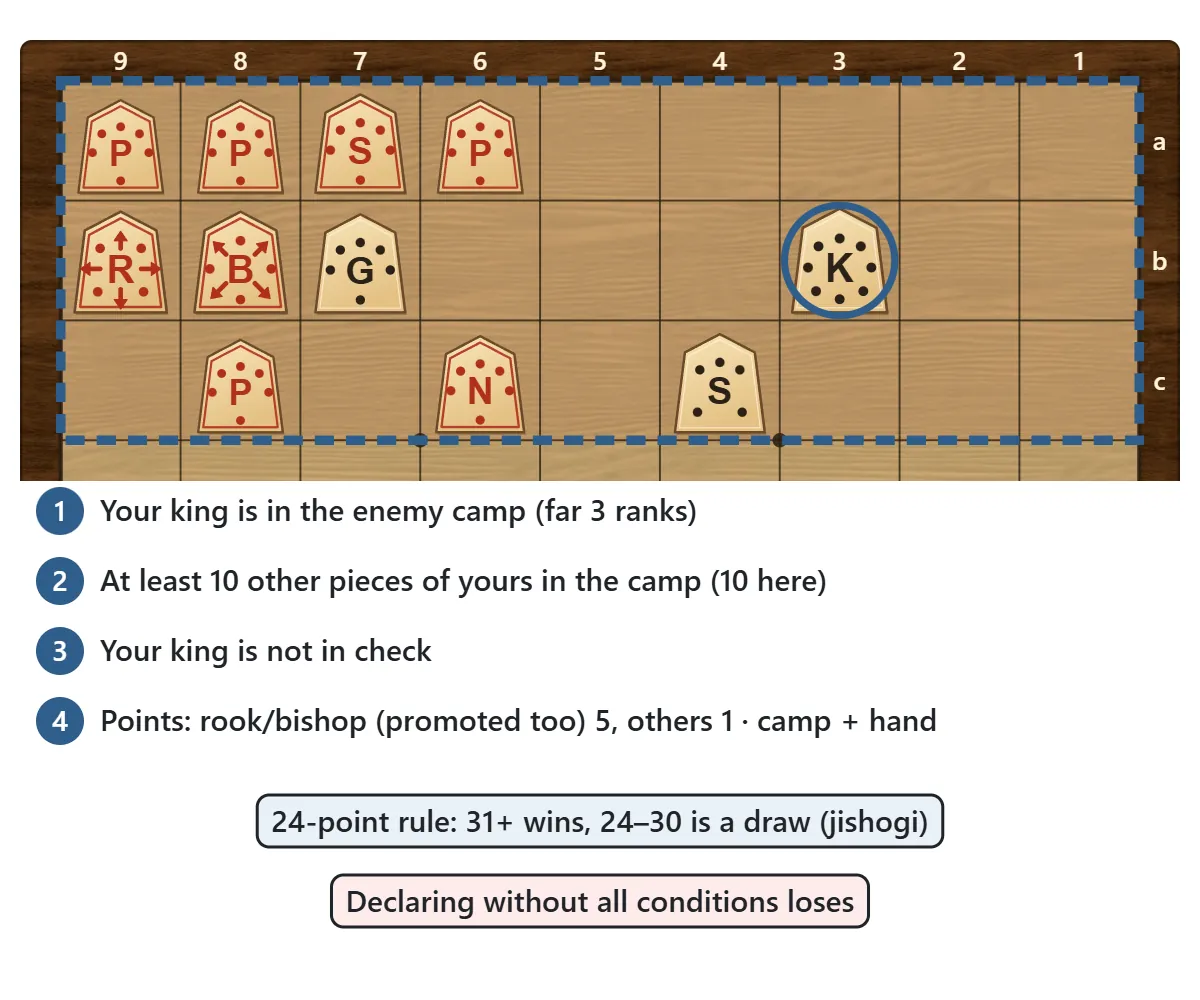
Most shogi pieces move forward, so a king that reaches the enemy camp – an entering king – becomes very hard to checkmate. If both kings get in, the game can stall. For this situation there is a declaration rule. On your turn you may press the Declare button when all of these are true:
- your king is in the enemy camp (the far three ranks);
- at least ten of your other pieces are in that camp;
- your king is not in check;
- you have enough points, counting your pieces in the camp plus your pieces in hand. A rook or bishop, promoted or not, is worth five points; every other piece is worth one; the king does not count.
Under the 24-point rule, 31 points or more wins and 24 to 30 points is a draw, known as jishogi (impasse). Under the 27-point rule, which you can choose in the settings, the first player needs 28 points and the second player 27, and there is no draw. With either rule, declaring without meeting every condition loses the game, so this game counts the conditions for you before you confirm. A game that reaches 500 moves without a result is also a draw.
Handicap games
Shogi has a long tradition of handicap games, komaochi, in which the stronger player removes pieces before the start. Here you can take away the CPU’s bishop, its rook, or both. In a handicap game the side giving the handicap (uwate) always moves first. Handicaps are a good way to keep games close while you are learning: try the Easy CPU without its rook and bishop, then give it more pieces back as you improve.
Piece styles, move guide, hints and the game record
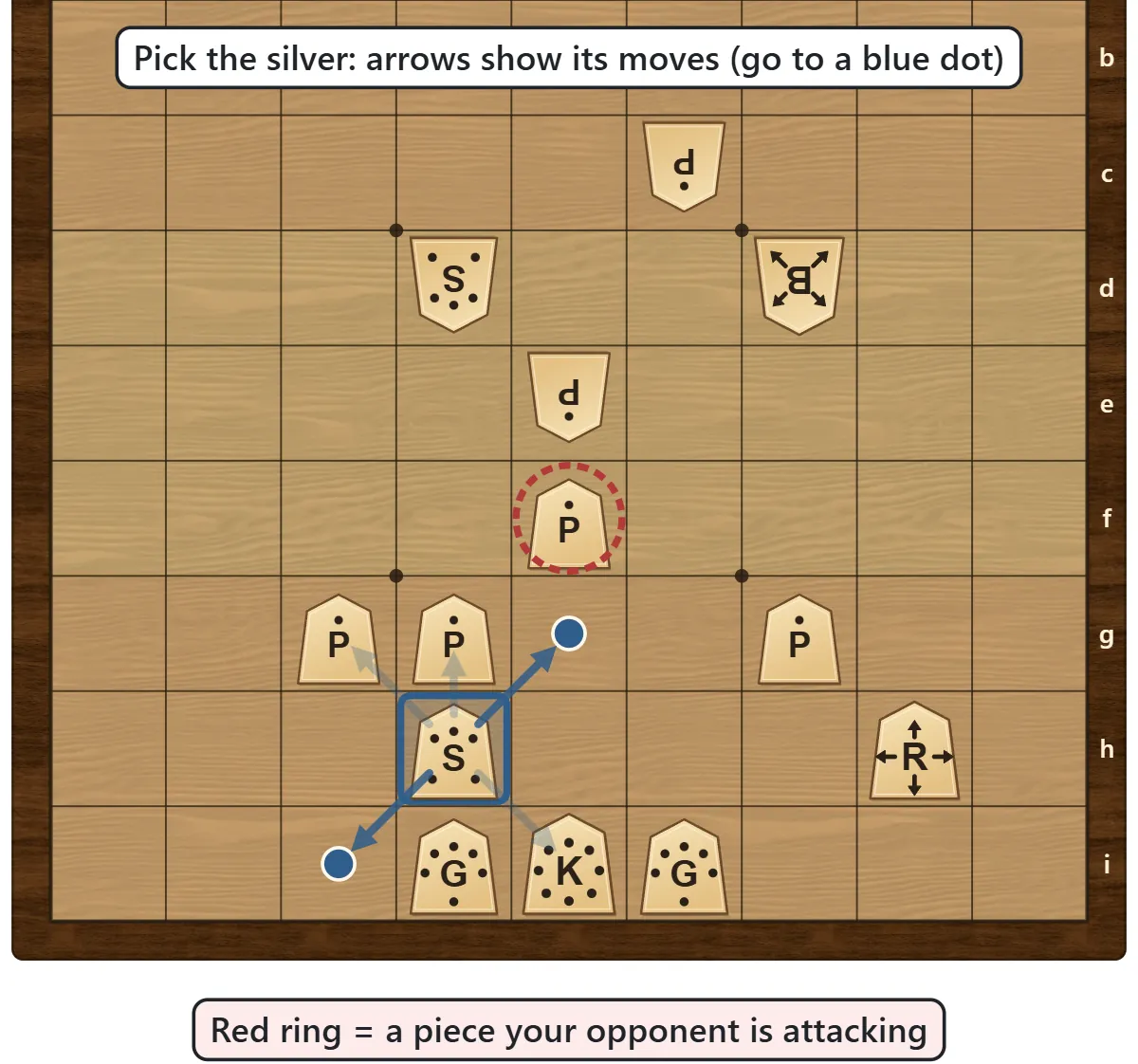
In the settings you can switch between letter pieces and traditional kanji pieces at any time; the board, your hand, the promotion dialog and the pictures on this page all follow your choice. With the move guide on, tapping a piece draws arrows in the directions it can move, and pieces that your opponent is attacking get a dashed red ring. Hint shows a suggested move with a green arrow, and Undo takes you back to your previous turn.
Below the board, the game record lists the moves in the Western notation used in English shogi books. A move like P-7f means a pawn moves to square 7f. Files are numbered 1 to 9 from right to left as the first player sees the board, and ranks are lettered a to i from the top. An x marks a capture (Bx2b), an asterisk marks a drop (P*5e), and a move that could promote ends in + if it did or = if it did not. When two identical pieces could reach the same square, the starting square is added, as in G6i-5h. The triangles show whose move it was: ▲ for sente and △ for gote.
Shogi strategy: tips for beginners
1. Check who defends a square before you move there
The most common way to lose early is to leave pieces where they can be taken for free. Before you move, ask whether any enemy piece can reach that square. In shogi a lost piece hurts twice: you lose it, and your opponent gains it to drop against you. The red rings of the move guide are a quick warning.
2. Build a castle around your king
At the start your king stands in the middle, where attacks will come. In the opening, move it two or three files to one side and gather the gold and silver generals around it. Shogi players call this defensive formation a castle, and even a simple one makes your king much safer when the pieces start flying.
3. Treat the rook and bishop with care
Rooks and bishops are the strongest pieces, and they become even stronger as the dragon and horse. Do not push them forward where a pawn or a silver can trap them; aim them at the enemy camp from a safe distance. A common first move is P-7f, which opens a diagonal for your bishop. Another is P-2f, which starts to advance the pawn in front of your rook.
4. Keep pieces in hand for the right moment
A piece in hand can appear on almost any square, which makes it a powerful threat. Drop to attack two things at once, to block a check, or to set up a mating net. The gold dropped on the head of the king – protected by another piece – is the most basic checkmate pattern, so golds and silvers in hand are especially valuable near the end.
5. Use pawns to open lines
Pawns are cheap, and in shogi you can often trade one on purpose. Pushing a pawn forward and letting it be captured can open a file for your rook or pull an enemy piece out of place. If the enemy takes your pawn, recapture: you are even again, and now you also have a pawn in hand to drop where it hurts.
6. When you are in check, look for all three answers
Do not panic when checked. Look for an escape square, a way to capture the checking piece, and a way to block – including a drop from your hand. Choose the answer that leaves your king safest, not simply the first one you see. The game only shows legal moves, so the blue dots list your options.
Shogi FAQ
Can I play shogi if I cannot read Japanese?
Yes. Choose the letter pieces: each one carries a single letter and marks that show its moves, so there is nothing to memorize before your first game. All menus and messages on this page are in English, and illegal moves are simply not offered.
How strong is the CPU?
Easy often misses captures, overlooks checkmates and drops pieces in odd places, so it is a good first opponent. Normal looks a little ahead: it moves pieces out of danger and looks for recaptures. Once you know how the pieces move you can beat it regularly. Hard reads more moves and punishes loose pieces quickly. Handicaps apply to every level.
Should I always promote?
Most of the time, yes: pawns, lances and knights become much more useful, and the dragon and horse are the strongest pieces in the game. Sometimes a silver or knight is better unpromoted, because it keeps its original moves. When promotion is forced, the game promotes automatically.
Why do the pieces all look the same color?
Because captured pieces switch sides, shogi pieces are not colored by player. You tell them apart by direction – yours point up the board, your opponent’s point down. Red on the letter pieces means promoted, not a different owner.
Can two people play on one device, and can I continue later?
Yes. Select “2 players on one device” and take turns: Player 1 moves the pieces at the bottom, Player 2 the pieces at the top. Your game is saved in your browser, so you can close the page and use Continue on the same device and browser. Sound is off at first; press “Sound: off” to turn it on.
Where shogi comes from
Shogi, chess, Chinese xiangqi and Thai makruk are thought to share an ancestor in the Indian game of chaturanga. How and when the game reached Japan is not certain, but records of shogi go back to the Heian period, roughly a thousand years ago, and a form close to today’s game was settled around the sixteenth century. The drop rule, which may have grown from the custom of using identical, uncolored pieces for both players, sets shogi apart from every other game in the family. During the Edo period families of shogi masters served the shogunate, and today professional players compete in title matches throughout the year.