 Yorimichi Games
How to play mini shogi
Mini shogi is shogi (Japanese chess) cut down to a board you can take in at a glance. The main game here uses a board 4 squares wide and 5 squares deep, and each player has only five pieces: a king, a gold, a silver, a bishop and a pawn. Every piece moves exactly as it does in full 9×9 shogi, so anything you learn here carries straight over to the big game. The features that make shogi special are all present: captured pieces switch sides and can be dropped back onto the board, and pieces that reach the far side can promote into stronger forms.
A game usually lasts about five minutes. That makes mini shogi a good first step if you have never played shogi, a quick way to practise drops and checkmates if you have, and a handy game for a short break. You can play the computer at three levels or share one screen with a friend. If you would like a slightly bigger challenge, the settings also include 5×5 minishogi, a well-known shogi variant that adds a rook.
Mini shogi setup
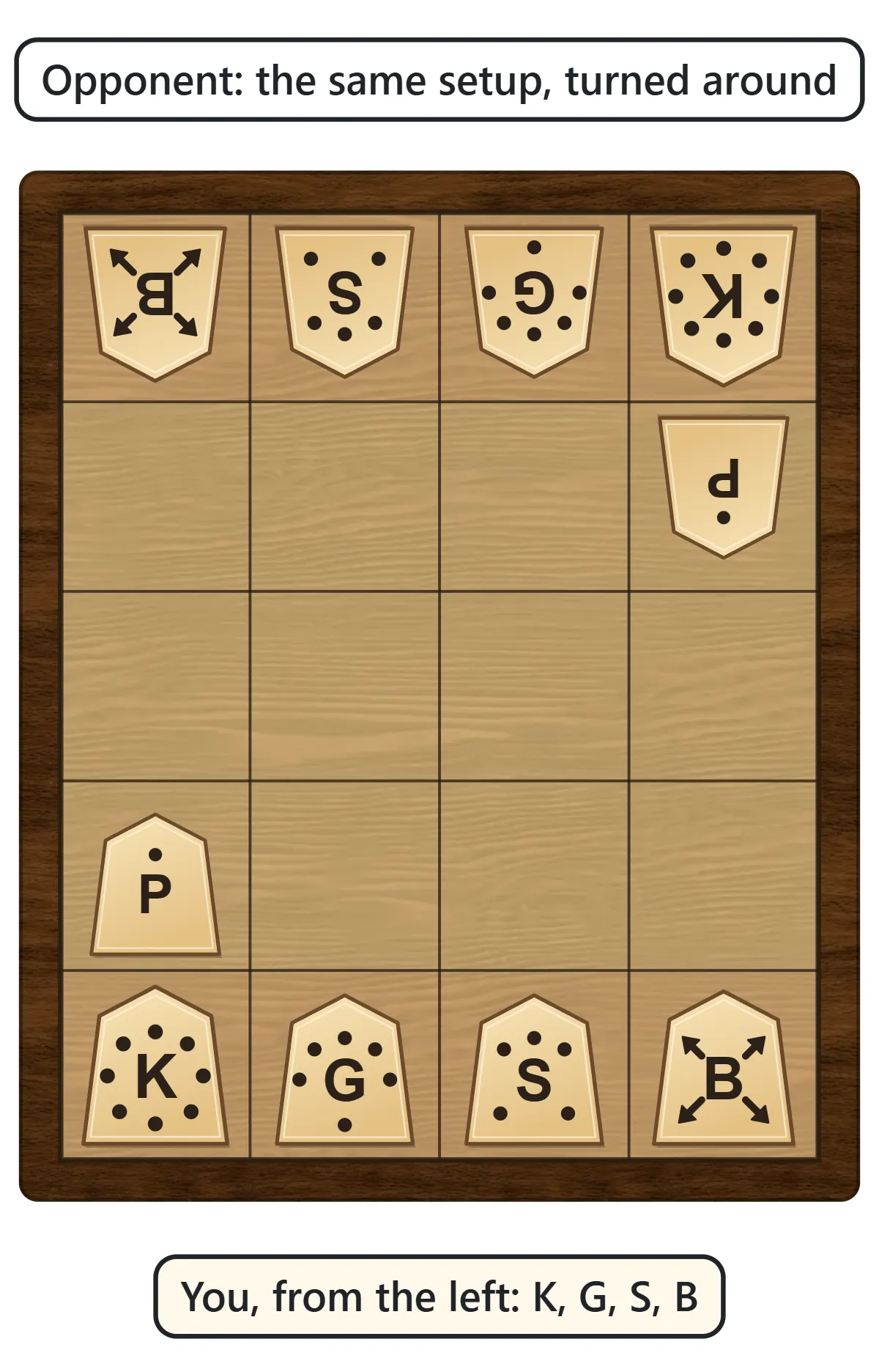
Each player sets up five pieces. On the rank nearest to you, place from left to right the king, the gold, the silver and the bishop, then put the pawn directly in front of the king. Your opponent uses the same arrangement rotated 180 degrees, so their king sits in the top right corner. This 4×5 layout is our own: it is the standard 5×5 minishogi setup with the rook removed so it fits four files.
In shogi, both sides’ pieces are the same colour. You tell them apart by the direction they point: your pieces point up the board, towards your opponent, and your opponent’s pieces point down towards you. On traditional pieces the kings are written with two slightly different characters, but they are the same piece with the same moves.
How the pieces move
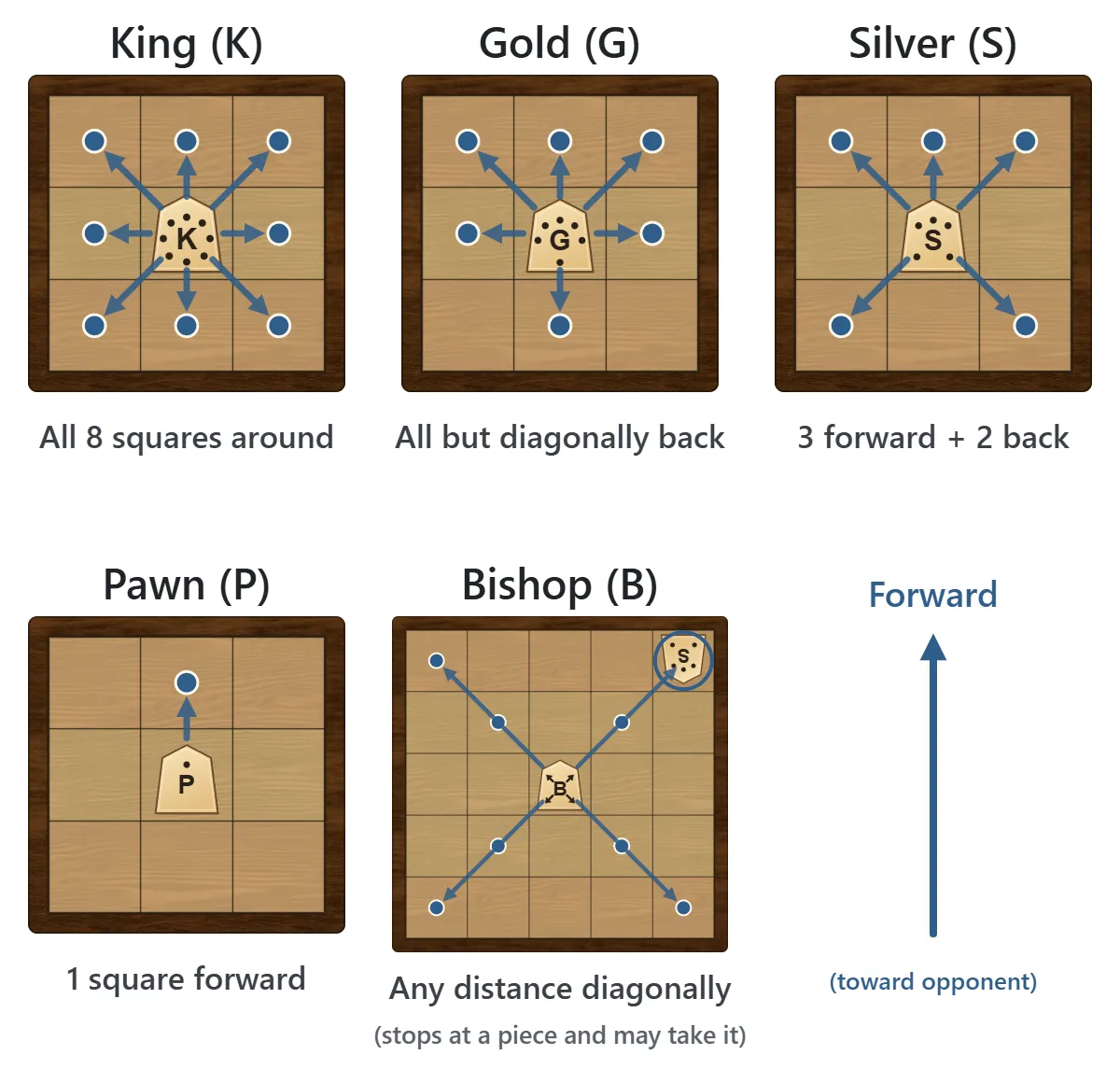
On your turn you either move one piece or drop one piece from your hand. The moves are:
| Piece | Moves |
|---|---|
| King (K) | One square in any of the eight directions |
| Gold (G) | One square forward, diagonally forward, sideways or straight back (not diagonally back) |
| Silver (S) | One square forward, diagonally forward or diagonally back (not sideways or straight back) |
| Bishop (B) | Any number of squares diagonally, until it meets another piece |
| Pawn (P) | One square straight forward, and it captures the same way |
You cannot move onto a square occupied by your own piece. Moving onto an opponent’s piece captures it. The bishop cannot jump: it stops when something is in the way, and if that something belongs to your opponent it may capture it. Note that the shogi pawn is simpler than a chess pawn: it always moves and captures straight ahead.
The letter pieces make these moves easy to remember. A dot next to the letter means “one step in this direction”, and an arrow means “as far as you like in this direction”. When a piece promotes, its letter and marks turn red and show the new moves.
Drops: using captured pieces
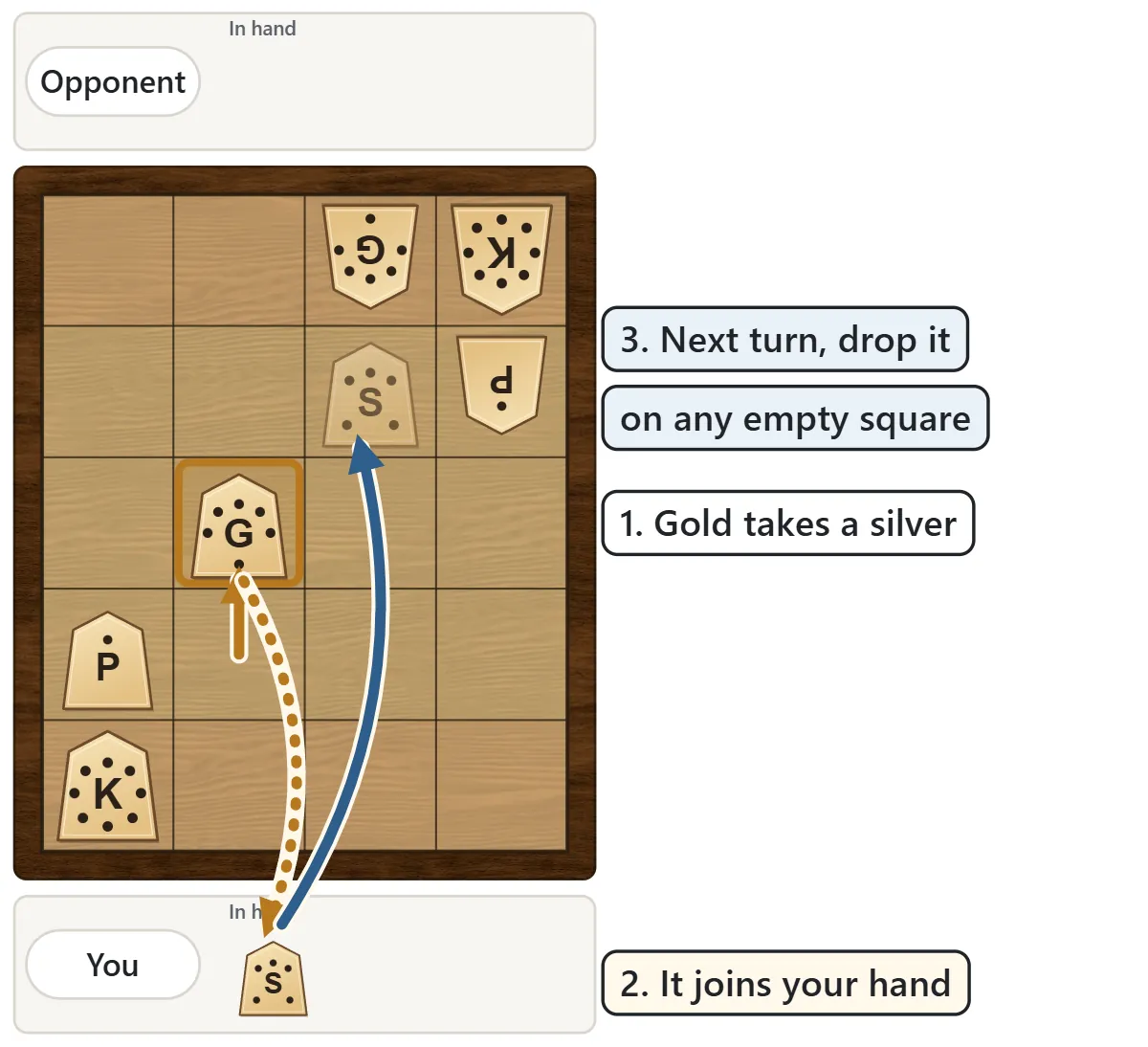
When you capture a piece, it becomes yours and goes into your hand, shown on the tray below the board. On any later turn, instead of moving a piece on the board, you may place one piece from your hand on any empty square. This is called a drop, and from the next turn the dropped piece moves normally as one of yours. There are a few limits. A pawn cannot be dropped on the last rank, because it would have no move. Under the standard rules you also cannot drop a pawn on a file that already holds one of your unpromoted pawns, and you cannot give checkmate with a pawn drop. A captured promoted piece always goes back to its original side, so a captured tokin becomes a plain pawn in your hand.
Promotion in mini shogi
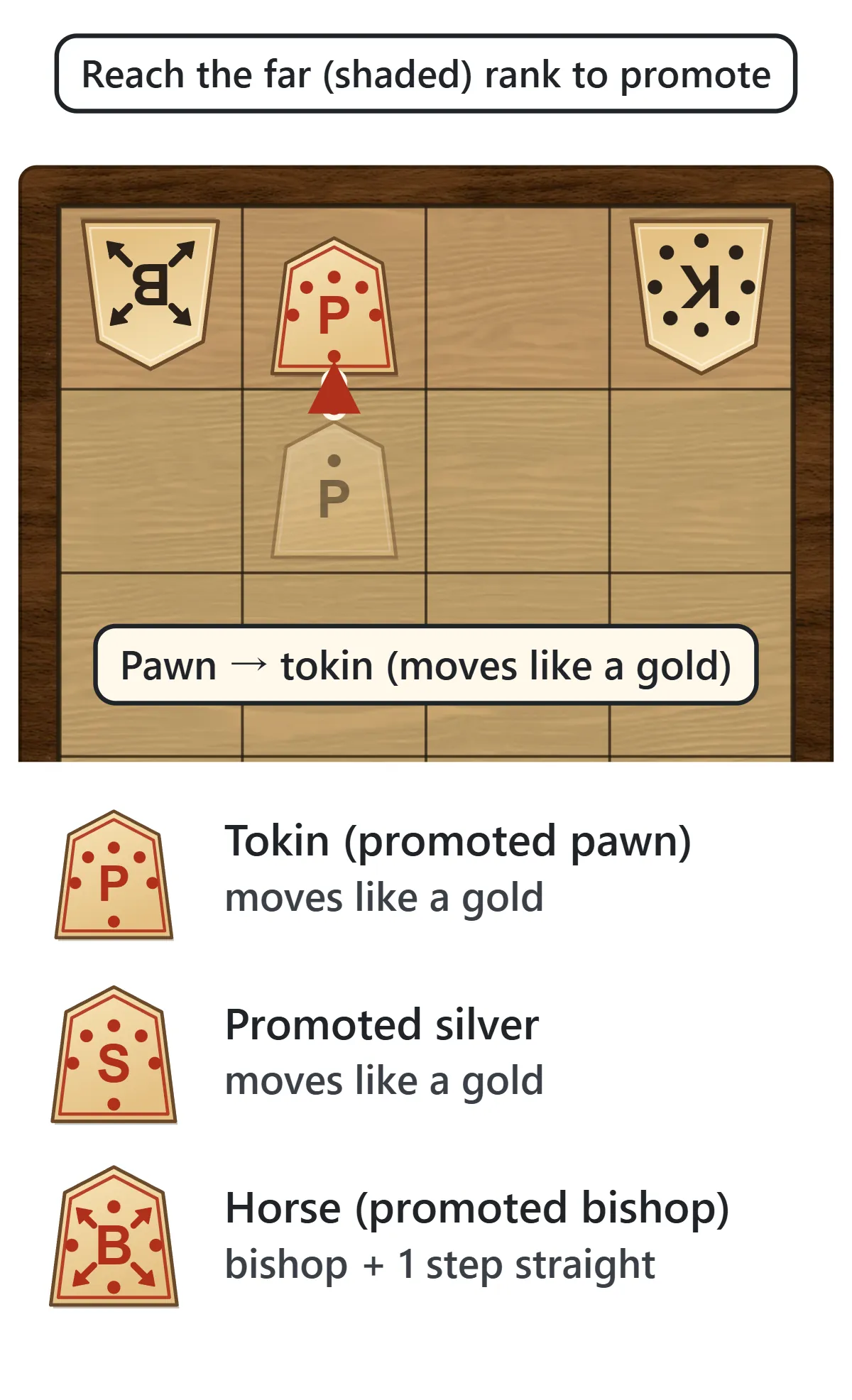
On this small board the promotion zone is only the far rank, the row where your opponent’s pieces start, lightly shaded on the board. When a piece moves into that rank, or moves out of it, it may promote. The pawn becomes a tokin and the silver becomes a promoted silver; both then move exactly like a gold. The bishop becomes a horse, which keeps its long diagonal moves and adds one step straight up, down, left or right. Kings and golds never promote. A pawn that reaches the far rank must promote, since it could never move again otherwise. For the silver and the bishop you choose, and the game asks you each time unless you pick the beginner rules, where pieces always promote automatically.
Check, checkmate and winning
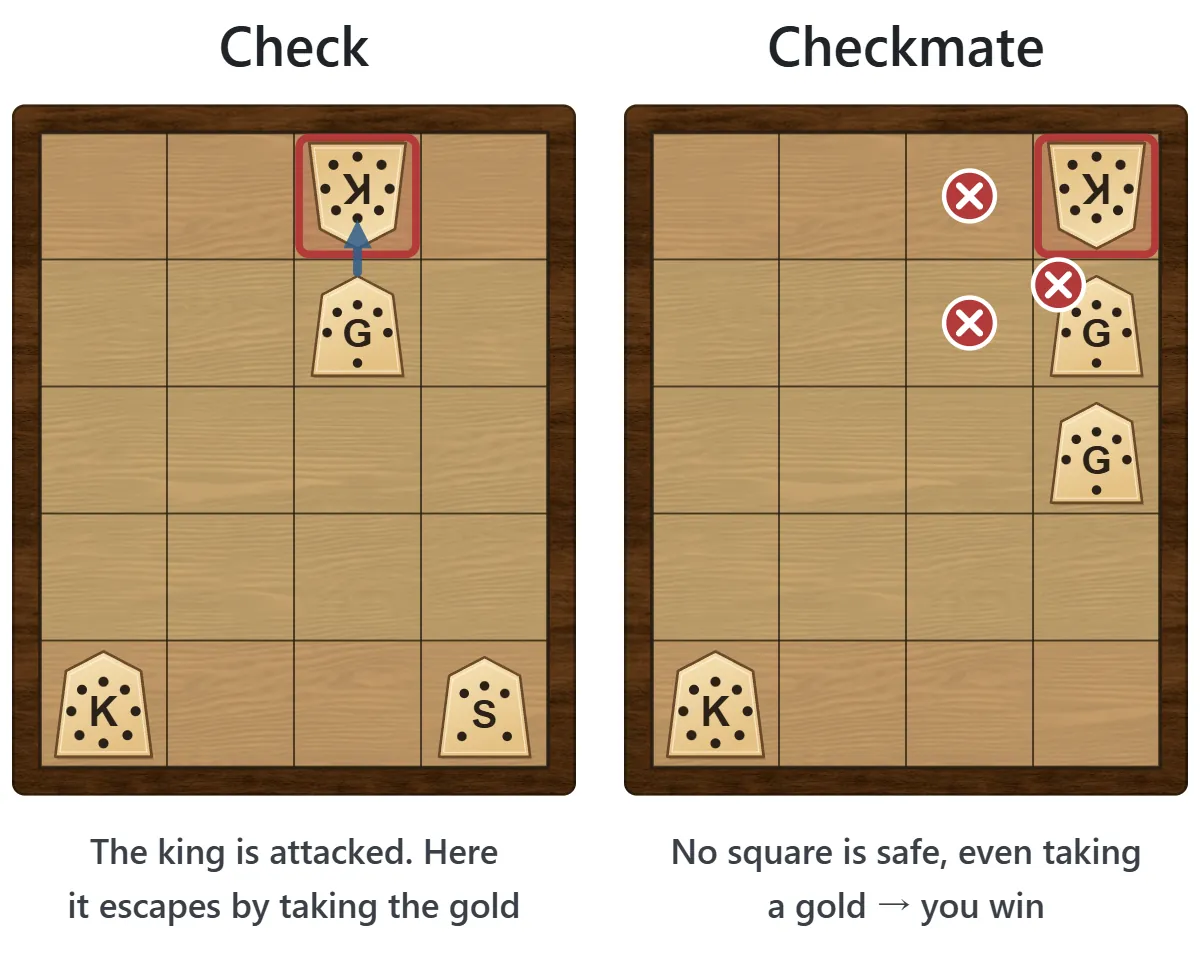
A king that is attacked is in check, and the game shows “Check!” on the board. You then have three ways out: move the king to a safe square, capture the attacking piece, or put a piece in between (by moving or by dropping). Under the standard rules and in 5×5 minishogi, the goal is checkmate, a check with no way out, just as in full shogi, and you are not allowed to make a move that leaves your own king in check. A player with no legal move at all also loses.
The beginner rules are more forgiving about learning checks but less forgiving about missing them: you may ignore a check, and the game ends as soon as someone actually captures a king. It is a very clear way to learn why the king must be protected.
Illegal moves and draws
With the standard rules, two moves are forbidden as in full shogi: nifu, having two unpromoted pawns on the same file, and uchifuzume, giving checkmate by dropping a pawn (checkmating by moving a pawn is fine). The game simply won’t let you make them and explains why. The beginner rules allow both. If the same position, with the same pieces in hand and the same player to move, appears four times, that is sennichite (repetition). It is normally a draw, but in 5×5 minishogi it counts as a loss for the player who moved first. If one player caused the repetition by giving check every move, that player loses instead. Very long games end in a draw after 200 moves on the 4×5 board or 300 moves on 5×5.
Move guide, hints and undo
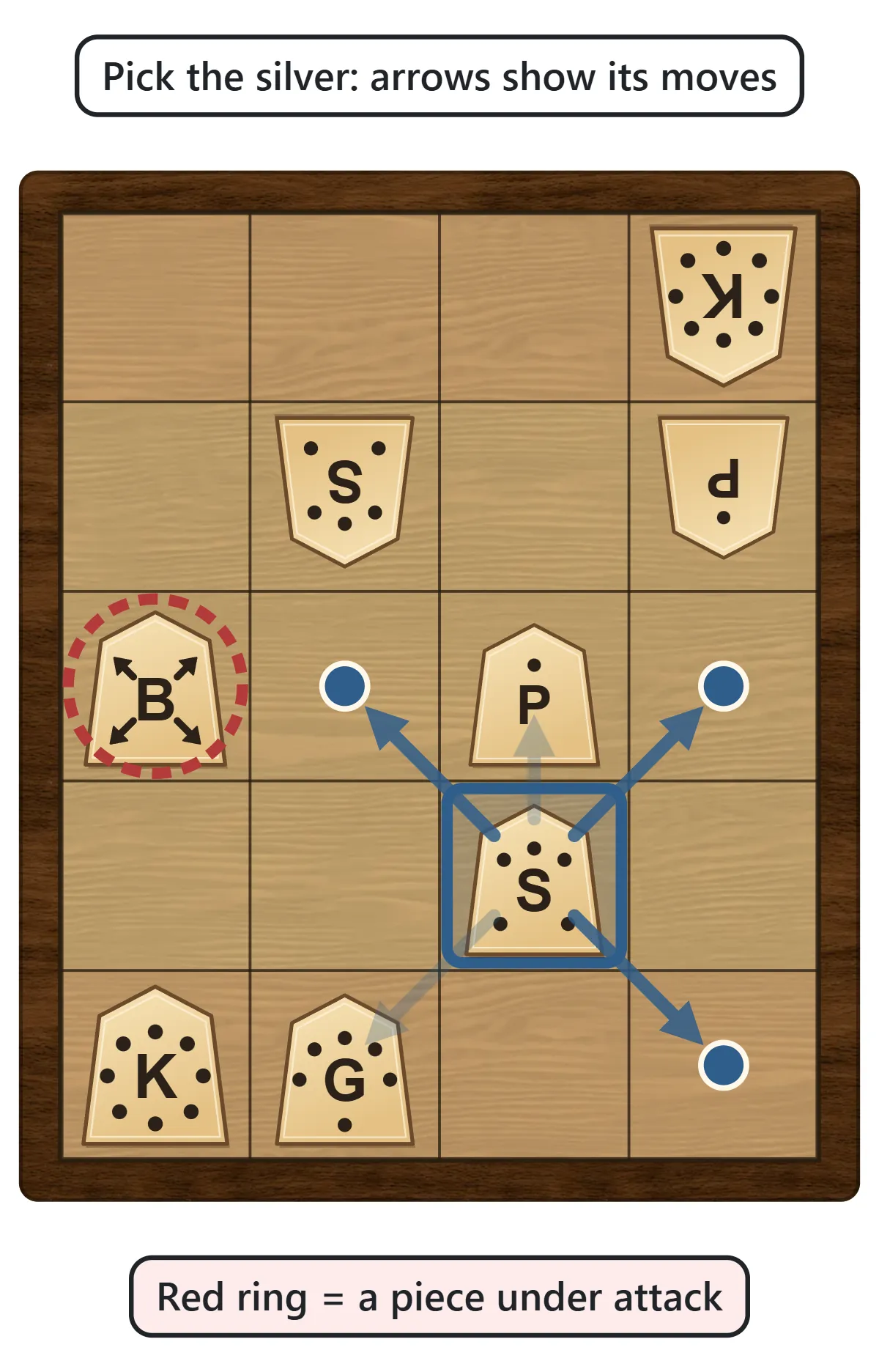
With the move guide switched on, selecting a piece draws arrows for every direction it can move, and a dashed red ring appears around any of your pieces that the opponent could capture next turn. Keep it on while you are learning the moves. Hint suggests a good move with a green arrow, and Undo takes you back to your last turn.
Mini shogi rules: which version to play
The settings offer three ready-made rule sets. Choose Custom, or open “Fine-tune the rules”, to change the board, the way to win and each special rule yourself.
| Rules | Board | How to win and special rules |
|---|---|---|
| Beginner | 4×5: K, G, S, B, P | Capture the king. Nifu and pawn-drop mate allowed. Pieces always promote. |
| Standard | 4×5: K, G, S, B, P | Checkmate. Nifu and pawn-drop mate illegal. You choose whether to promote. |
| 5×5 minishogi | 5×5: adds a rook | Full shogi rules. Repetition is a loss for the first player. |
Custom games can also add one unusual rule: a king that walks onto the far rank and survives there wins the game. It turns the king into an attacking piece and makes for a very different kind of race.
5x5 shogi (minishogi)
Minishogi, also called 5×5 shogi or gogo shogi, is the best known of the small shogi variants. Each side has six pieces: the same five as here plus a rook, which moves any distance straight up, down, left or right and promotes to a dragon that can also step one square diagonally. The back rank from left to right is king, gold, silver, bishop, rook, with the pawn in front of the king. The promotion zone is again just the far rank. With two long-range pieces each, minishogi is sharper than the 4×5 game and rewards reading a few moves ahead. It is a good choice once you win comfortably on the smaller board.
Mini shogi strategy tips
1. Before you move, check that the piece is safe
On a board this small every piece is close to the enemy. Before moving, look at the target square and ask whether any opposing piece can reach it. The red rings of the move guide are a quick reminder.
2. Think about the recapture
Taking a pawn with your gold looks free until the opponent’s silver takes your gold back. Look one move past the capture: if you lose more than you win, find another move.
3. Save your drops for the right moment
A piece in hand can land on almost any empty square, which makes it flexible. Dropped next to the enemy king it can give check out of nowhere, and dropped next to your own king it can block an attack. There is rarely a need to use it right away.
4. Keep the gold and silver near your king
A king with a gold or silver beside it is much harder to approach. A king standing alone can be checked by drops from several sides and cornered quickly.
5. Watch the bishop’s diagonals
The bishop attacks from across the board. Avoid leaving valuable pieces, especially your king, on an open diagonal of the enemy bishop, and look for chances to aim your own bishop at the opponent’s king or gold.
6. Push the pawn to make a tokin
The pawn is the weakest piece, but on the far rank it becomes a tokin that moves like a gold. Even better, if the tokin is captured your opponent only gains a pawn. A tokin deep in the enemy camp is a real threat.
Mini shogi FAQ
Can I play without knowing shogi?
Yes. There are only five kinds of piece, the letter pieces show their moves, and the move guide draws arrows when you select one. Start with the beginner rules against the Easy computer. Because the moves are the same as in full shogi, you can move on to the full game when you feel ready.
How strong is the computer?
Easy is good at grabbing pieces in front of it but often leaves its own pieces hanging or forgets to guard its king, so beginners can win against it. Normal sometimes looks ahead, steps out of danger and sets up recaptures; once you know the moves you should be able to beat it more often than not. Hard is careful about where it puts its pieces and punishes loose ones immediately, so it suits players with a few games behind them.
Can two people play on one device?
Yes. Choose “2 players on one device” as the opponent. Player 1 plays from the bottom and Player 2 from the top, taking turns on the same screen. Undo and hints work in this mode too.
Can I switch between letter pieces and kanji pieces?
Yes, at any time in the settings, even in the middle of a game. The pieces, the promotion window and the diagrams on this page all change together, and your choice is remembered next time.
Can I stop and continue later?
Yes. Open the page again in the same browser on the same device and press Continue. Sound is off at first; press “Sound: off” to turn it on.
Where mini shogi comes from
People have been shrinking the shogi board for a long time. The most famous small version is 5×5 minishogi, which is said to have been devised around 1970 by Shigenobu Kusumoto of Osaka. Other inventors have tried boards of 3×3, 4×5 and 6×6 squares, and variants where pieces flip over each time they capture. All of them share the same appeal: the kings meet within a few moves, so the core ideas of shogi (capture, drop, promote and checkmate) come up again and again in a short game. The 4×5 mini shogi on this page was designed in that spirit, as a gentle doorway into full shogi.