 Yorimichi Games
How to play Gunjin Shogi
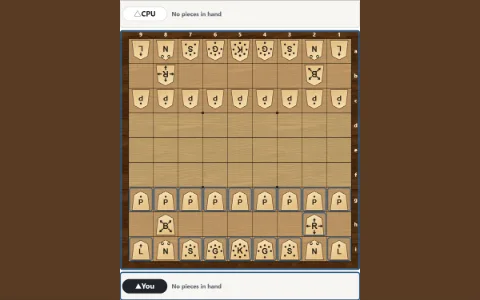
Gunjin Shogi, which translates as “military shogi”, is a two-player board game from Japan built around one simple idea: you never see what your opponent’s pieces are. Each side has a set of ranked officers from General down to Second Lieutenant, plus a few special pieces such as the Plane, the Tank, the Engineer, the Spy, the Mine and the Flag. All of them stand face down, so the other player only sees the backs. When two pieces meet, a referee looks at both of them in secret and announces which one stays on the board. The players learn only “you won”, “you lost” or “it’s a tie”, and from those results they piece together what is hiding on the other side.
At a real table you need a third person to act as the referee. In this online version the referee is built into the game, so you can play against the computer on your own. The CPU plays fair: it sees exactly what you see and never peeks at your hidden pieces.
The board and setting up your pieces
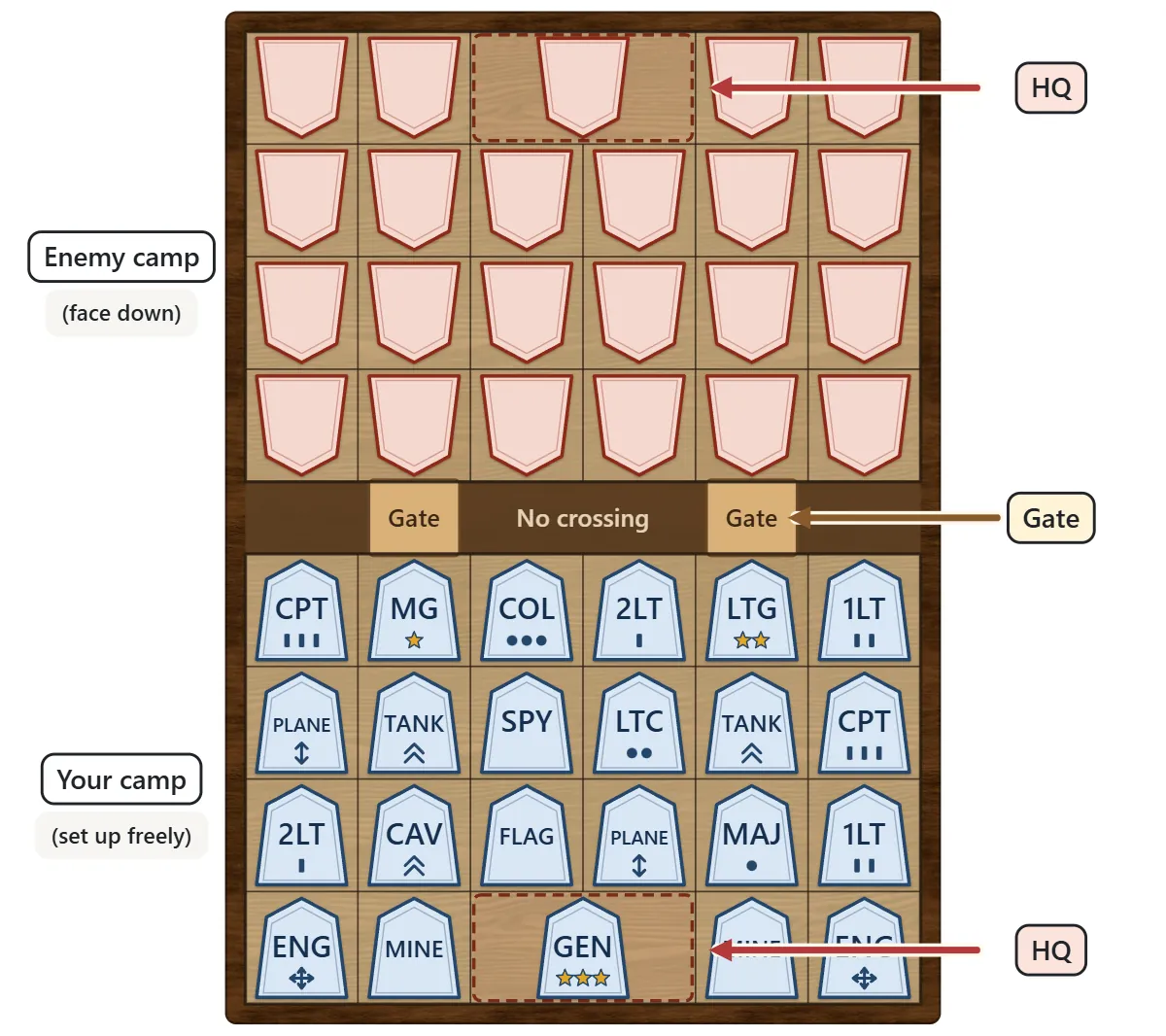
The board is split into two camps with a strip in the middle that pieces cannot enter. The only ways across are the two gates, which work like bridges over the strip. The two middle squares of each back row form that side’s headquarters. It is drawn as one wide square and holds a single piece.
You may place your pieces anywhere in your own camp, with one restriction: the Mine and the Flag, which can never move, may not stand on the square directly in front of a gate (the lightly shaded squares). Choose Automatic and the game lays out your pieces using common ideas, such as a strong piece or a Mine in the headquarters and strong pieces near the gates. Choose Arrange my own to start from that layout and then tap two of your pieces one after the other to swap them.
How the pieces move
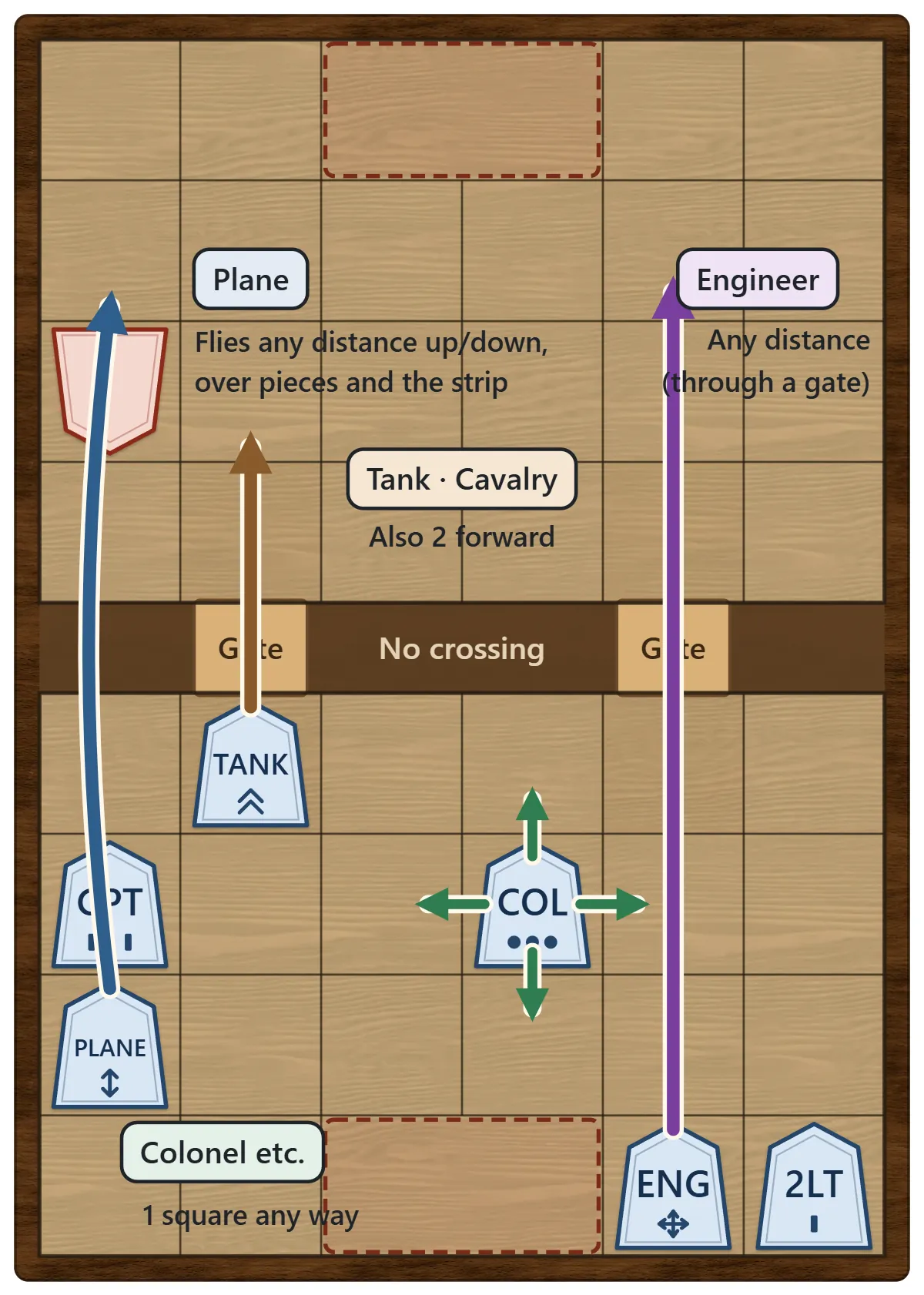
| Piece | How it moves |
|---|---|
| Officers (General to Second Lieutenant) and the Spy | 1 square up, down, left or right |
| Tank and Cavalry | 1 square in a straight line, or 2 squares forward if the first square is empty |
| Engineer | Any number of empty squares in a straight line, like a rook in chess (no jumping) |
| Plane | Any distance up or down, flying over pieces and over the strip; 1 square sideways |
| Mine and Flag | Never move |
On your turn you move one piece. If an enemy piece stands on the square you want, you move into it and a battle takes place. You can only cross into the enemy camp through a gate. The Plane is the one exception: it can fly across from any column.
Battles and the referee

When pieces meet, the referee’s decision appears in the middle of the board. If the attacker wins, it moves into the square. If it loses, the attacker is removed. Two pieces of the same kind tie, and both are removed. Pieces that leave the board never come back, and unlike regular shogi you never capture a piece to use it yourself.
The setting After a battle, show decides how much you learn. Nothing is the classic way to play: you only hear who won. The winning piece turns the winner face up, which makes it much easier for beginners to track the enemy’s strongest pieces. Both pieces reveals everything that fought.
Gunjin Shogi piece ranks: who beats whom
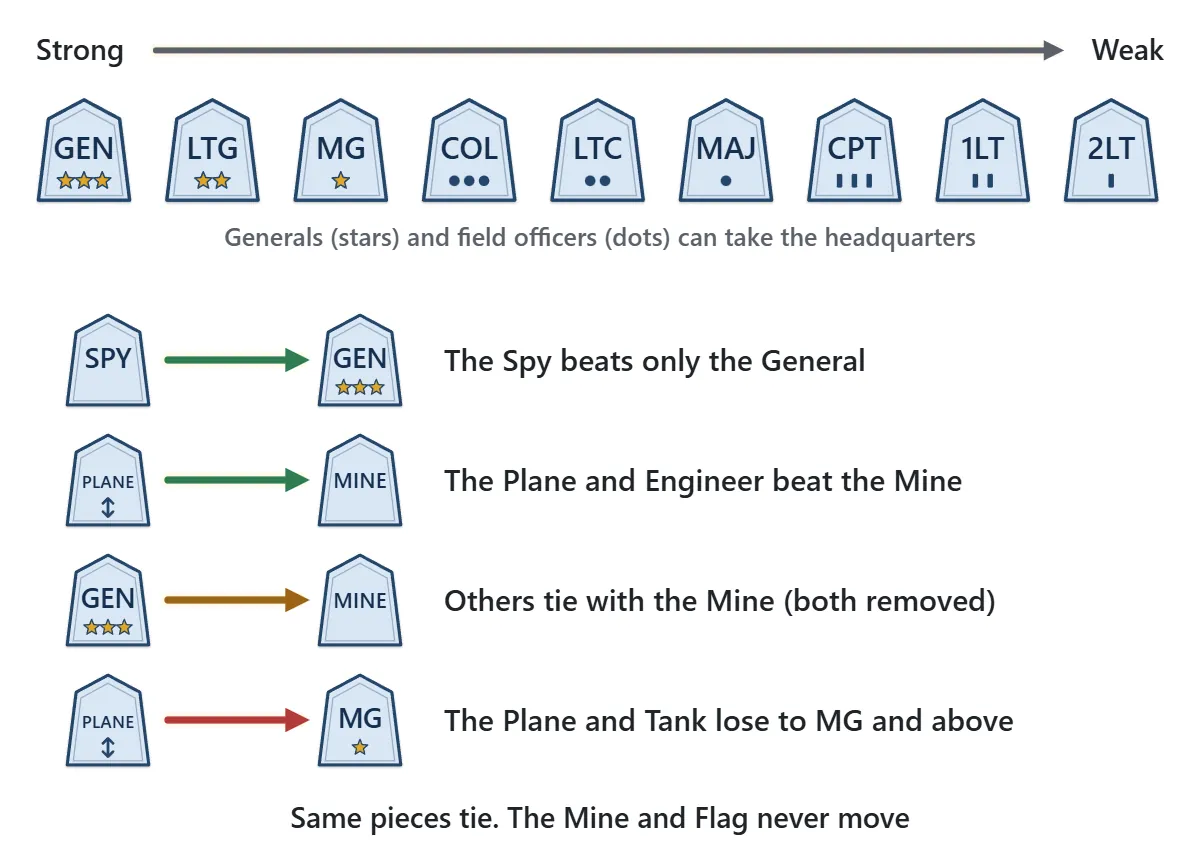
The officers follow a simple ladder. A higher rank always beats a lower rank:
| Rank | Label | Marks |
|---|---|---|
| General 大将 (taishō) | GEN | 3 stars |
| Lieutenant General 中将 (chūjō) | LTG | 2 stars |
| Major General 少将 (shōshō) | MG | 1 star |
| Colonel 大佐 (taisa) | COL | 3 dots |
| Lieutenant Colonel 中佐 (chūsa) | LTC | 2 dots |
| Major 少佐 (shōsa) | MAJ | 1 dot |
| Captain 大尉 (taii) | CPT | 3 bars |
| First Lieutenant 中尉 (chūi) | 1LT | 2 bars |
| Second Lieutenant 少尉 (shōi) | 2LT | 1 bar |
On top of that ladder come the special pieces:
- The Spy is the weakest piece, but it beats the General, whether it attacks or is attacked.
- The Plane loses only to the three generals. It beats every other piece, including the Mine.
- The Tank loses to the generals, the Plane and the Engineer, and beats the other officers, the Cavalry and the Spy.
- The Engineer beats the Mine, the Tank and the Spy and loses to everything else. The Cavalry beats only the Engineer and the Spy.
- The Mine never moves. The Plane and the Engineer beat it; any other piece that runs into it ties, and both leave the board.
You never need to memorize all of this. The Piece chart button shows every matchup for the board you are playing.
The Flag borrows its strength
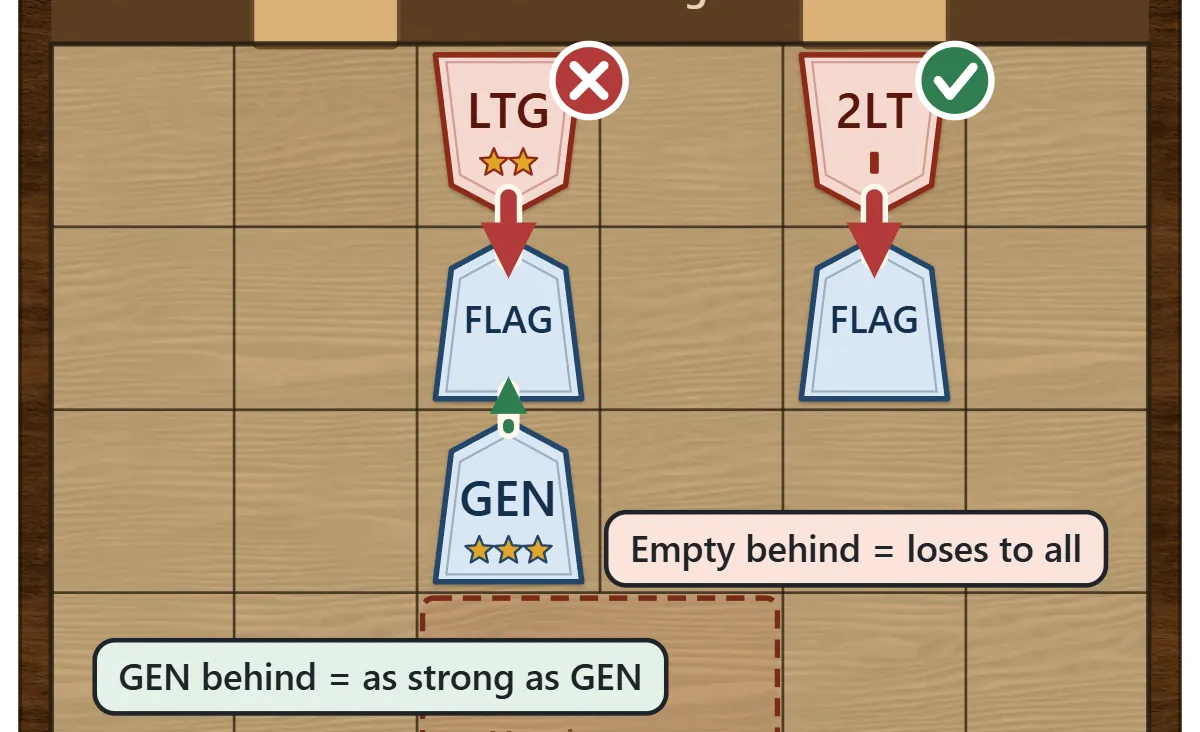
The Flag cannot move, and it has no strength of its own. Instead it is exactly as strong as your piece directly behind it, on the side closer to your back row. With a General behind it, the Flag fights like a General. With a Mine behind it, an attacker and the Flag tie, and the Mine stays. If the square behind is empty or holds an enemy piece, or if the Flag sits on your back row, it loses to anything.
How to win
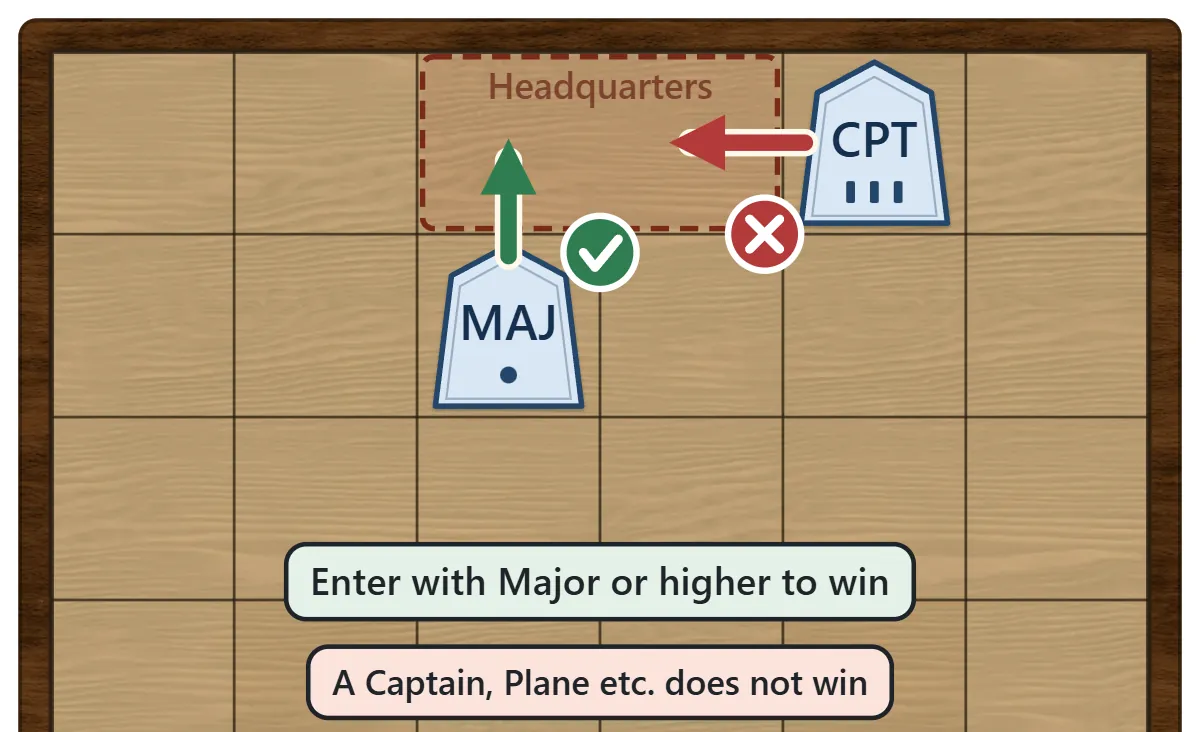
You win when a General, Lieutenant General, Major General, Colonel, Lieutenant Colonel or Major enters the enemy headquarters. If an enemy piece is standing there, beating it takes the headquarters at once. Captains and lieutenants, the Plane, the Tank and the other special pieces can go in, but that does not win the game. You also win if your opponent has no movable pieces left (everything except the Mines and the Flag). The game is a draw if both sides run out of movable pieces at the same moment, or if it reaches the move limit (320 moves with 23 pieces).
Deduce the hidden pieces and take notes
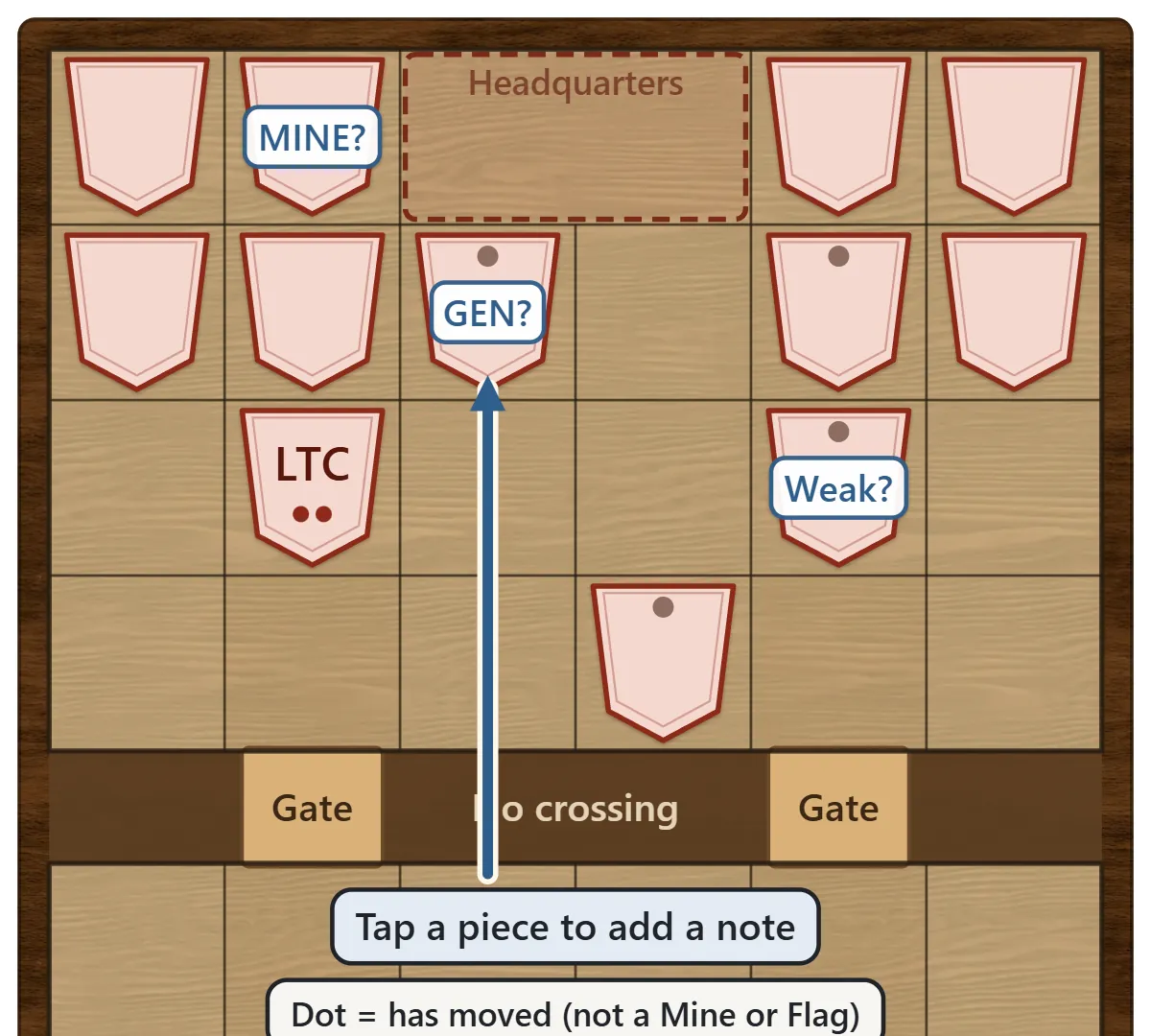
Tap any hidden enemy piece to attach a note such as GEN?, MINE?, Strong? or Weak?. A small dot appears on every piece that has moved at least once, so you know it is neither a Mine nor a Flag. A piece that jumped two squares forward must be a Tank, Cavalry, Engineer or Plane, and a piece that flew over the strip is a Plane. Results help too: whatever beat your Colonel must be a general, a Plane or a Tank.
Gunjin Shogi rules and variations
Gunjin Shogi has been sold and played in Japan for more than a century, and the number of pieces and the small rules differ from set to set and region to region. This version offers three well-known setups.
| Setup | Board and pieces | Good for |
|---|---|---|
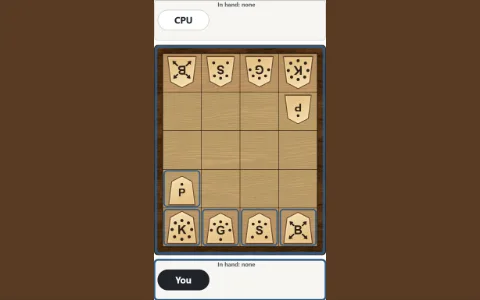
| Starter | A 6×3 camp with 17 pieces; no Flag, Cavalry, Lieutenant Colonel or lieutenants | First games; fewer pieces to learn and shorter games |
| Standard | A 6×4 camp with the classic 23-piece set | The usual game |
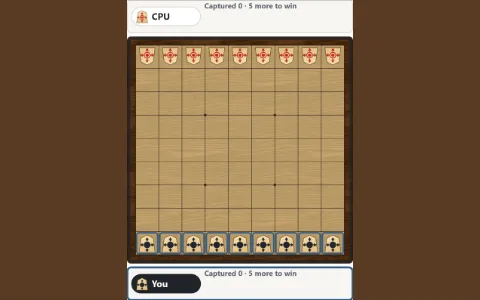
| Large board | An 8×4 camp with the 31-piece set | Long, thoughtful games |
Under Fine-tune the rules you can pick house rules that vary between regions. In the traditional result chart the Engineer beats the Tank, but many players grew up with video game versions where the Tank wins, so both are available. You can also let a winning Mine stay on the board, or play so that losing your General loses the game.
Gunjin Shogi strategy tips
1. Guard your headquarters with a strong piece or a Mine
An empty or weakly held headquarters can fall to a single Major. Place your General there, or put a Mine in it with the General or Lieutenant General next door. Once the game starts, avoid moving the piece in your headquarters without a good reason.
2. Don’t send strong pieces into pieces that never moved
A piece that has not moved might be a Mine. If your General runs into a Mine, both are gone. Test unmoved pieces with low-ranking officers, or with an Engineer or Plane, which beat Mines.
3. Attack with the Lieutenant General and Major General
The General loses only to the Spy, which is exactly why it attracts the Spy when it goes forward. Keep the General back for defense and send the next two ranks after moving enemy pieces. If your Lieutenant General loses, you know that piece is the General.
4. Narrow things down from every result
The weaker the piece that wins, the more you learn. If your Cavalry wins, the enemy piece must have been an Engineer or a Spy. Write what you learn in the notes, and later you will know where to send your strongest pieces.
5. Your Plane gives itself away
As soon as a Plane flies over the strip or another piece, everyone knows what it is. Early on, move it one square at a time and let it pretend to be an ordinary officer.
6. Keep the Spy close to where the General will come
Once you know which piece is the enemy General, the Spy beats it. Because the Spy loses to everything else, do not push it too far forward; let it wait behind your front line.
Gunjin Shogi FAQ
Can I play without a referee?
Yes. The game’s built-in referee decides every battle, so you can play against the CPU on your own. It only reveals pieces in the way you chose in the settings.
Does the CPU see my pieces?
No. The CPU works only from what is visible on the board: which pieces moved and how, which piece left the board after each battle, and any pieces that were revealed. It never looks at your hidden pieces.
How do the CPU levels differ?
Easy sets up carelessly, wanders forward without much thought and sometimes forgets to guard its headquarters, so it is a comfortable opponent for your first games. Normal reads clues from moves and results but makes the occasional slip. Hard is wary of Mines and keeps a solid defense.
Can I undo a move or pause?
Yes. Undo takes you back to just before your last move, together with the CPU’s reply. Pause stops the CPU from thinking until you resume. If you close the page in the middle of a game, press Continue on the same device to pick up where you left off. Sound is off until you turn it on.
What do GEN, LTG and the stars mean?
With the English piece style, each officer shows a short rank label and marks for its strength: three, two or one star for the generals, dots for the field officers (Colonel, Lieutenant Colonel, Major) and bars for the company officers (Captain and lieutenants). More marks means a higher rank within the group, and stars beat dots, which beat bars. The special pieces show their names instead, with small arrows for the Plane, Tank, Cavalry and Engineer as a reminder of how they move. Choose Traditional (kanji) to see the pieces as they are written in Japan.
Why are the rules different from the set I own?
Sets and regions differ in the number of pieces, the shape of the board and the small rules. This version uses the long-established 23-piece and 31-piece sets and their traditional result chart. The number of gates and the size of the headquarters were chosen to keep the board easy to read.
What is Gunjin Shogi?
No one knows exactly who invented Gunjin Shogi or when. Records show that sets were already being made and sold in the middle of the Meiji era, in the 1890s, and the game has also gone by names such as kōgun shōgi (“marching shogi”). A children’s games book from the end of the Meiji era describes it as a pastime known all over Japan. Despite the name, it shares little with regular shogi apart from the pentagon-shaped pieces. What makes it special is hidden information: unlike shogi or chess, where everything is in plain view, the fun lies in bluffing, reading your opponent and making good guesses. Families in Japan still play it at home, with a parent or a friend happy to take the role of the referee.