 Yorimichi Games

How to play Ohajiki
Ohajiki is a traditional Japanese game played with small, flat glass pieces, a little like marbles that have been pressed into coins. Everyone puts the same number of pieces into a shared pile and scatters them across a table. Players then take turns flicking one piece into another with a fingertip. Hit the piece you were aiming at – and nothing else – and it is yours. When the table is nearly empty, the player who has collected the most pieces wins. The name comes from the Japanese verb hajiku, “to flick”.
This online version shows a low Japanese table from above. You can play against the computer, or pass one phone, tablet or computer around so that 2 to 4 people can play together.
1. Scatter the pieces
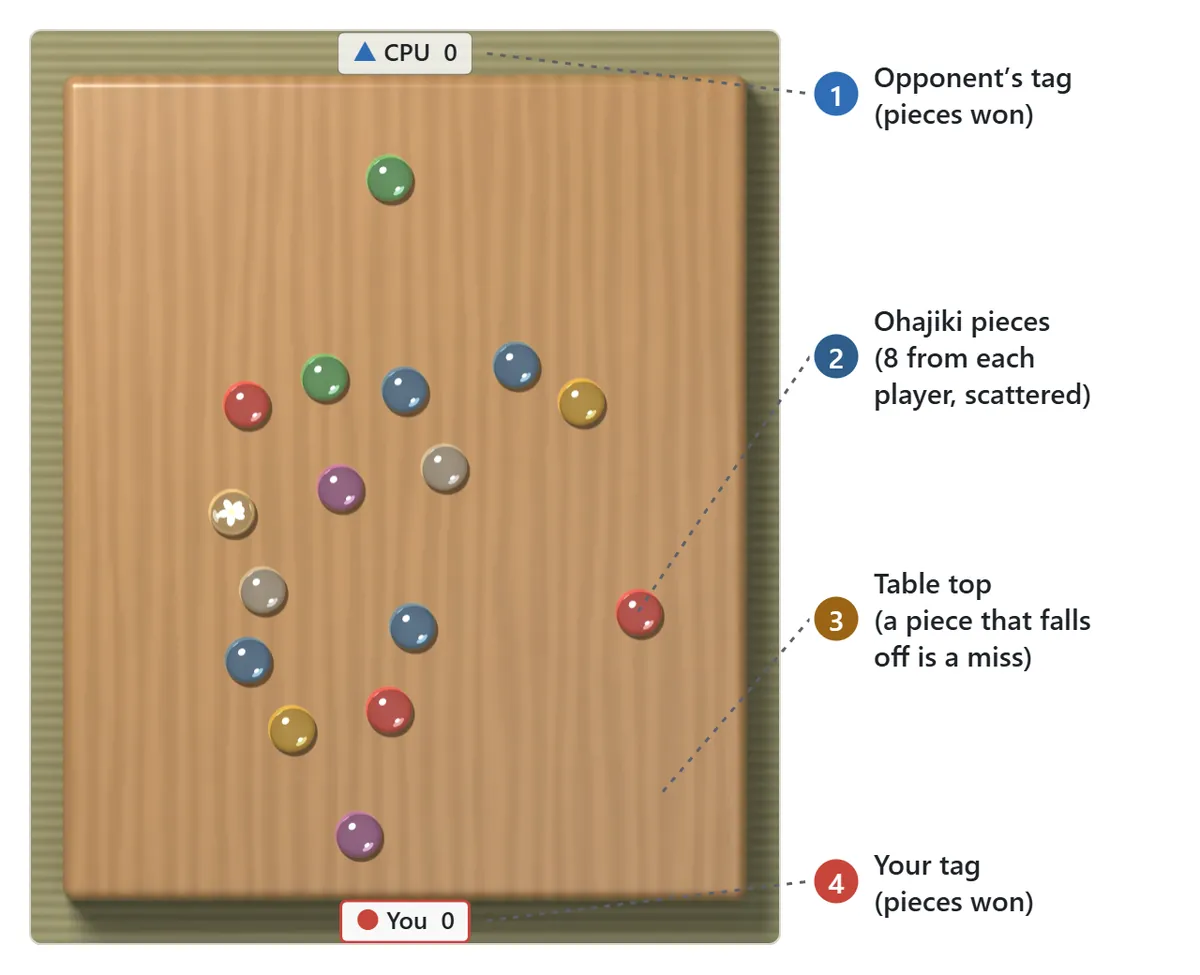
At the start, each player puts in the same number of pieces (5, 8 or 10, set in the options) and they are scattered at random across the table top. A coin toss decides who flicks first, and play then goes around in order. Each player’s count of pieces won is shown on their name tag and in the bar above the table.
2. Choose a piece to flick and a target
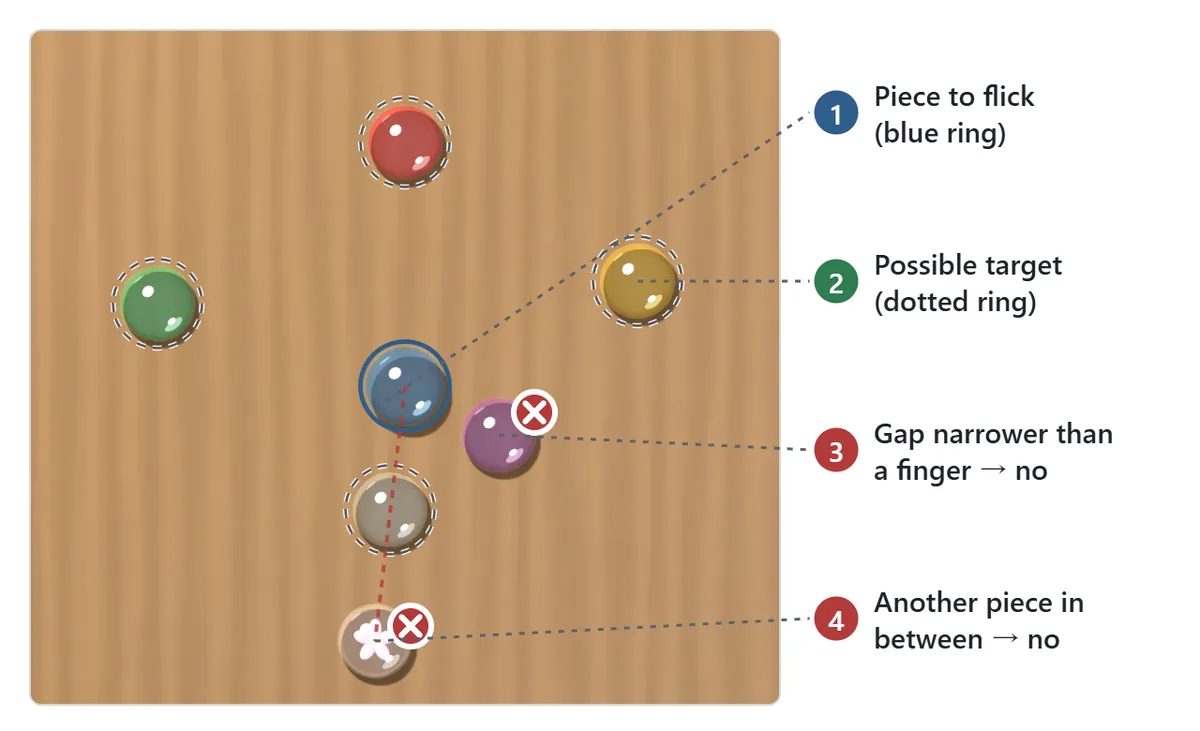
On your turn, first pick the piece you will flick – any piece on the table will do. Every piece you are allowed to aim at then gets a dotted ring, and you pick one of those as your target. Two kinds of pair are not allowed: pieces that sit closer together than the width of a finger, because you could not draw a line between them, and pieces with a third piece in the straight line between them.
3. Draw a line between them
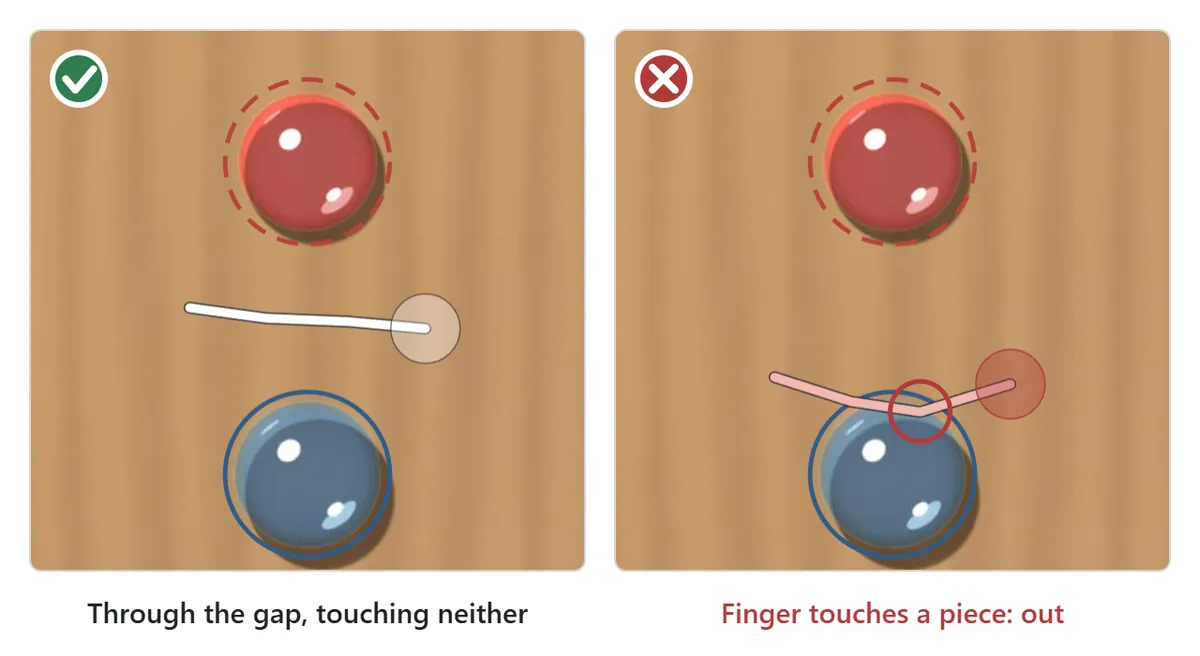
Once both pieces are chosen, the view zooms in and you draw a line through the gap between them with your finger or mouse. This is the traditional signal that says “these are the two I am playing”, and people have long done it with their little finger. If your finger touches either piece while drawing, you are out and the turn passes without a flick. If your line simply misses the gap, you can try again.
4. Pull back and flick
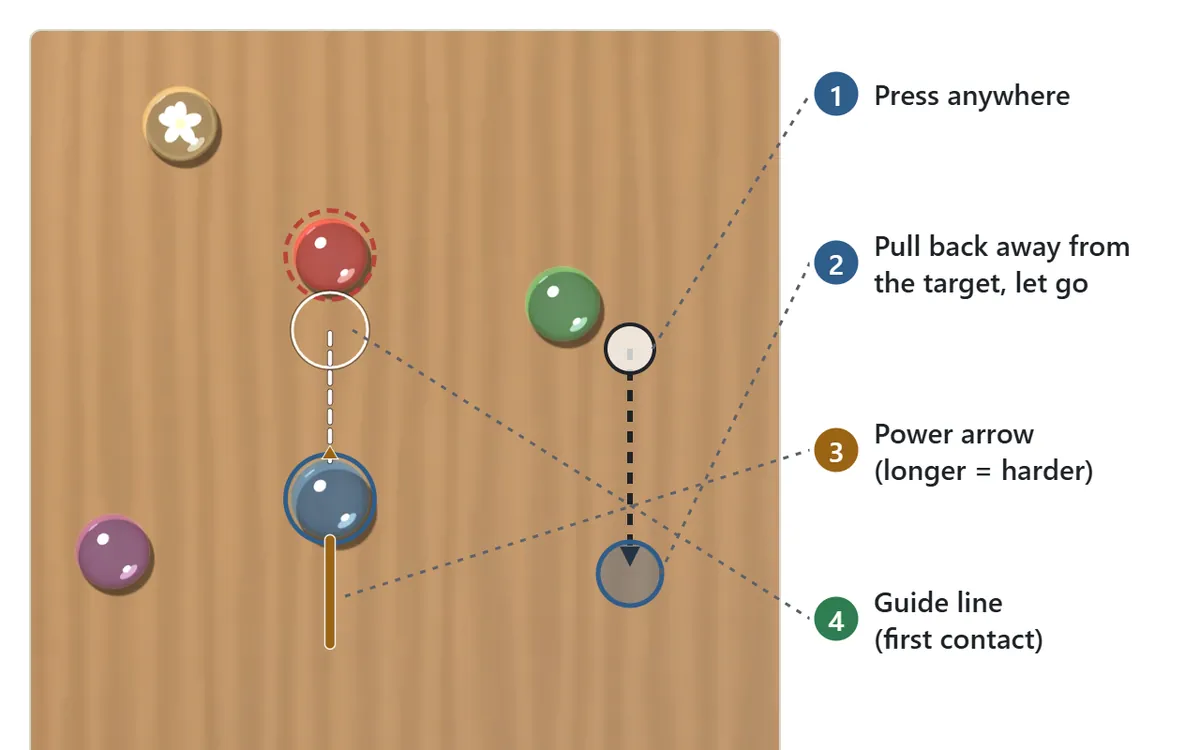
With the line drawn, press anywhere on the table, pull back in the opposite direction from where you want the piece to go, and let go. The farther you pull, the harder the flick. With the guide line switched on, a white dotted line shows where your piece would travel up to the first thing it touches. If you prefer, you can set the direction with the “<” and “>” buttons and the power with the slider, then press “Flick”.
5. Hit only your target to win it
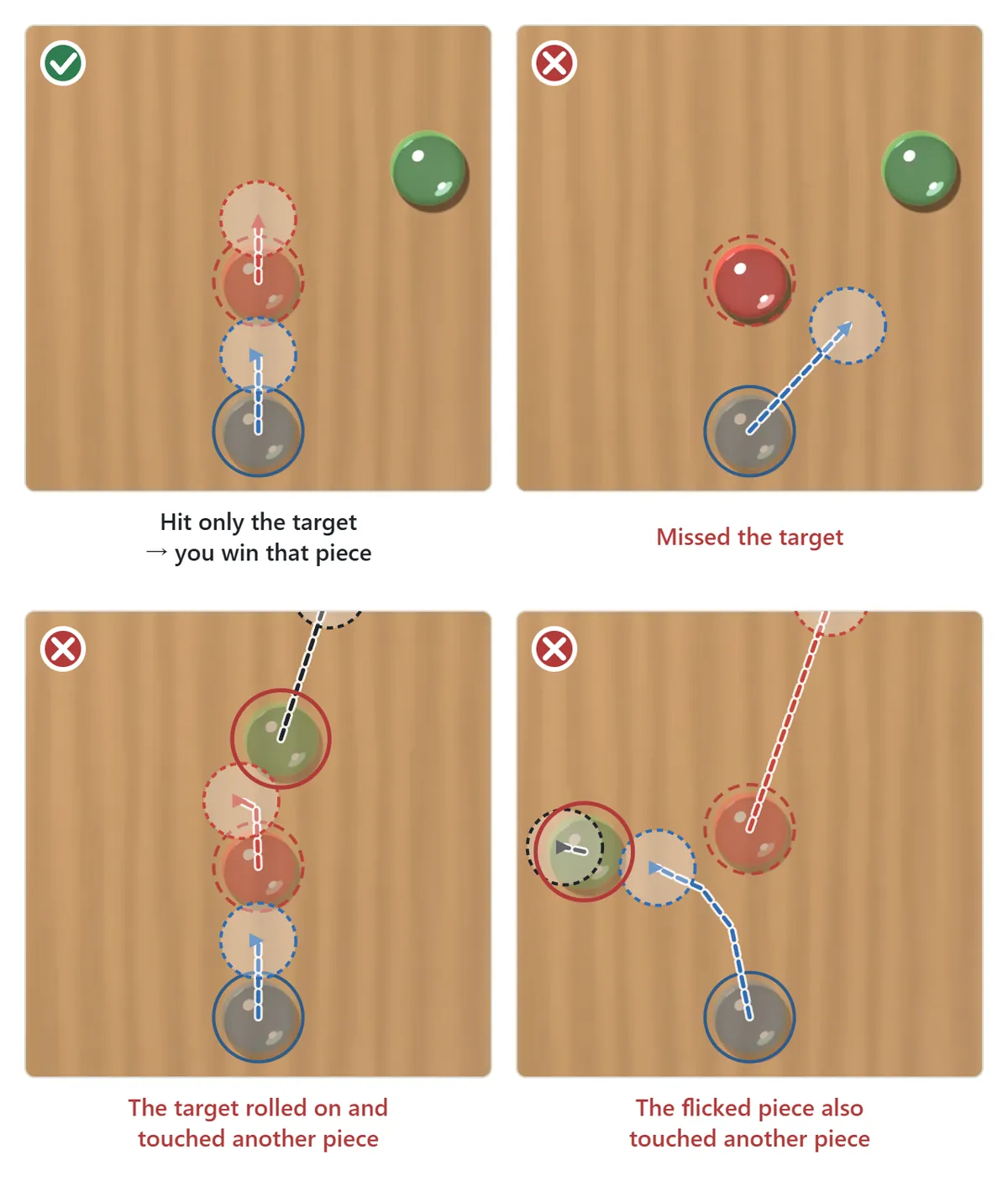
If your piece hits the target and nothing else touches anything, you win the target and flick again straight away. The flick fails if you miss, if you hit a different piece, if the target rolls on and bumps into another piece, or if a piece slides off the edge of the table. Then it is the next player’s turn. A piece that falls off is put back on the edge of the table near where it fell.
6. How the game ends
The game ends when only one piece is left on the table. The player with the most pieces wins; equal counts are a draw. If at some point no two pieces can be paired any more, the remaining pieces are gathered up and scattered again.
Ohajiki rules: Standard vs Traditional
Ohajiki rules vary from region to region and even from family to family. This game gathers the best-known ones into two sets, Standard and Traditional, and the Custom option lets you switch each rule on or off yourself.
| Rule | Standard | Traditional |
|---|---|---|
| Touching a piece while drawing the line | Out | Out |
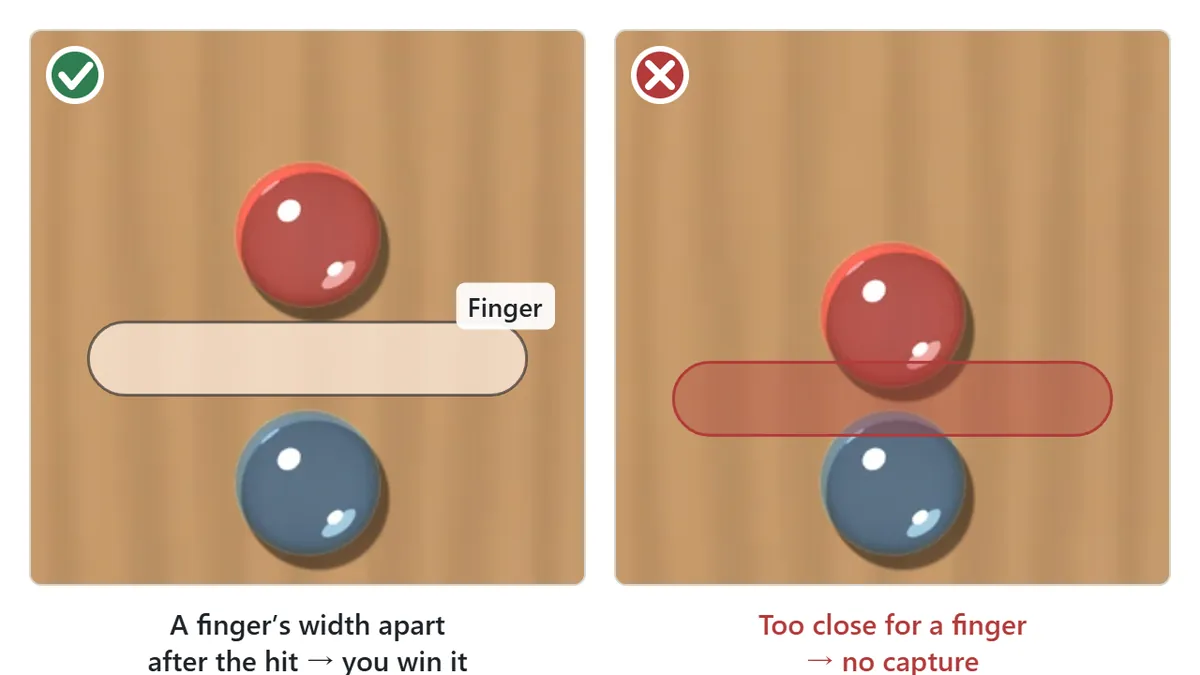
| Kiru (cut) after the hit | Not needed | The two pieces must end up a finger’s width apart |
| Onebo (pieces that land touching) | None: pieces are scattered apart | Given to the first player |
Kiru means “to cut”: after the hit, you must be able to slide a finger between the two pieces. It turns every flick into a test of touch, because a gentle tap that leaves the pieces touching wins nothing. Onebo are pieces that land stuck together when the pile is scattered; under the Traditional rules the first player collects them before the first flick. In Custom you can also allow a redraw when your line touches a piece, or let a successful flick win both the target and the flicked piece. If you are new to the game, start with Standard.
Computer opponents
| CPU level | What it feels like |
|---|---|
| Easy | Grabs at nearby pieces and often flicks too hard, knocking into other pieces. Good for learning the rules |
| Normal | Picks pairs that are easy to hit, but sometimes misjudges the power. For players who are getting a feel for the flick |
| Hard | Chooses pairs with open space around them and hits with just the right power, though it still misses now and then |
Ohajiki tips and strategy
1. Pick close pairs with open space
The easiest pairs are neither too close nor too far apart, with nothing sitting beyond the target. A piece you hit keeps rolling in the direction it was struck, so check that the path behind it is clear before you commit.
2. Don’t flick too hard
The most common mistake is a flick so strong that the target shoots across the table and bumps into something. Glass pieces glide easily, so a touch that feels slightly too soft is usually plenty.
3. Hit it head-on
A straight, head-on hit stops your piece almost dead and sends the target straight ahead. A glancing hit sends both pieces off to the sides, where they are far more likely to touch something else.
4. Keep the line short and central
Draw your line through the middle of the gap, at right angles to the two pieces, and keep it short. A long, sweeping line is how fingertips end up brushing a piece.
5. With kiru, add a little power
Under the Traditional rules the two pieces must finish a finger’s width apart. Tap too gently and they stay touching. Aim for just enough power to make the target roll a short way clear.
6. Think one flick ahead
Every win earns another flick. If your piece stops somewhere with an easy target nearby, you can string together a long run of captures.
Ohajiki FAQ
Can I play on a phone?
Yes. Tap pieces to choose them, draw the line by running your finger through the gap, then pull back on the screen and let go to flick. The view zooms in while you draw the line, so even tight gaps are easy to trace.
Why don’t any dotted rings appear?
The piece you chose has no valid partner: every other piece is either closer than a finger’s width or blocked by a piece in between. Press “Choose again” and try another piece. If no pair is possible anywhere on the table, the pieces are scattered again automatically.
I hit the target, so why didn’t I win it?
If the target or your own piece touched any other piece afterwards, even lightly, the flick does not count. Under the Traditional rules the two pieces also need to end up a finger’s width apart. The bar above the table always tells you why.
Can I stop and come back later?
On the same device and browser, press “Continue” to pick up at the start of the turn where you left off. The game saves automatically after every flick.
Anything to know about real ohajiki pieces?
They are small, so keep them away from very young children who might put them in their mouths. Counting the pieces as you put them away makes them much harder to lose.
History of Ohajiki
Ohajiki is thought to descend from an old Chinese game in which players flicked go stones at each other, which reached Japan around the Nara period in the 8th century. By the Heian period it was played at the imperial court, and because small pebbles were used at first, it was known as ishi-hajiki, “stone flicking”. In the Edo period people often played with the shells of a small sea snail called kisago, and the colorful glass pieces familiar today spread widely from the end of the Meiji era, in the early 1900s.
For centuries ohajiki was a favorite quiet game for playing indoors, and many people in Japan also remember the glass pieces as counters from arithmetic lessons. The gentle clink of glass on glass is still part of the charm.
For another game from Japanese summer festivals, try Smartball, where you shoot a ball through the pins into numbered holes.