 Yorimichi Games
How to play Acchi Muite Hoi
Acchi Muite Hoi is a quick two-player game from Japan that starts with rock paper scissors. The winner of the throw points a finger up, down, left or right, and at the same moment the loser turns their head up, down, left or right. If the face ends up looking the same way the finger points, the pointer wins the point. If not, you go back to rock paper scissors and try again. It needs no equipment at all, which is why Japanese kids (and plenty of adults) play it anywhere – in the classroom, on the train, at parties.
The name is simply the chant you say while playing. Acchi means “over there”, muite means “look” or “face”, and hoi is a snappy “hey!” – so the whole thing works out to “Look that way – hey!”. In this game you play against the CPU, and your job is to press the right button in time with the call.
One round, step by step
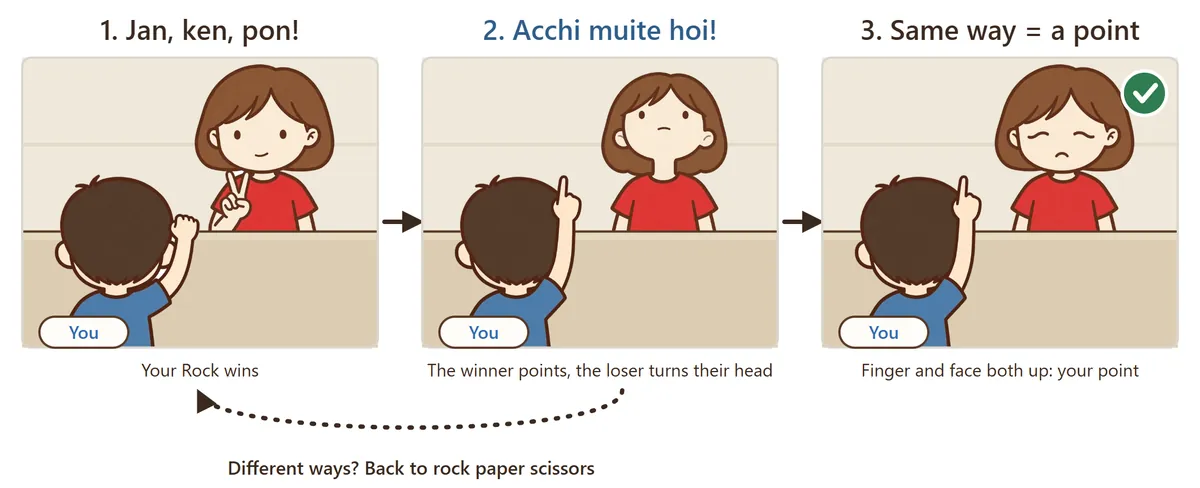
First comes rock paper scissors, played the Japanese way: everyone chants “Jan, ken, pon!” and throws on “pon”. As soon as there is a winner, the call switches to “Acchi muite hoi!”. On “hoi”, the winner points and the loser turns their head. In this game, Rock, Paper and Scissors buttons appear for the throw, and up, down, left and right buttons appear for the pointing part. The name tags on the table and the bar above the game tell you whether you are pointing or looking away this time. You are the player seen from behind in the front of the picture; the CPU faces you across the table.
Same direction: the pointer scores
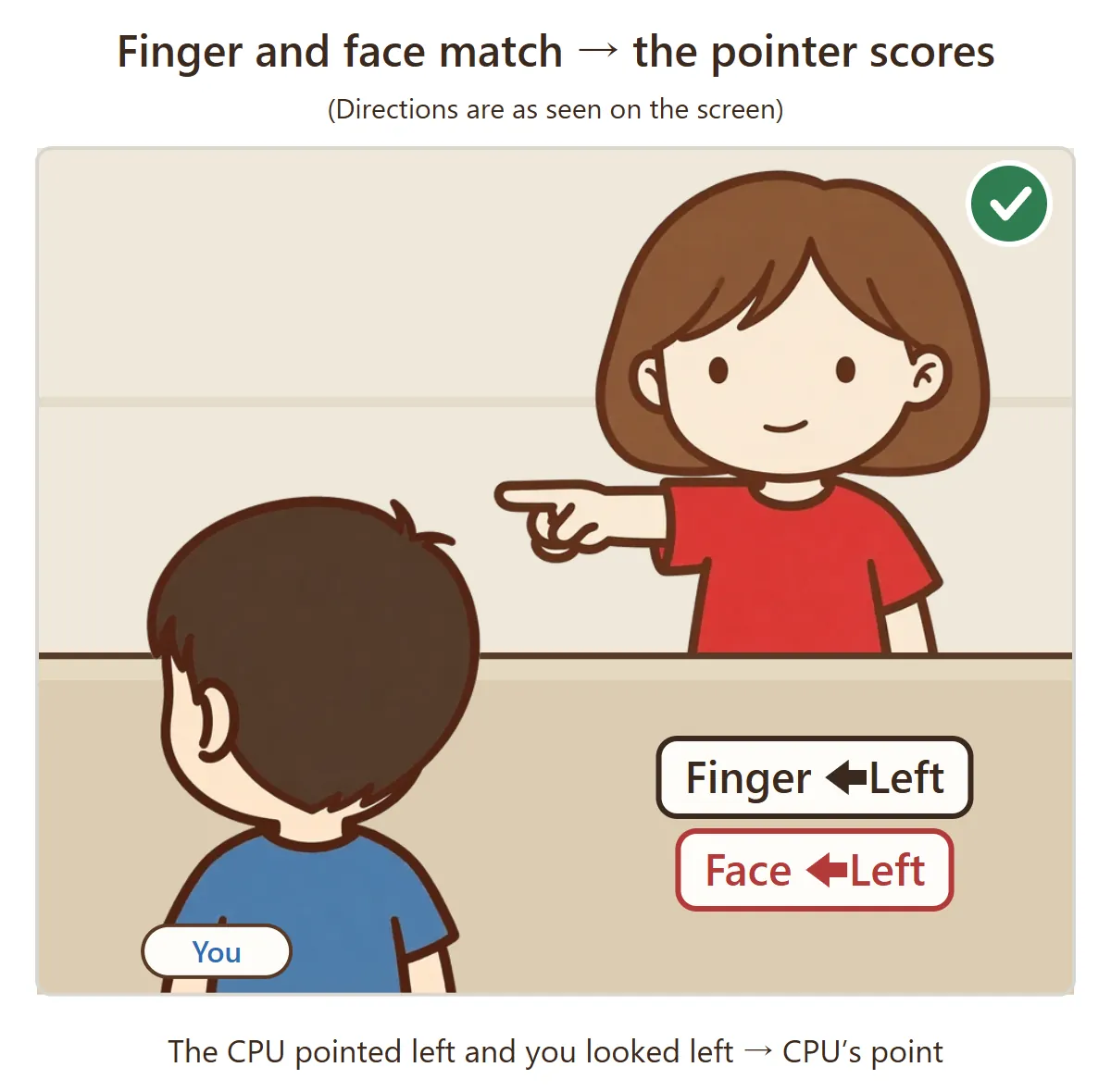
In this game, up, down, left and right always mean directions as seen on your screen, for both the finger and the face. If the CPU points to the left side of the screen and your head turns to the left side of the screen, that is the same direction. When a point is decided, a line under the picture shows both with arrows, for example “Finger ← · Face ←”. When you are the one turning your head, think of it as dodging the finger.
Different directions: back to rock paper scissors
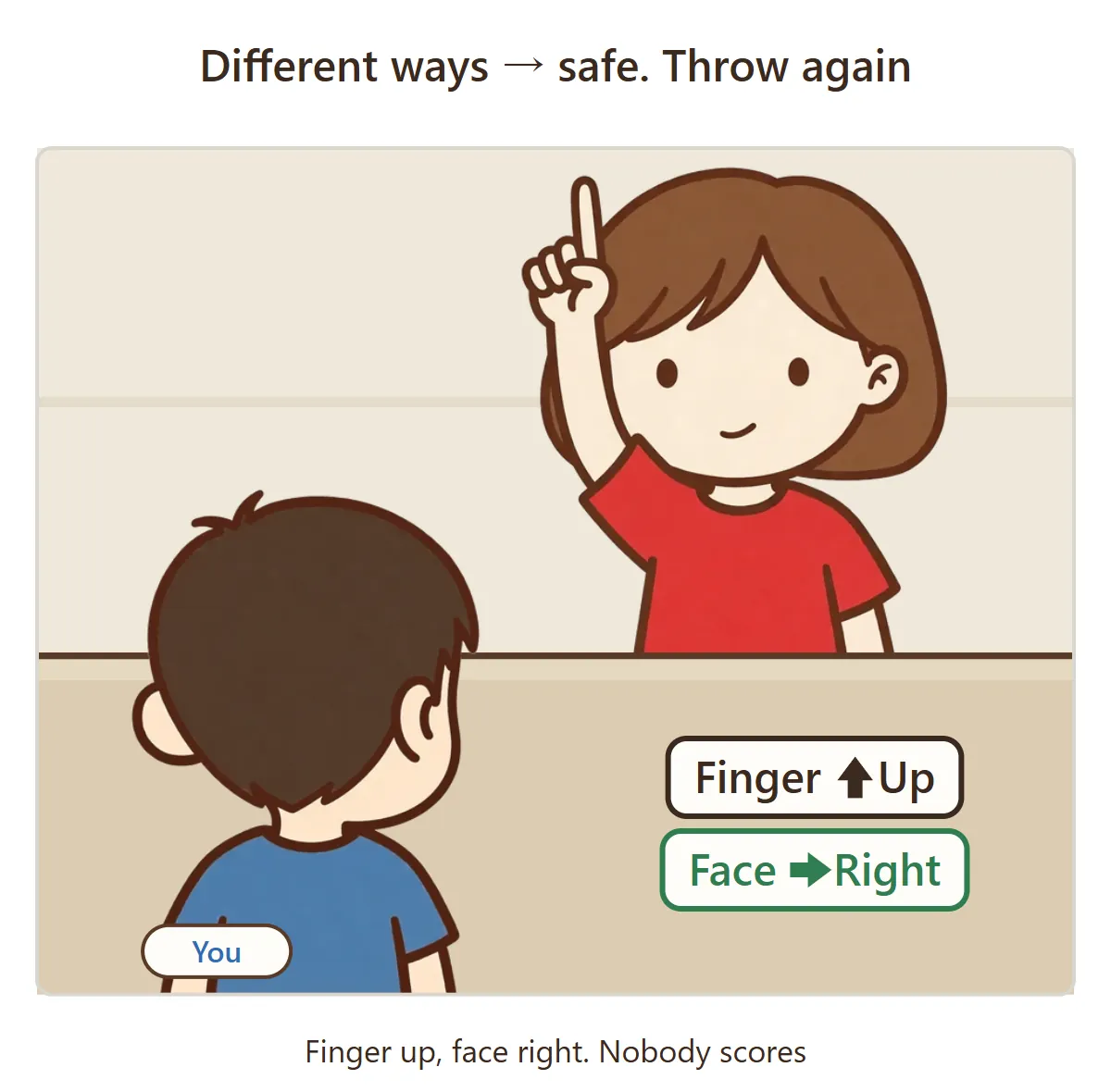
Every time a point goes on without a winner, the call gets a little faster. The longer one point drags on, the easier it is to fumble, so stay calm. As soon as someone scores, the speed goes back to normal.
Ties
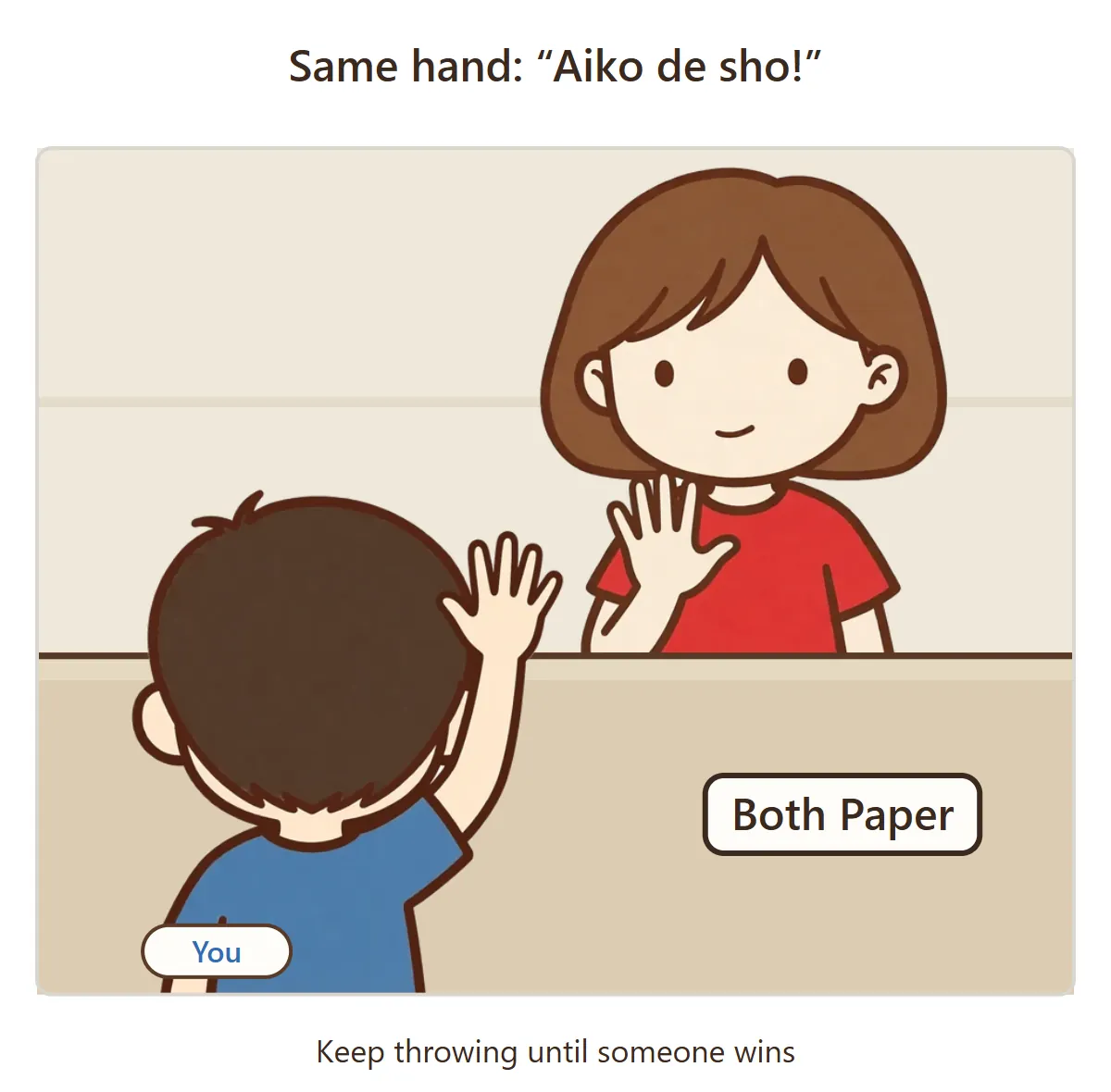
If you both throw the same hand, the call changes to “Aiko de sho!” – Japanese for roughly “it’s a tie, so… go!”. Throw again on “sho”.
Timing: don’t be late on “Pon!” and “Hoi!”
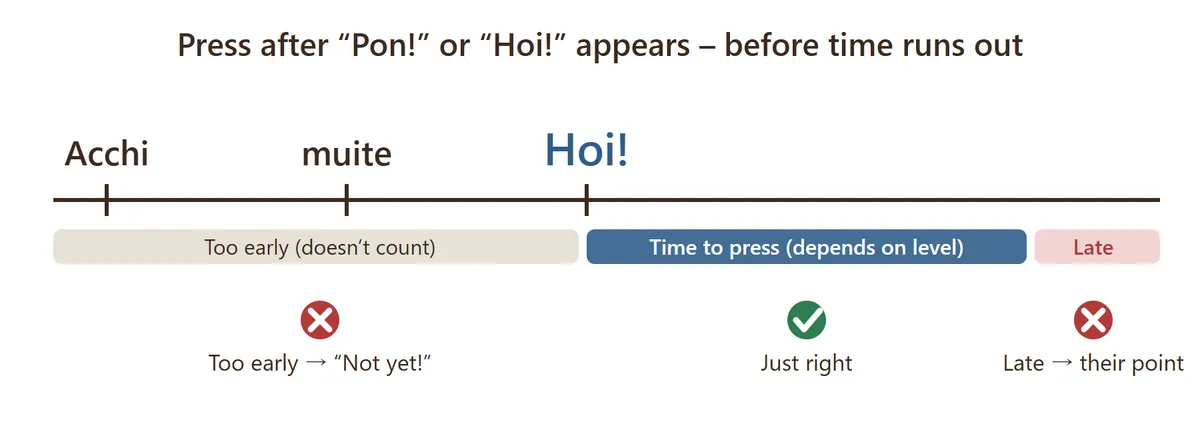
This is a rhythm game: you press along with the call. When the last word – “Pon!” or “Hoi!” – appears, press before the blue bar at the top empties. Be late in rock paper scissors and it counts as a late throw, which loses, so the other side gets to point. Be late when pointing or turning your head and the other side simply gets the point. Press before the word appears and you’ll see “Not yet!” – that press doesn’t count, but there is no penalty, so just press again.
You can play with a keyboard too. For rock paper scissors, 1 is Rock, 2 is Scissors and 3 is Paper (or use ←, ↑ and →). For pointing and looking, use the arrow keys or W, A, S and D.
Acchi muite hoi vs kocchi muite hoi
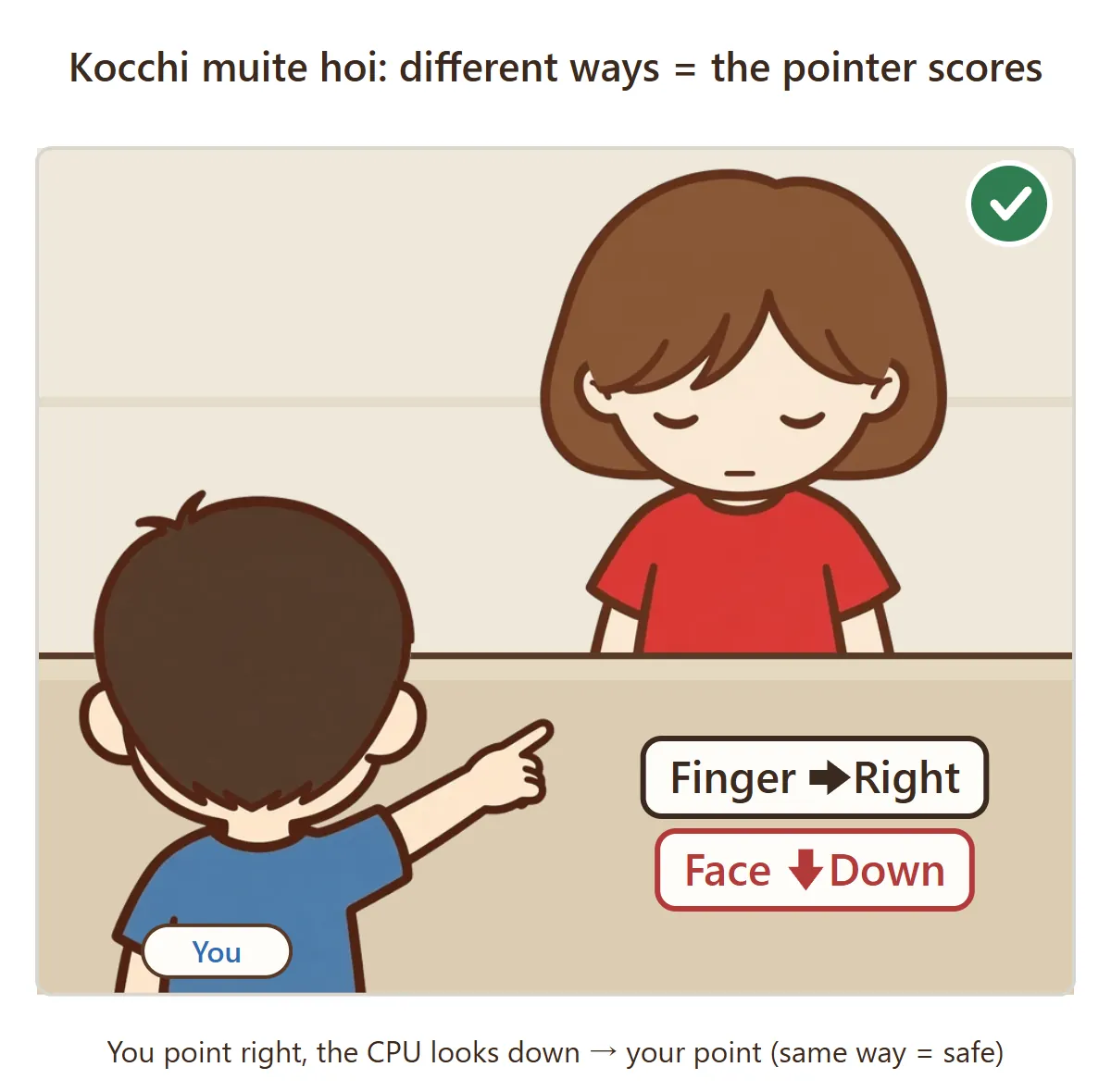
| Rule | Acchi muite hoi | Kocchi muite hoi |
|---|---|---|
| The call | “Acchi muite hoi!” (look that way) | “Kocchi muite hoi!” (look this way) |
| Pointer scores when | Finger and face match | They don’t match |
| Back to the throw when | They don’t match | They match |
| The looker tries to | Dodge the finger | Follow the finger |
In kocchi muite hoi the person turning their head has to guess the exact direction of the finger, so the pointer has a big advantage and points are decided fast. It’s a good pick when you want a quick, snappy match. Under “Custom” you can also limit the directions to left and right only, which is handy for younger players or for your first few games.
Match length can be one point, first to 3 or first to 5. In “First to 3”, the first player to win three points takes the match.
Acchi muite hoi tips and strategy
1. Ride the rhythm
“Jan – ken – pon” and “Acchi – muite – hoi” move at a steady beat. If you only start deciding when you see the last word, you may run out of time. Pick your hand or direction before the last beat and press on the rhythm. That is the most reliable way to never be late.
2. Don’t get stuck on one direction
Most people have a favorite direction, or a habit of always switching from the last one. On Normal and Hard, the CPU remembers the hands and directions you use most. Mix it up – and now and then, repeat a direction on purpose to throw it off.
3. Find the CPU’s habits
The CPU has habits too. On Easy it tends to repeat the same hand and the same direction. Play a few rounds, notice what comes up again and again, then point where it likes to look – or look where it rarely points.
4. Use up and down when you dodge
If you only ever dodge left or right, the pointer only has to guess between two. Using up and down as well spreads out the possibilities, and you will escape more often.
5. Keep your cool when the pace picks up
The call speeds up every time a point is replayed, and that is exactly when early presses (“Not yet!”) and late presses creep in. Go back to basics: wait for the word, then press before the bar runs out.
6. Win more throws
You can only score while you are pointing, and you only get to point by winning rock paper scissors – in both versions. The more throws you win, the more chances you get. Keeping track of what the CPU threw last can give you a hint about its next hand.
Acchi Muite Hoi FAQ
Can I wait to see the finger before I turn my head?
No – and you can’t in real life either. Fingers and faces move together on “hoi”. In this game, the CPU’s finger or face is revealed at the same moment you press your button, so it all comes down to reading your opponent.
Which difficulty should I choose?
Start with Easy: the call is slow, you get plenty of time to press, and the CPU has habits you can spot. Move on to Normal when you are comfortable – the call is quicker and the CPU sometimes goes after your favorite hand or direction. Hard is faster still and reads what you tend to do after each throw, which makes it a tough opponent.
Where are my records kept?
At the end of each match you see your current and best win streak for that difficulty, plus your average time to press after “Pon!” and “Hoi!”. Records are saved in this browser on this device, so they will be there next time.
Can I stop and continue later?
Yes. Open the page again on the same device and browser and choose “Continue” to pick up with the same score. “Pause” stops the game and restarts the current call when you resume.
Is there sound?
Sound is off at first. Press “Sound: off” to hear a tick on each beat of the call and sound effects for the results.
Do I need to know Japanese?
Not at all. The call is shown in Japanese sounds written in the English alphabet, just as players say it, and everything else is in English. You only need to watch for the last word – “Pon!” or “Hoi!” – and press.
Where Acchi Muite Hoi comes from
Acchi Muite Hoi is said to have started as a party game in the traditional teahouses of Kyoto, where guests and entertainers played quick games with forfeits. Television shows later brought it to living rooms all over Japan, and today almost everyone there knows it, from small children to grandparents. The wording of the chant varies a little from place to place – the rock paper scissors part in particular has many local versions – and a very similar game is played in Korea. Outside Asia it is best known to fans of Japanese TV, anime and variety shows, which is exactly why it is worth a try: it takes ten seconds to learn, and the “look that way!” moment never stops being funny.