 Yorimichi Games
How to play this fishing game
This free fishing game has two modes. Festival fishing is a quick arcade game: toy fish swim around a tank like the ones at a Japanese summer festival stall, and you pull them out with a magnet on a line. You have 60 seconds to score as many points as you can. Sea & river fishing is a calmer, more realistic game. You pick one of five fishing spots – a harbor pier, a sandy beach, a rocky shore, a river or a lake – cast your line, wait for a bite, set the hook and reel the fish in without snapping the line. Every fish you land is added to your fish guide, with its name, size and what makes it special. There are 26 species to collect, all fish that people really catch around Japan. You can play with a mouse, a touchscreen or the keyboard, and nothing needs to be installed.
Festival fishing rules: drop the magnet just ahead of a fish
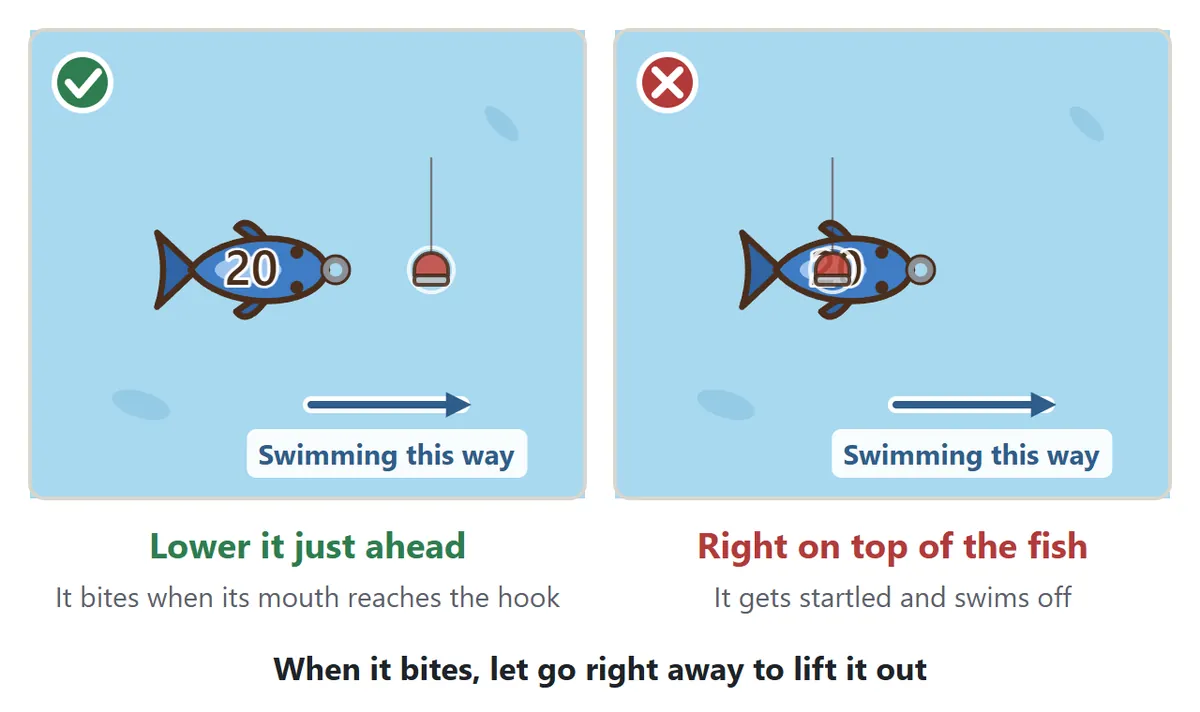
Press Start and the game counts down 3, 2, 1. Eight toy fish are swimming in the tank. Each one has a small metal ring on its mouth, and the magnet on your line sticks to it when the mouth touches the magnet.
On a computer, move the hook with your mouse. The hook stays in the water only while you hold the mouse button down. On a phone or tablet, press and hold a little ahead of a fish and the hook drops there; it appears slightly above your fingertip so your finger does not hide it. When a fish bites, a yellow ring flashes around the hook. That is the moment to let go and lift the fish out. If you keep holding, the fish wriggles and eventually shakes itself free.
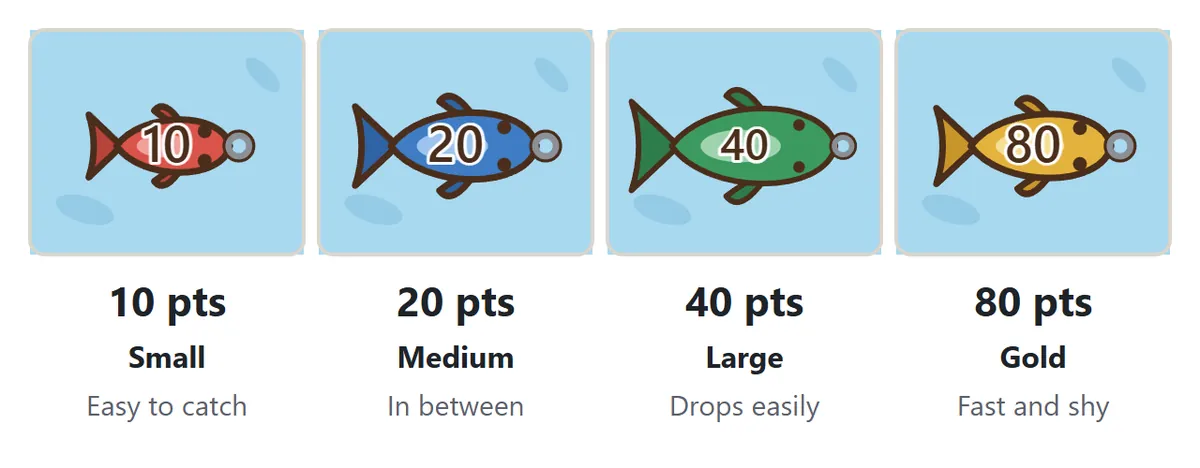
There are four kinds of toy fish. The small red fish is worth 10 points, the blue fish 20, the big green fish 40 and the rare gold fish 80. Bigger fish are more easily startled when you drop the hook close to them, and they are more likely to fall off with a splash as you lift them. The gold fish swims very fast, so you have to get ahead of it. Whenever you land a fish, a new one swims in from the edge of the tank.
Sea and river fishing: cast, wait, strike, reel

First choose a fishing spot. Press and hold the screen (or hold the space bar) and a marker slides back and forth along the bar above the water, from near the shore to far out. Let go when it reaches the spot you want and your line flies there. Different fish live at different distances. On the sandy beach, for example, Japanese whiting feed far out over the sand, while gobies stay close to the shore.
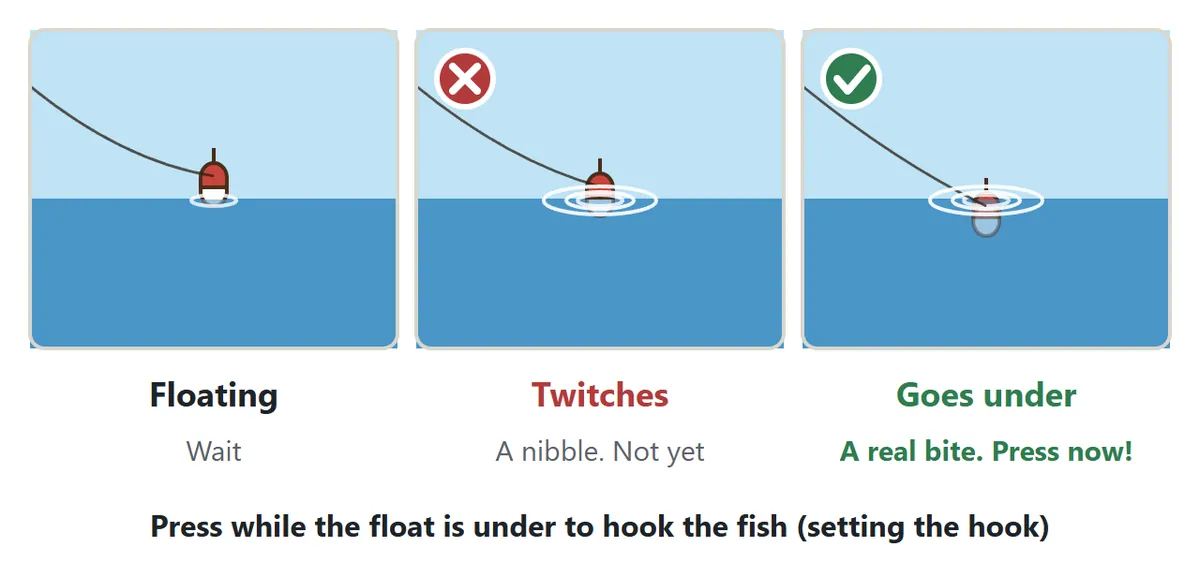
Once the float lands, watch it closely. When a fish pecks at the bait, the float twitches a little. Anglers call this a nibble: the fish has not taken the bait properly yet, and if you strike now it gets scared away. When the float is pulled right under the water, that is the real bite. Press straight away to set the hook in the fish’s mouth. Wait too long and the fish steals your bait.
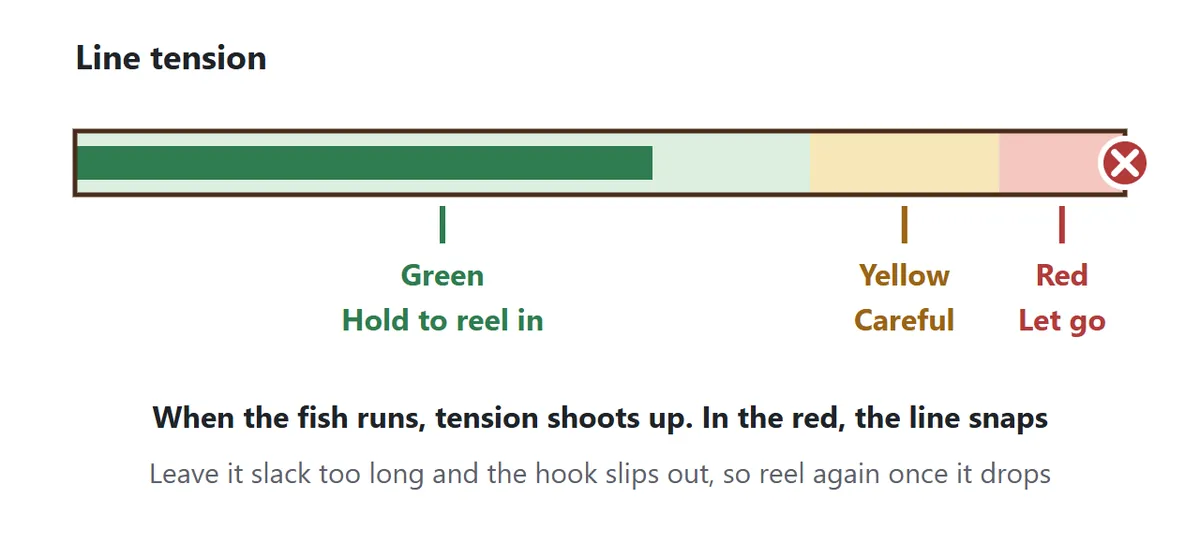
With a fish on the hook, hold to reel it toward the shore while you watch the tension meter at the top of the screen. When the fish runs, the tension shoots up. If it reaches the red zone the line snaps, so let go as soon as the meter moves from yellow toward red. While you are not reeling, line comes off the reel and the fish swims a little further away, but the line holds. Do not wait too long, though: a slack line lets the hook slip out. Once the fish calms down and the tension drops, start reeling again. When the distance counter reaches zero, the fish is yours.
Each trip gives you ten casts, and every spot has its own goal shown at the top of the screen. When you land a fish, a card shows its name, size and a short description, and a new species goes straight into your fish guide.
Fishing spots and the fish you can catch
| Spot | Common catches | Big one |
|---|---|---|
| Harbor pier | Japanese jack mackerel, Japanese sardine, chub mackerel, yellowfin goby, Japanese rockfish, black sea bream | Red sea bream |
| Sandy beach | Japanese whiting, yellowfin goby, marbled flounder, white croaker | Olive flounder |
| Rocky shore | Largescale blackfish, marbled rockfish, thread-sail filefish, wrasse, Japanese rockfish | Barred knifejaw |
| River | Pale chub, Japanese dace, ayu, yamame trout, Amur catfish | Japanese eel |
| Lake | Silver crucian carp, Japanese smelt, common carp, largemouth bass | Amur catfish |
What bites changes from day to day. Each day, every spot has one fish that is biting especially well. The big fish only turn up on some days. The spot marked “Today” in the settings is today’s featured spot, and its big fish is always around. Everyone gets the same fish on the same day, so you can compare your catch with friends and family.
Choosing a difficulty
| Level | Festival fishing | Sea & river fishing |
|---|---|---|
| Easy | Slow fish that come over to a still hook | The float stays under longer and the line is strong |
| Normal | Fish move at normal speed; lift quickly | More nibbles and stronger fish |
| Hard | Fast, shy fish that slip off quickly | Short strike window and a line that snaps easily |
If this is your first time, start on Easy and keep going until you reach the goal. Move on to Normal once that feels comfortable, and try Hard when you want a real challenge.
Fishing game tips
1. Festival fishing: wait in front of the fish
Dropping the magnet right on top of a fish makes it dart away. Look at which way a fish’s head is pointing and lower the hook a little ahead of it. Fish that notice a still hook will often swim over to it on their own.
2. Festival fishing: lift the moment it bites
The longer a fish hangs on the hook before you lift it, the more likely it is to drop off on the way up. Big green fish and gold fish come loose especially quickly. As soon as you see the yellow ring, let go.
3. Festival fishing: don’t chase only the gold fish
The gold fish is worth 80 points, but it is fast and nervous, and chasing it can eat up your time. Catching whatever is close, one fish after another, often ends with a higher total.
4. Sea and river fishing: be patient with nibbles
When the float twitches, hold back. There are usually a couple of twitches before the float goes under. Keep your eyes on it and press the instant it sinks.
5. Sea and river fishing: let go on yellow
When the tension meter enters the yellow zone, take your finger off. When it drops back into the green, hold to reel again. Repeating this brings the fish in bit by bit without breaking the line. Just don’t leave the line slack for too long.
6. Sea and river fishing: cast to where your target lives
Each species has its favorite distance. The fish guide shows where every fish can be caught, even ones you have not landed yet. For Japanese whiting, cast far out from the sandy beach; for rockfish, fish close to the pier or rocks.
How to tell Japanese fish apart
Olive flounder or marbled flounder?
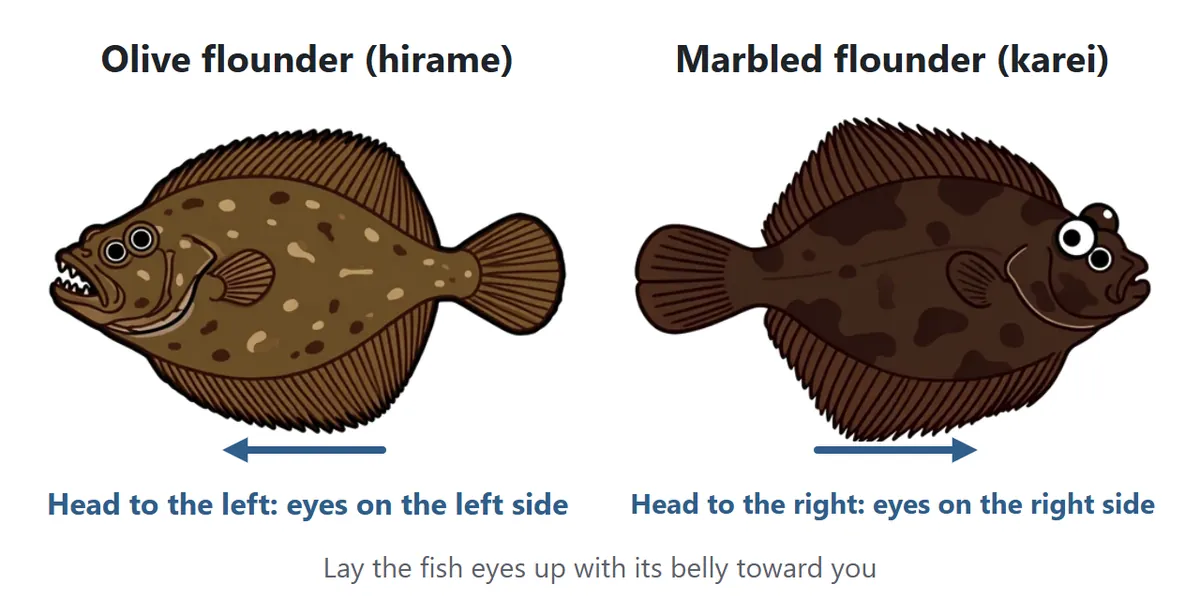
Both are flatfish with both eyes on one side of the body. Lay the fish eyed side up with its belly toward you. If the head points to the left, it is an olive flounder (hirame); if it points to the right, it is a marbled flounder (karei). Japanese anglers remember it with a short rhyme, “left hirame, right karei” (there are a few exceptions). The olive flounder also has a big mouth full of sharp teeth, while the marbled flounder’s mouth is small.
Common carp or crucian carp?
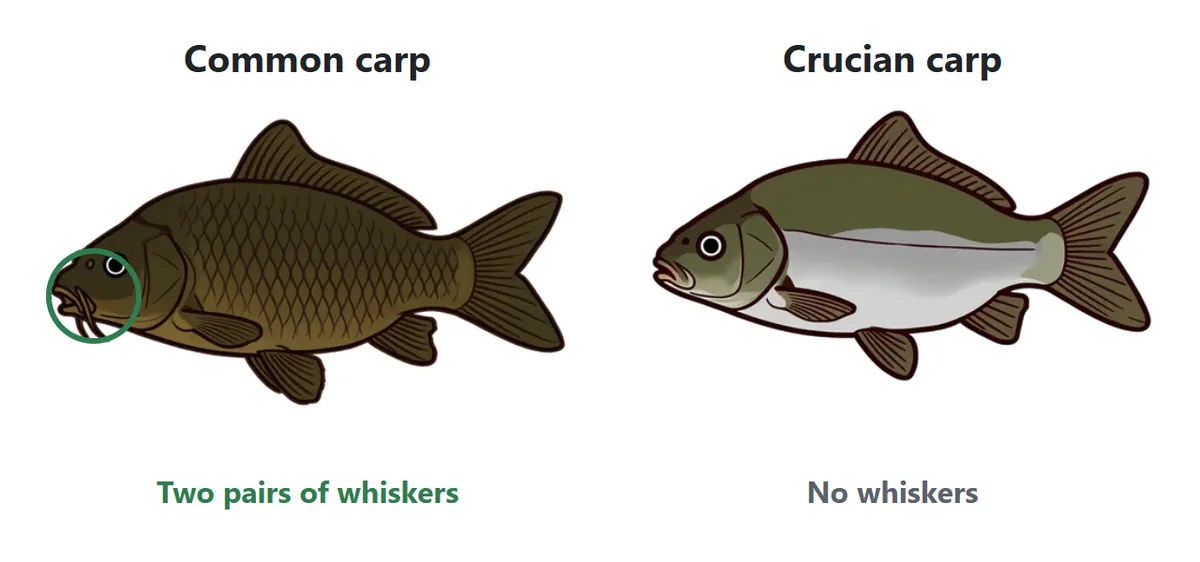
These two look alike, but the common carp has two pairs of whiskers around its mouth and the crucian carp has none. Common carp also grow much larger, sometimes past 70 cm.
Jack mackerel, chub mackerel and sardine
All three are blue-backed fish that anglers catch from harbor piers. The Japanese jack mackerel has a row of hard, ridged scales running along its side. The chub mackerel has dark wavy lines on its back. The Japanese sardine has a single row of black spots along its side.
Rockfish and scorpionfish
Both live around rocks. The Japanese rockfish has huge bulging eyes and blurry bands on its body. The marbled rockfish has a large head and a reddish-brown body with pale blotches – and venomous fin spines, so real ones should be handled carefully.
Make your own magnet fishing game
Festival fishing is based on the magnet fishing game that children play at Japanese festival stalls and in kindergartens, and you can make one at home in a few minutes. Cut fish shapes from thick card, color them in and fix a paper clip to each mouth. For the rod, tie a piece of string to a chopstick or a short stick and attach a small magnet to the end. Spread the fish out in a box or on the floor and you are ready. Give each color its own score and see how many points everyone can collect in one minute. Strong magnets and small parts are dangerous if swallowed, so an adult should keep an eye on young children.
Another favorite at Japanese festivals is water balloon fishing, where you try to hook a floating balloon by its rubber band with a small wire hook on a twist of paper. The paper gets weaker as it gets wet, so speed is everything.
Fishing game FAQ
Where is my fish guide saved?
Your fish guide (which fish you caught, how many and your biggest) and your best scores are saved in this browser on this device. There is no sign-up or login. Come back on the same device and browser and you can keep collecting.
Can I stop and continue later?
Yes, press Continue. Festival fishing picks up with the time and score you had. Sea and river fishing restarts the cast you were on, from before you cast.
Are the fish sizes realistic?
Each fish comes in the range of sizes that anglers usually catch. Bigger fish are rarer and pull harder. The fish guide shows the usual size of each species and your own personal best.
Can I pause, and is there sound?
Press Pause, or the P or Esc key. The game also pauses by itself when you switch to another tab. Sound is off at first; press “Sound: off” to turn it on.
Anything to know before real fishing?
Many rivers and lakes need a fishing permit, and some fish have a closed season. In Japan, largemouth bass is an invasive species, and it is against the law to move live bass or release them into other waters. The Japanese eel is endangered. Near water, always wear a life jacket and go with an adult.
About fishing and festival fishing
Fishing with a rod, line and hook is one of the oldest ways people have caught fish. Float fishing is popular all over Japan, and the tense wait between the first twitch of the float and the moment it disappears is still the heart of the sport. Catching toy fish with a magnet or a little hook, on the other hand, is a much-loved children’s game at festival stalls. It may not be a real fish, but the thrill of feeling something bite is just the same. This game lets you enjoy both.