 Yorimichi Games
How to play two-player riichi mahjong
Riichi mahjong is the Japanese style of mahjong. It uses 136 tiles, four copies each of 34 different tiles. You hold 13 tiles, and on each turn you draw one tile and discard one. The first player to complete a winning shape that also contains at least one scoring pattern, called a yaku, wins the hand and scores points. This version is for two players: you against the computer. The tiles, the yaku and the scoring are the same as in the usual four-player game, so everything you learn here carries over.
Reading the table
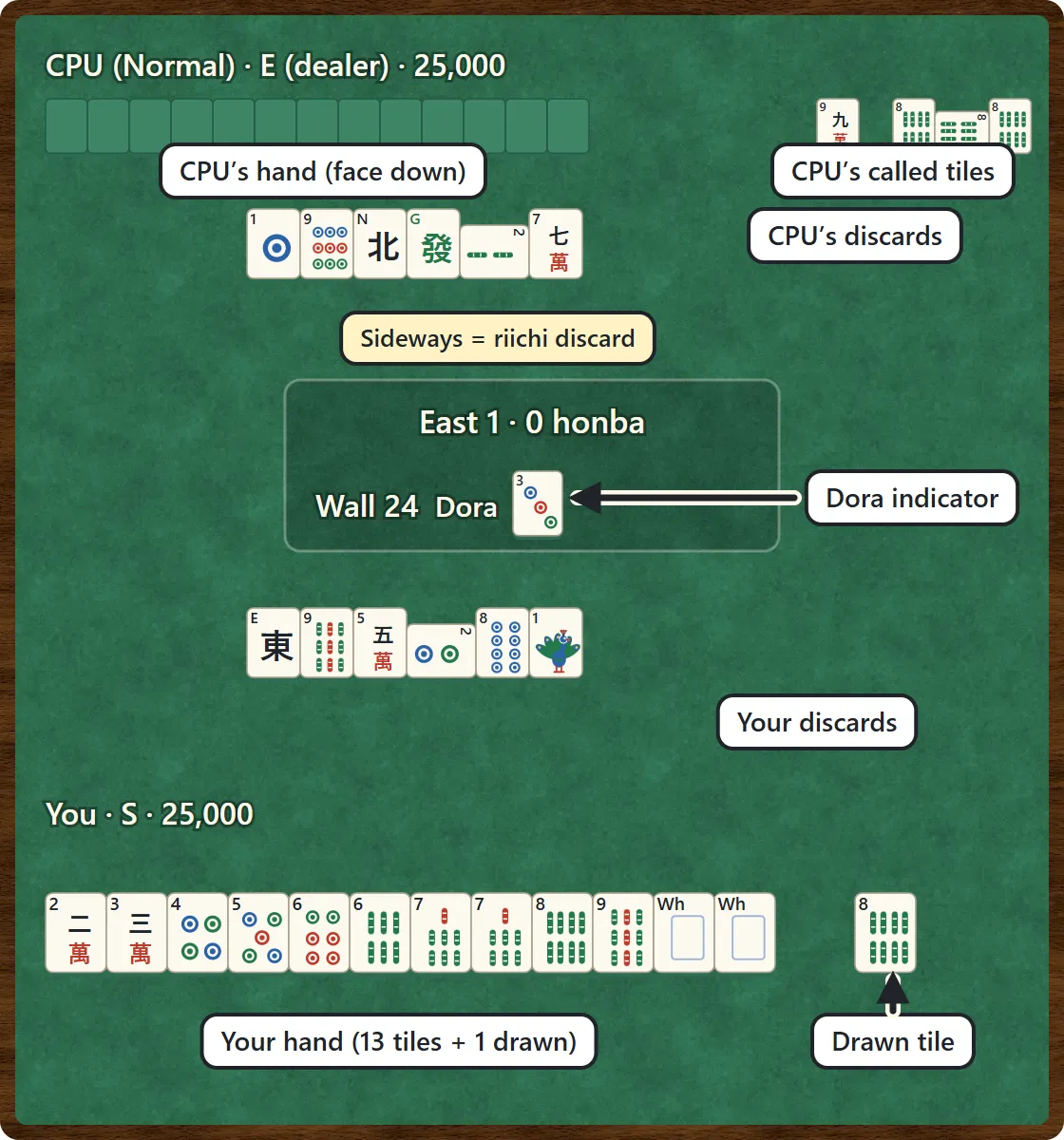
Tiles come in three numbered suits and in honor tiles. The suits are characters (also called man, with the Chinese character for “ten thousand” under a number), dots (pin, circles) and bamboo (sou, sticks; the 1 of Bamboo shows a bird). Each suit runs from 1 to 9. The honors are the four winds, East, South, West and North, and the three dragons, White, Green and Red. Tiles numbered 1 and 9 are called terminals. If you’re not used to reading the Chinese characters, keep “Show small numbers and letters in the tile corners” turned on in the settings: suit tiles get their number in the corner, winds get E, S, W or N, and dragons get Wh, G or R.
The winning hand: four sets and a pair

A complete hand has 14 tiles: four sets of three tiles plus one pair. A set is either a sequence of three consecutive numbers in the same suit (such as 3-4-5 Dots) or a triplet of three identical tiles. Honors can only form triplets, never sequences. There are two special shapes that don’t follow this rule: seven different pairs (chiitoitsu), and thirteen orphans (kokushi musou), one of every terminal and honor plus a duplicate.
Each turn: draw, discard, ron and calls
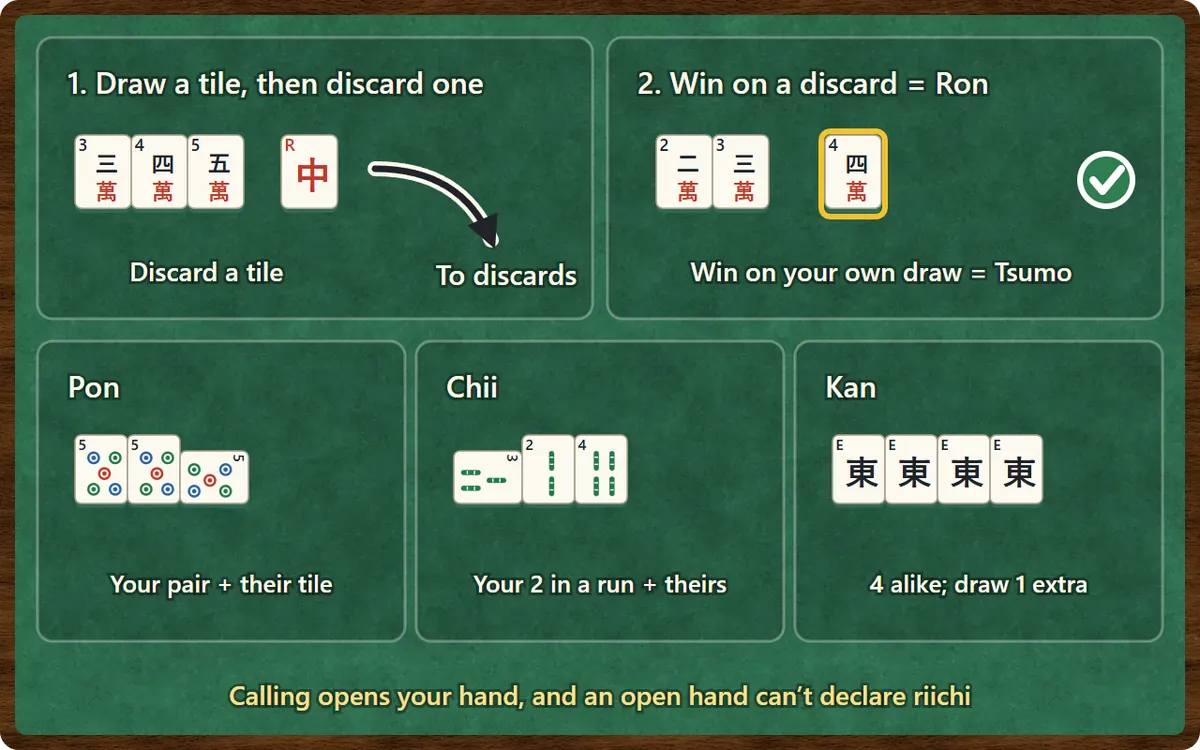
- On your turn you draw a tile from the wall. It appears a little apart on the right of your hand.
- If your hand is complete and has a yaku, press “Tsumo” to win. Otherwise tap the tile you want to discard. It lifts up; tap it again or press “Discard”.
- When your opponent discards a tile that completes your hand, press “Ron”. You can also call the discard to complete a set: pon with a pair you hold, chii with two tiles that make a sequence, or kan with a triplet you hold.
Calling speeds up your hand, but it makes your hand “open”. An open hand can’t declare riichi, and several yaku disappear or lose value. For your first games, try to keep your hand closed and aim for riichi.
Waits and furiten
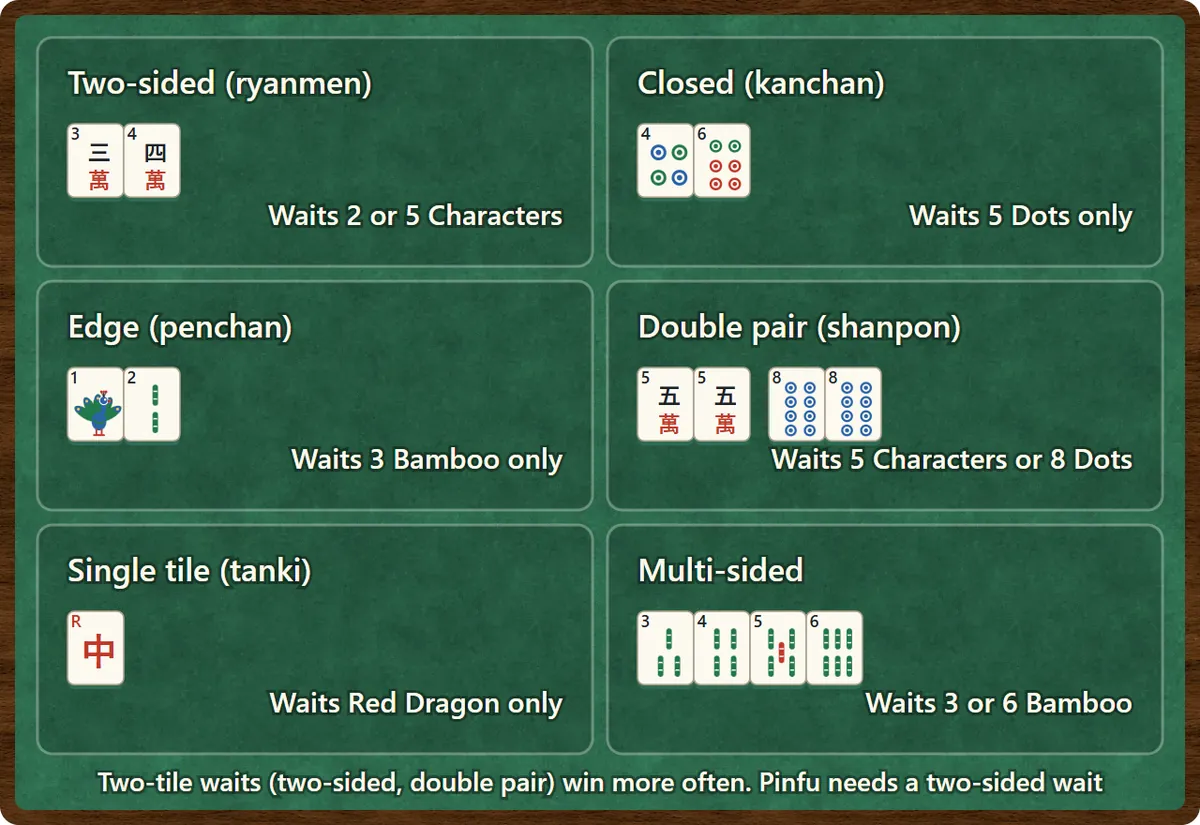
When your hand needs just one more tile to win, it is ready, and the tiles that would complete it are your waits. A two-sided wait like 3-4 can be completed by a 2 or a 5, so it is much easier to win with than a closed 4-6 or an edge 1-2. If one of your waiting tiles is already in your own discards, you are furiten and can’t win by ron on that wait, although you can still win by drawing the tile yourself. Letting a winning discard go by also makes you furiten until your next discard, or for the rest of the hand after riichi.
Riichi
When your closed hand is ready, you can declare riichi as you discard. You put 1,000 of your points on the table as a riichi stick and turn your discard sideways. After that your hand is locked: every tile you draw that doesn’t win is discarded automatically. In return, riichi is a yaku on its own, so any complete hand can win, and you may get extra han for ippatsu (winning within one go-around) and for ura dora, the hidden dora revealed when a riichi hand wins.
Two-player mahjong rules: how it differs from four players
Two-player mahjong plays the four-player rules with two seats. All 136 tiles are used, and the only seats are East (the dealer) and South. These are the rules in this game:
| Rule | In this game |
|---|---|
| Tiles | All 136 tiles. One red five each in characters, dots and bamboo (can be turned off) |
| Length | East only: East 1 and East 2. Hanchan: East 1, East 2, South 1 and South 2 (more hands are played when the dealer repeats) |
| Draws | Up to 20 draws per player each hand (18 or 22 can be chosen). When the wall runs out, the hand is a draw |
| Chii | Your opponent always plays just before you, so you can chii any of their discards |
| Tsumo | With only one opponent, a self-drawn win scores the same as a ron |
| Draws (no winner) | A ready player receives 1,000 points from a player who isn’t ready. A ready dealer keeps the deal |
| Points and end | Each player starts with 25,000. The match ends when someone drops below zero or after the last hand; if the dealer is on top after winning the last hand, the match ends there |
| Other | Open tanyao on (can be turned off), nine-terminal abortive draw on (can be turned off), counted yakuman and combined yakuman allowed |
Riichi mahjong yaku list for beginners
The most important rule in riichi mahjong is that you can’t win without at least one yaku. A complete shape alone isn’t enough, and the Tsumo and Ron buttons only appear when your hand has a yaku. There are about forty yaku, but you only need a handful to start:
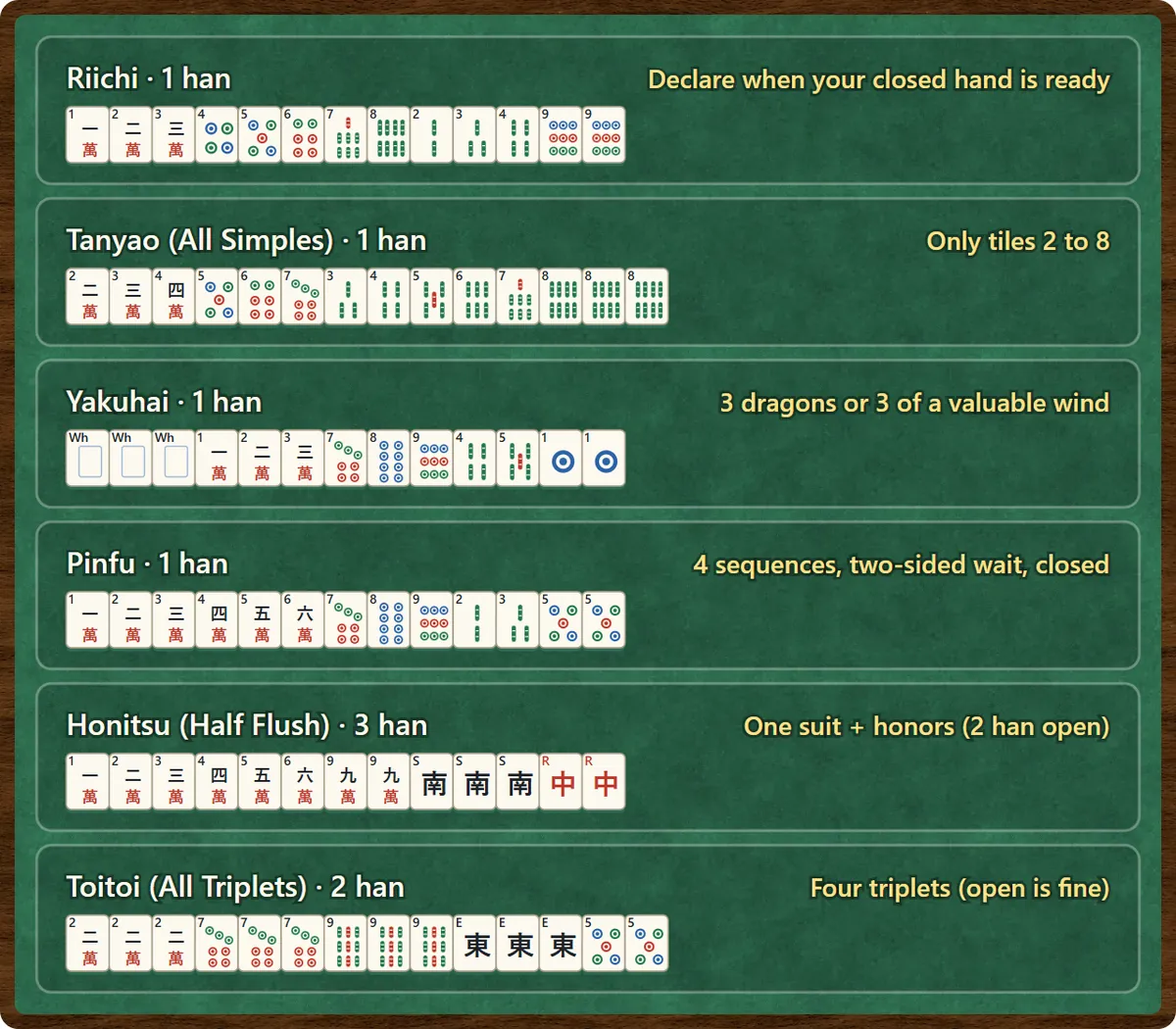
- Riichi: declare when your closed hand is ready. This is the yaku you will use most.
- Tanyao (All Simples): use only tiles numbered 2 to 8, with no terminals or honors. Open hands count too.
- Yakuhai: a triplet of dragons, of the round wind (East in the East round) or of your seat wind (East for the dealer, South for the other player). Each triplet is 1 han.
- Menzen Tsumo: win on your own draw with a closed hand.
- Pinfu, Iipeikou, Honitsu (Half Flush), Toitoi (All Triplets) and Chiitoitsu (Seven Pairs): shape-based yaku that raise your score.
During a match, the “Yaku & scores” button under the table opens the full yaku list with han values and the score table.
| Han | Yaku |
|---|---|
| 1 | Riichi, Ippatsu, Menzen Tsumo, Pinfu, Tanyao, Iipeikou, Yakuhai (dragons, round wind, seat wind), Rinshan Kaihou, Chankan, Haitei, Houtei |
| 2 | Double Riichi, Chiitoitsu, Sanshoku Doujun*, Ittsu*, Chanta*, Toitoi, Sanankou, Sanshoku Doukou, Sankantsu, Shousangen, Honroutou |
| 3 | Honitsu*, Junchan*, Ryanpeikou |
| 6 | Chinitsu* |
| Yakuman | Kokushi Musou, Suuankou, Daisangen, Shousuushii, Daisuushii, Tsuuiisou, Ryuuiisou, Chinroutou, Chuuren Poutou, Suukantsu, Tenhou, Chiihou |
Yaku marked * are worth one han less when your hand is open. Pinfu, Iipeikou, Ryanpeikou, Chiitoitsu, Riichi and Menzen Tsumo need a closed hand.
Dora
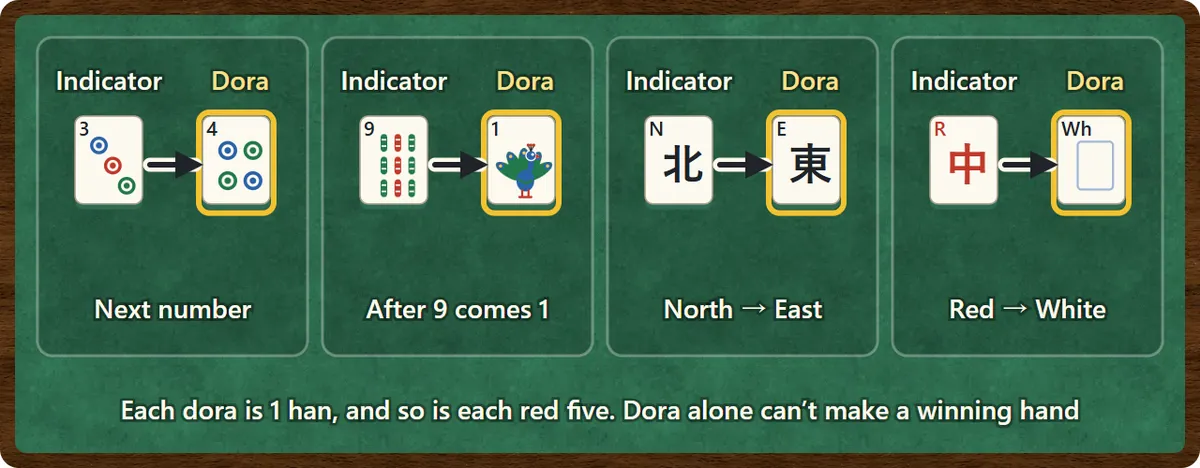
Dora are bonus tiles: each one in your winning hand adds 1 han. The dora is the tile that comes after the dora indicator in the center of the table. Each kan reveals another indicator, and a riichi win also reveals the ura dora under them. Red fives count as dora too. Dora are not yaku, though, so a hand full of dora still needs a real yaku to win.
Riichi mahjong scoring explained
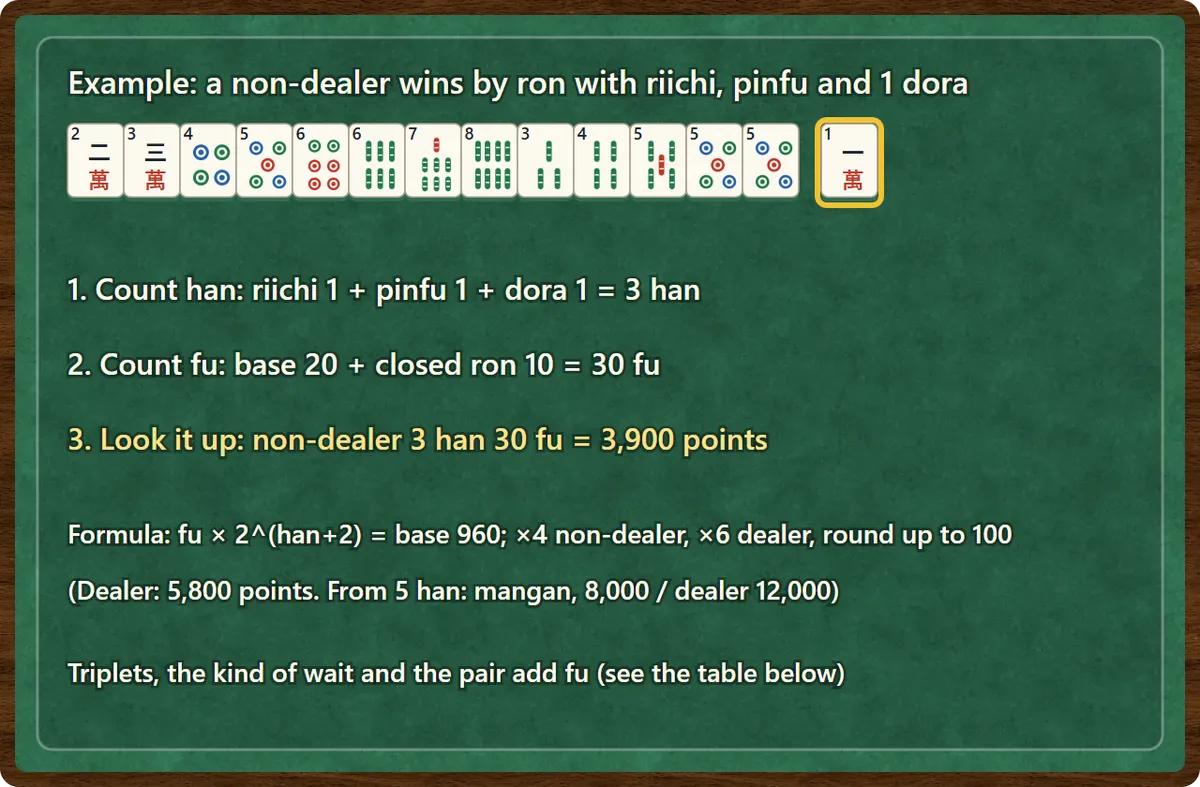
A winning hand’s score depends on two numbers. Han is the total of your yaku and dora. Fu is a smaller count based on the shape of the hand: triplets, the kind of wait and the pair. Each extra han roughly doubles the score, and from 5 han upward the score is a fixed limit (mangan and above), so fu no longer matters.
Counting fu
| Item | Fu |
|---|---|
| Base | 20 |
| Ron with a closed hand | +10 |
| Tsumo (except pinfu tsumo) | +2 |
| Triplet of 2–8 | open 2, closed 4 |
| Triplet of terminals or honors | open 4, closed 8 |
| Kan | 4 times the triplet value |
| Pair of dragons or a valuable wind | +2 (+4 if it is both round and seat wind) |
| Closed, edge or single wait | +2 |
Round the total up to the next 10 (32 becomes 40). There are three exceptions: pinfu tsumo is always 20 fu, seven pairs is always 25 fu, and an open hand that would stay at 20 fu is counted as 30 fu. When a hand can be split into sets in more than one way, the highest score is used.
Score table (ron points; tsumo scores the same in this game)
| Han | 30 fu | 40 fu |
|---|---|---|
| 1 | 1,000 / 1,500 | 1,300 / 2,000 |
| 2 | 2,000 / 2,900 | 2,600 / 3,900 |
| 3 | 3,900 / 5,800 | 5,200 / 7,700 |
| 4 | 7,700 / 11,600 | 8,000 / 12,000 |
Each cell shows non-dealer / dealer points. The limits are mangan (5 han) 8,000 / 12,000, haneman (6–7 han) 12,000 / 18,000, baiman (8–10 han) 16,000 / 24,000, sanbaiman (11–12 han) 24,000 / 36,000 and yakuman 32,000 / 48,000. The formula behind the table is fu × 2(han + 2), multiplied by 4 for a non-dealer or 6 for the dealer and rounded up to the next 100. Each honba counter adds 300 points, and the winner also collects any riichi sticks on the table. The full table is in the game under “Yaku & scores”, and the Scoring practice lets you test yourself: you see a hand and its conditions, choose from four scores, and get the han and fu breakdown afterwards.
Mahjong strategy: 6 tips to win more
1. Discard isolated honors and terminals first
A lone honor tile or a 1 or 9 that doesn’t connect to anything rarely becomes part of a set. Throw these away in the first few turns and your hand moves faster. Keep a pair of dragons or of your valuable winds, though: a third copy gives you a yaku.
2. Watch the shanten number and improving tiles
Shanten is how many tiles you are away from ready, and improving tiles are the draws that move your hand forward. When in doubt, discard the tile that keeps shanten the same and leaves the most improving tiles. With hints on, the game shows both numbers and frames the best discards with a dashed line. The “What to discard” practice drills exactly this decision.
3. Build two-sided shapes
Two consecutive tiles like 3-4 can become a sequence from either side, so they accept twice as many tiles as a gap shape like 4-6 or an edge shape like 1-2. Try to keep two-sided shapes in your hand, and you will finish with a better wait.
4. Against riichi, discard tiles your opponent already threw
In two-player mahjong, any tile in your opponent’s discards is furiten for them, so they can never ron on it. When the CPU declares riichi and your own hand is still far from ready, discarding copies of tiles from its discard pile is completely safe.
5. Don’t call without a yaku
Calling closes the door to riichi. Only call when your hand will still have a yaku afterwards, such as a dragon pon or an all-simples hand. An open hand without a yaku can reach a complete shape and still not be allowed to win.
6. Think about exhaustive draws
With a limited number of draws, many two-player hands end without a winner. If you are ready when the wall runs out, you receive 1,000 points from an opponent who isn’t. When only a few draws are left, getting to ready, even with a poor hand, is often worth it.
Two-player mahjong FAQ
How is this different from four-player riichi?
The yaku, the scoring, riichi and furiten all work the same way. The differences are that there are only two seats, you can chii any discard, a tsumo win scores the same as a ron, and each hand has a fixed number of draws.
My hand is complete, so why can’t I win?
Either the hand has no yaku or you are furiten. Open hands need a yaku such as yakuhai or tanyao, and dora don’t count as yaku. If the hint line says furiten, you can only win by drawing the tile yourself.
Which CPU level should I choose?
Start with Easy. It builds its hand loosely and often calls without a yaku, so a steady hand will win plenty of points. Normal looks at shanten and improving tiles, and Hard also weighs the value of its hand and plays safe against your riichi.
What can I do in Solo practice?
“What to discard” asks you to choose the best tile out of 14, “Find the waits” asks for every tile that completes a ready hand, and “Scoring” asks for the score of a winning hand from four choices. The Daily problems are a set of five that changes every day.
Is this a version of American mahjong or mahjong solitaire?
No. American mahjong uses a yearly card of hands and joker tiles, and mahjong solitaire is a tile-matching puzzle. This game follows Japanese riichi rules. If you want the matching puzzle, try Mahjong Solitaire.
Can I stop and continue later? Is there sound?
Yes. Open the page again in the same browser on the same device and press “Continue” to pick up your match. Sound starts off; press “Sound: off” to turn on the tile and win sounds.
Where riichi mahjong comes from
Mahjong began in China and is generally said to have taken its modern form in the 19th century. It reached Japan in the early 20th century, and over the following decades Japanese players added their own rules, such as riichi and dora, which became the riichi mahjong played today.