 Yorimichi Games

How to play Mahjong Solitaire
Mahjong Solitaire is a one-player tile-matching puzzle that uses the tiles from the Chinese game of mahjong. The tiles are piled up in a layout several levels high, and your goal is to take them all away, two identical tiles at a time. You don’t need to know anything about the four-player game of mahjong – there are no hands, no scoring and no melds to learn. If you can spot two pictures that are the same, you can start playing right away.
The catch is that you can’t take just any tile. Only tiles that are “free” can be removed, and the tiles that are free change every time you take a pair. Picking the right pair at the right moment is what turns a simple matching game into a real puzzle.
Reading the board
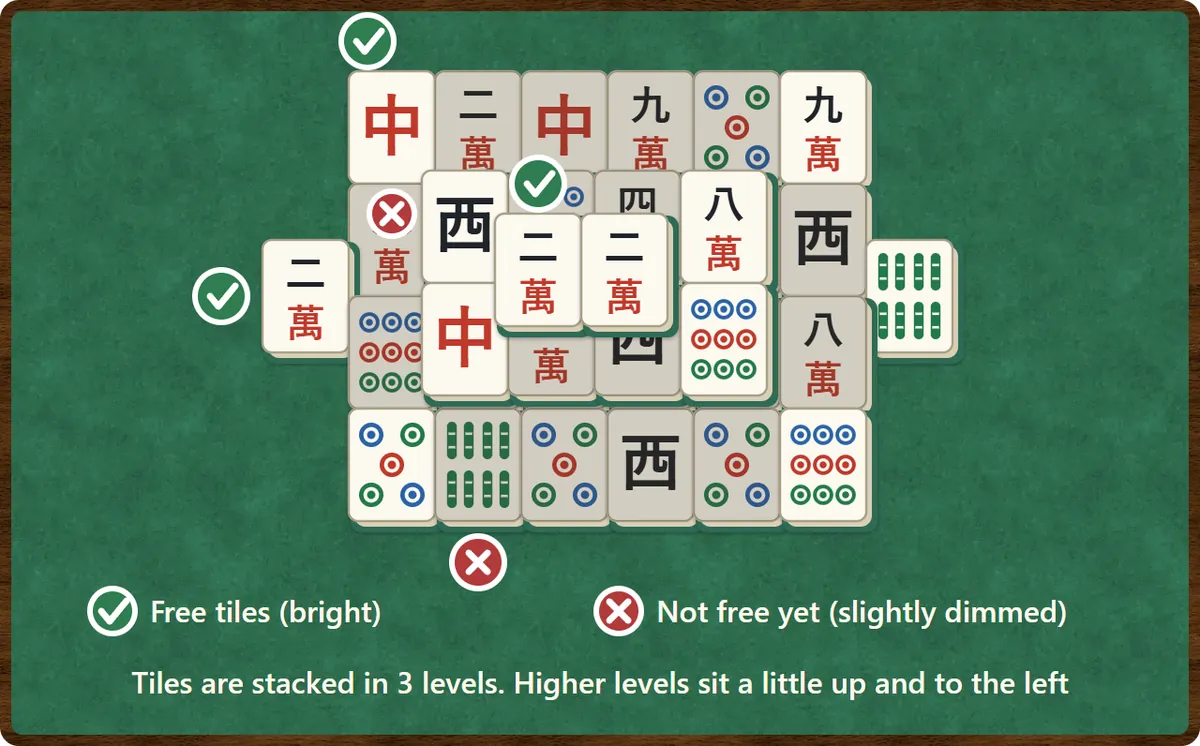
Every layout is built from levels. A tile on a higher level is drawn slightly up and to the left of the level below it, so you can see how the stack overlaps. To make things easier, this version dims every tile that can’t be taken yet. If you prefer the traditional look, you can switch the dimming off in the settings.
The tiles

A full mahjong set has three suits numbered from 1 to 9: Dots (circles), Bamboo (sticks) and Characters (a number written above a red symbol). Next come the honor tiles: four Winds – East, South, West and North – and three Dragons – white, green and red. Every one of these tiles appears four times in the set.
Two tiles confuse almost every new player. The 1 of Bamboo shows a bird instead of a single stick, and the White Dragon is a completely blank tile. Both are traditional designs, not printing mistakes.
The set is finished off by eight bonus tiles: four Flowers (plum, orchid, chrysanthemum and bamboo) and four Seasons (spring, summer, autumn and winter). There is only one of each, and each carries a small number from 1 to 4 in the top corner. If the numbers or the Chinese characters are hard to tell apart, turn on the markers: every suit tile then shows its number in the corner, Flowers show an F, Seasons an S and the White Dragon a W. The smaller layouts use only some of the tile kinds, which makes them quicker to scan.
Mahjong Solitaire rules
Which tiles are free?
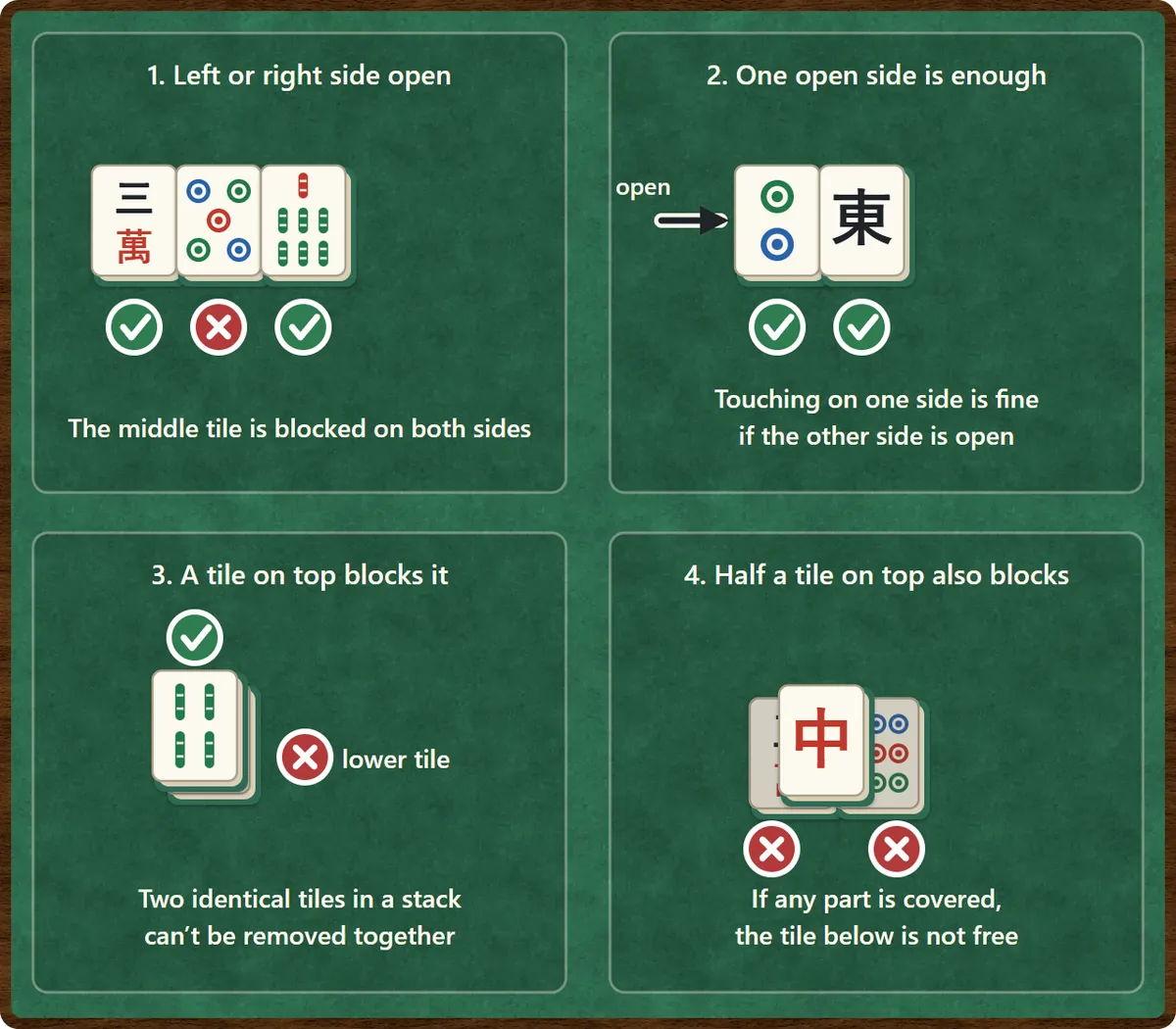
A tile is free when it meets both of these conditions:
- Nothing is on top of it. This includes a tile that sits only halfway over it – any overlap at all counts as covered.
- Its left side or its right side is open. Picture sliding the tile out sideways: if a neighbor touches it on both the left and the right, it’s stuck. One open side is enough.
Tiles directly above or below it on the screen (toward the back or front of the table) don’t matter. Only the left and right neighbors and the tiles lying on top count. When you tap a tile that isn’t free, the game tells you why, for example that a tile is lying on top of it.
Matching pairs
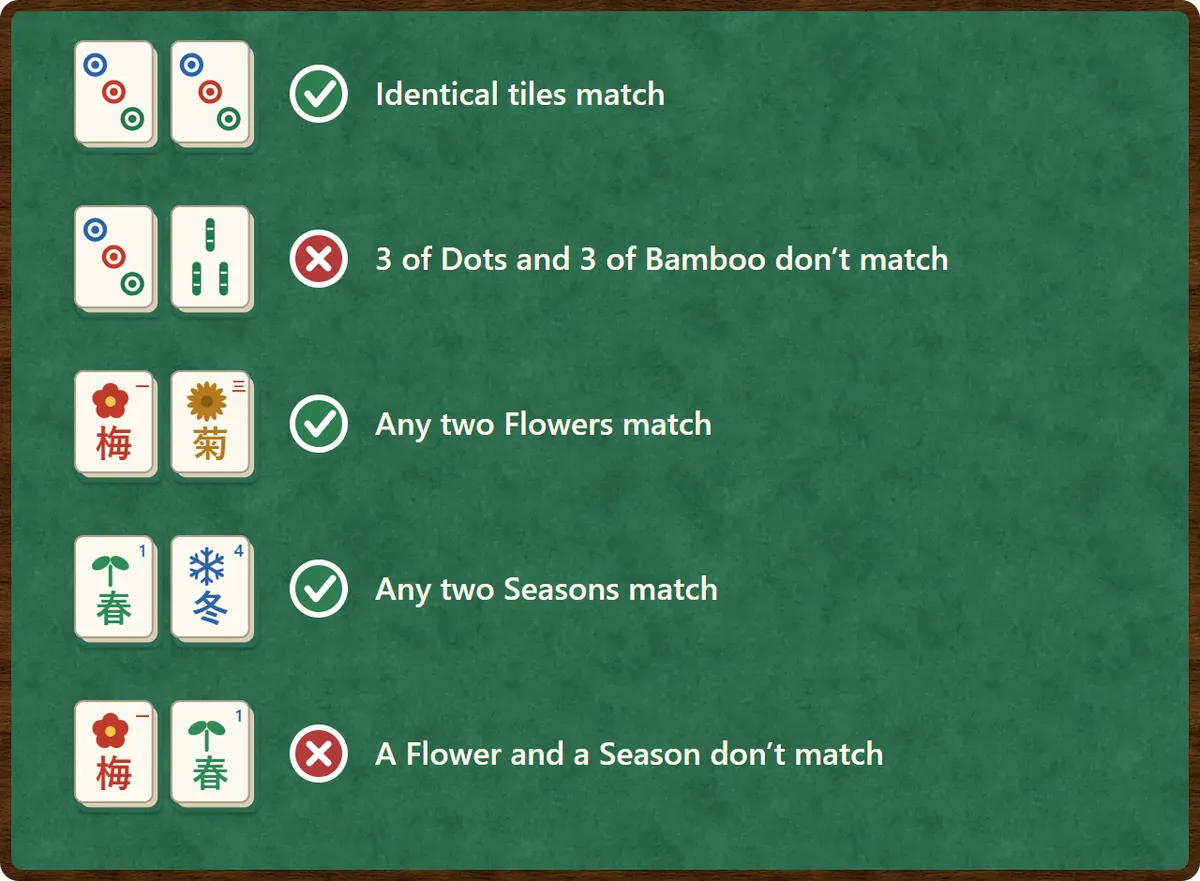
Choose two free tiles that are exactly the same and both disappear. Numbers alone are not enough: a 3 of Dots and a 3 of Bamboo are different tiles. The one exception is the bonus tiles. Because there is only one of each, any Flower matches any other Flower and any Season matches any other Season. A Flower and a Season never match each other.
Winning and getting stuck
You win when the last pair leaves the table. If no two free tiles match any more, you are stuck. Here you can undo as many moves as you like, or shuffle the tiles that are left. The shuffle rearranges the remaining tiles into an order that can still be cleared, keeping the shape of the stack the same.
A trap to watch for
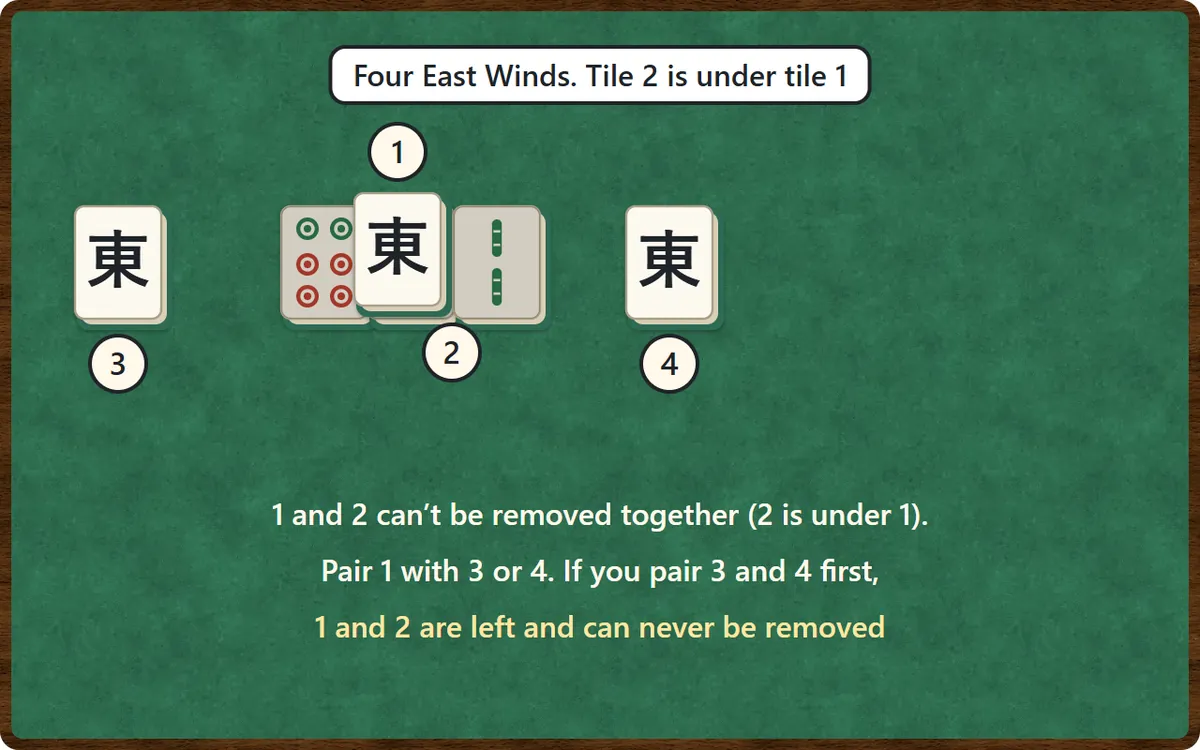
Since each ordinary tile comes in fours, two identical tiles sometimes end up stacked on top of each other. The top tile and the one under it can never be free at the same time, so the top tile must be paired with one of the other two copies. If you match those other two copies with each other first, the stacked pair is left behind and the board can no longer be cleared.
Using this game
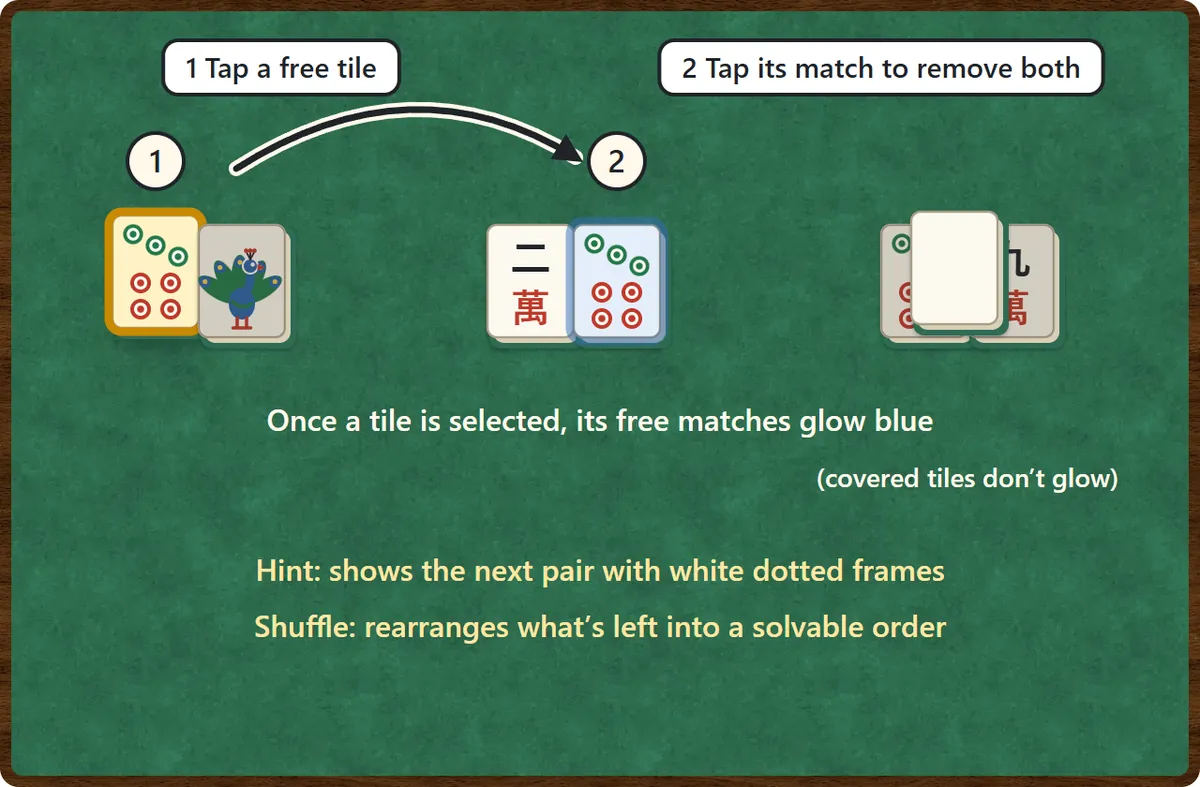
Tap or click a free tile to select it. Every free tile it can pair with glows blue; tap one of them and both tiles are removed. When the selected tile has exactly one free partner, a quick double tap removes the pair in one go. Undo takes back as many moves as you like. Hint shows a pair that still leaves the whole board solvable, and if you have already gone down a dead end, it tells you how many moves to undo. Shuffle rearranges the remaining tiles. On a small phone screen, turn the phone sideways or press Zoom in to make the tiles bigger and drag inside the frame to move around. You can also play with a keyboard: the arrow keys step through the free tiles, Enter selects and matches, Z undoes, H gives a hint, S shuffles and M toggles the markers.
Four layouts

| Layout | Tiles | What it’s like |
|---|---|---|
| Hill | 36, 3 levels | A small mound that takes a few minutes. Good for learning the rules |
| Terraces | 72, 3 levels | Each level is shifted by half a tile. Plenty of free tiles, easy to plan ahead |
| Butterfly | 108, 3 levels | Two wings and a body. Deciding which part to open first is the key |
| Shell | 144, 5 levels | The traditional turtle-shell shape using the full set |
Every deal here has been checked to be solvable before you see it. The deal is built backwards from the last pair, so there is always at least one way to clear the whole board. If you get stuck, a different choice somewhere earlier will get you through. The daily deal uses the Shell layout and is the same for every player on the same day, so you can compare times with friends. You can also enter a deal number to replay a board you liked.
Mahjong Solitaire strategy and tips
1. Dig into the tallest stacks first
The highest part of the layout hides the most tiles. Clearing the top of a stack early opens up everything underneath it. When you have several pairs to choose from, prefer the ones on higher levels or the ones that are covering many other tiles.
2. Choose which end of a long row to open
A long row can only be taken from its ends. If you keep eating into the same end, tiles at the other end stay locked for a long time. Look at what is waiting at both ends of a row and decide which side to open first, rather than grabbing whichever pair you see first.
3. With three copies free, choose the best two
When three identical tiles are free at once, the two you pick matter. Take the two that uncover the most new tiles, and keep the third one for later. If all four copies are free, just take all four – there is nothing to lose.
4. Look out for stacked twins
Before you match two copies of a tile, check where the other two copies are. If one of them is sitting on top of another, you need to keep a partner for the top one. This is the most common way a solvable board turns into an unsolvable one.
5. Don’t hurry
There is no time limit, so take a moment before every move. Scan the whole board, list the pairs you could take, and ask which one opens the most new tiles. Players who pause like this get stuck far less often than players who take the first pair they notice.
6. Use Undo and Hint to learn
If you run out of moves, undo a few steps and try a different pair. When you are truly lost, the hint will point you along a path that clears the board. Games won without any hints or shuffles count toward your personal best time, so once you are comfortable, try clearing a layout on your own.
Mahjong Solitaire FAQ
Do I need to know how to play mahjong?
No. The game only borrows the mahjong tiles. The rules have nothing to do with regular mahjong: you simply look for pairs of identical tiles among the free ones.
How do the Flower and Season tiles match?
Any Flower matches any other Flower, and any Season matches any other Season, even though the pictures are different. A Flower never matches a Season. In this game the Flowers show plants – plum, orchid, chrysanthemum and bamboo – and the Seasons show a sprout, the sun, a maple leaf and a snowflake. Turn on the markers and they are labeled F and S.
Can every game be won?
Yes, every deal in this game can be cleared. That doesn’t mean every move is safe, though: taking pairs in the wrong order can still leave you stuck. When that happens, undo or shuffle.
What does Shuffle do?
It gathers the tiles that are still on the table and puts them back in the same positions in a new order that can be cleared. The shape of the stack doesn’t change. If the shape itself can’t be cleared any more – for example when only two tiles are left, one on top of the other – shuffling can’t help, so undo instead. Games where you shuffled don’t count toward your best time.
Can I stop and continue later?
Yes. The game is saved on your device as you play. Open this page again in the same browser and press Continue in the settings. Your undo history is kept too. Sound is off at first; press “Sound: off” to turn on the sound effects.
Where Mahjong Solitaire comes from
Despite the ancient-looking tiles, Mahjong Solitaire is a computer-age game. The first version was written in 1981 by Brodie Lockard for the PLATO computer network, and during the 1980s it spread to home computers and game consoles. You will sometimes read that it is an old Chinese pastime, but there is no real evidence for that. Over the years players have invented hundreds of layouts, from the classic turtle-shell shape to animals, towers and pyramids. Its mix of calm picture-matching and careful planning is probably why it is still one of the most played solitaire games on computers and phones.