 Yorimichi Games
How to play Maze Collect
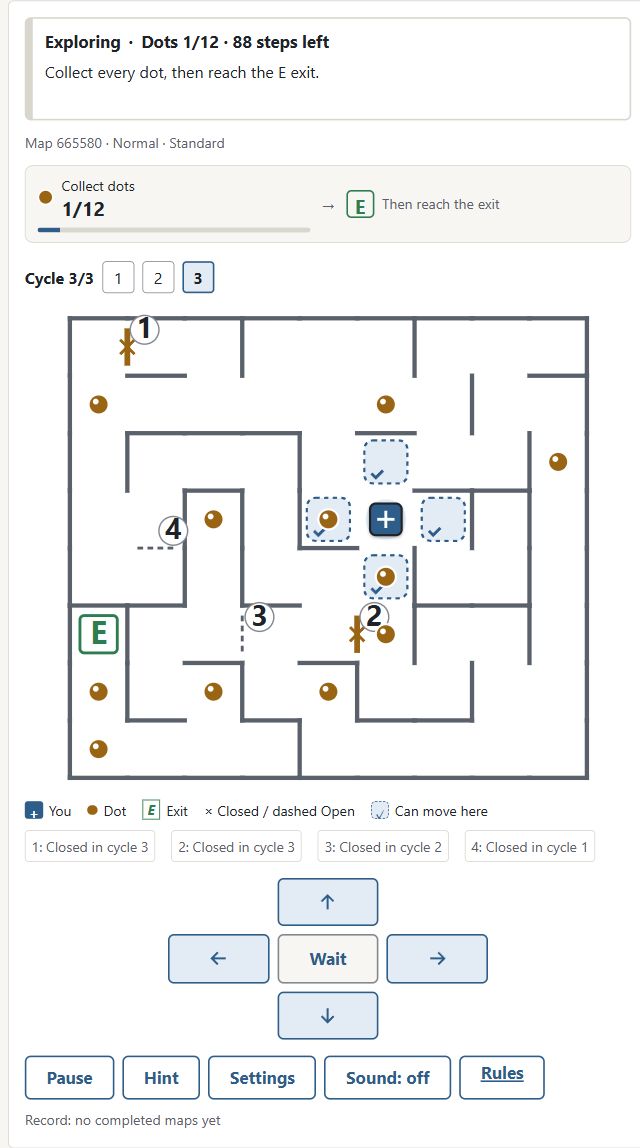
Explore a maze, pick up every scattered dot, and finish at the exit marked E. Your position is a square survey marker with a cross inside it. Move one cell at a time in four directions. Entering a cell with a dot collects it automatically, without a second button or an extra action. A collected dot stays collected even if you return to that cell later. There is no tail to manage, no pursuer to outrun, and no need to keep moving while you think.
Choose Easy, Normal, or Hard, then select Standard or Practice. Leave the map number blank for a new map, or enter a number from 1 to 999999 to play the same layout again at the same difficulty. Before moving, look for the exit and the groups of dots. Reaching E immediately is not enough: the collection must be complete. Try to plan both your outward journey and the route that will bring you back to the exit.
Collect every dot before finishing
Dots are placed at individual locations rather than along every corridor. Some are near junctions, some are deeper inside a branch, and others can be reached from more than one direction. The counter above the board shows how many you have collected and how many the map contains. Repeated visits do not create more dots or increase the counter twice.
You may enter or pass through the exit while dots remain. This does not end the game or cause a penalty. The exit remains available, so you can continue exploring and return when the collection is finished. Consider leaving a dot near E until later if doing so fits your route. Collecting the nearest dot first can be useful, but it can also lead to unnecessary trips through the same junction. Look at where a whole branch leads before deciding to turn back.
Gate rules and the three-step cycle
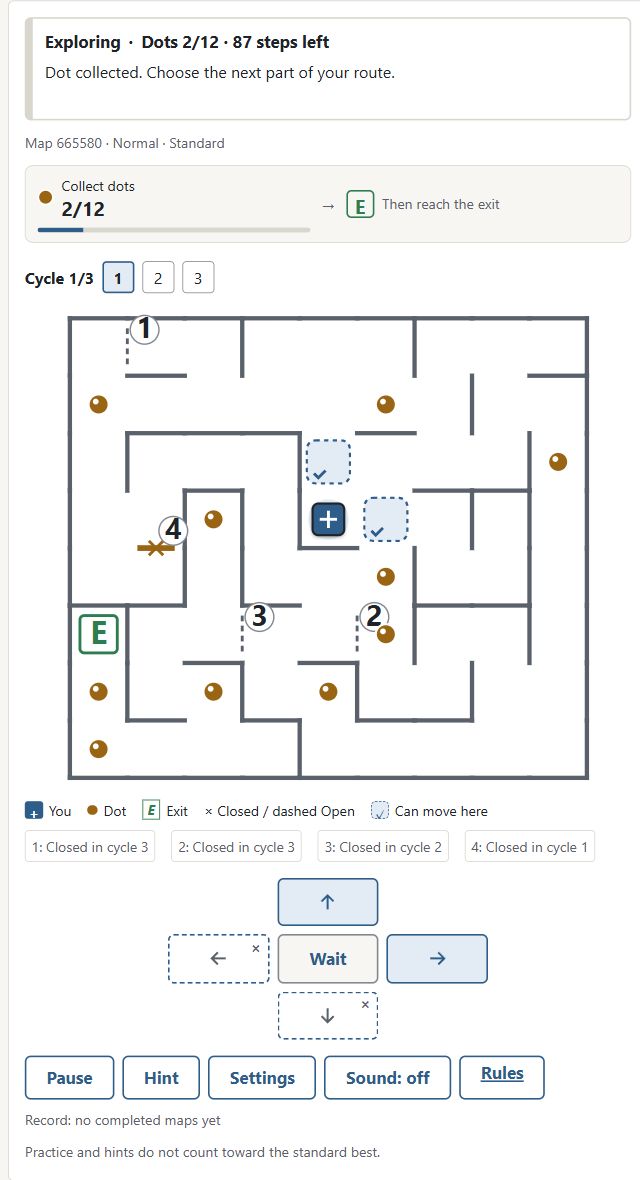
Numbered gates interrupt some passages. Each gate is closed in one of three cycles and open in the other two. A closed gate has a solid bar and a cross; an open gate uses a broken line. The numbers identify gates, and the list below the board tells you the cycle in which each one closes. The three boxes above the maze show the current cycle. These shapes and labels allow you to read a gate without relying only on its color.
A successful move or a Wait action advances the cycle from 1 to 2, then 3, then back to 1. Whether you can cross a gate is decided using the cycle shown before your action. If a gate closes after you have crossed it, your marker is safe. Gates occupy the boundary between cells, rather than the cells themselves. They cannot crush the marker or end a round through contact. Nothing advances while you are simply looking at the board.
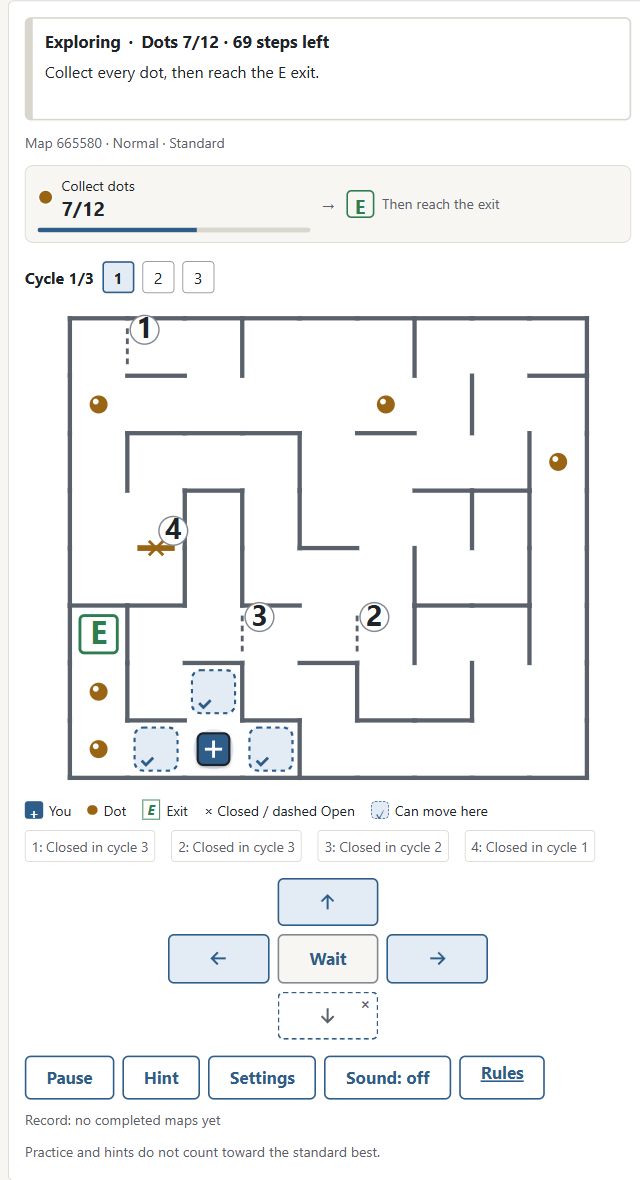
Waiting and blocked moves
Use Wait to stay in your current cell and advance the cycle by one step. You can wait anywhere, including a junction some distance from a gate. This lets you adjust the cycle before arriving at a passage. Waiting has the same cost as moving in Standard mode, so it is worth comparing a short route with a wait against a longer route that is already open.
Attempting to move into a wall, outside the board, or through a closed gate does not move the marker, spend a step, or advance the cycle. Pressing the same blocked direction repeatedly will not make the gate open. Choose Wait instead. Movement never wraps around the edge of the board. You cannot move diagonally, jump across a wall, or tap a distant dot to travel there automatically. Each action is a single decision that you can check before taking the next one.
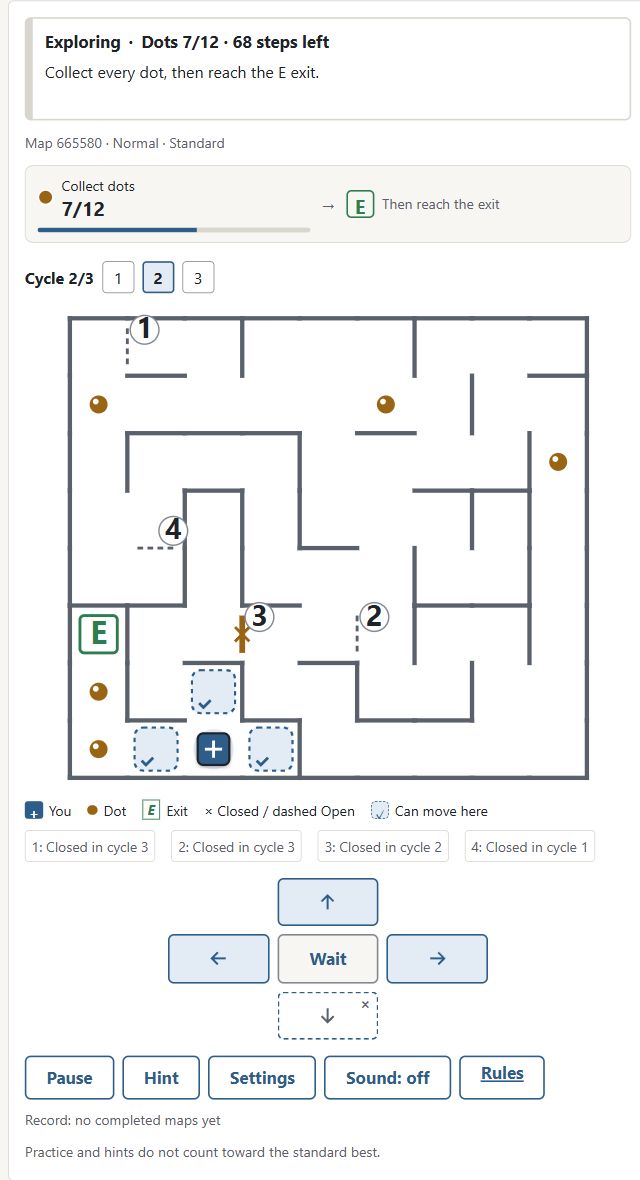
Step allowance, completion, and failure
Standard mode gives you a finite step allowance. Each move and each wait spends one step. Collecting a dot on arrival costs nothing beyond that move. If the allowance reaches zero while the collection and exit condition are still incomplete, the round ends. If your final available step brings you to E after collecting all dots, completion takes priority and you succeed. Collecting the last dot away from E is not completion by itself. You still need enough steps to reach the exit.
Every map has connected passages, and every dot and the exit can be reached with the gate cycle taken into account. The allowance includes a route that collects all dots and finishes at E. This does not mean that every order of collection will fit, or that the first route you choose will be the shortest. Backtracking and waiting can spend the extra allowance. Check the remaining counter before committing to a remote branch, especially when the exit is on the other side of the board.
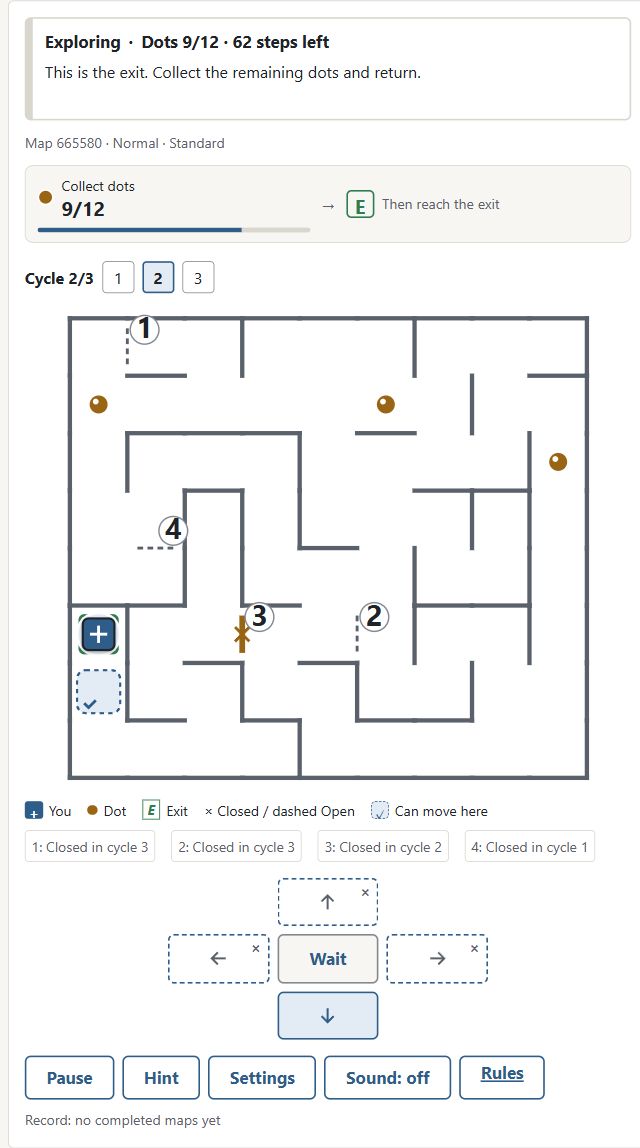
Difficulty, Practice mode, and hints
Easy has a seven-by-six board, eight dots, and two gates. Normal has nine by eight cells, twelve dots, and four gates. Hard has eleven by nine cells, sixteen dots, and six gates. Higher settings give you more places to visit and less spare allowance relative to a complete collection route. Difficulty comes from route choices and cycle planning, rather than faster animation or a computer opponent.
Practice removes the normal step allowance so you can explore freely. A practice round finishes after at most 10,000 steps. Hint suggests one next action from your current position and collection. Sometimes the suggestion is Wait, because the useful passage is closed in the current cycle. A hint is a route suggestion, not a promise of the fewest possible steps for the whole map. Practice rounds and rounds in which you use a hint do not count toward the Standard best-step record. You can still finish them and review the result.
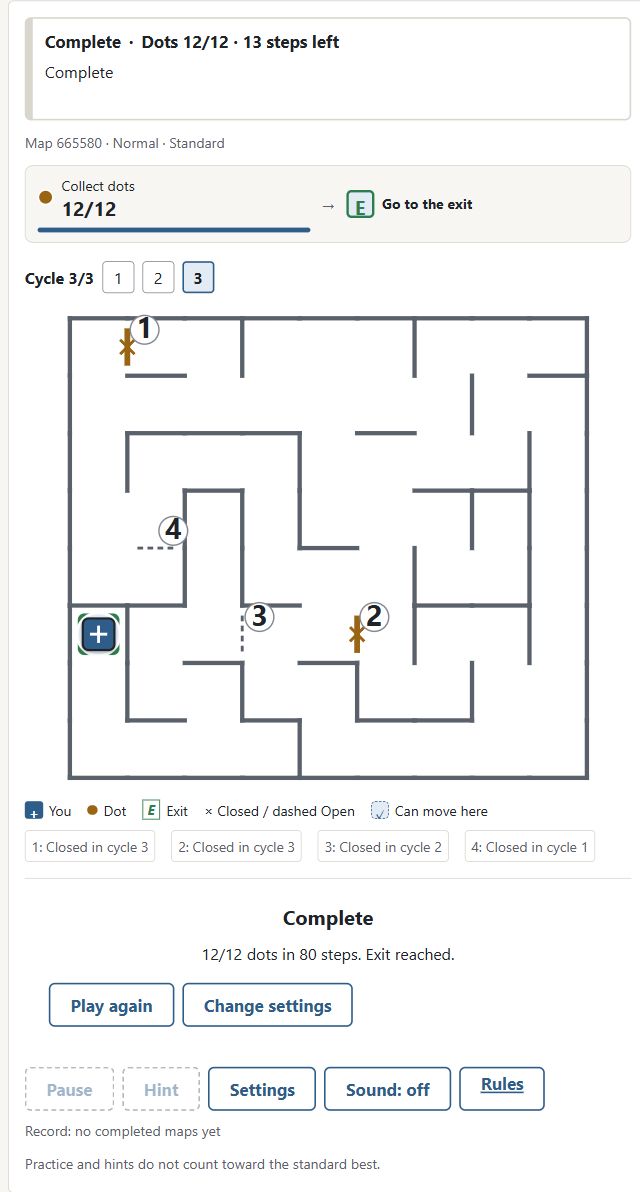
| Level | Dots / gates | Board |
|---|---|---|
| Easy | 8 / 2 | 7 × 6 |
| Normal | 12 / 4 | 9 × 8 |
| Hard | 16 / 6 | 11 × 9 |
Touch, mouse, and keyboard controls
On a phone or tablet, use the large direction buttons, tap a neighboring cell, or make a short swipe across the board. One swipe moves one cell; it does not send the marker running down a corridor. A distant cell cannot be selected as an automatic destination. If the smaller cells are uncomfortable to tap, the direction buttons give you the same choices with a larger target. Wait is in the center of the button group. Directions always refer to the screen.
On a computer, use the arrow keys or W, A, S, and D. Space waits one step, P pauses or resumes, and H requests a hint. Holding a key does not repeatedly advance the game. While a settings field has focus, the movement shortcuts do not change your position. Pause leaves the marker, collection, cycle, and allowance exactly as they were. Sound is optional and starts off; the board and messages provide the information needed to play.
Saved games and another attempt
Progress is stored in the current browser on the current device. When you reopen the page, choose Continue to return to the saved map. Settings can be opened during a round without replacing the existing progress; Continue returns to that round, while Start begins the settings you selected. Switching between the Japanese and English pages uses the same saved progress. A result can also be reopened without counting the completion a second time.
Play again resets the same map number and difficulty, allowing you to compare another route. To get a different maze, open Settings and leave the map number blank before starting. A number is useful when you want to revisit a layout, but it does not transfer progress between devices. Clearing browser storage removes the saved round and local record. Storage may also be unavailable in some private browsing environments. The game does not require an account or send your progress to another player.
Maze Collect strategy: five useful habits
First, locate E before choosing your opening direction. A good collection route must also finish at the exit, so think about the final journey rather than only the next dot. Second, collect the dots inside one branch together when that avoids repeated trips through its entrance. Entering a dead end for one dot and later returning for another can consume much of the allowance.
Third, check a gate number against the current cycle before approaching it. You may be able to cross now, take one useful move before returning, or wait once instead of making a long detour. Fourth, use loops as return routes. If two passages lead back to the same junction, collecting along one side and returning along the other can be more efficient than retracing the entire path. Fifth, reassess the dots that remain after each group is collected. A route that looked promising at the start may need to change as the collection shrinks and the exit becomes the main destination.
Maze Collect FAQ
Can every dot be reached? Yes. The passages are connected, and a closed gate becomes open when the cycle advances. Does entering the exit early lose the round? No. You can leave it and continue collecting. Does a blocked move consume a step? No. Only a successful move or Wait does so. Does pausing change the cycle? No. There is no clock driving the gates in the background.
Can I win on my last step? Yes, if all dots have been collected and that step reaches E. Are hints always optimal? No. They provide a usable next action, but do not guarantee a globally shortest collection order. Is there a computer opponent? No. This is a single-player exploration and route-planning game. Why did my best-step record not change? Practice and hinted attempts are excluded, and a Standard attempt must complete the collection and reach E. The record is kept for the same map number and difficulty. It reflects your local completed attempts, not a ranking against other players.
Exploration and collecting as a puzzle
A maze can ask you to find a single destination, visit several locations, or choose a route that returns to a useful exit. Those goals produce different decisions even on the same network of passages. Maze Collect combines a set of scattered destinations with a final exit and a small repeating gate cycle. A short path to one dot may be less helpful than a route that collects several dots in one branch.
Loops provide alternative ways back, while dead ends require you to retrace at least part of your path. Gates add the question of when to cross as well as where to go. This page uses its own collection, allowance, and gate rules. Once you know a map, replay it and compare the parts of the route where you turned back, waited, or crossed a junction more than once.