 Yorimichi Games
How to play Ball Drop
Ball Drop is a route planning puzzle with one ball, a fixed release point, several numbered ramps and a target at the bottom. Your task is to set the ramps before releasing the ball. The ball then falls, slides and bounces through the board. You do not steer it during the run. A successful layout brings its center into the marked target when it reaches the bottom. There is no score for collecting objects and no reward for pressing a button quickly.
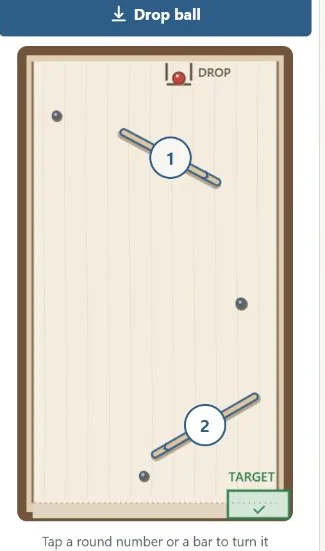
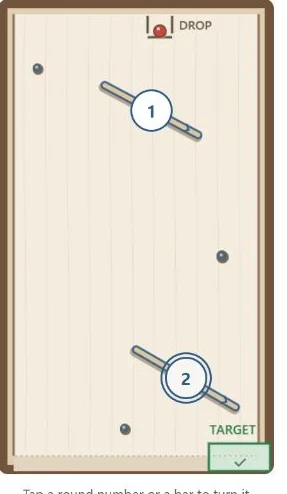
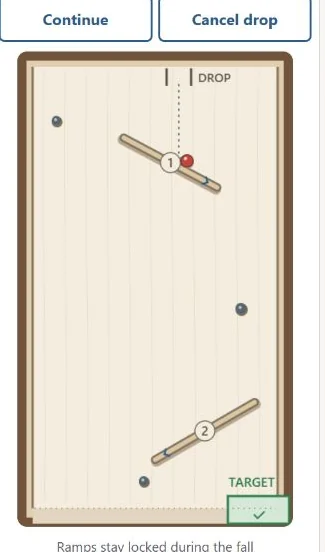
Choose a difficulty and a board number, then press Start. The red ball at the top marks the release point. The green box with a check mark identifies the target. The numbered bars are the ramps you can change. Blue edges and round numbered handles mark the ramps you can turn. A double ring marks the most recently used ramp. Turn the ramps in any order, then press Drop ball and watch the route. There is no limit on the number of tries, so an unsuccessful drop is a chance to learn rather than the end of a game.
Turning ramps and reading direction
Each ramp has two positions: down left and down right. These directions are measured from your view of the screen. Down right means the right end is lower than the left end. A ball resting on a slope tends to move toward the lower end, but an incoming ball already has momentum. It may bounce off a ramp or pass its end without following the whole bar. Watch the actual movement instead of assuming every contact produces a long slide.
Tap the number on a ramp or use its button in Ramp directions & tools. Each tap switches the direction once. The circular pins and the outer walls stay fixed. Ramps are locked while the ball is falling. You cannot turn a bar at the last moment to catch a missed ball. If you want to examine a contact, pause the fall and continue when ready. Cancel drop cancels the current run so you can change the layout. A cancelled drop still counts as an attempt.
Pins, walls and a successful drop
A pin redirects the ball when the two touch. Contacts reduce some of its speed, while gravity continues to pull it downward. A ball leaving the end of a ramp can carry sideways motion into the next part of the board. The side walls return the ball toward the interior rather than removing it from play. Some routes use this rebound; others need a gentler handover from one ramp to another. The direction of the next ramp matters only if the ball actually reaches it.
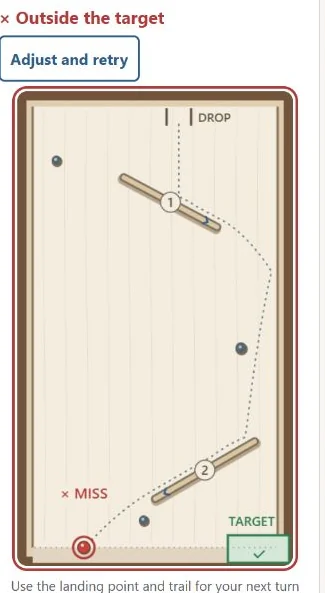
At the bottom, the center of the ball must lie within the horizontal target interval. Touching the outside of the green box with the edge of the ball is not enough. Aim for the middle of the target when judging a route. A drop that reaches the bottom outside the interval is a miss. A ball that does not finish within the allowed run becomes a stopped result. Both outcomes let you return to the same board and try another arrangement. They do not remove a life or lock the puzzle.
Results, records and saved games
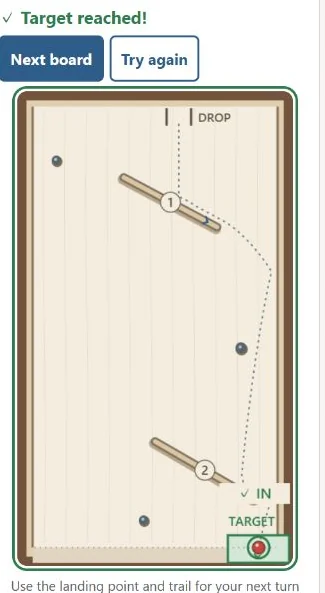
After a successful drop, choose Next board or try the same puzzle again. Each difficulty contains ten boards. After board ten, the next button takes you back to board one in that difficulty. You can also choose any board from settings, including one you have already cleared. There is no need to complete a whole set in one sitting, and you may leave a difficult puzzle for another day.
Your browser keeps the number of boards cleared in each difficulty. It also records the fewest drops used to clear each board without a hint. A hinted solution still counts as a cleared board, but it does not improve an unassisted record. Starting a board afresh through settings resets that session's attempts while retaining earlier records. The current layout, attempt count and moving ball can be saved. When Continue opens a saved fall, it stays paused until you resume it. This gives you time to recognize the position before movement starts again.
Easy, Normal and Hard puzzles
Easy has two adjustable ramps and a wide target. Begin by observing which way the first bar sends the ball. Then decide how the second bar should receive it. Normal adds a third ramp and a narrower target. An arrangement that points toward the target near the bottom can still fail if an earlier bar sends the ball past the required contact. Think about the position and direction at each handover, not just the final slope.
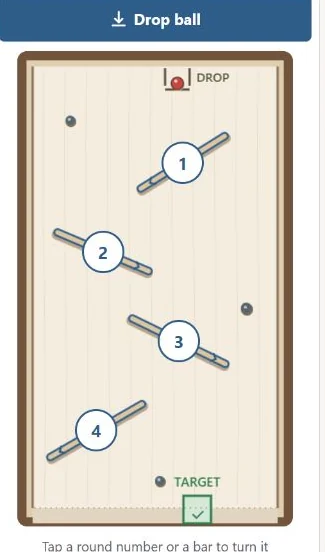
Hard uses four ramps and a narrow target. A small change early in the route can create a large difference at the bottom. The ball does not become faster or less predictable just because you choose a harder puzzle. The difficulty comes from more choices and a more precise destination. Take your time: a carefully considered layout has the same result whether you set it quickly or slowly. All boards have a working arrangement, so a failed run means another route remains to be found.
Ball Drop strategy: learn from the trail
The trail shows where the ball went during the previous run. Start by finding the last object it contacted. If the ball arrived to the right of the target, the bottom ramp is not necessarily the cause. A higher ramp may have sent it too far sideways, allowing it to miss the lower one entirely. Follow the trail backward from the miss to identify the first point where the route differed from your plan.
Change one ramp at a time when experimenting. This makes it easier to connect an adjustment with its effect. Changing several bars at once can produce a better outcome without explaining why it worked. Undo restores the most recent turn before a drop. Initial layout returns all ramps to their starting directions. Neither action counts as a new attempt until you actually drop the ball. You can hide the trail if you prefer an uncluttered view, then show it again when comparing routes.
Hints identify one ramp whose direction differs from a successful arrangement. They do not turn the bar for you or move the ball. Apply the suggestion yourself and watch what changes. If every ramp is already correct, the hint tells you the layout will reach the target. Using a hint is a useful way to study a difficult handover, even though that session will not set an unassisted record. Revisit the same board later and try to explain the route before dropping.
Ball Drop FAQ
Is this Smartball or a coin pusher?
No. There is no spring launch, no moving shelf and no stream of objects to collect. This game asks you to arrange a route before dropping one ball. It is a puzzle about fixed pins and adjustable slopes.
Can the same layout give different results?
The same board and ramp directions produce the same route. Pausing does not change the outcome. If two drops look different, check whether you changed a ramp or selected another board before comparing them.
How can I play without a mouse?
Touch the round numbered handles on the board, or open Ramp directions & tools for text buttons. On a keyboard, keys 1 to 4 turn the corresponding ramps, Space drops the ball, Z undoes a turn, and P pauses a moving ball. Buttons can also be reached with Tab and activated normally.
Why did a ball touching the target miss?
The test uses the center of the ball at the bottom line. Its outer edge can overlap the green interval while the center remains outside. Use the target center as your visual guide rather than trying to graze an edge.
Where is my saved game?
Continue reads the most recent game in the same browser. Changing devices, using another browser or clearing storage will not transfer it. Storage may also be unavailable in restricted browsing. The Japanese and English pages share the same saved game and records.
Does the board represent a real machine?
It is a simplified model for a puzzle. Real materials, rotation and small surface differences can alter a physical ball's route. Treat this as a way to practice observation and planning rather than a design tool for real equipment.
About this original puzzle
Rolling balls and slopes appear in many homemade tracks and construction toys. This collection uses that broad idea to offer original layouts with two choices per ramp and a clear destination. It does not recreate a particular product's board or rules. The satisfying part is connecting what you saw in one run with a better plan for the next.