 Yorimichi Games
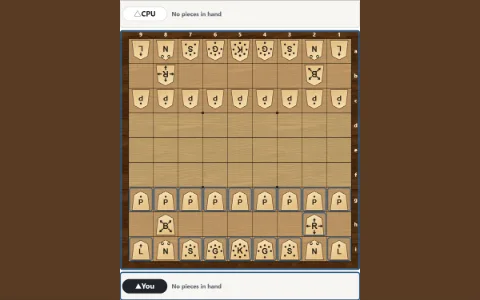
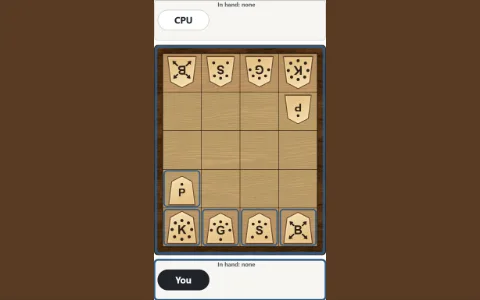
What is tsume shogi?
Tsume shogi is the puzzle side of shogi, the Japanese form of chess. Each problem shows a position near the enemy king, a few of your pieces and usually one or two pieces in your hand. Your job is to checkmate that king in an exact number of moves, and every single move you make has to be a check. A puzzle solved in one move is called a “mate in 1” (ittezume), one that takes your move, the defender’s reply and your second move is a “mate in 3,” and so on. Because the solver always makes the last move, the length is always an odd number: 1, 3, 5, 7…
In a real game of shogi the final phase is a race to mate the king first, and players who can spot a mating sequence quickly win far more games. Tsume shogi takes that moment out of the game and lets you practise it on its own, which is why beginners and professionals alike solve these puzzles every day. The shogi problems on this page were made for players who have only just learned how the pieces move. The computer defends by choosing the reply that survives longest, so you can move the pieces on the board and see for yourself whether your idea really works.
How to read a shogi puzzle
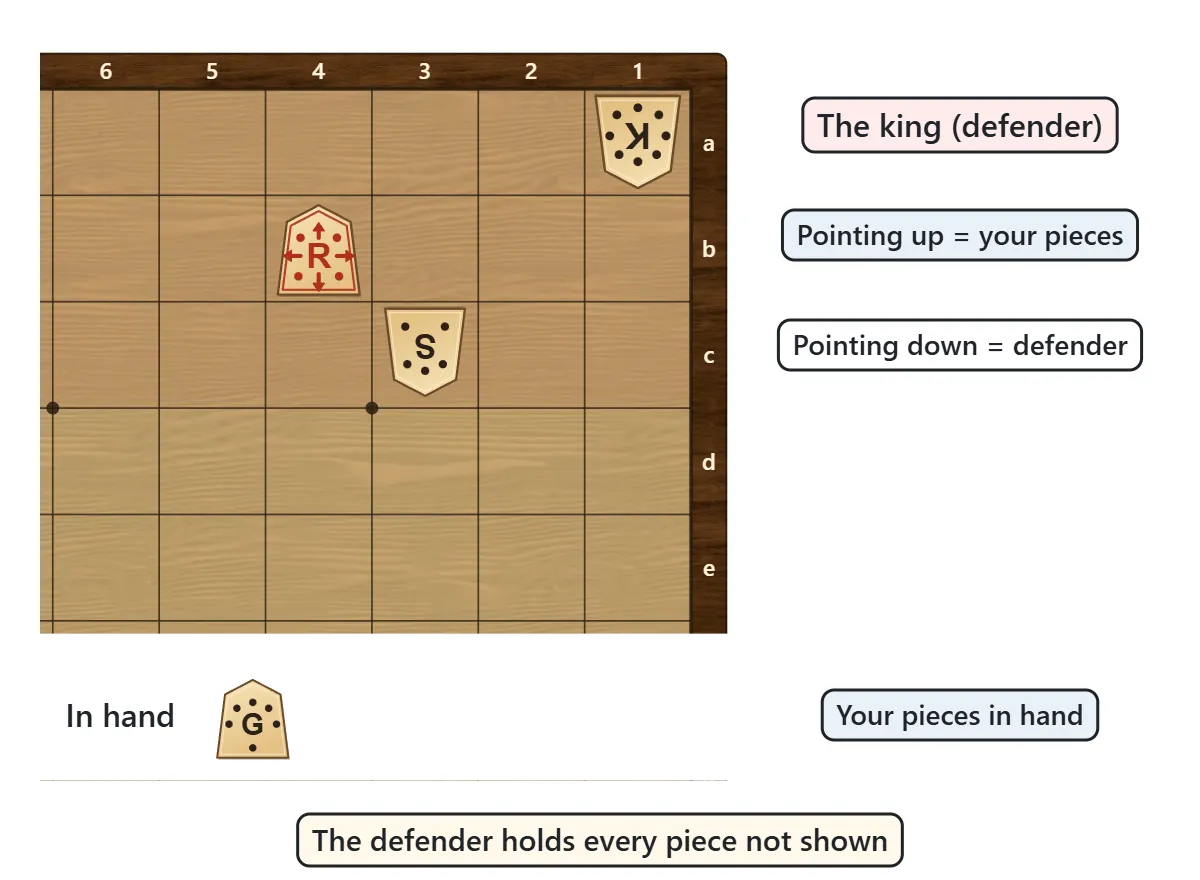
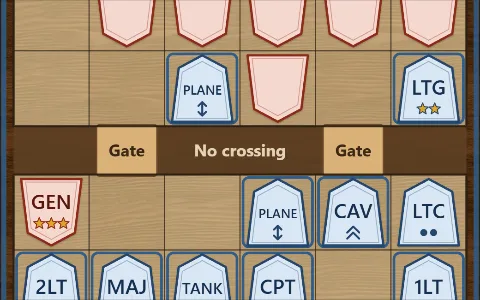
Shogi pieces all have the same color, so ownership is shown by the direction a piece points. Your pieces point up, toward the defender, and the defender’s pieces point down. The tray under the board holds your pieces in hand; you can drop any of them on an empty square as your move, as long as the drop gives check. The defender’s hand is written as “every remaining piece”: any piece that is not on the board and not in your hand belongs to the defender (except a second king) and can be dropped to block a check. Most beginner problems use a small corner of the board, with the king on an edge or in a corner and only a handful of pieces nearby.
If the Japanese characters on the traditional pieces are unfamiliar, choose “Letters with move marks” in the settings. Each piece then shows a letter – K for king, R for rook, B for bishop, G for gold, S for silver, N for knight, L for lance and P for pawn – and small dots and arrows that show where it can go. The board is labelled in the Western style, files 1 to 9 from right to left and ranks a to i from top to bottom, so a square is written like 2b.
Tsume shogi rules
A shogi puzzle uses the normal rules of shogi, plus a few conventions that make every problem fair and give it a single answer.
| Rule | What it means |
|---|---|
| Check every move | Each of your moves must give check. A quiet move, however strong, is not allowed. |
| Longest defense | The defender picks the reply that delays mate the longest. If two replies are equally long, it chooses the one that uses up more of your pieces in hand. |
| Defender holds the rest | Every piece not on the board and not in your hand is in the defender’s hand. |
| No futile blocks | A block that is simply captured without delaying mate (mudaai) is not counted. |
| Nothing left over | When solved correctly, your hand is empty at the moment of mate. |
| Normal fouls apply | Two unpromoted pawns on one file (nifu), mate by a pawn drop (uchifuzume) and drops where a piece could never move again are illegal. |
Mate in 1 example: the gold on the king’s head
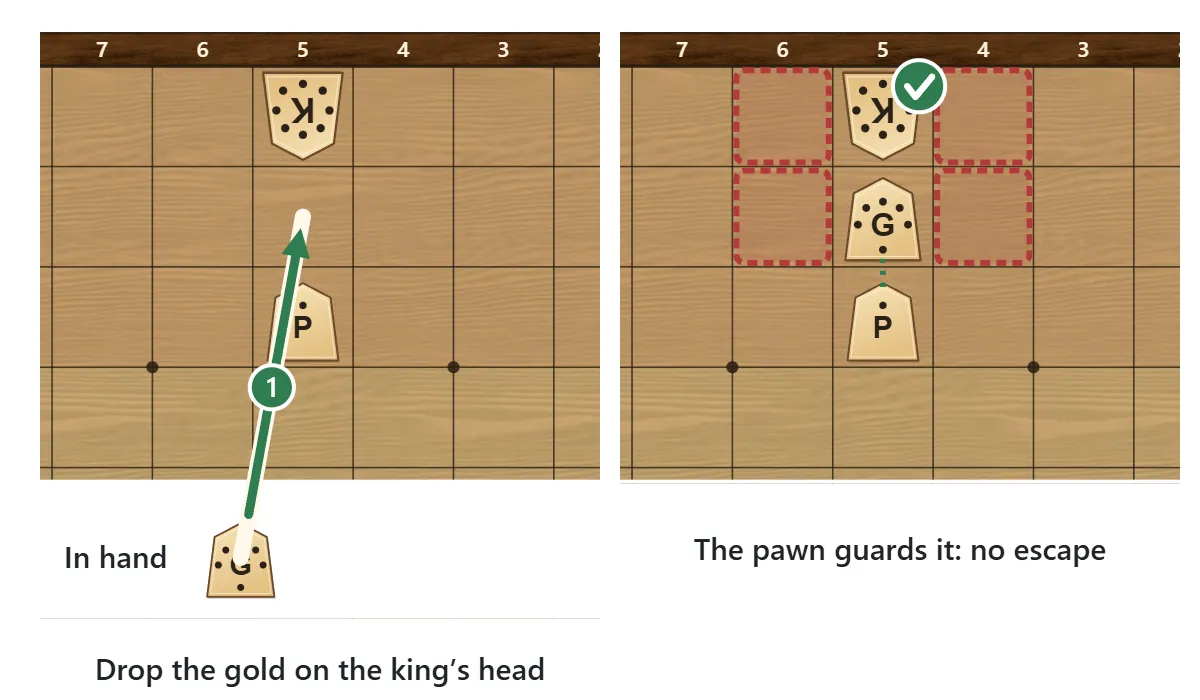
The most common one-move mate is the “gold on the head” (atama-kin): you drop a gold general on the square directly in front of the king. A gold covers the squares in front, diagonally in front, to both sides and straight behind it, so in one move it takes away most of the king’s escape squares. The catch is protection. If nothing of yours covers the square where the gold lands, the king simply captures it. Before you drop, check that another of your pieces – here a pawn – guards that square.
Thinking in three moves: check, reply, mate
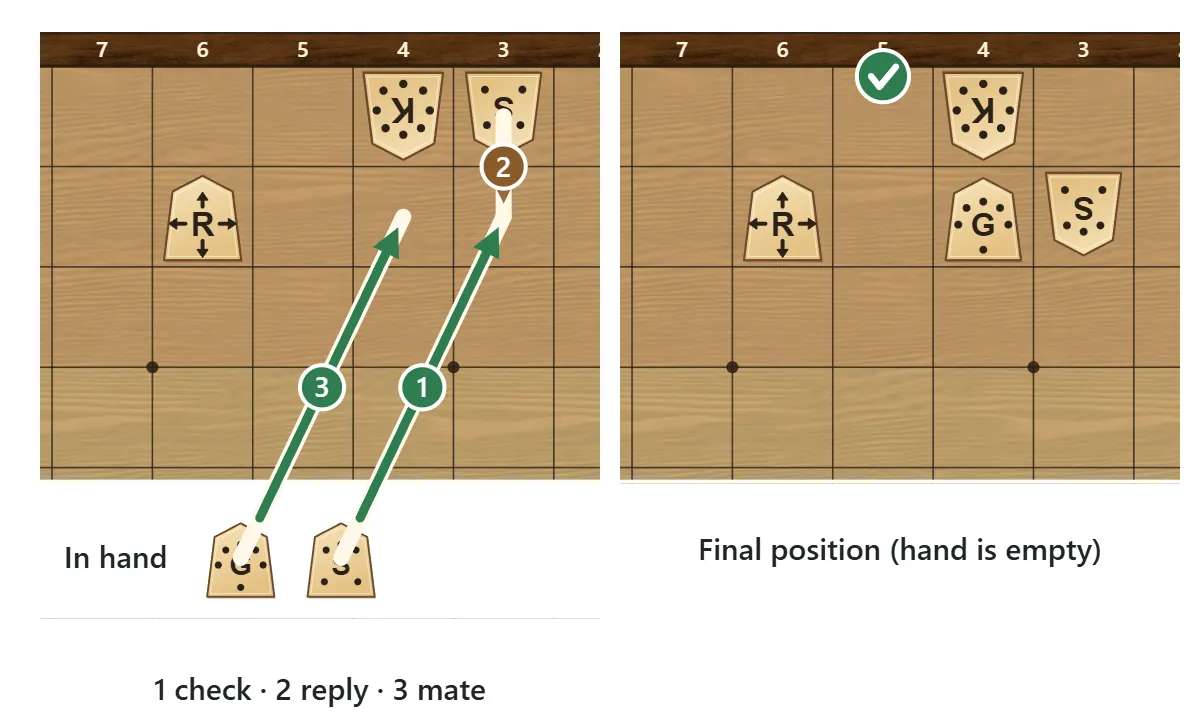
In a mate in 3 you give check, the defender answers by moving the king, capturing or blocking, and then your third move delivers mate. The first move is very often a sacrifice: you offer a piece that the defender must take, because taking it drags the king or a defender onto a worse square. Once you see that, the last move becomes a simple one-move mate. A mate in 5 adds one more round of check and reply, but the idea is the same.
Mate by a pawn drop is illegal
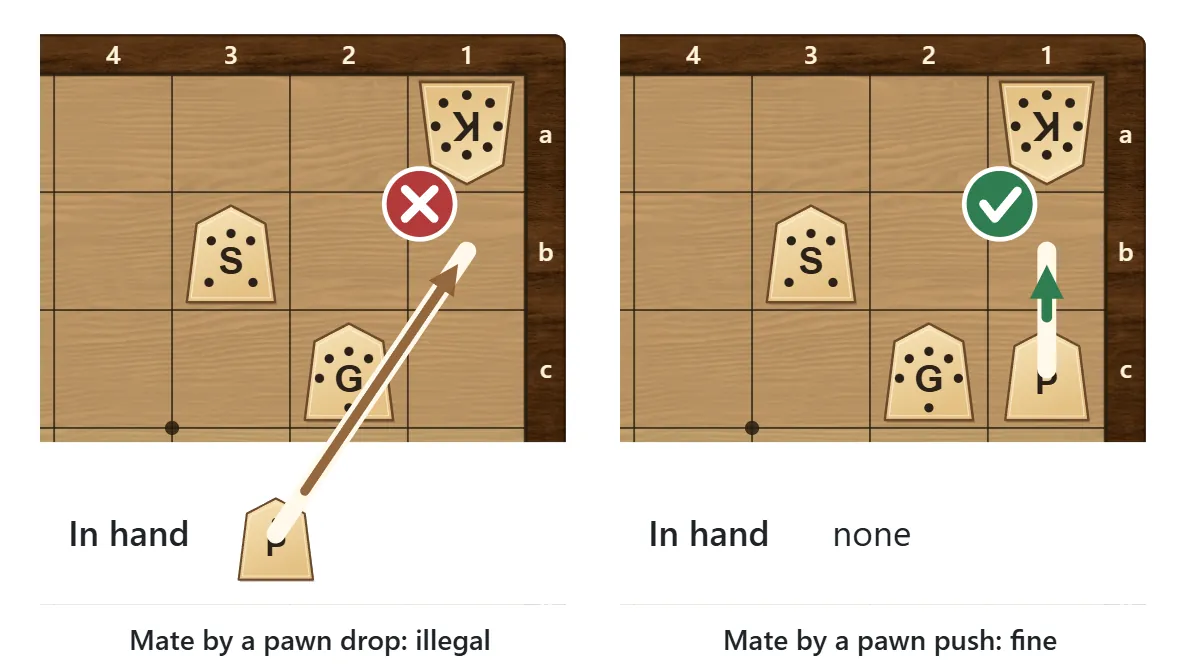
Just as in a normal game, you may not deliver checkmate by dropping a pawn from your hand (uchifuzume). Moving a pawn that is already on the board to give mate is perfectly legal. Some problems are built around this rule: the obvious pawn drop would be mate but is forbidden, so you have to find another way to finish.
Futile blocks (mudaai)
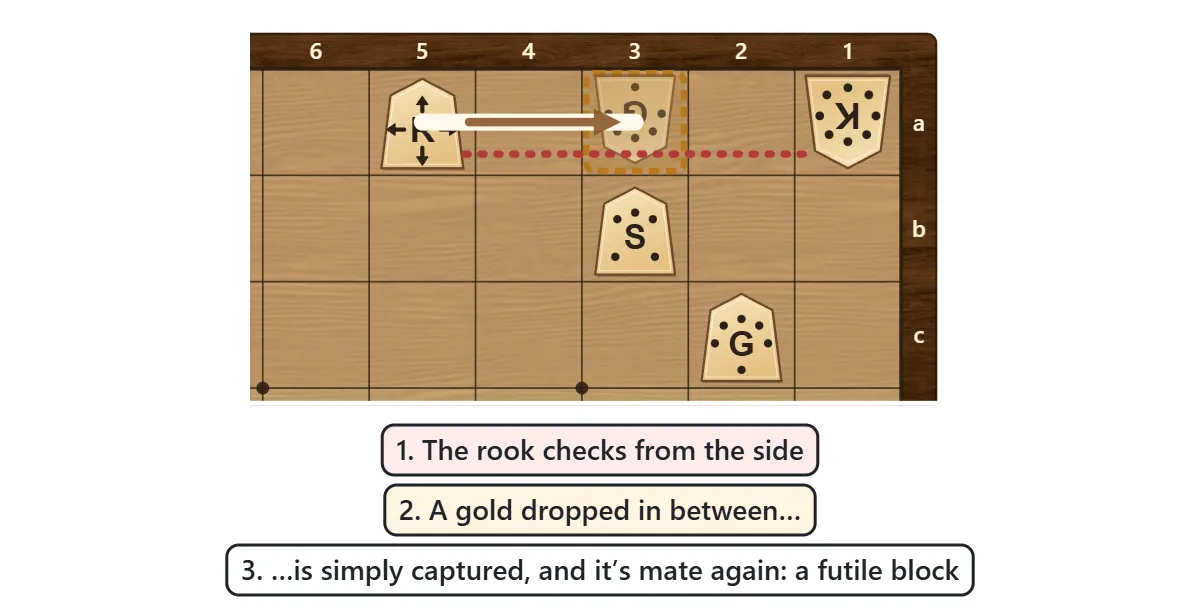
When a rook, bishop or lance checks from a distance, the defender can drop a piece in between. If that piece is simply captured and the position is mate all the same, the block is called futile (mudaai) and does not count toward the length of the puzzle. The defender on this page never makes a futile block. A block that really changes something – because the captured piece is useless to you, or because capturing it opens an escape square – is a genuine defense and is counted.
How to play these shogi puzzles
Pick Mate in 1, Mate in 3, Mate in 5 or the Daily puzzle and press Start. Tap the piece you want to move, or a piece in your hand, and then tap the destination. With the move guide on, blue dots appear only on squares where the move gives check, and a move that is not check is refused.
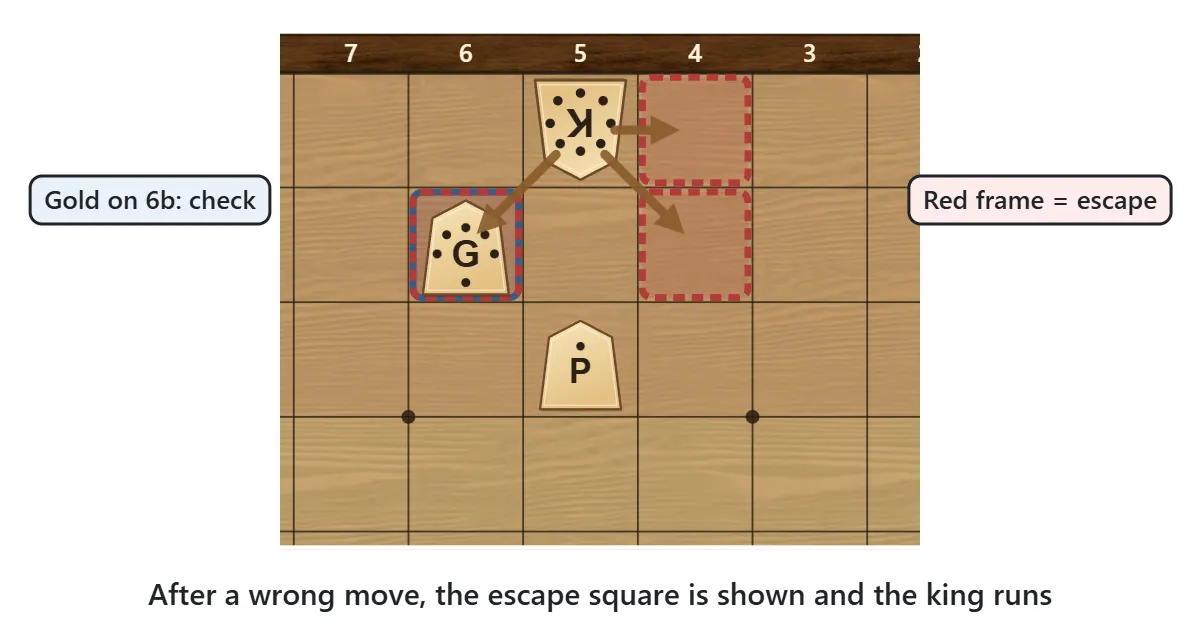
When your move is right, the defender replies with its longest defense. When it isn’t, the board shows why: the squares the king can escape to, the defender that can capture your checking piece, or the block that stops your attack. Press “Go back and retry” to return to the position before your move and try again.
Stuck? Press Hint once and the piece to use is framed in green. Press it again and an arrow shows where it goes. If you still want to see the answer, “Solution” plays the whole sequence from the start. Solved puzzles are marked in the puzzle list: ○ for a clean solve with no hints or mistakes, △ for a solve after a hint or a mistake, and × when you viewed the solution. Your progress is stored in this browser on this device.
The Daily puzzle changes with the date, and everyone who opens the page on the same day gets the same problem. Tuesdays and Thursdays bring a mate in 1, weekends a mate in 5, and the other days a mate in 3. The page also counts how many days in a row you have solved it.
Tips for solving tsume shogi
1. Count the king’s escape squares first
Before looking for a move, look at the eight squares around the king. Cross out the ones your pieces already attack and the ones blocked by the defender’s own pieces. What remains are the escape squares. If only one or two are left, search for a check that also covers them.
2. List every possible check
Since every move must be a check, the number of candidates is small. Go through your pieces and your hand and ask, for each one, “Can this piece give check, and from which squares?” Writing the list in your head prevents the most common mistake: never noticing the right move at all. The move guide on this page marks only checking squares, which makes this habit easier to learn.
3. Make sure the checking piece is protected
A piece that checks from the square next to the king needs support, or the king will simply take it. When a move fails here, the red frames usually point to exactly this: an unprotected checking piece, or an escape square you left open.
4. Plan to use every piece in hand
A correct solution never leaves pieces in your hand. If you hold a gold and a silver, the answer uses both. This is one of the strongest clues in any shogi puzzle, and it quickly rules out tempting moves that leave something unused.
5. In a mate in 3, look for a sacrifice
If no check leads directly to mate, consider giving a piece away. A sacrifice can pull the king forward onto a square where it is easier to trap, or lure a defender away from the square it was guarding. Put “checks that lose a piece” on your list instead of ruling them out.
6. Save the gold for last
The gold general is the best mating piece, so it is often the final move. Silvers, knights, rooks and bishops tend to do the preparation, and the gold closes the net. When a problem has a gold in hand, try imagining it as the last move and work backwards.
Tsume shogi FAQ
I only just learned the shogi pieces. Can I solve these?
Yes. If you know how the pieces move, you can start with mate in 1. Turn the move guide on and choose letter pieces: the selected piece shows its moves as arrows, and dots appear only where a move gives check. If you want to review the moves first, the shogi page explains every piece.
Should I start with mate in 1, 3 or 5?
Begin with mate in 1 to get used to the different kinds of check and to closing escape squares. When those feel easy, move on to mate in 3, and then to mate in 5. Each set has 36 shogi problems, roughly in order of difficulty.
It looks like there are two answers. Why is only one accepted?
Every problem was checked by computer, searching all moves, so that it has exactly one solution. If another move looks like mate, look again at the defender’s possible blocks and at whether you would finish with pieces left in your hand. When a different check does not mate, the board shows why.
How does the computer choose its replies?
It picks the move that makes the mate take longest, and among equally long replies, the one that forces you to use more of your pieces in hand. That is the standard convention in tsume shogi: a puzzle only counts as solved if it works against the most stubborn defense.
Will my progress be saved?
Your solved marks and any puzzle in progress are kept in this browser on this device. Clearing your browsing data removes them. Sound is off at first; press “Sound: off” to turn it on.
A short history of shogi problems
Shogi problems have a long history. The oldest surviving collection is usually credited to Ohashi Sokei, the first head of a family of shogi masters, in the early seventeenth century. During the Edo period it became the custom for the leading shogi families to present books of problems to the shogun, and composers competed to create very long sequences and beautiful final positions. Some of those early works would not satisfy modern rules, for example because pieces are left over in hand. Today new tsume shogi appear every day in newspapers, magazines and apps, and there are even contests for solving them at speed. All the problems on this page were newly made for this site.