 Yorimichi Games
What is tsumego?
Tsumego are Go problems. Each one shows a small part of the board with a few black and white stones, tells you who plays first, and sets a goal: kill the white group, make the black group live, or capture some white stones. The word is Japanese and is usually translated as “life-and-death problems”, because most of them are about whether a group of stones can survive. Players of every strength solve them, from people who learned the rules last week to professionals, since reading out a sequence in your head is the skill that decides most real games.
In a Go book, a problem is labelled with the side to move and the goal, such as “Black to kill” or “Black to live”. Here you always play Black, and the computer answers every move as White. The beginner set also includes “Black to capture” problems that teach the basic capturing techniques before you move on to life and death.
How to read the problem board
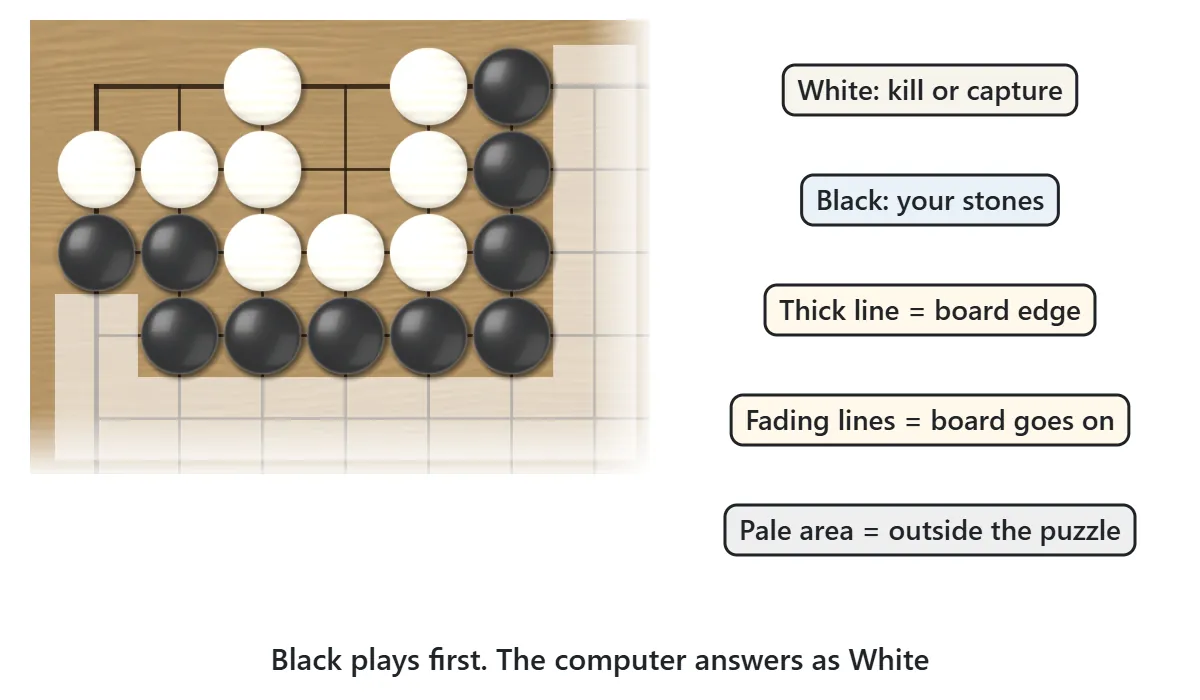
The board on screen is a corner or side of a normal 19×19 board, zoomed in so the stones are easy to tap. A side that ends in a thick line is the real edge of the board. A side where the lines fade away continues beyond what you see. Pale points are outside the puzzle and can’t be played. Black stones that touch the pale area or the open side are treated as connected to friendly stones outside, so they can’t be captured.
The status bar shows the goal (for example “Black to kill”) and how many moves are left. Move counts include both sides, as in Go books: a 3-move problem is Black, White, Black. If you like to name points the way English-language Go books do, turn on the board coordinates in the settings. Columns are lettered from A to T without the letter I, rows are numbered from 1 at the bottom to 19 at the top, and the labels show where the problem sits on a full board.
How to play these Go problems
Pick Beginner, Elementary, Intermediate or the Daily puzzle and press Start. Tap an intersection to play a black stone. If your move is right, White answers with its most stubborn reply, and the puzzle is solved when the goal is settled within the given number of moves.
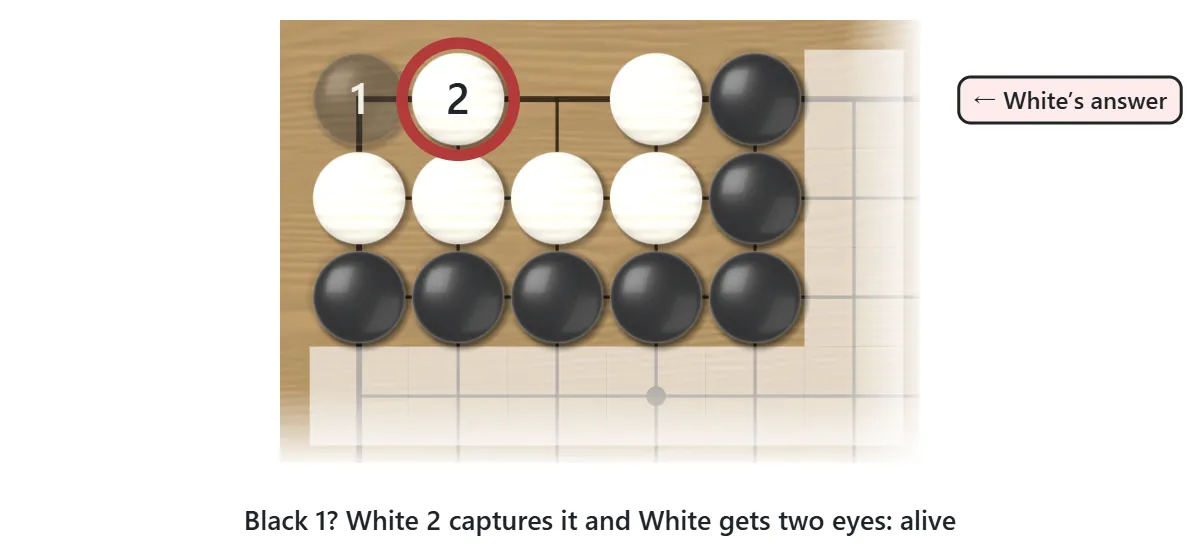
When you play a wrong move, White plays the answer that refutes it, marks it with a red ring and explains why it works, for example “White makes two eyes and lives”. Press “Go back and retry” to return to the position before your mistake. If you are stuck, press Hint once to see a green frame around four points that contain the answer, along with a short idea to look for. Press Hint again to see the exact point. “Show answer” plays out the whole solution, and the puzzle list marks each problem with ○, △ or ×.
| Level | What you’ll find |
|---|---|
| Beginner | 1- and 3-move problems: capturing in atari, ladders, nets, nakade, and splitting your space into two eyes |
| Elementary | A mix of capturing and life-and-death problems, with more 3- and 5-move lines |
| Intermediate | Vital points outside the eye, 7- and 9-move sequences, and sacrifice stones |
The Daily puzzle changes every day, and everyone who opens the page on the same date gets the same problem. It is a Beginner problem on Tuesdays and Thursdays, an Intermediate one on weekends and an Elementary one on the other days, and the result screen counts how many days in a row you have solved it.
Capturing basics for beginners
Liberties and atari
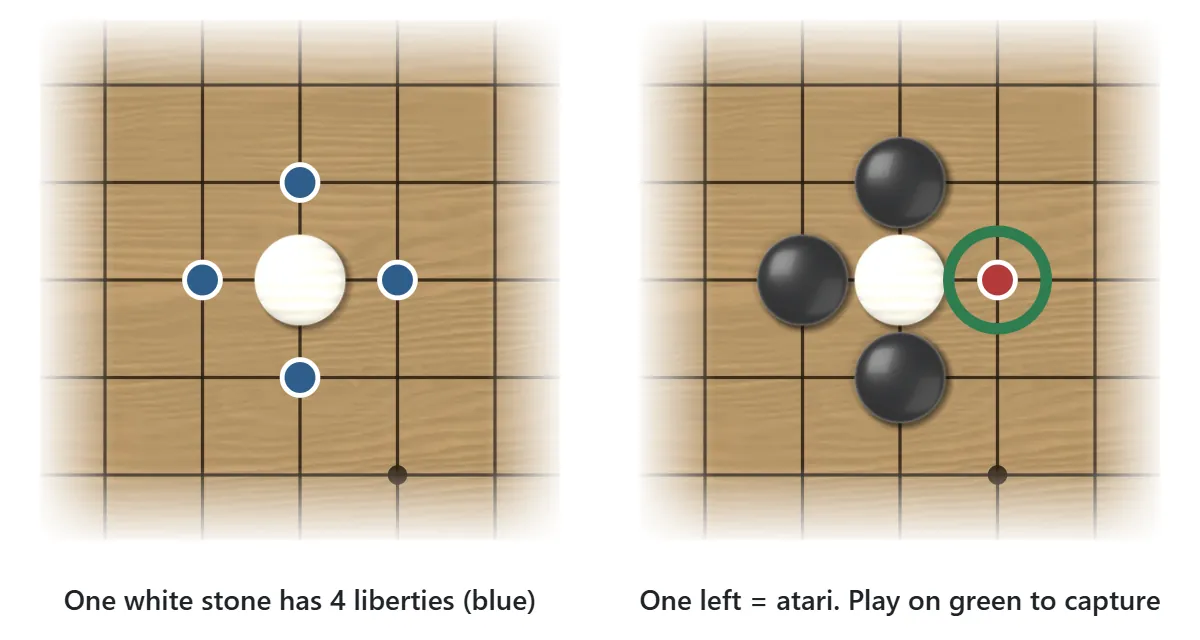
The empty points directly above, below, left and right of a stone are its liberties. Stones that are connected share their liberties. When a group loses its last liberty, it is captured and taken off the board. A group with just one liberty left is “in atari”. With the atari marks turned on, any group in atari gets a dashed red ring, and its last liberty is marked with a small circle.
The ladder
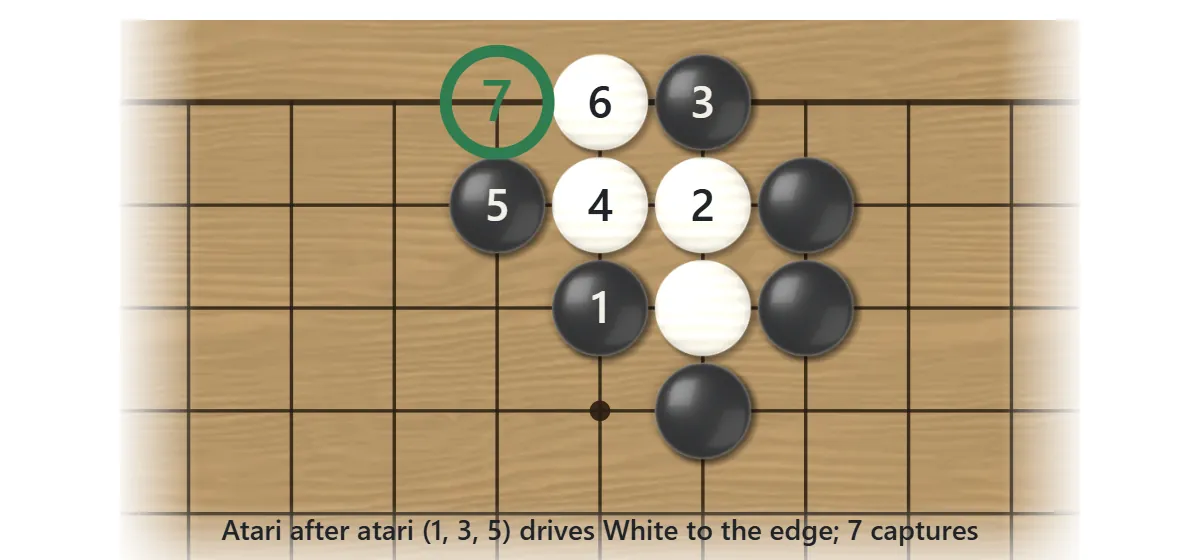
If a stone in atari runs away but only gets two liberties, you can put it straight back in atari. Repeat this zigzag and the white stones slide across the board until they hit the edge or one of your stones, and then they are captured. This is the ladder. What matters is the direction of your atari: give it from the wrong side and White reaches three liberties and gets away.
The net

Sometimes chasing with atari just pushes White into open space. A net (called geta in Japanese) does something calmer: it covers White’s escape route from a diagonal, without giving atari. Whichever way White tries to run, it can’t gain liberties, and you capture it on the next moves. Think of it as throwing a net instead of chasing.
Life and death basics
Two eyes make a group alive
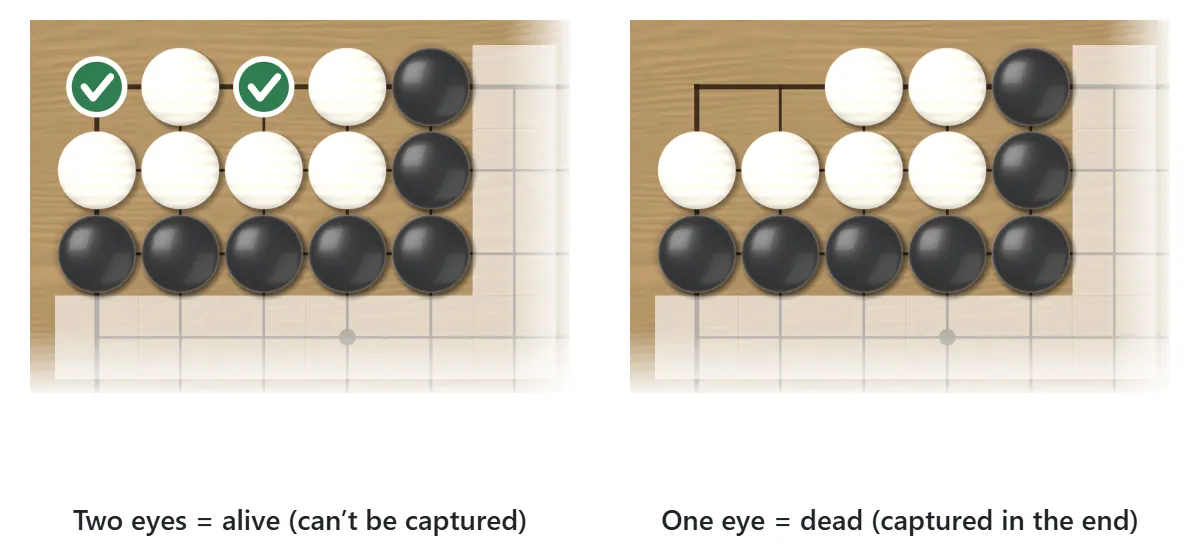
An eye is an empty point surrounded by your own stones. A group with two separate eyes can never be captured: a stone played in either eye would have no liberties and capture nothing, so it is an illegal suicide move. A group with only one eye will be captured in the end, once the outside is filled. That is why every life-and-death problem is really a fight over the second eye.
Nakade: the vital point inside the eye space
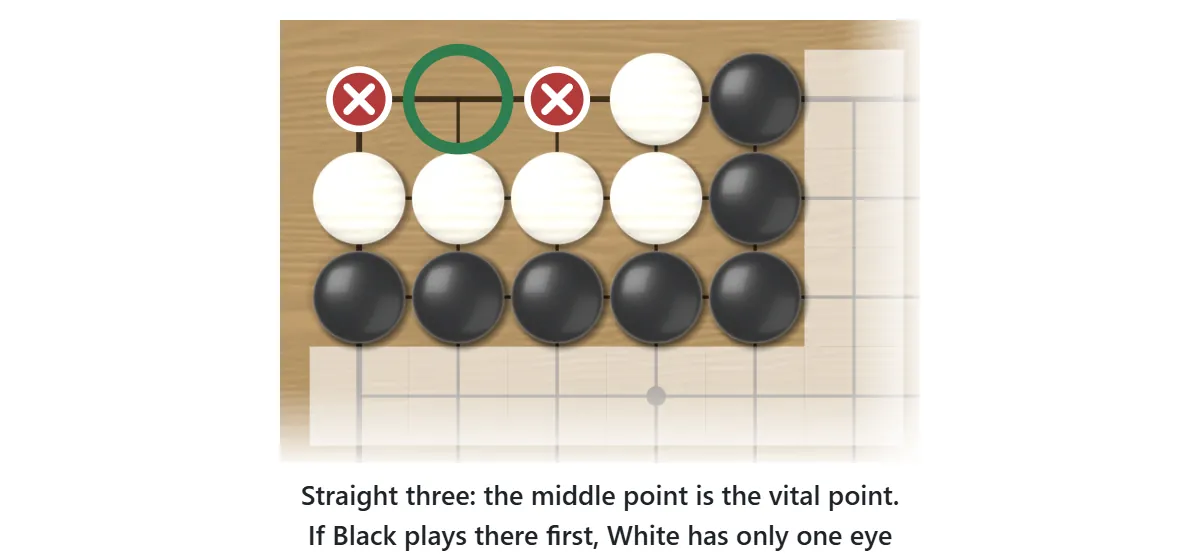
With three empty points in a row (straight three) or in a bent line (bent three), the middle point decides everything. If White plays there, the space splits into two eyes and White lives. If Black plays there first, White is left with a single eye and dies. Playing inside the opponent’s eye space like this is called nakade. Larger shapes of four or five points have vital points too, and learning them is a big part of tsumego.
False eyes
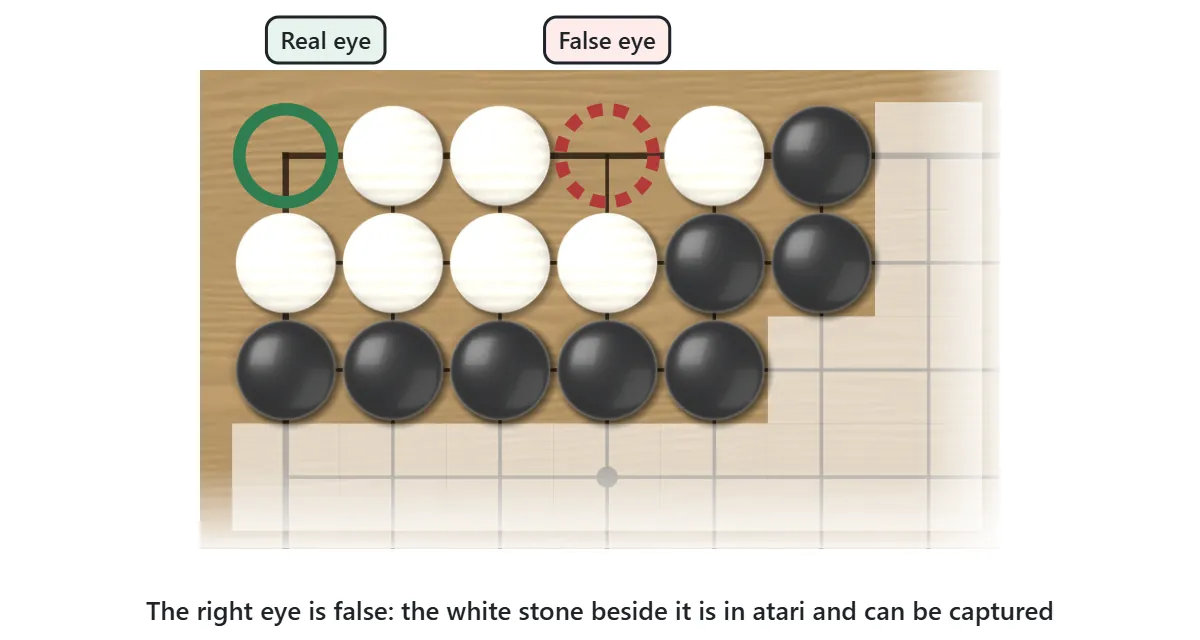
Some eyes only look like eyes. If one of the stones around the eye can be put in atari and captured, the eye disappears. This is a false eye. A group with one real eye and one false eye is dead. In kill problems, the key move is often a diagonal point next to White’s eye that turns it into a false eye.
How to solve tsumego: 5 tips
1. Check the goal and your opponent’s vital point
In a kill problem, look for the point White needs to make two eyes. In a live problem, look for the point where White would attack your eyes. The answer to a Go problem is very often the point your opponent would most like to play.
2. Count the eye space
If the space inside the group is three points, look for a nakade. If it is wider, find a move from the outside that makes it smaller, such as a hane or a placement. When you are the one trying to live, it is usually the other way round: widen your space first, or split it in two.
3. Narrow it down to two or three candidates and read White’s answer
Don’t stop at the first move. Picture where White will answer and what you will do next. When you go wrong, the refutation White shows you is exactly the line you missed, so take a second to understand it before you retry.
4. Don’t be afraid of sacrifices
A stone that White is allowed to capture can leave White with a false eye, or set up a snapback where you take back a whole group at once. In the Intermediate set, this kind of “give one to take more” move is often the answer.
5. Solve the same problems again
Tsumego work through pattern memory. The more often you see a shape, the faster you spot its vital point. Come back to the problems marked × (answer shown) or △ (hint or mistake) a few days later, and the shapes will start to jump out at you in your own games.
Tsumego FAQ
Are these Go problems good for beginners?
Yes. If you know how stones are captured, you can start with the Beginner set, which begins with “Black to capture” problems on atari, ladders and nets before moving on to nakade and two eyes. If you are new to Go itself, try Go (9×9) first to learn the rules against the computer.
Is it free? Do I need an app or an account?
It’s free and runs in your browser with no sign-up. It works on computers, tablets and phones, and the board is zoomed in on the problem so the points are easy to tap on a small screen.
Why doesn’t my move count when it also seems to work?
Every problem was checked by the computer, reading all of White’s replies, so that there is only one correct first move. If another move looks just as good, play it and watch White’s answer. In capturing problems, a move that captures but needs more moves than the problem allows is shown as “That also captures, but it takes more than 3 moves”.
Are there ko or seki problems?
No ko problems are included: every problem here is settled without a ko fight, because a ko result depends on threats elsewhere on the board and is hard to judge in a small problem. A seki (where neither side can approach the other) counts as life for White.
Is my progress saved?
Your solved marks, daily streak and any unfinished problem are stored in this browser on this device. Clearing your browsing data also clears them.
A short history of Go problems
Life-and-death problems are as old as Go books. One of the most famous collections is the Xuanxuan Qijing, compiled in China during the Yuan dynasty, and in Japan the Edo period produced classic problem books such as Igo Hatsuyōron and Gokyō Shūmyō, which are still studied today. The Japanese word tsumego is thought to have come into use by analogy with tsume shogi, the checkmate puzzles of Japanese chess. The problems on this page are all new: the shapes were generated by a program and checked by a search, not copied from any book.
If you enjoy puzzles like these, try Tsume Shogi (Shogi Puzzles) as well. To play a whole game of Go from start to finish, open Go (9×9) and play against the computer.