 Yorimichi Games
How to play Go
Go is a two-player board game played with black and white stones. It is known as weiqi in China, baduk in Korea and igo in Japan, and it is one of the oldest board games still played today. Players take turns placing stones on the points where the lines cross, and at the end the player who has surrounded more of the board wins. The rules fit on a single page: you place stones, stones that are completely surrounded are captured, and there are a couple of points where you are not allowed to play. Everything else, from opening ideas to life and death, grows out of those few rules.
This game uses a 9x9 board by default. The full-size board has 19 lines each way and a serious game can take an hour or more, but on 9x9 a game usually lasts about ten minutes, which makes it the classic board for learning. When you want more room, switch to 13x13 in the settings.
Placing stones
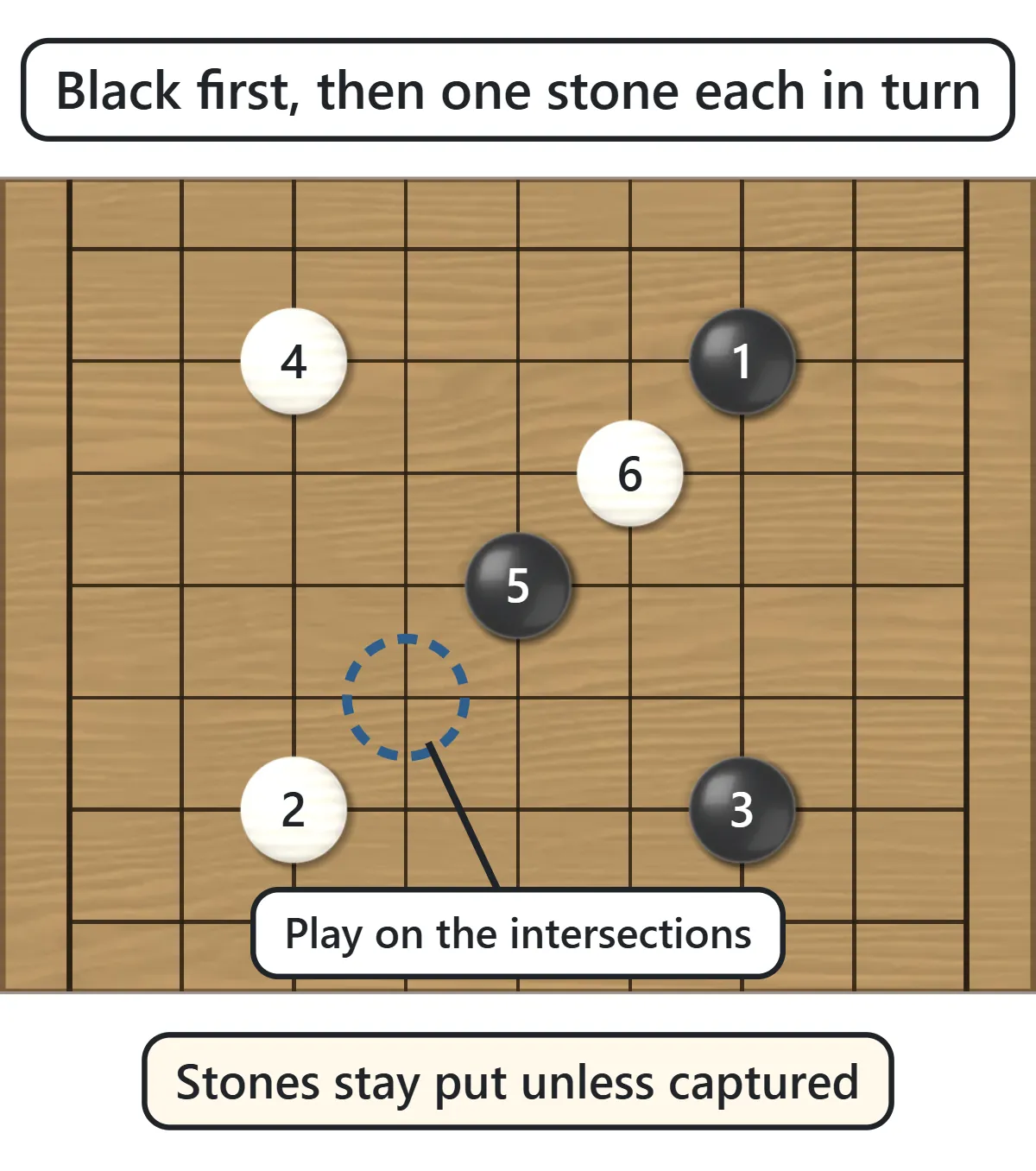
Black always plays first. After that the players alternate: White, Black, White, and so on. Stones go on the intersections of the lines, not inside the squares, and the edges and corners of the board are fair game too. Once a stone is placed it never moves. The only way it leaves the board is by being captured. If you have nothing useful to do, you can pass instead of placing a stone.
Liberties and atari
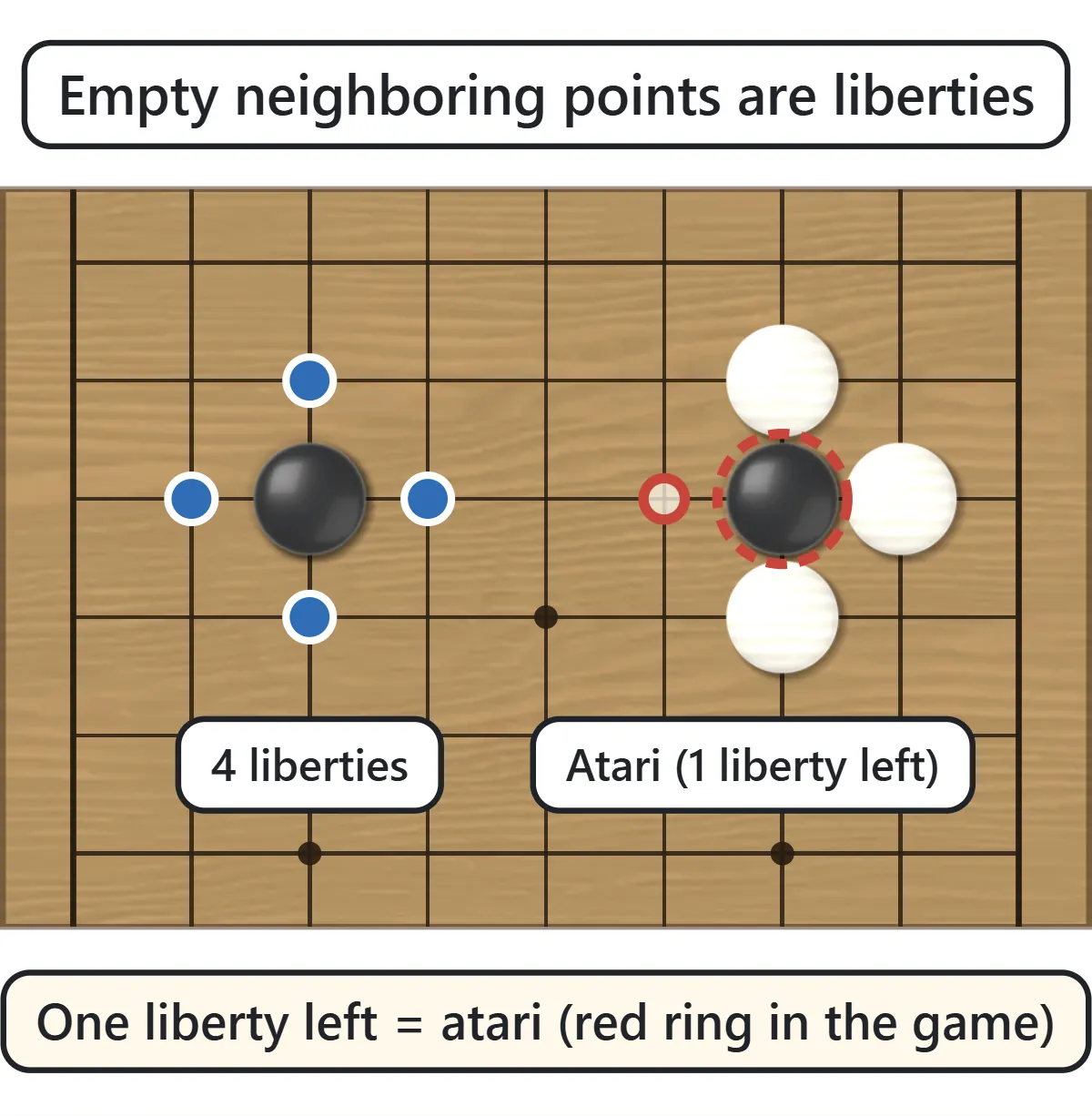
The empty points directly above, below, left and right of a stone are its liberties. Diagonal points do not count. Stones of the same color that touch along the lines form a single group, or chain, and share their liberties. A lone stone in the middle of the board has four liberties, a stone on the edge has three, and a stone in the corner has only two.
When a stone or group is down to its last liberty, it is said to be in atari: if the opponent fills that point, the group is captured. In this game, stones in atari get a red dashed ring and their last liberty gets a small red circle, so you can spot the danger at a glance. You can turn these marks off in the settings once you no longer need them.
Capturing stones
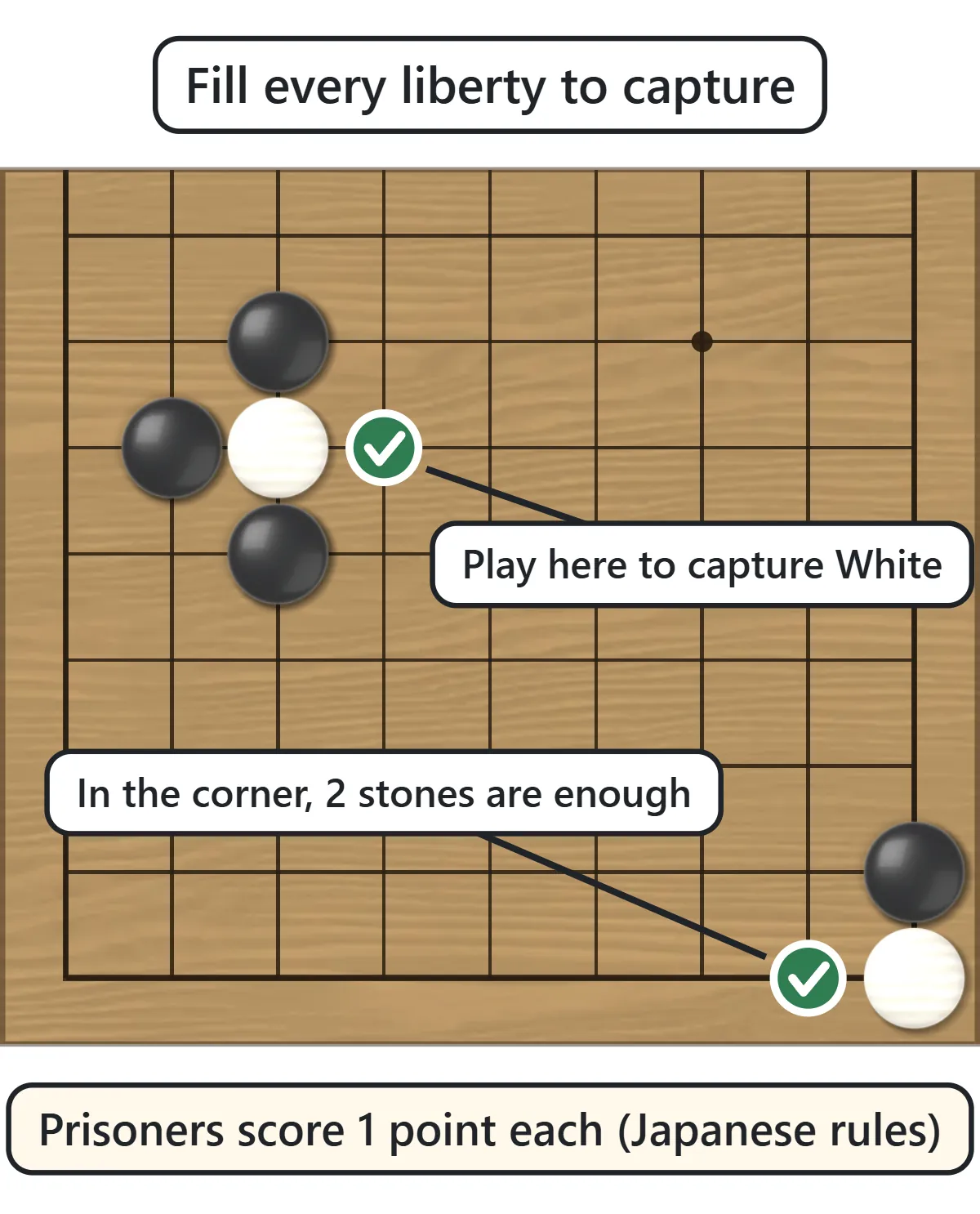
Fill every liberty of an enemy stone or group and it is captured: all of its stones come off the board at once. Captured stones are called prisoners. Under Japanese rules, each prisoner is worth one point for the player who took it at the end of the game. Because stones on the edge and in the corner have fewer liberties, they are captured more quickly, which is one reason why moves on the first line are rarely good early in the game.
The suicide rule: where you can’t play

You may not place a stone where it (or the group it joins) would have no liberties at all. This is called suicide, and it is illegal in both Japanese and Chinese rules. There is one important exception: if your move takes away the last liberty of an enemy group, that group is captured first, your stone gains liberties, and the move is legal. If you tap a point where you cannot play, the game tells you why.
The ko rule
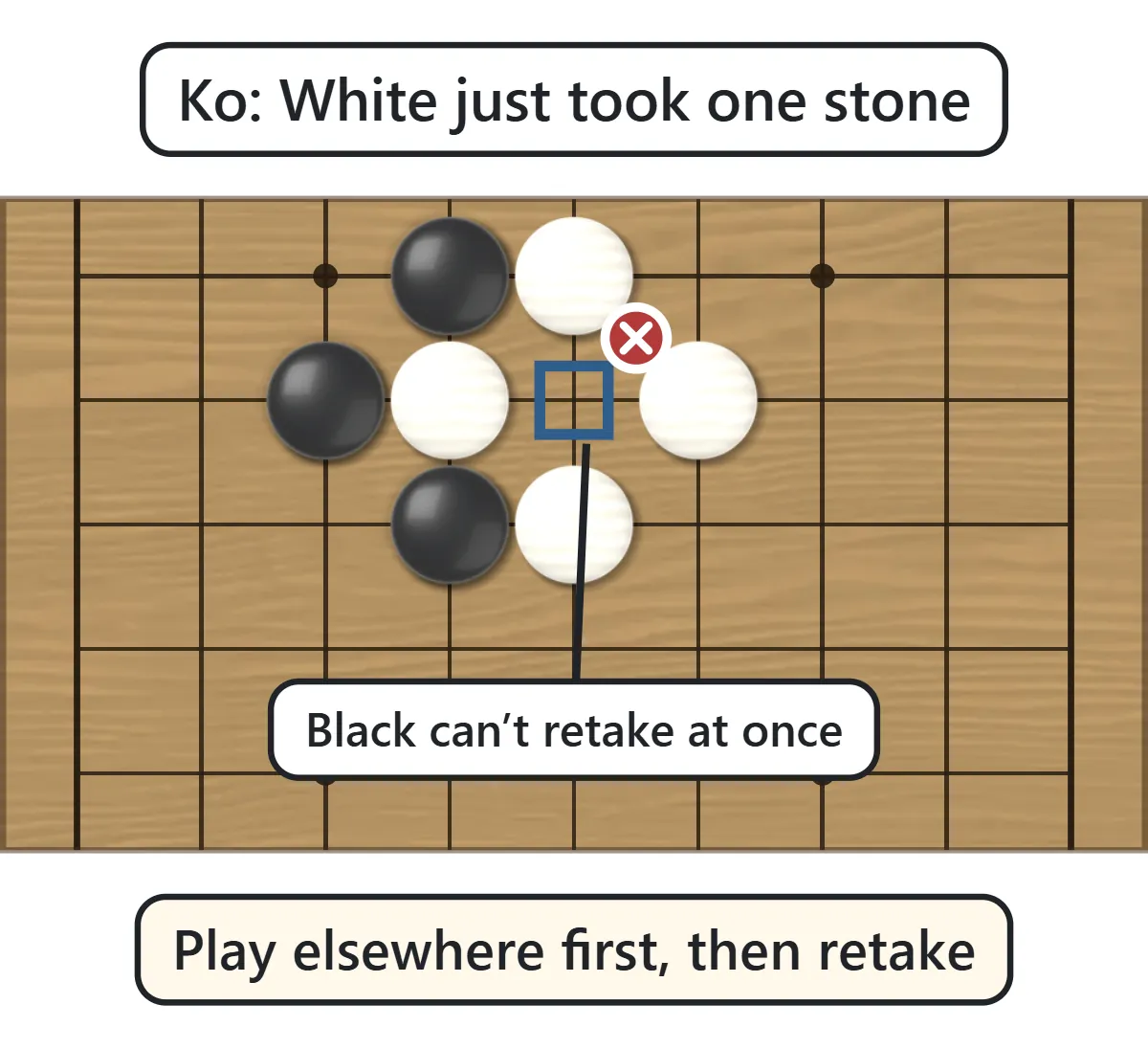
Sometimes both players could capture one stone back and forth at the same spot forever. That shape is called a ko. To stop the loop, the rule says: after your stone was captured in a ko, you may not recapture immediately. You have to play somewhere else first, usually a threatening move your opponent must answer (a ko threat), and only then may you take back. In this game, a ko point that you can’t take right now is shown with a blue square.
A few very rare positions, such as a triple ko, can repeat the whole board over and over. Here, if exactly the same position with the same player to move comes up for the third time, the game ends with no result, as it does under Japanese rules.
How a game of Go ends and how to count the score

When neither player can gain anything more, both players pass in a row and play stops. Next comes a step that confuses many beginners: deciding which stones are dead. A dead stone is one that is sitting inside the opponent’s area and has no way to survive, even though it has not been captured yet. Instead of making the players fill in every last point to prove it, Go lets them agree on the dead stones and simply remove them.
Here the CPU does the first pass for you. It marks the stones it thinks are dead with a red ×, and the board shows who owns each empty point. If you disagree, tap a stone to switch its whole group between dead and alive; the running count below the board updates immediately. When you are happy, press Count and finish. If you realize there is still something to play for, press Keep playing and the game resumes.
With the default Japanese rules (territory scoring), your score is the number of empty points surrounded only by your living stones, plus your prisoners, including the dead stones you removed. Points that touch both colors are neutral points, called dame, and belong to no one. In a seki (a standoff where neither side can attack without being captured), the empty points inside do not count for either player under Japanese rules. Because Black has the advantage of moving first, White receives komi, 6.5 points by default. The half point means a normal game can never be a tie.
Go rules options: Japanese vs Chinese scoring, handicaps and Capture Go
You can change the rules in the settings. If you are new to Go, begin with a 9x9 board, Japanese rules and no handicap, and add handicap stones if you keep losing.
| Rule | How the score works | Komi |
|---|---|---|
| Japanese rules (default) | Territory + prisoners (captured and dead stones) | 6.5 |
| Chinese rules | Territory + your living stones on the board; prisoners don’t count | 7.5 |
| Handicap game | Black places stones on the star points first, then White moves | None (a tie is jigo) |
| Capture Go | No counting: the first to capture 1 (or 3, or 5) stones wins | None |
Chinese rules (area scoring) count the stones you have on the board instead of the stones you captured. The difference sounds big, but since both players place roughly the same number of stones, the two methods give the same winner in almost every game. Area scoring has one practical advantage: playing inside your own territory costs you nothing, so you never lose points by making sure a group is safe. Seki points do count under Chinese rules. This game does not add the extra compensation for handicap stones that some Chinese rule sets give White.
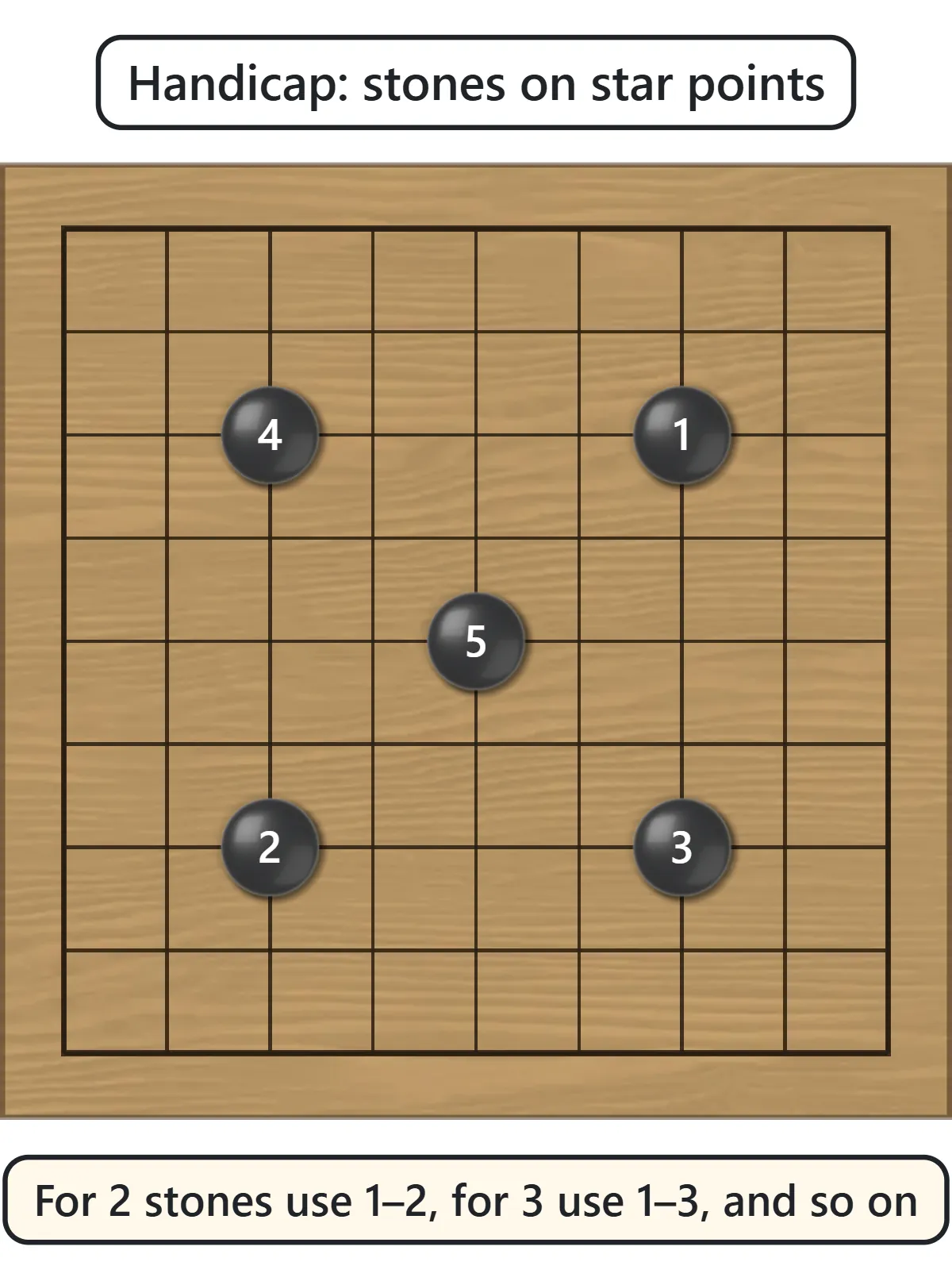
Handicap stones let players of different strength enjoy an even game. The weaker player takes Black and places two or more stones on fixed star points before the game starts, and then White makes the first move. On 9x9 you can place up to 5 stones, and on 13x13 up to 9. A single handicap stone is worth a lot on a small board, so add them one at a time. When a game ends, the result screen suggests a handicap for your next game and gives you a button to start it right away.
Capture Go, also called Atari Go, is a popular first step for beginners. There is no territory: whoever captures the agreed number of stones first wins. It trains exactly the skills you need in real Go games — spotting atari, running away, connecting your stones and cutting your opponent’s. For a dedicated beginner version on smaller 6x6 and 7x7 boards with warnings and hints, try Capture Go.
Go strategy for beginners: 6 tips
1. Always check for atari
Before every move, ask two questions: is any of my stones in atari, and is any of my opponent’s? If yours are, extend or connect to give them more liberties. If theirs are, you can capture. The red rings help at first, but try to build the habit of looking yourself.
2. Keep your stones connected
Separated stones can be chased and captured one at a time. Stones that are connected share liberties and are much harder to kill. When your opponent threatens to cut between two of your stones, it is often worth spending a move to connect them.
3. Corners first, then sides, then the center
A corner uses two edges of the board as walls, so it takes the fewest stones to surround territory there. The side uses one edge, and the center uses none. That is why strong players usually start in the corners. On 9x9 the board is small enough that the center point (tengen) and the 3-3 points are also popular first moves.
4. Think about territory, not just captures
Capturing is fun, but the game is decided by who surrounds more. It is easy to chase one small stone across the board while your opponent quietly builds a huge area. When a capture is only worth a point or two, compare it with a move that makes your own territory bigger.
5. Two eyes make a group alive
An eye is an empty point completely surrounded by one group. A group with two separate eyes can never be captured, because the opponent would have to fill both eyes at once, and each single move into an eye is suicide. This is what Go players mean by a group being alive. A group that invades your opponent’s area and cannot make two eyes will end up as dead stones.
6. Close your borders before you pass
Near the end of the game, check the boundary between your territory and your opponent’s. Any gap is an invitation for them to push in and shrink your area. Neutral points (dame) are worth nothing, so once every border is sealed and nothing is left to gain, it is time to pass.
Go FAQ
Which CPU level should I choose?
If you are new to Go, start with Easy. It often misses stones in atari and fails to capture, so you get to enjoy taking stones while you learn to finish a whole game. Normal starts to attack and defend now and then, but still makes plenty of mistakes. Hard surrounds territory with sensible shapes and grabs most of the stones it can capture. If you can’t beat it yet, add handicap stones.
How many handicap stones should I take?
Play a game without a handicap first. If you lose by a lot, try two stones next time, then three, and so on, one at a time. Once you start winning comfortably, take one stone away. The result screen does this bookkeeping for you and suggests the next step.
When should I pass?
Pass when all the borders are closed and no move would increase your territory or reduce your opponent’s. If your opponent passes and you pass too, play stops and you move on to marking dead stones. If you change your mind during that step, choose Keep playing.
How do I know which stones are dead?
Dead stones are stones stuck inside the other player’s area that cannot make two eyes. If you’re not sure, it’s fine to accept the CPU’s estimate. You can also tap a group to switch it between dead and alive and watch how the score changes before you decide.
What do the letters and numbers around the board mean?
They are board coordinates, the usual way to name a point in English-language Go books and apps. Columns are labelled with letters from the left, skipping the letter I so it is not confused with J, and rows are numbered from the bottom. The center of a 9x9 board is E5. You can switch the coordinates off in the settings.
Can I undo a move or get a hint?
Yes. With Undo turned on, you can take back your last move (the CPU’s reply is taken back too). The Hint button shows, with a blue ring, the move a strong CPU would choose. If you stop in the middle of a game, the Continue button on the same device and browser picks up where you left off.
Can two people play on one device? Is there a 13x13 board?
Yes to both. Choose “A friend” as the opponent to take turns on the same screen, and pick 13x13 under Board size for a bigger game with more room for corners, sides and large frameworks.
A short history of Go
Go was born in China more than 2,000 years ago and is often called the oldest board game still played in its original form. It reached Korea and Japan well over a thousand years ago; an ancient Go board and stones are kept among the treasures of the Shōsōin repository in Nara, Japan. In Japan the game flourished under government-supported Go houses in the Edo period, and much of the Go vocabulary used in English today, such as atari, sente, gote, ko, komi and joseki, comes from Japanese. Today the game is played all over the world, and the small 9x9 and 13x13 boards are widely used for teaching and for quick games.