 Yorimichi Games
How to play peg solitaire
Peg solitaire is a one-player puzzle played on a board full of holes. You start with every hole filled except one, and you remove pieces by jumping them, one at a time, until no more jumps are possible. The goal is to finish with a single peg, and for a perfect game, to leave that last peg in a particular hole. The pieces can be pegs or marbles (the marble version is often called marble solitaire), but the puzzle is the same. This version uses marbles resting in the hollows of a wooden board.
Setting up
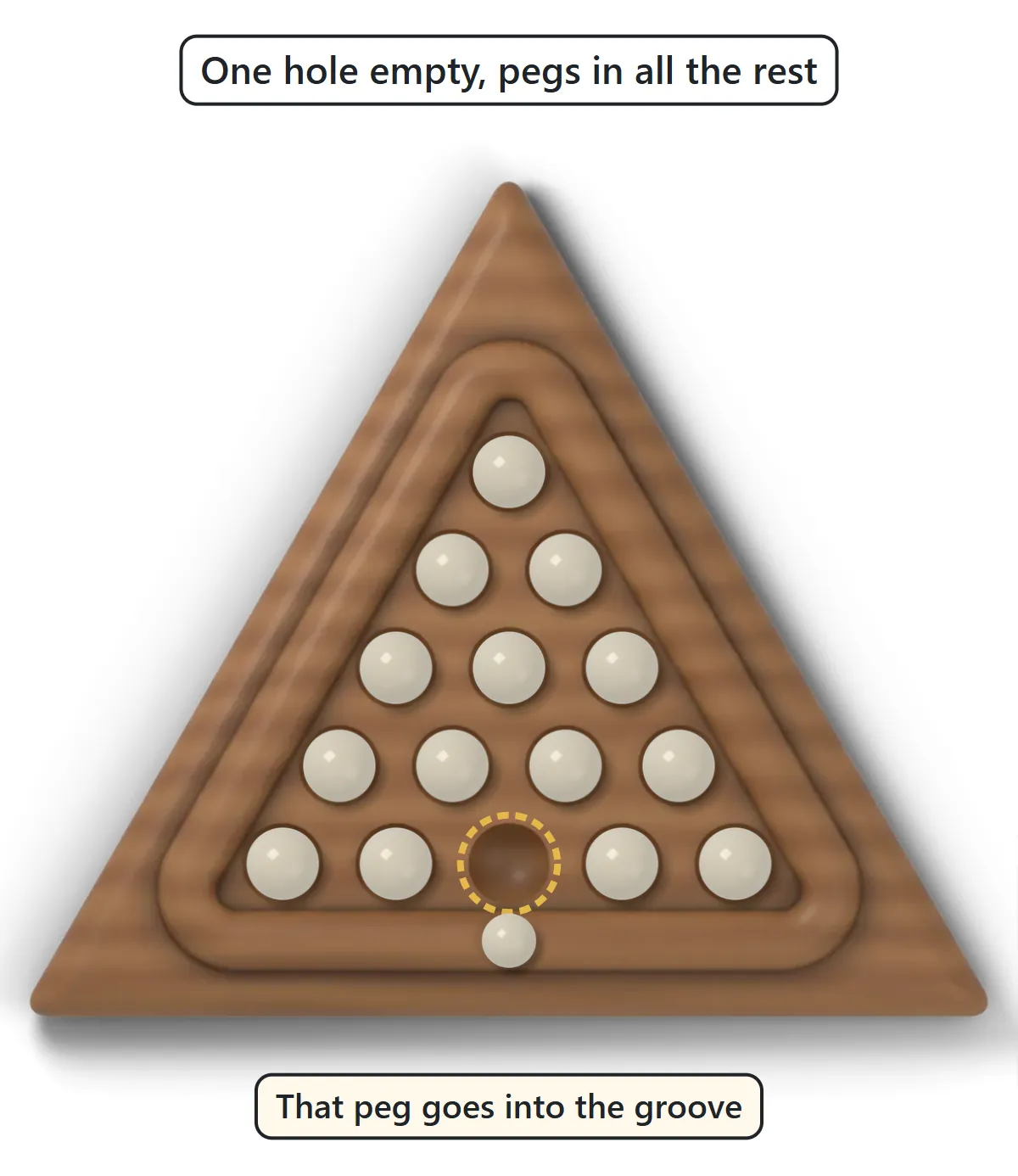
Empty one hole and put a peg in every other hole. Which hole you empty decides how hard the puzzle is and where the last peg can end up. Each board here starts from a recommended hole that gives a good, solvable game. If you pick “Choose it myself”, you remove the first peg yourself by clicking it after you press Start.
Jumping and removing pegs
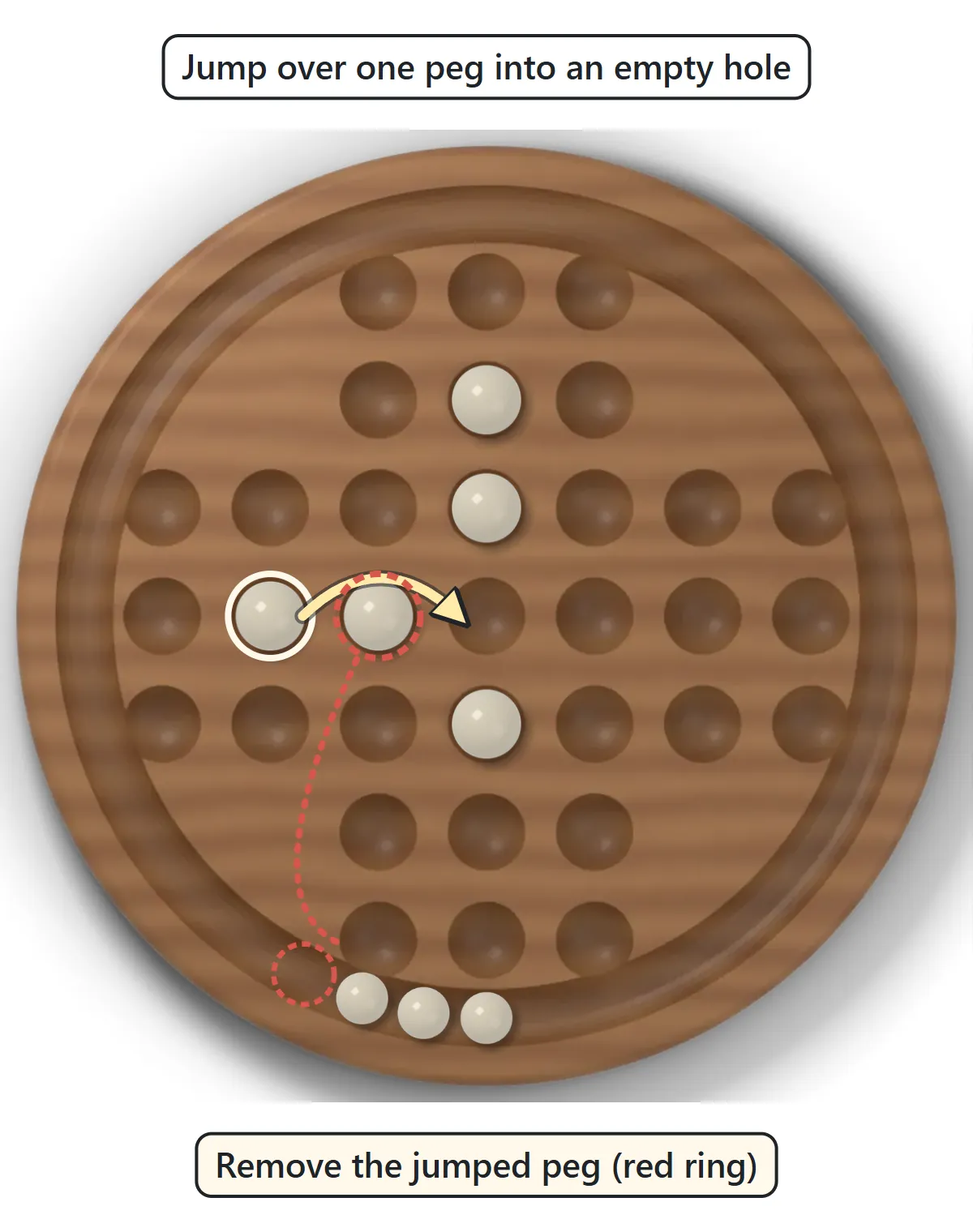
There is only one kind of move. Pick a peg, jump it over a neighboring peg, and land in the empty hole directly on the other side. The peg you jumped over comes off the board (here it rolls into the groove around the edge). Every jump removes exactly one peg, so a board that starts with 32 pegs needs 31 jumps to get down to one.
If the peg that just landed can jump again, you may carry on with it. By the usual way of counting, a chain of jumps made by the same peg is a single move, which is how the shortest solutions are measured.
Moves that are not allowed
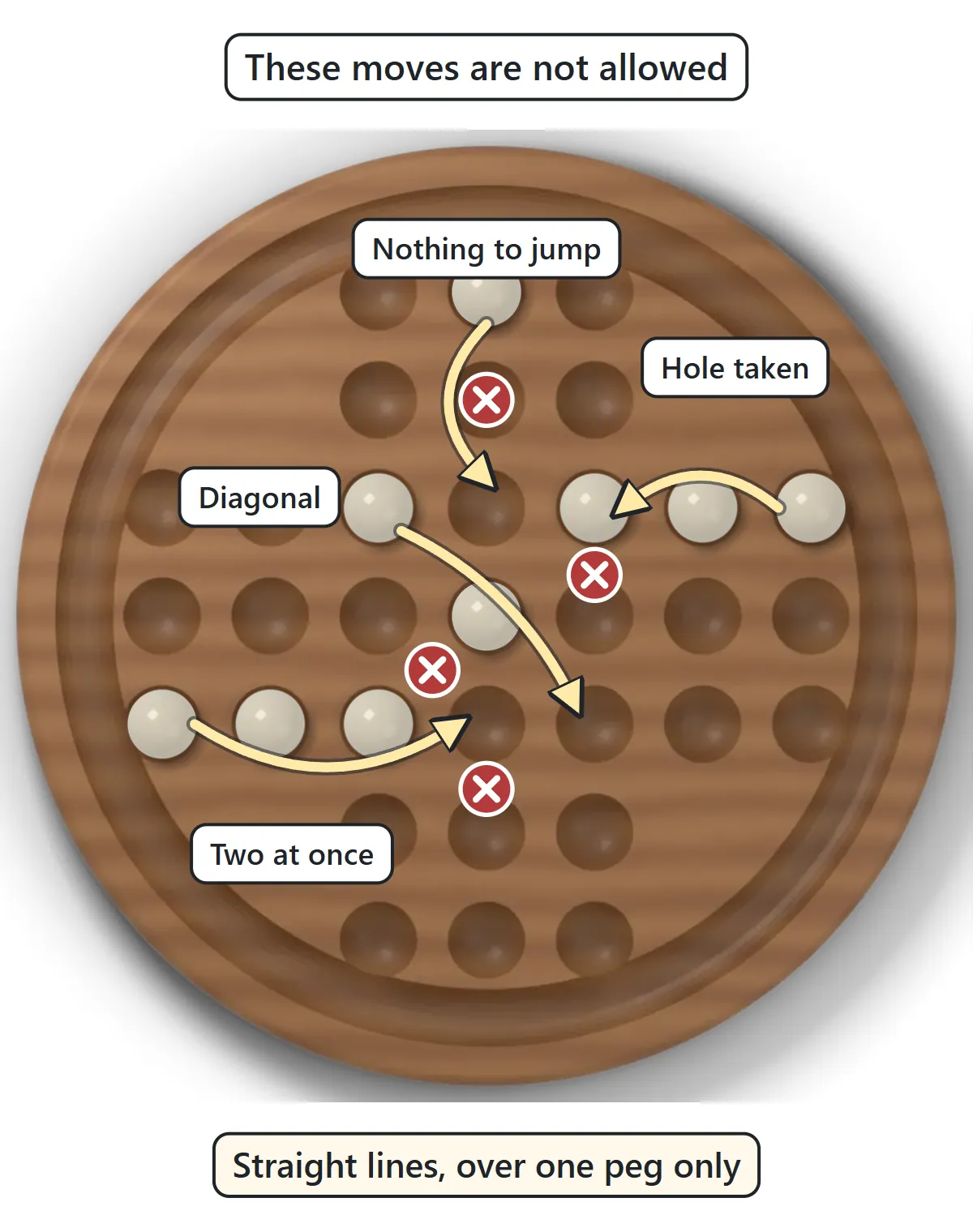
- On the English and European boards you jump up, down, left or right. Diagonal jumps are not allowed.
- On the triangle board the holes line up in three directions, so a peg can jump in six directions: sideways along a row and along both diagonals.
- You jump over exactly one peg. You can’t jump two pegs at once, and you can’t jump over an empty hole.
- The landing hole must be empty. There is no sliding a peg into a neighboring hole without a jump.
Peg solitaire rules for winning and scoring
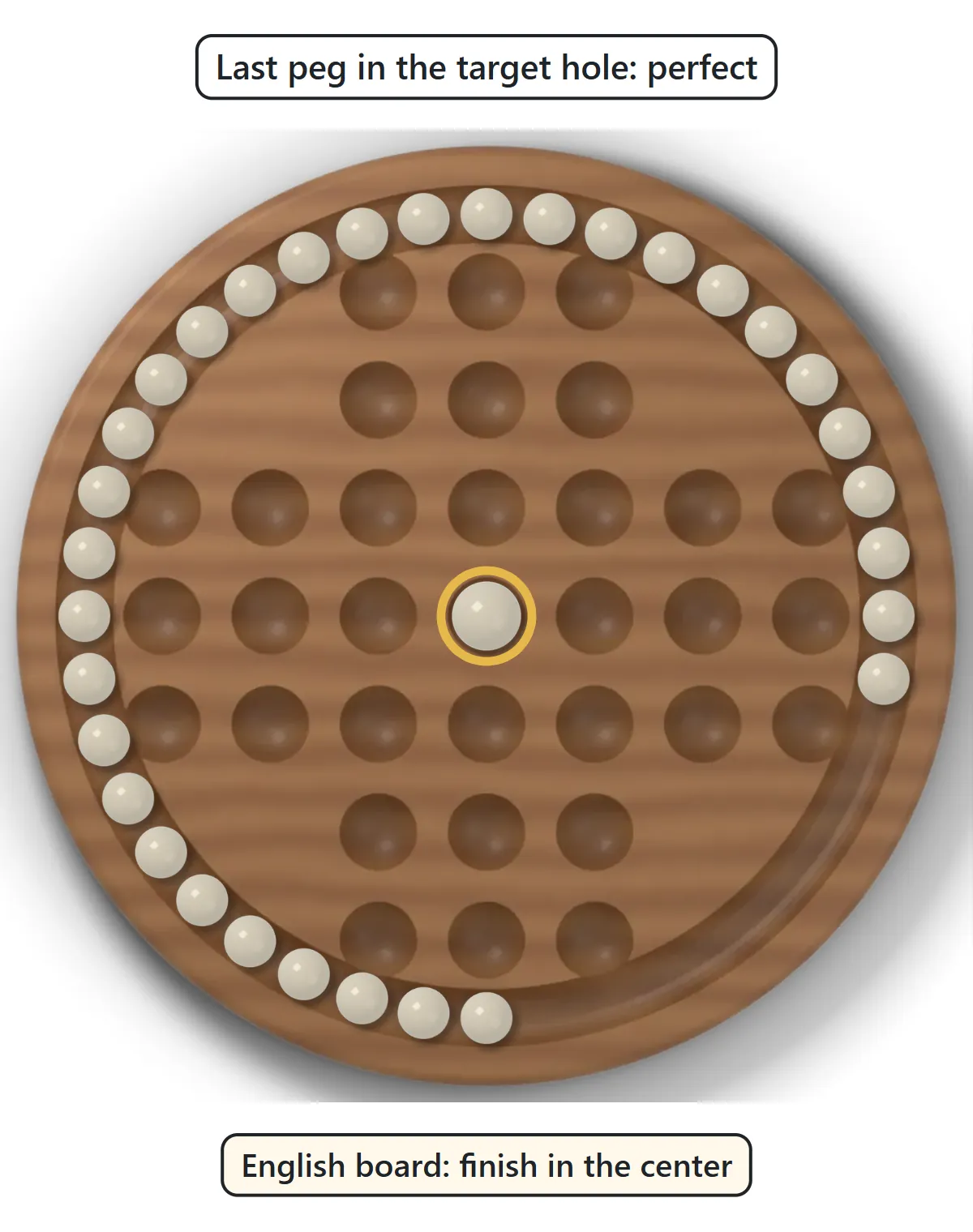
The game ends when no peg can jump. The fewer pegs are left, the better. One peg counts as solved, and one peg in the target hole is a perfect finish. On most boards the target is the hole you emptied at the start; on the English board that is the famous “finish in the center”. The target hole is marked with a small gold ring.
| Pegs left | Result |
|---|---|
| 1, in the target hole | Perfect! |
| 1 | Solved |
| 2 | So close |
| 3–4 | Nearly there |
| 5 or more | Try again |
Peg solitaire boards
| Board | Shape and jumps | Start and target |
|---|---|---|
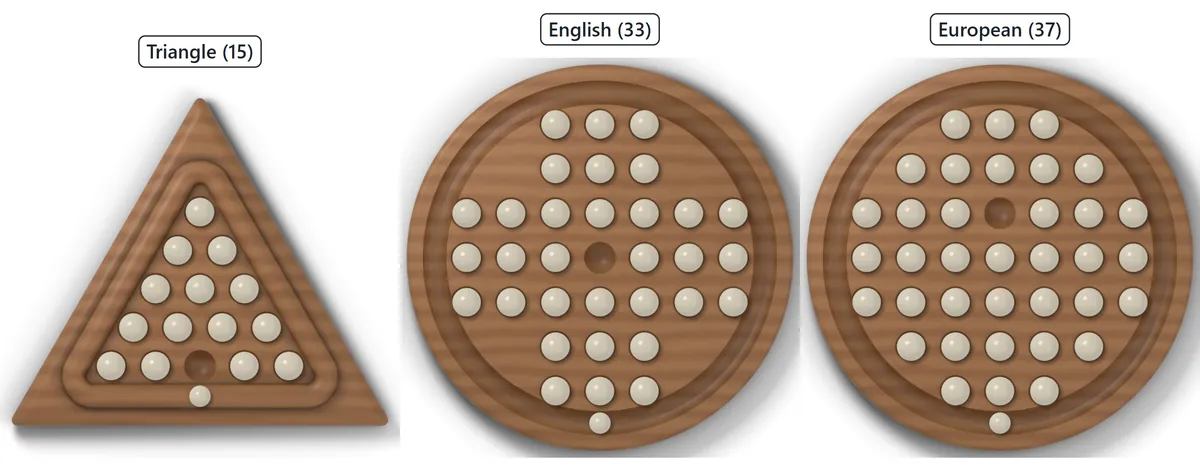
| Triangle, 15 holes | Five holes per side, jumps in 6 directions, 14 pegs | Middle of the bottom row; finish in the same hole |
| English, 33 holes | A cross (a 7×7 square without its corners), 4 directions, 32 pegs | The center; finish in the center |
| European, 37 holes | The cross plus four extra holes, 4 directions, 36 pegs | Just above the center; finish just below it |
The English board is the best-known peg solitaire board. You start with the center empty, and the classic challenge is to end with one peg back in the center. It takes some planning, but once you learn to clear the board in blocks (see the tips below) it is very solvable. The shortest known solution takes 18 moves, counting chains of jumps as one move.
The European board, long played in France, adds four holes to the cross. It is the hardest of the three. If you start with the center empty, it has been proved that you can never get down to one peg: two is the best possible. That is why this game recommends starting with the hole just above the center. Only 16 of the 37 holes lead to a one-peg finish. If you choose one of the others, the game tells you so at the start.
The triangle peg game
The 15-hole triangle is the peg game many people first meet on a restaurant table, usually with golf tees for pegs. Because pegs can also jump diagonally, it is the friendliest of the three boards and a good one to start with. You can reach one peg from any starting hole, but if you empty one of the three inner holes, the last peg can never finish in that same hole; the gold ring then shows the best hole you can aim for instead.
Daily puzzle
The daily puzzle starts from a position that looks like a game already in progress, with only a handful of pegs left. There is one puzzle per board each day, the same for everyone, and each one is guaranteed to be solvable. Most of them contain a tempting first move that makes the puzzle impossible, so they are great practice for thinking a few moves ahead.
Peg solitaire strategy and tips
1. Clear the edges and corners first
Pegs on the edge of the board, and especially in the corners, can only be jumped from a few directions. If you leave them until the end, they tend to get stranded. The pegs in the middle can be cleared almost any time, so work from the outside in.
2. Don’t leave a peg on its own
A peg with no neighbors can’t be jumped until another peg comes close, and that often never happens. Before each move, ask whether it leaves any peg isolated. This one habit prevents most failed games.
3. Remove pegs three at a time
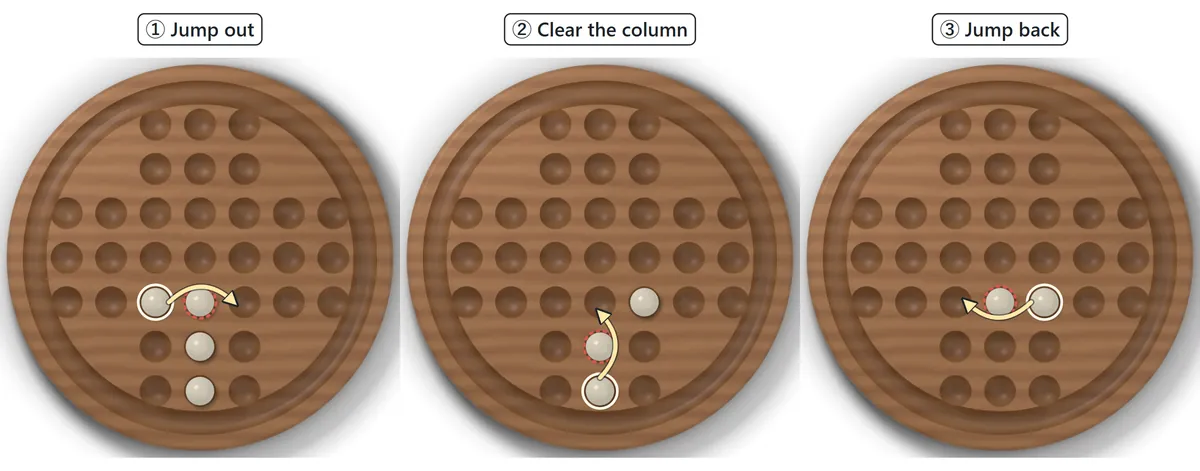
On the English and European boards there is a classic way to remove a row of three pegs with the help of one peg beside them. The helper jumps out, the row is cleared with a jump along it, and then the helper jumps back to where it started. Think of the board as a set of blocks and clear it block by block; that is how most people solve the 33-hole board for the first time.
4. On the triangle, avoid the corners and the inner holes
On the triangle board, jumping into a corner and jumping out of one of the three inner holes are both moves that tend to lead to a dead end. If you have another choice, try that first.
5. Work backward from the finish
When only a few pegs remain, think in reverse. Where will the last peg be? Where would the last two need to be one move earlier? If you are going for a perfect finish, gather your pegs around the target hole well before the end.
6. Use Hint and Undo
Hint shows a move that still leads to a single peg (or to a perfect finish while that is still possible). Hints here are not guesses: the game actually searches for a solution. If you find yourself in a position that can’t be solved, go back a few moves with Undo and try another path.
Peg solitaire FAQ
Can pegs jump diagonally?
Not on the English or European boards. The standard rules only allow straight jumps along rows and columns, and this game follows them. On the triangle board the holes are arranged differently, so the diagonal lines are part of the board and jumps along them are normal.
Does it matter where the last peg ends up?
Getting down to one peg anywhere counts as solved. Leaving it in the target hole marked with the gold ring is a perfect finish. Which holes can hold the last peg depends on which hole you emptied at the start.
Is every starting hole solvable?
On the triangle and English boards, yes: you can reach one peg from any starting hole. On the European board only 16 starting holes can be solved down to one peg, and the center is not one of them.
Why does the hint sometimes take a while or find nothing?
With lots of pegs on the board, the number of possible move sequences is enormous, so a solution can take a moment to find. If no answer comes quickly, make a few more moves and press Hint again. Once about twenty pegs are left, answers appear almost instantly.
What does “one peg is no longer possible” mean?
It means that from the current position, every way of continuing leaves at least two pegs. You can play on for the best score or press Undo and try something else. You can turn this message off in the settings.
Can I continue a game later?
Yes. Your game is saved as you play. Open the page again in the same browser on the same device and choose “Continue”. A daily puzzle can be continued only on the same day. Sound is off until you turn it on.
A short history of peg solitaire
Nobody knows exactly where peg solitaire was invented, but the earliest records come from France at the end of the 17th century. The August 1697 issue of the French magazine Mercure galant described the board, the rules and some sample problems, and an engraving by Claude-Auguste Berey from the same period shows a French noblewoman with the board at her side. The puzzle spread across Europe, and the cross-shaped board became especially popular in England, which is why the 33-hole version is called the English board. Mathematicians have loved it ever since: which holes can be solved, where the last peg can end, and how short a solution can be are all questions that have been studied in detail, and the 18-move solution for the English board was found as early as 1912.