 Yorimichi Games
How to play pinball
Pinball is played on a gently sloping table. A steel ball rolls down toward you, and your only tools are the two flippers at the bottom. Knock the ball back up the table, hit bumpers, targets and lanes to score, and try not to let it slip past the flippers. You get three balls per game. When the third ball drains, the game is over and your score is final. The rules are simple, but how long you keep each ball alive and how accurately you aim make a huge difference to your score. This version runs in any modern browser on a phone, tablet, Chromebook or computer, with no download and no sign-up.
The table at a glance
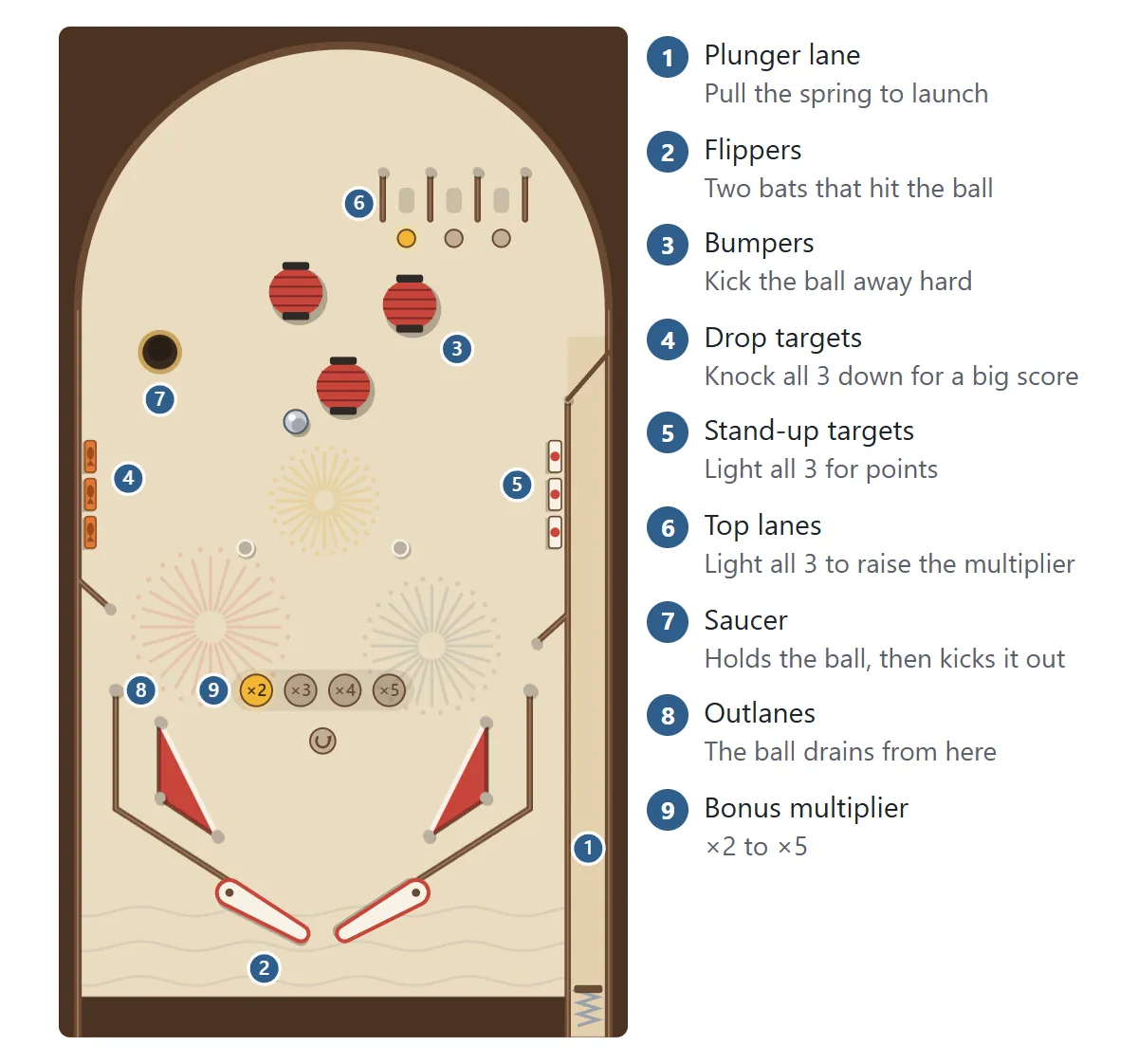
The top of the screen is the far, high end of the table and the bottom is the near, low end. You launch the ball from the narrow plunger lane on the right. It travels up the lane, follows the curved rail across the top and drops onto the playfield. From there, gravity pulls it back toward the flippers. Round pop bumpers kick the ball away hard whenever it touches them, and the triangular slingshots just above the flippers do the same. Drop targets fall down when hit, stand-up targets light up, and the three top lanes light up as the ball rolls through them.
Launching the ball (and the skill shot)
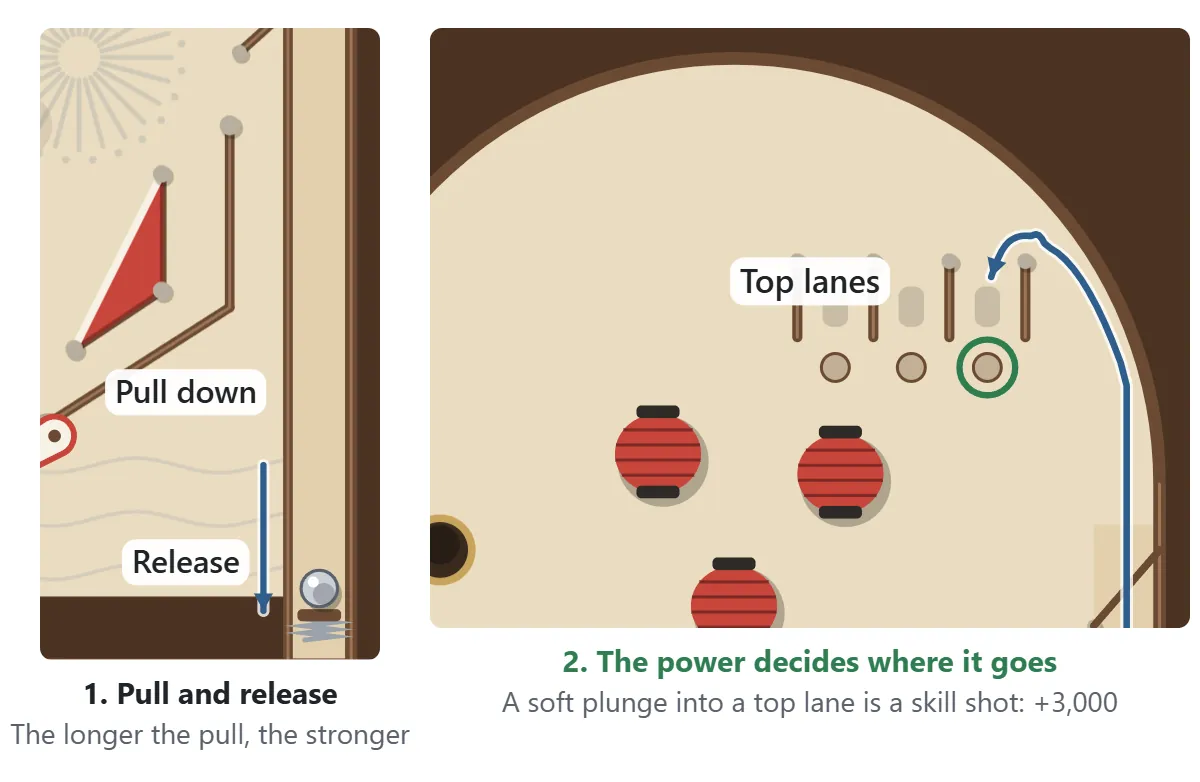
On a phone or tablet, put a finger anywhere on the table, pull down and let go. With a mouse, press on the table, drag down and release. On a keyboard, hold Space to pull back the plunger and release it to fire. Holding the Launch button under the table works the same way.
A strong launch rides all the way around the top rail and comes down on the left side of the table. A softer launch drops off the rail on the right. If a soft launch rolls straight into one of the top lanes before touching anything else, you earn a skill shot worth 3,000 points. The window of good power is narrow, so it takes a few tries to get the feel. A launch that is too weak to reach the top simply rolls back into the plunger lane – you do not lose the ball, just launch again.
Using the flippers
On a touch screen, touch and hold the left half of the table to raise the left flipper and the right half for the right flipper. You can use two fingers to hold both. On a keyboard, use the Left arrow or Z for the left flipper and the Right arrow or / for the right flipper. The Left and Right buttons under the table work with a mouse or a finger too. A flipper stays up while you hold it and drops as soon as you let go.
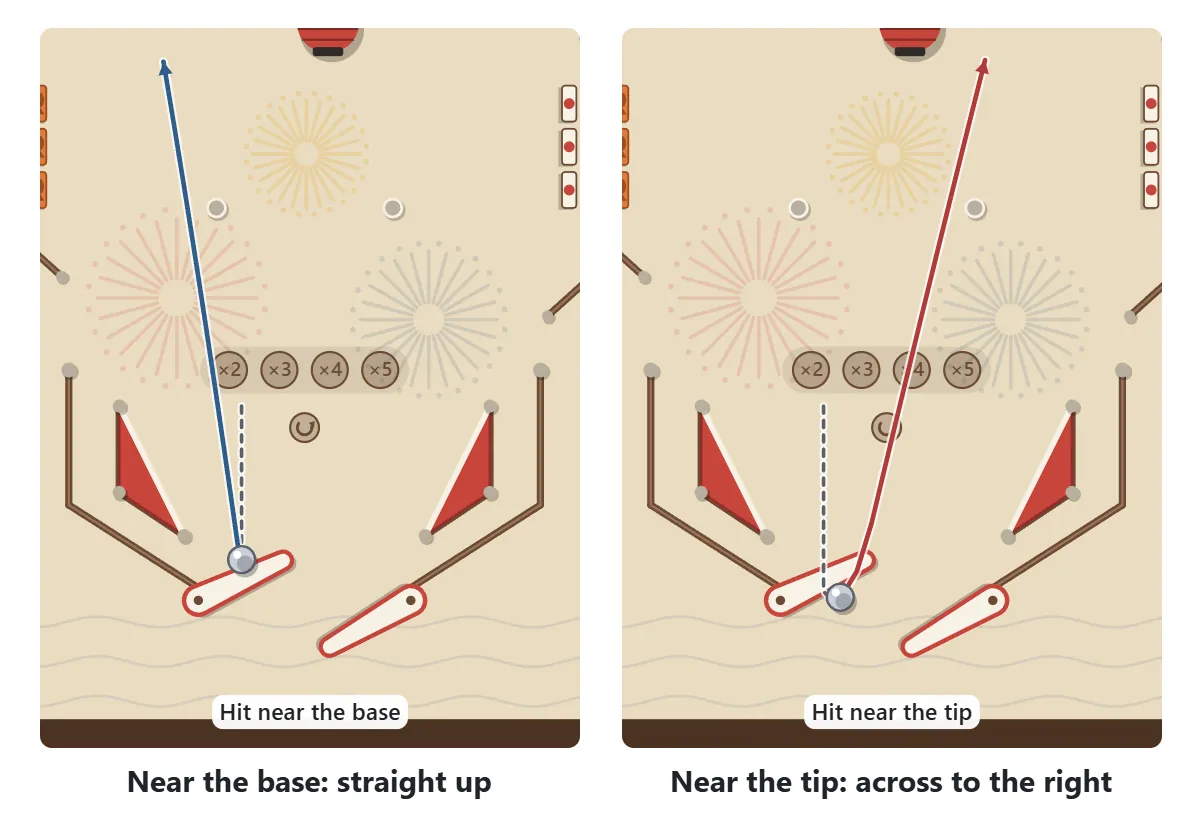
The spot where the ball meets the flipper decides its direction. A ball struck near the base (the pivot) goes more or less straight up the table, while a ball struck near the tip flies across to the opposite side. Aiming in pinball is therefore mostly about timing: you choose a target by choosing the moment you flip.
Pinball rules and scoring
| Feature | Points |
|---|---|
| Pop bumper | 100 per hit |
| Slingshot | 10 per kick |
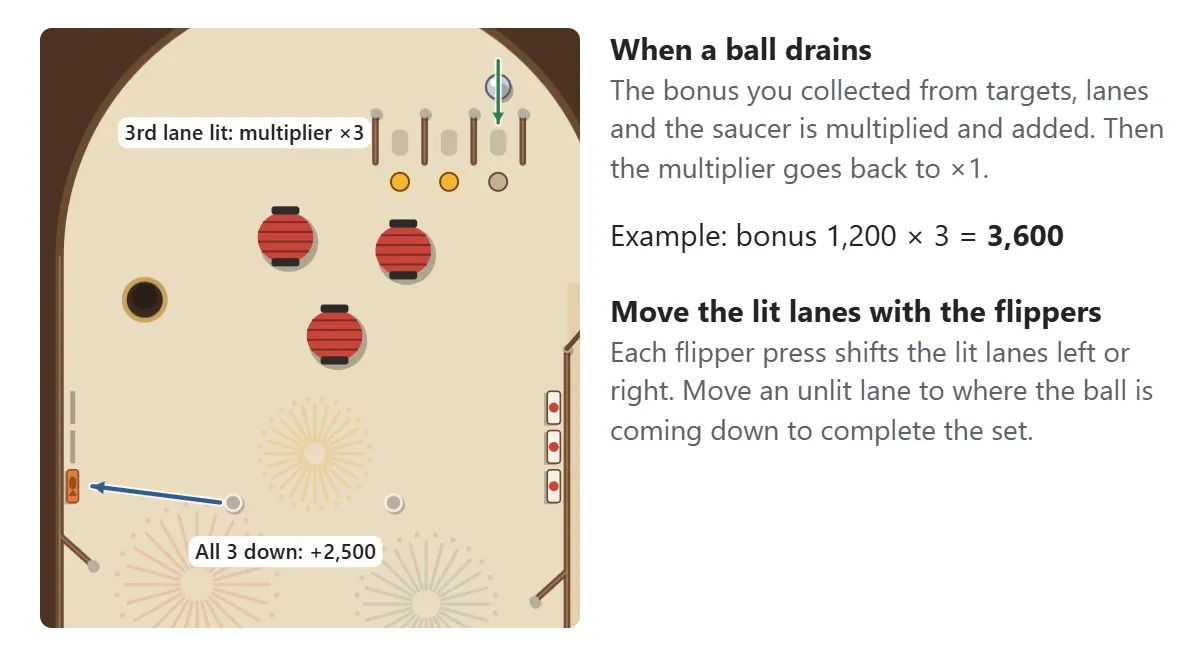
| Top lane | 300 each. Light all three for 1,000 and +1 bonus multiplier (up to ×5) |
| Drop target | 250 each. All three down: 2,500, then they reset |
| Stand-up target | 300 per hit. Light all three: 1,500 |
| Saucer | 1,000. Holds the ball for a moment, then kicks it out |
| Spinner (Starry Sky) | 20 per spin – a faster ball spins it more |
| Skill shot | 3,000 for a launch that goes straight into a top lane |
Targets, lanes and the saucer also build up a bonus. When a ball drains, the bonus is multiplied by the current multiplier and added to your score, and the multiplier goes back to ×1. Raising the multiplier first and then collecting bonus is the way to big scores. The lit top lanes shift left or right every time you press a flipper (this is often called lane change), so you can move an unlit lane under a falling ball and complete the set faster.
Where the ball drains
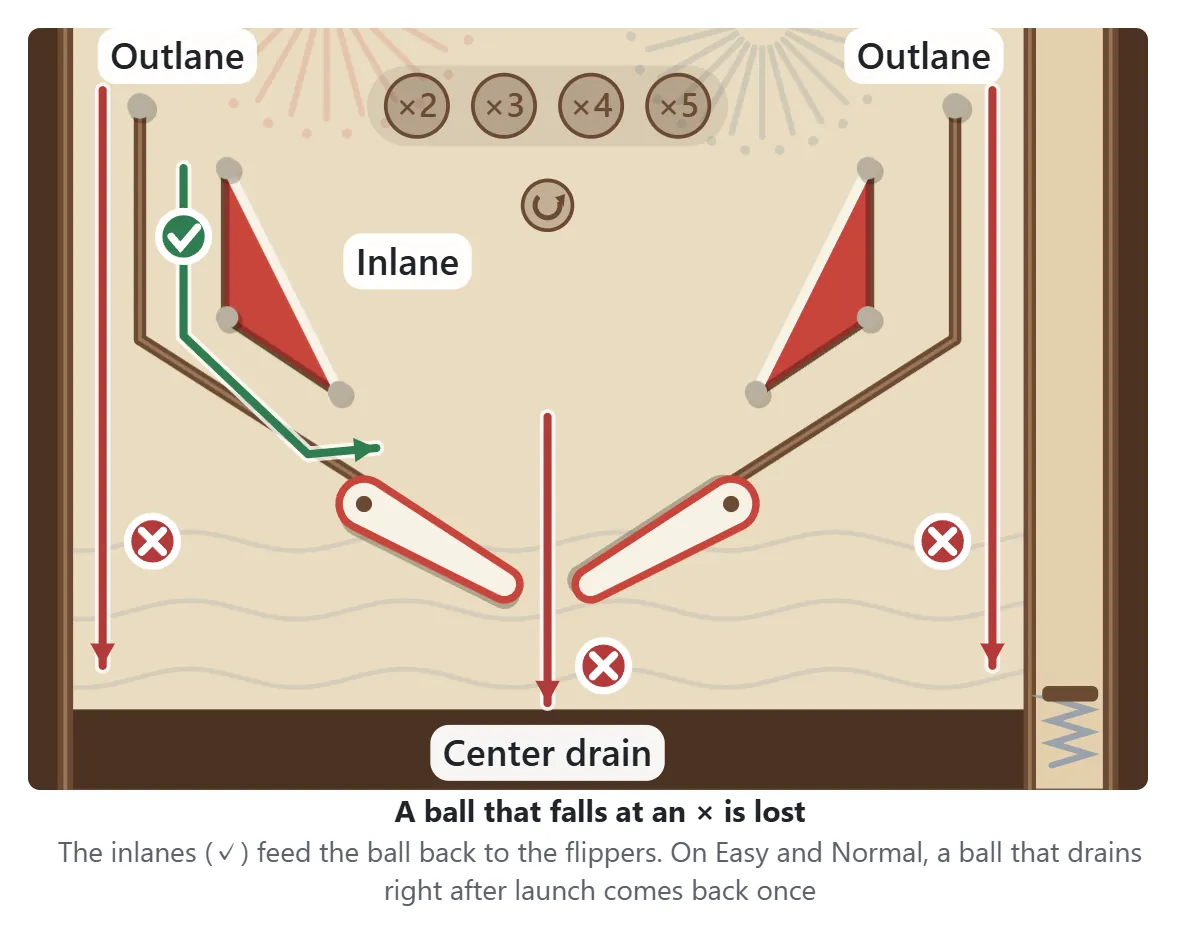
You lose a ball when it falls between the two flippers (the center drain) or down one of the outer lanes on the far left and right (the outlanes). The inlanes just inside them are friendly: they feed the ball back onto the flippers. On Easy and Normal there is a ball save: if a ball drains soon after it reaches the playfield (15 seconds on Easy, 8 on Normal), it is returned to the plunger once. The round arrow light near the flippers is lit while the ball save is active.
Nudging
On a real machine, players bump the cabinet to change the ball’s path, and the machine punishes rough play with a “tilt”. Here the Nudge button (Up arrow or N on a keyboard) gives the table a small bump that pops the ball up a little. You can nudge three times per ball, and it never costs points, so save your nudges for a ball that is heading for an outlane.
Tables, difficulty and the daily table
| Table | What makes it different |
|---|---|
| Festival | A warm paper-colored table with fireworks. Three lantern bumpers, goldfish drop targets on the left wall and a saucer at the top left |
| Starry Sky | A navy night sky. Two planet bumpers and a spinner in the center channel – shoot straight up to spin it |
| Forest | Soft moss green with leaves. Three mushroom bumpers and a burrow (saucer) at the top right |
| Difficulty | How it feels |
|---|---|
| Easy | A gentle slope, so the ball moves slowly. Narrow outlanes, a small post between the flippers and a 15-second ball save |
| Normal | Regular speed and an 8-second ball save |
| Hard | A steep slope with a fast ball, wide outlanes and no ball save |
In Free play you choose the table and difficulty, and your best score is saved for each combination. The Daily table changes every day: the table and one feature that scores double are picked by the date, the difficulty is Normal, and everyone who plays on the same day gets the same setup.
Pinball tips and strategy
1. Don’t flip both flippers at once
Mashing both flippers every time the ball comes down opens the gap between them and makes center drains more likely. Flip only the flipper on the side where the ball is arriving, once, as it reaches the flipper.
2. Trap the ball, then aim
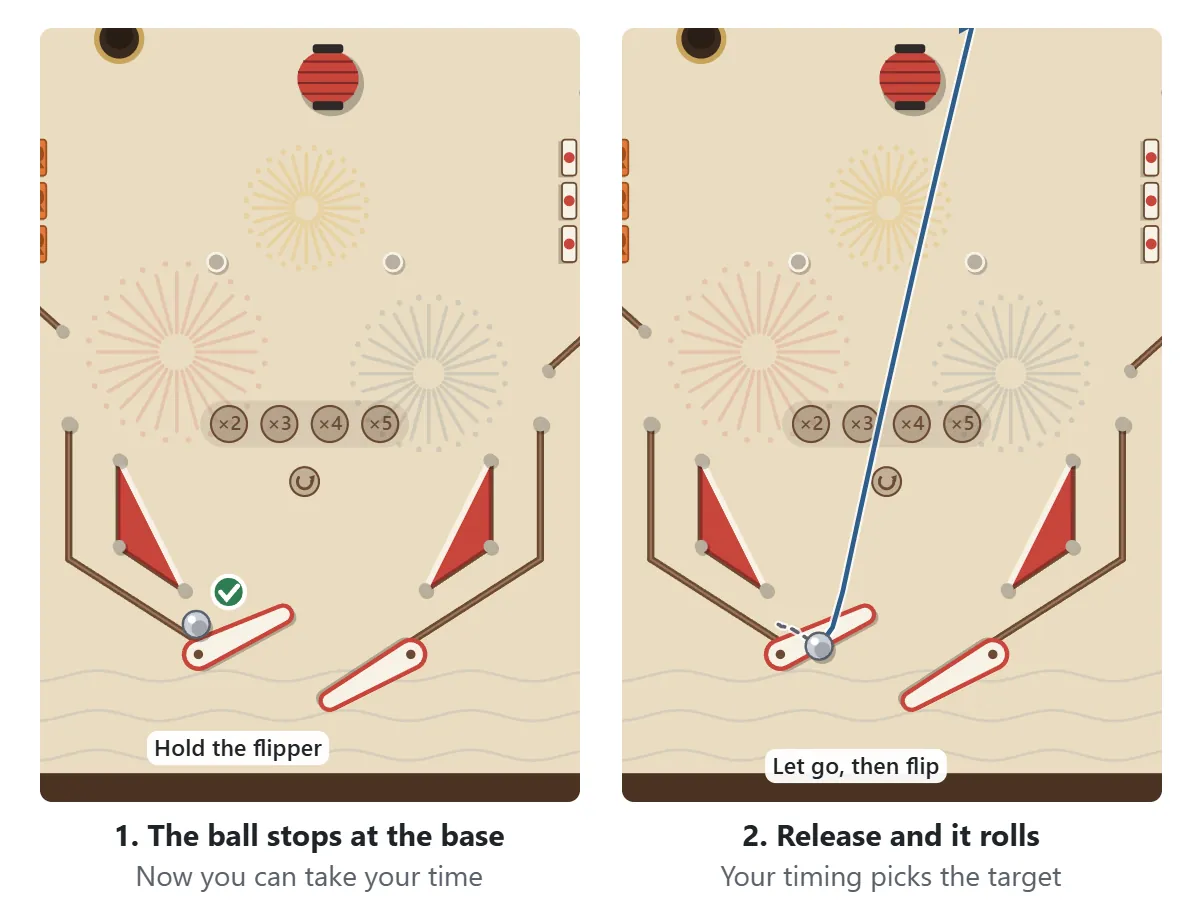
Hold a flipper up as the ball comes down and it rolls into the corner at the base of the flipper and stops. This is called trapping or cradling, and it is the single most useful skill in pinball: once the ball is still, you can take your time. Let go and the ball starts to roll toward the tip. Flip again when it reaches the spot that sends it where you want. The short pause between releasing and flipping is how you pick your shot.
3. Aim with timing, not with the flipper angle
To hit a particular bumper or target, think about where the ball will be on the flipper when you flip. Near the base sends it up, near the tip sends it across. Practice with a trapped ball until you know which pause length hits which target.
4. Watch the flippers, not only the ball
If you follow the ball around the bumpers with your eyes, you may react too late when it finally drops. While the ball is bouncing around at the top, keep your eyes just above the flippers and wait for it to come to you.
5. Save your nudges
Three nudges per ball are enough to rescue a ball or two, but not if you spend them early. Keep them for the moment a ball is drifting toward an outlane or the center drain.
6. Build the multiplier before the bonus
The end-of-ball bonus is multiplied, so light the top lanes first to raise the multiplier, then go for targets and the saucer. Use lane change while the ball is falling from the top to line up the unlit lane.
Pinball FAQ
Can I play pinball on my phone or tablet?
Yes. The table is portrait, so you can hold your phone upright and use the left and right halves of the screen as flipper buttons. Two-finger play works too. It is built to run smoothly on school Chromebooks and iPads as well.
What are the keyboard controls?
Left arrow or Z for the left flipper, Right arrow or / for the right flipper, hold and release Space to launch, Up arrow or N to nudge, and P or Esc to pause. You can also press the left or right half of the table with the mouse.
Does nudging cost anything?
No. You get three nudges per ball, they never take points away, and they refill with the next ball.
Can I continue a game later?
Yes, on the same device and browser. The game is saved before each ball is launched, so “Continue” picks up at the launch of the ball you were on.
Is it free?
Completely free, with no account needed. It is a game of skill for high scores only – there are no prizes or payments.
A short history of pinball
Rolling a ball down a sloping board toward holes and pins goes back to bagatelle, a table game related to billiards that was popular in Europe. The “pins” that the ball bounced between eventually gave pinball its name. In the 1930s, coin-operated tables spread quickly across the United States. They had no flippers yet: once the ball was launched, all you could do was watch where it landed, which made them look a lot like games of chance.
Because of that, several American cities banned pinball for decades. Things changed after player-controlled flippers appeared in the late 1940s. Now the ball could be kept in play and aimed, and pinball became a game of skill. By the mid-1970s, bans were being lifted after it was shown in court that a good player can call a shot and make it. Electronic scoring, sound and light shows followed, and pinball has lived on ever since in arcades, in collectors’ homes and on computer screens.
If you like games with rolling and bouncing balls, try Bowling, where you roll the ball to knock down pins, or Billiards, where you aim the cue ball to sink the others.