 Yorimichi Games
How to Play Bowling Online
Ten-pin bowling is simple to learn: roll a ball down a long wooden lane and knock over as many of the ten pins standing at the far end as you can. A game has ten frames, and in each frame you get up to two balls. Clear all ten with your first ball and you have a strike; clear the rest with your second ball and you have a spare. Both earn bonus pins from the balls that follow, which is where the big scores come from.
In this free bowling game you make the same decisions a real bowler makes on the approach: where to stand, where to aim, how hard to throw and how much hook to put on the ball. The pins are not scripted. They are knocked over by the ball and by each other, so a slightly different angle can turn a strike into a stubborn corner pin. You can bowl a solo game and chase your high score, take on one to three CPU bowlers, or pass one phone, tablet or computer around for up to four people.
The lane and the pins
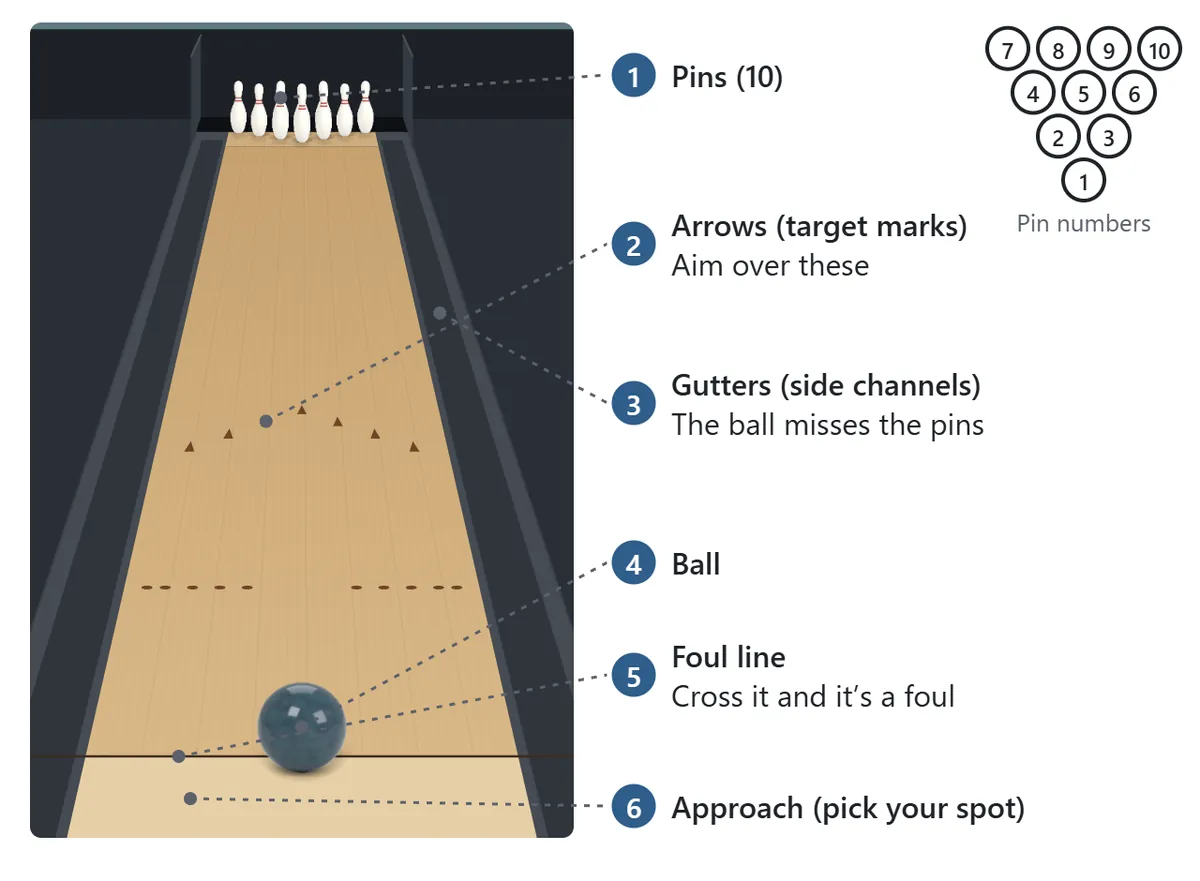
The lane is the long, narrow strip the ball rolls on. On each side is a gutter, a channel that swallows any ball that drifts too far and carries it harmlessly past the pins. The line nearest you is the foul line; your feet must stay behind it when you release the ball. About fifteen feet down the lane are seven small triangles called arrows (bowlers also call them the spots or target arrows). They are much easier to aim at than the pins sixty feet away, and that is exactly what they are for.
The pins are set in a triangle of four rows. The front pin is the 1 pin, also called the head pin. Behind it are the 2 and 3 pins, then 4, 5 and 6, and finally 7, 8, 9 and 10 across the back. Bowlers use these numbers to describe what is left standing, as in “I left the 10 pin” or “that is a 7–10 split.”
Rolling the ball in three steps
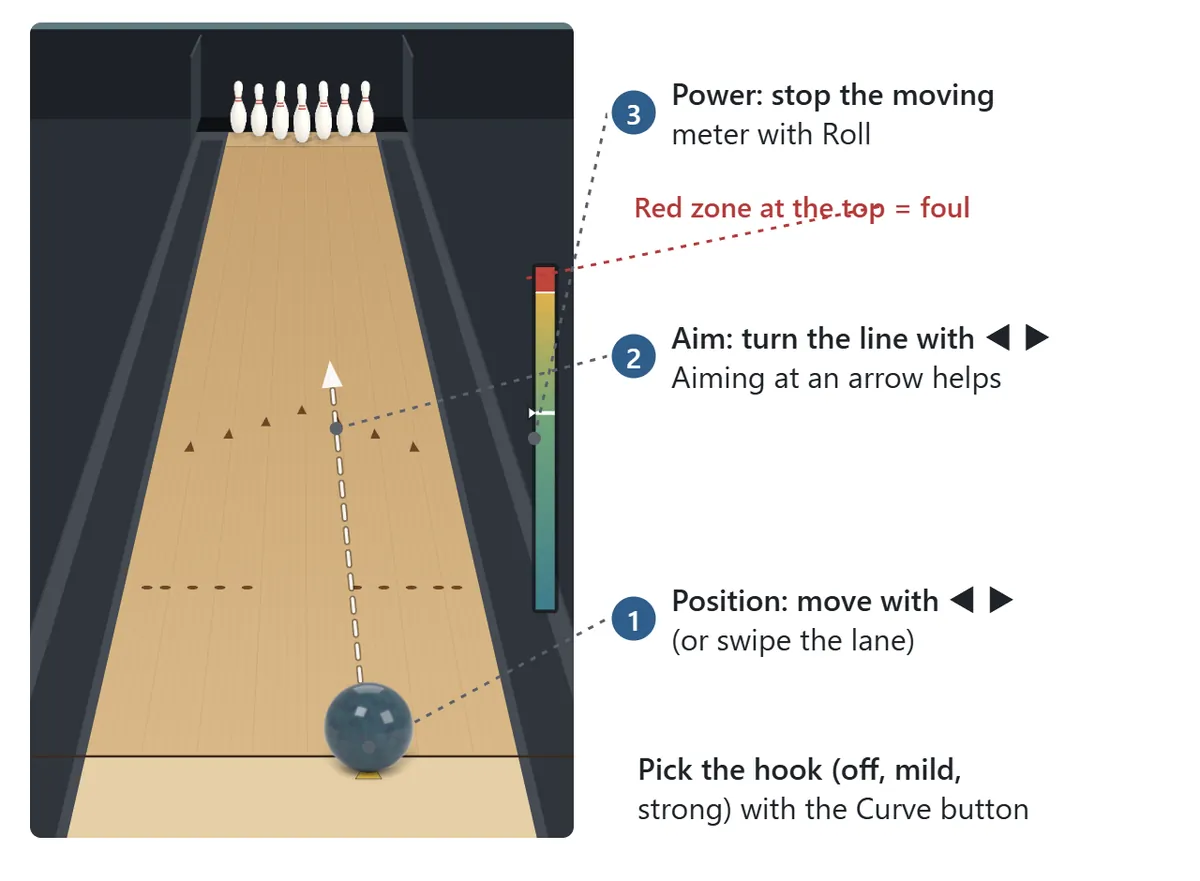
Every ball is rolled in the same three steps. First, move the ball left or right with the ◀ ▶ buttons to pick where you stand. You can also swipe the lane with a finger, drag it with the mouse, or use the arrow keys. Press Set. Second, turn the line that runs out from the ball until it points where you want to go, and press Set again. Third, a power meter appears on the right side of the lane and rises and falls on its own. Press Roll, tap the lane or hit the Space bar to stop it, and the ball is on its way.
The red zone at the very top of the meter means you charged the line too hard and stepped over it. Stop the meter there and the ball counts as a foul. Power also has a cost before that point: the harder you throw, the more your release wobbles, so the ball can drift a little off your line. Most players find that stopping just below the top gives a strong ball that still goes where it is aimed. If you pick the wrong setting, press Back to return to the previous step.
Hook ball and the pocket

The Curve button cycles through off, mild and strong. A right-handed bowler’s hook bends to the left near the pins; a left-handed bowler’s hook bends to the right. This follows how real lanes behave. The front two-thirds of a lane is coated with a thin layer of oil, so the ball skids and holds its line there. Once it reaches the dry back end it grips the wood and turns. A slower ball spends more time on the dry part, so it hooks more.
The best place to hit for a strike is not the head pin dead center. For a right-hander it is the gap between the 1 and 3 pins; for a left-hander, between the 1 and 2 pins. This target is called the pocket. A ball that hits the head pin square on tends to split the rack in two and leave pins standing on both sides. A ball that curves into the pocket at an angle drives the pins into one another, and they knock each other down like dominoes.
How to keep score in bowling
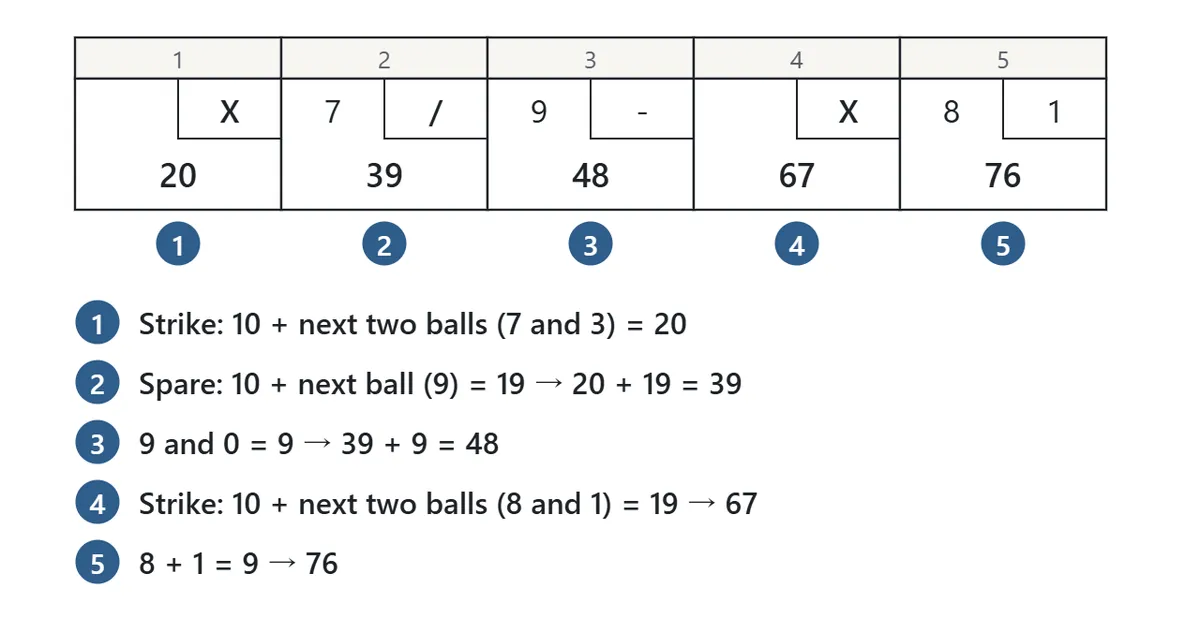
Scoring looks confusing on a real score sheet, but it rests on three simple rules. In an open frame, where you leave at least one pin after two balls, you score the number of pins you knocked down. A spare scores 10 plus the pins from your next ball. A strike scores 10 plus the pins from your next two balls. Because of the bonuses, one frame can be worth up to 30 points, which happens when you throw three strikes in a row.
That is also why the score for a strike or spare stays blank for a while. The game cannot know the bonus until you have thrown the balls that follow. The score sheet under the lane works the same way as the one at a bowling center: each frame shows the marks for the balls you threw, and the running total is filled in as soon as it is settled. You never need to add anything up yourself.
Bowling rules for the 10th frame
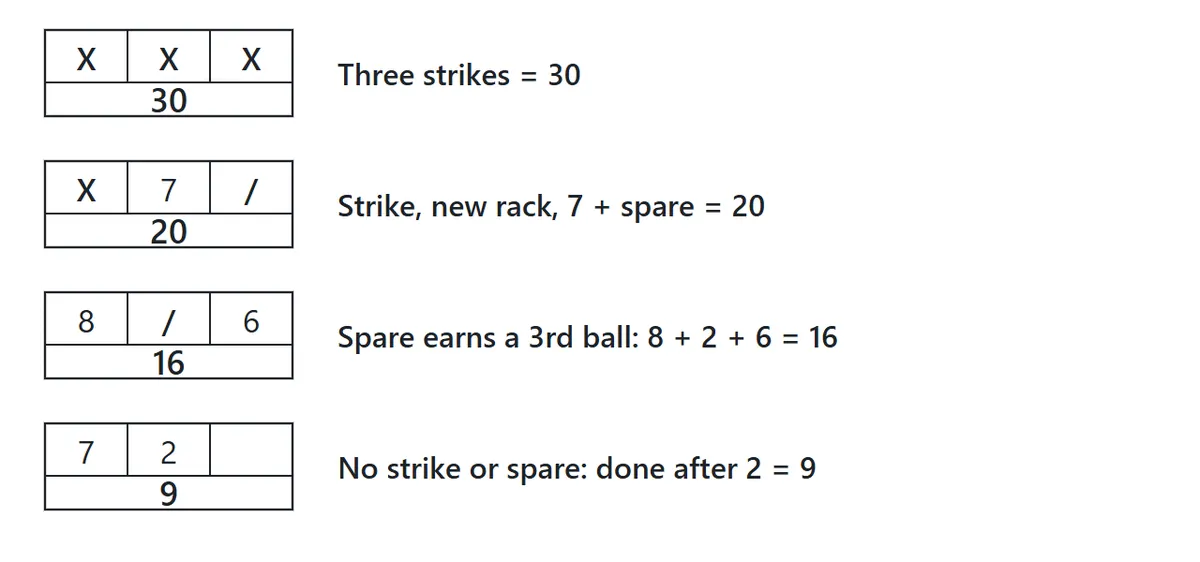
The last frame has a small twist. A strike or spare needs bonus balls to be scored, and there is no 11th frame to take them from, so they are thrown right away. Strike in the 10th and you get two more balls; spare and you get one more. After a strike the pins are reset to a full rack. If you strike on every ball from the first frame to the last, that is twelve strikes in a row and a perfect score of 300.
Bowling score sheet symbols
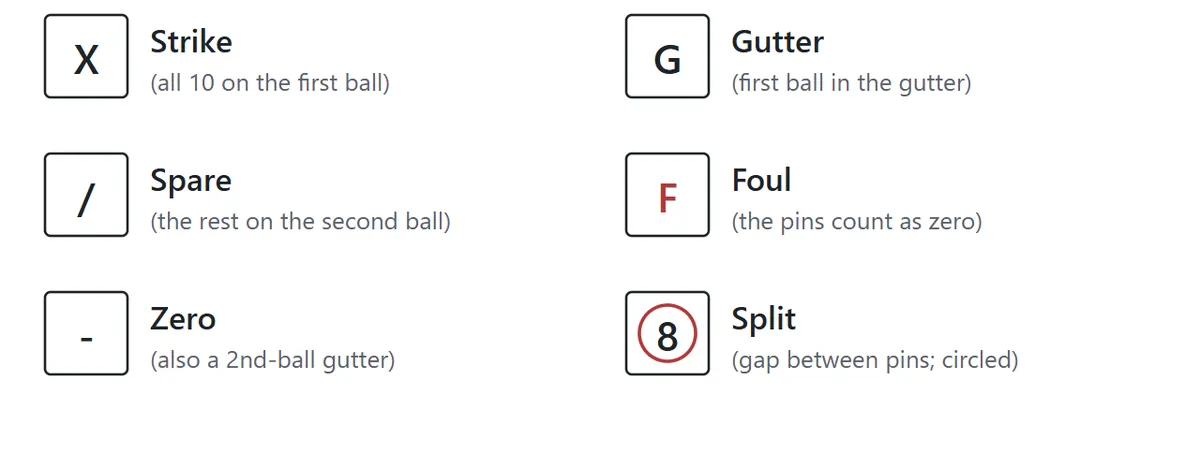
Besides the pin counts, the sheet uses a few standard marks. X is a strike and / is a spare. A dash means the ball knocked down nothing. G marks a first ball that ended up in the gutter, and F marks a foul. When the pins left after the first ball are separated by a gap, the count for that ball is circled to show a split.
Splits
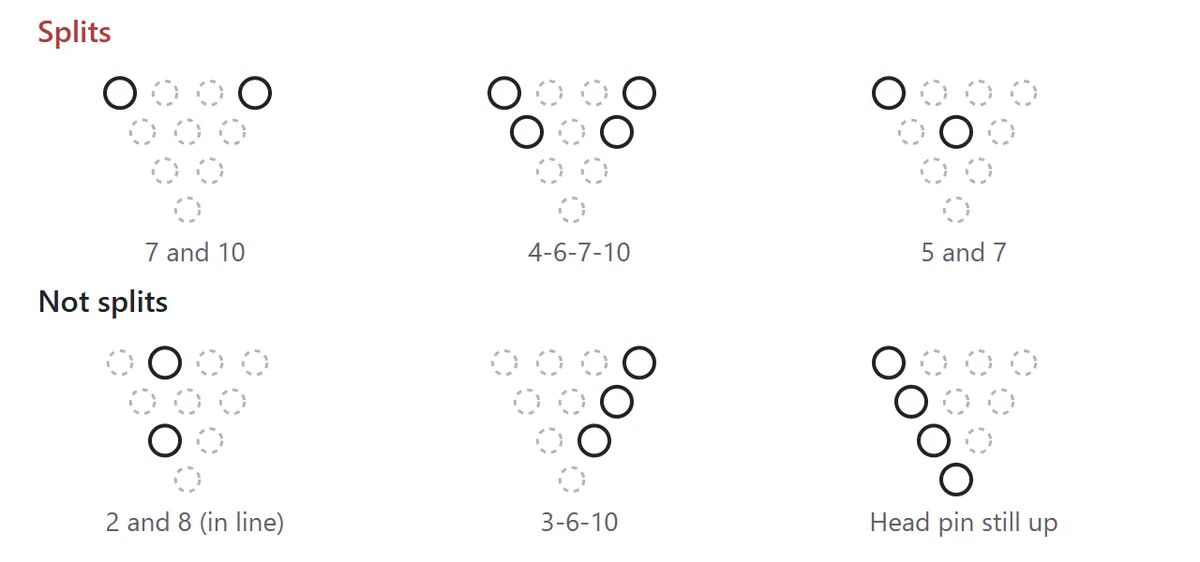
A split is a leave where the head pin is down and the remaining pins have a missing pin between them. The 7–10, one pin in each back corner, is the most famous of all and very hard to convert. A ball cannot touch both pins at once, so the only way to pick it up is to hit one pin so thin that it slides across the deck and takes out the other. Pins standing one behind another, like the 2 and 8, are not a split, and neither is anything that still includes the head pin.
Fouls
If you cross the foul line as you release the ball, the ball counts but every pin it knocks down is worth zero. After a foul on the first ball, the pins are set back up and you throw your second ball at a full rack. That means a foul followed by a clean ten is scored as a spare. In this game a foul happens when you stop the power meter in the red zone.
Game modes and settings
| Setting | What it does |
|---|---|
| Solo | Bowl ten frames on your own. Your high score and average are saved. |
| vs CPU | You and one to three CPU bowlers take turns frame by frame. Highest total wins. |
| Take turns | Two to four people share one device and bowl in order. |
| Bowling hand | Right-handed hooks bend left; left-handed hooks bend right. |
| Aim line | “To the arrows” stops just past the arrows. “To the pins” runs the whole lane, which makes aiming easier. Neither shows the hook. |
CPU levels
| Level | What it is like to play against |
|---|---|
| Easy | Throws straight at the head pin, often misses its line and sometimes fouls. Good while you learn the rules. |
| Normal | Hooks the ball toward the pocket and picks up most spares, but now and then leaves a big mess. |
| Hard | A strong hook into the pocket and plenty of strikes, with smart spare shooting. A test once you can break 150. |
Every level still leaves pins and throws the occasional gutter ball. Bowling is a game of small margins, and a run of strikes late in the game can wipe out a big lead, so do not give up after a slow start.
Bowling tips to raise your score
1. Aim for the pocket, not the head pin
A full hit on the head pin splits the rack and leaves pins on both sides. Aim a little right of center if you bowl right-handed, or a little left if you bowl left-handed, and let the ball enter the pocket.
2. Look at the arrows, not the pins
Lining up a target sixty feet away is hard. Choose which arrow your line should cross and send every ball over that same arrow. Consistency comes much faster that way, both in this game and at a real center.
3. Stop the power meter just below the top
More speed hits the pins harder, but it also makes the release less accurate, and the red zone is a foul. Find a spot on the meter you can hit every time and stick with it.
4. Pair your hook with your position
If you use a strong hook as a right-hander, stand to the right and aim at one of the arrows right of center, so the ball has room to bend back into the pocket. If it keeps crossing over to the wrong side, add a little speed or drop to a milder hook.
5. Shoot corner spares cross-lane
For a single pin on the edge, such as the 10 pin, stand on the opposite side and roll across the lane. The angle keeps the ball away from the gutter for longer. Turning the curve off for spares makes the ball go where you point it.
6. Make the easy spares
You do not need strikes to post a good score. A game of nothing but spares with a few pins on each first ball comes out around 150 or more. With one or two pins left, slow down and aim at the middle of them.
Bowling FAQ
Can I play this bowling game on a phone or tablet?
Yes. The lane fits a tall screen and the buttons sit right under it. You can swipe the lane to set your position and aim, and tap it to stop the power meter. It also works with a mouse or keyboard on a computer or Chromebook.
When are strike and spare bonuses added?
As soon as the balls they depend on have been thrown. A strike waits for two more balls and a spare waits for one, so the frame’s total stays empty until then.
Why do the pins fall differently when I throw the same way?
Tiny changes in where the ball meets the pins, and in its angle, change how the pins bounce off each other. There is also a small wobble in every release, so aiming at the same spot will not always give the same result, just as on a real lane.
Can I stop in the middle and finish later?
Yes. The game saves after every ball. Open the page again on the same device and browser and press Continue to pick up from the same frame.
What is a turkey?
Three strikes in a row. Two in a row is a double. The game calls them out when they happen, along with a perfect game of twelve straight strikes.
How is this different from real bowling?
You cannot choose a ball weight or walk an approach, and speed and hook come in set steps. The pins are simulated on a flat, top-down plane, so they never fly into the air. Scoring and the score sheet marks follow the standard ten-pin rules.
A short history of ten-pin bowling
Games of rolling something at a set of standing targets are very old and turn up in many parts of Europe. Dutch and German settlers brought a nine-pin version to North America, and it became a popular pastime in the taverns and alleys of the early 1800s. Somewhere along the way a tenth pin was added and the pins were arranged in the triangle used today. A popular story says the extra pin was a way around local bans on ninepins, though the real reason is hard to pin down. By the end of the century bowlers in the United States had agreed on common rules for pin size, lane length and scoring, and the ten-pin game spread around the world. Automatic pinsetters in the 1950s made bowling centers practical everywhere, and it is still one of the few sports where people of any age can share a lane and play on equal terms.