 Yorimichi Games
How to play the coin pusher game
A coin pusher is a table covered in coins, with a wide block – the pusher – sliding slowly back and forth at the back. You drop a coin onto the table. When the pusher moves forward, it shoves your coin into the coins in front of it, they shove the next ones, and the coins at the very front get pushed over the edge. Every coin that falls off the front edge is yours. You get a set number of coins to drop, and the goal is simple: win back as many as you can. This version runs in any browser on a computer, phone, tablet or Chromebook, with no sign-up. The coins are plain wooden playing pieces, like slices of a small branch – there is no real money involved and nothing to buy.
The table
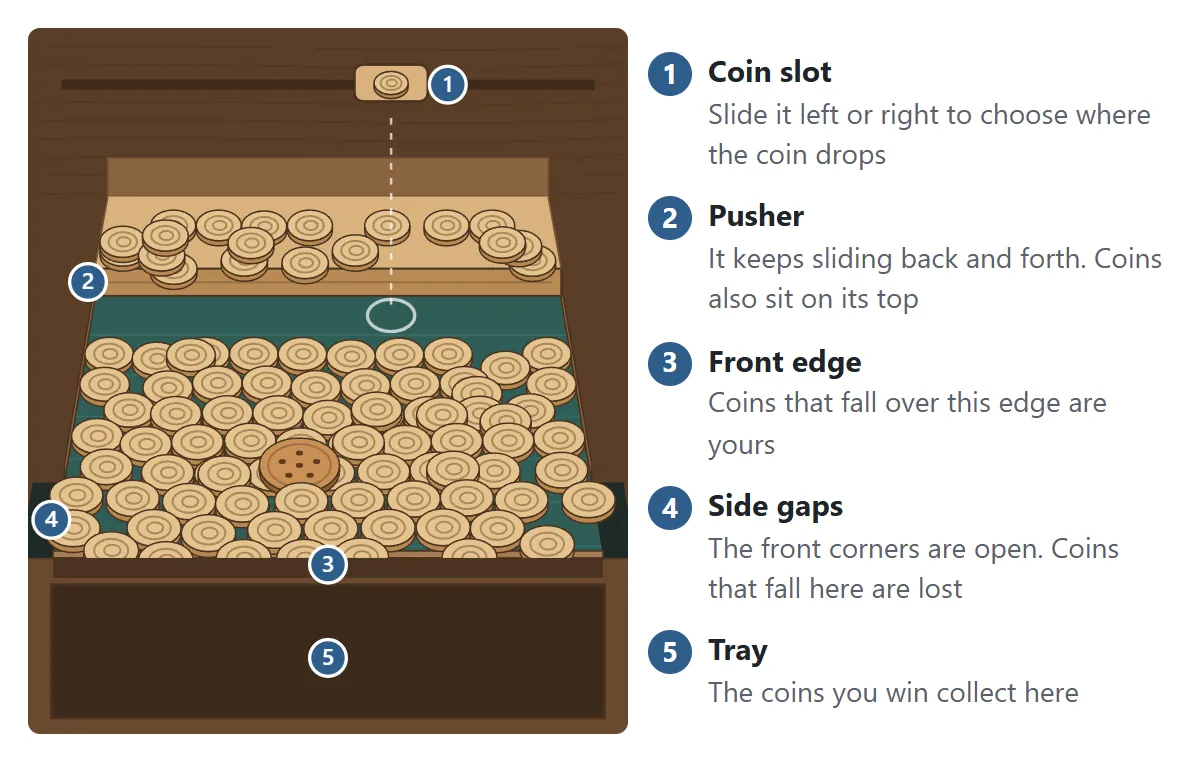
The top of the screen is the back of the table and the bottom is the front, nearest to you. A rail runs across the top with the coin slot on it; slide the slot left or right to choose where your coin lands. At the back is the pusher, which never stops moving. Its flat top is a second, upper level, and coins pile up there too. The green floor in front of it is where most of the action happens. The front edge is at the bottom: coins that tip over it drop into the tray and count toward your score. The two front corners are open. Coins that get squeezed out sideways there drop into the side gaps and are lost.
How coins get pushed off
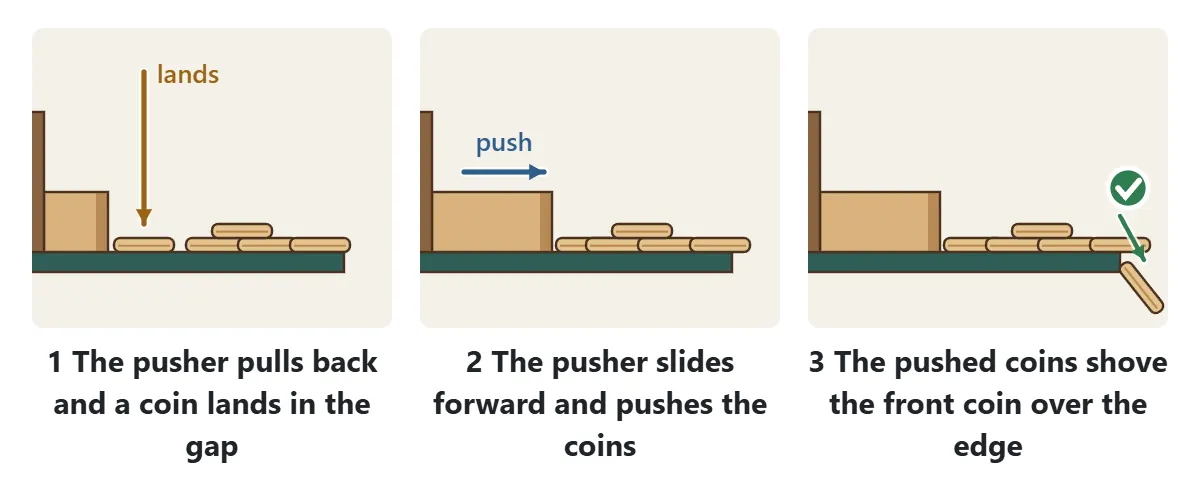
Your own coin almost never falls off right away. It lands in a gap on the floor, and on the next stroke the pusher drives it into the coins in front. They pass the push along, row by row, and the coins hanging over the front edge are the ones that drop. In other words, you drop one coin at the back so that somebody else’s coin falls at the front. The fuller the table, the better the push travels from back to front.
Coin pusher strategy: where and when to drop
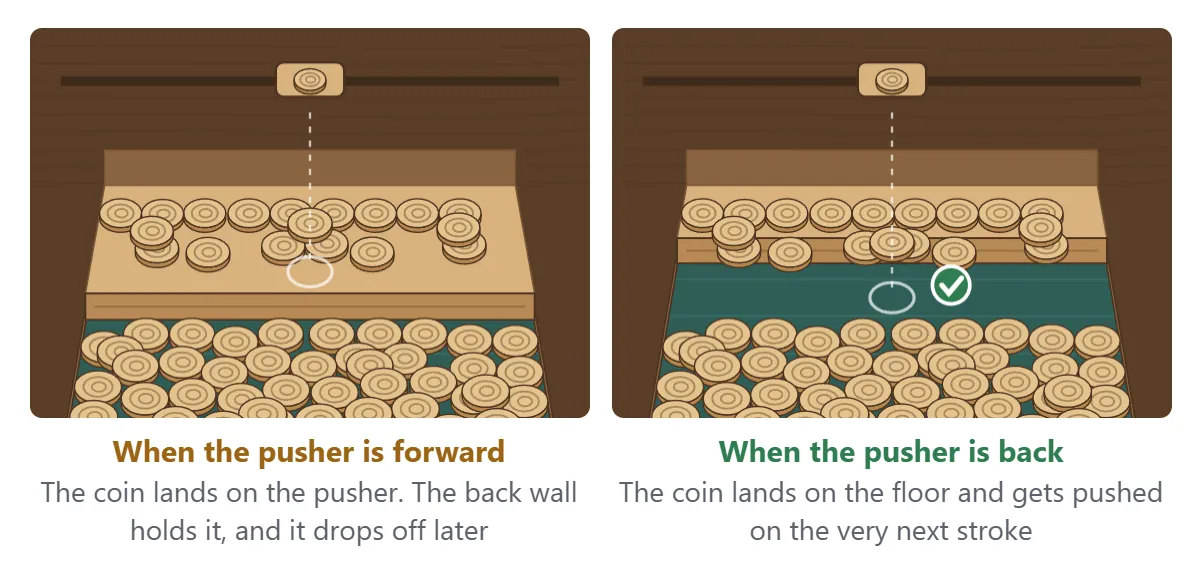
A coin takes a moment to fall from the slot to the table. If it arrives while the pusher is forward, it lands on the pusher’s top. That coin is not wasted: each time the pusher pulls back, the back wall stops the coins on top from going with it, they creep toward the pusher’s front, and eventually they fall onto the floor. But they do their work later. If the coin arrives while the pusher is pulled back, it lands on the open floor and gets pushed on the very next stroke.
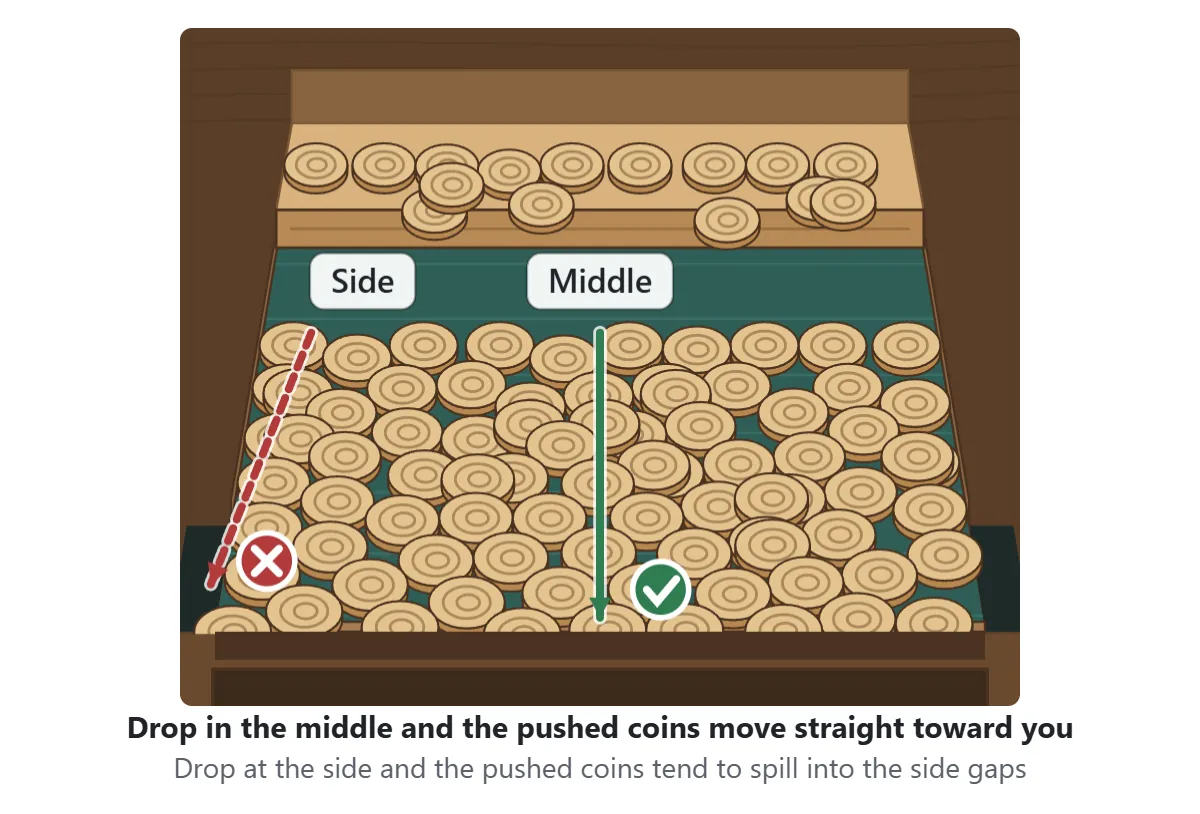
Position matters as much as timing. A coin dropped in the middle sends its push straight toward the front edge. A coin dropped near a side tends to squeeze the coins sideways, and the ones near the open corners slide into the side gaps instead of falling off the front.
Special coins
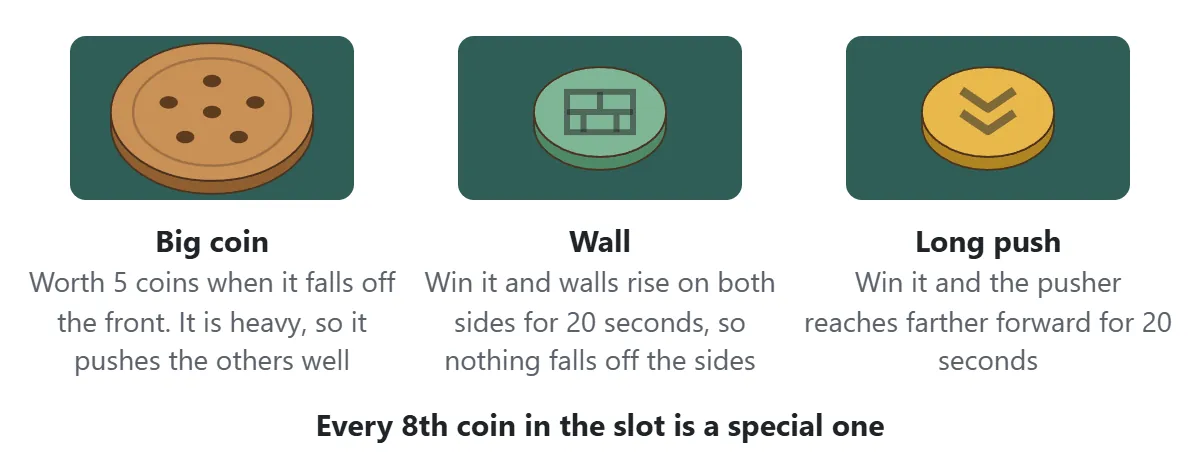
Every eighth coin in the slot is replaced by a special one. The bar above the table tells you what is coming (“Next: Big coin”), so you can decide where to drop it. A special coin only works when it falls off the front edge; if it slips into a side gap, nothing happens.
| Special | When you win it |
|---|---|
| Big coin (five dots) | Counts as 5 coins. On the table it is heavy and pushes hard. There is always one on the table at the start |
| Wall (brick pattern) | For 20 seconds, walls close the front corners, so nothing is lost to the sides |
| Long push (chevrons) | For 20 seconds, the pusher slides farther forward and moves more coins |
Modes and difficulty
| Mode | What you do |
|---|---|
| Solo | Choose 20, 30 or 50 coins and a difficulty, and see how many you can win. Your best is saved for each difficulty and number of coins |
| Daily table | A new table every day. The starting coins and the order of the special coins change daily, and everyone gets the same table on the same day. 30 coins on Normal |
| Level | How it feels |
|---|---|
| Easy | The pusher moves slowly and far, and the front edge is low. Coins fall easily |
| Normal | A normal pusher and a slightly raised front edge. Where and when you drop starts to matter |
| Hard | A fast pusher with a short stroke and a high front edge. Coins pile up at the front and spill to the sides more often |
After your last coin, the pusher makes five more strokes and the game ends. Coins that fall during those last strokes still count.
Coin pusher tips
1. Drop in the middle
Coins dropped near the sides tend to push others into the side gaps. The middle of the table is the safe default.
2. Time your drop for when the pusher is back
Your coin lands a moment after you drop it. Drop just as the pusher reaches its farthest point and starts pulling back, and the coin lands in the fresh gap, ready for the next stroke.
3. Aim behind the coins that are about to fall
Look for coins already hanging over the front edge, or a pile building up near it. Drop your coin in line behind them – a small extra push is often all it takes.
4. Don’t rush
The pusher only pushes once per stroke, however many coins you drop. One or two coins per stroke, in rhythm with the pusher, wastes the fewest.
5. Put the specials where they count
A big coin in the middle pushes hard for you. The wall and the long push only start working once you win them, so drop them when the table is packed right up to the edge – then you get the most out of their 20 seconds.
6. Watch the final strokes
The pusher keeps going for five strokes after your last coin. Coins teetering on the edge often fall in those last pushes.
The science: levers and friction
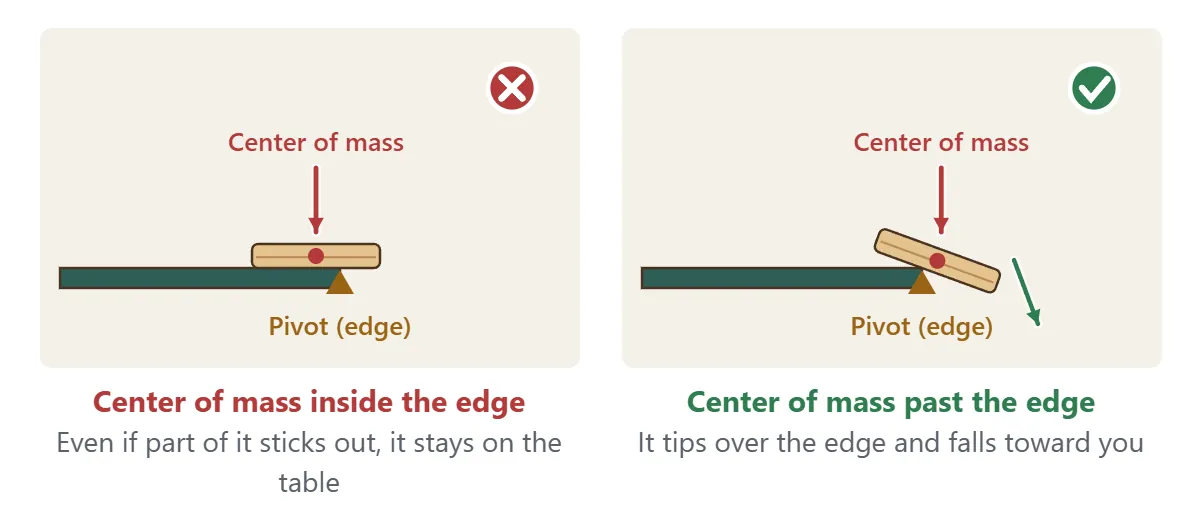
Whether a coin falls is a neat little lever problem. You can treat the whole weight of a coin as acting at one point, its center of mass – for a flat round coin, the center. A coin sticking out over the edge is like a lever with the edge as its pivot. While the center of mass is still on the table side, the weight turns the coin back onto the table, so it stays put even when almost half of it hangs over. The instant the center passes the edge, the weight turns it the other way, and the coin tips off. In this game too, a coin falls once its center crosses the edge; on Hard, the raised edge means it has to be pushed a little farther.
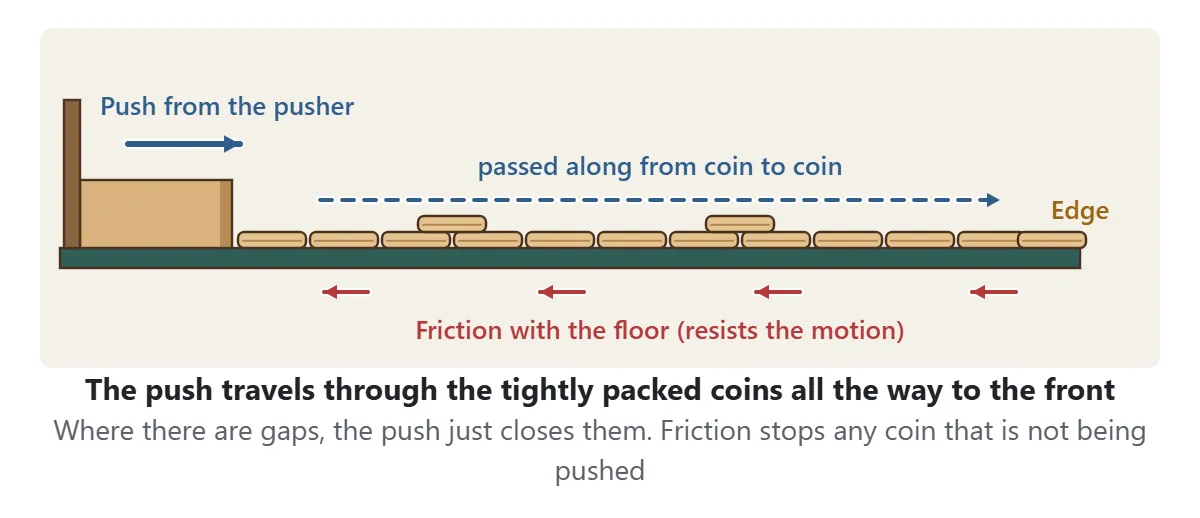
The push itself travels through contact: the pusher presses on the first row, which presses on the next, and so on to the front. If the table has gaps, the push is used up closing them and never reaches the edge – which is why a packed table pays off. Friction does the opposite job. Between each coin and the floor, it resists sliding, so a coin that is not being pushed soon stops. Friction is also why the coins stay where they are when the pusher pulls back, and why a coin lying on top of another rides along with it. Watching a coin pusher is really watching pushing forces and friction balance out, a little at a time.
Coin pusher FAQ
Can I play on a phone or tablet?
Yes. Tap the table to drop a coin at that position, or keep your finger down, slide to the spot and let go. The arrow buttons and the Drop button below the table work too. The number of coins on the table is capped so the game stays smooth on school Chromebooks and older tablets.
Does it cost anything? Can I win anything?
No and no. The game is free with no sign-up, and the coins exist only inside the game. You cannot buy them or trade them for anything – you simply count how many you win and try to beat your best.
Can I stop and continue later?
Yes. On the same device and browser, press Continue to pick up with the same table and the same number of coins left. The game saves automatically while you play.
What happens to coins that fall off the sides?
They do not count. The results screen shows how many fell off the front and how many slipped off the sides.
Why did my coin land on top of the pusher?
It arrived while the pusher was forward. It will drop to the floor after a few strokes. To land on the floor, drop a moment before the pusher pulls back.
A short history of the coin pusher
The coin pusher is usually traced back to Britain in the 1960s, where a large moving table that many people could play at once became popular, and the idea spread around the world from there. Its appeal is easy to see: a table crammed with coins, a single coin of yours that sets off a chain of pushes, and that agonizing moment when a coin hangs on the edge and refuses to fall. The idea was later scaled up for a British television quiz show, and in Japan homemade coin pushers built from cardboard or wood are a popular craft project. This version is made like a wooden toy table, to enjoy the way pushing and friction move the coins.
If you like watching things roll and tumble, try Smartball, the Japanese festival pinball game, or Shooting Gallery, where you knock small toys off a shelf with a cork.