 Yorimichi Games
How to play mini golf
Mini golf – also called minigolf or miniature golf – is golf with only the putter. Each hole is a short, walled lane with a starting spot and a cup, and your job is to roll the ball into the cup in as few strokes as possible. Add up your strokes for every hole; the lowest total wins. This version shows each hole from directly above, so you can see every wall, slope and hazard before you putt. There are eighteen original holes, a new hole of the day every day, and you can play alone, against up to three CPU golfers or with two to four people sharing one phone, tablet or computer.
Reading the hole
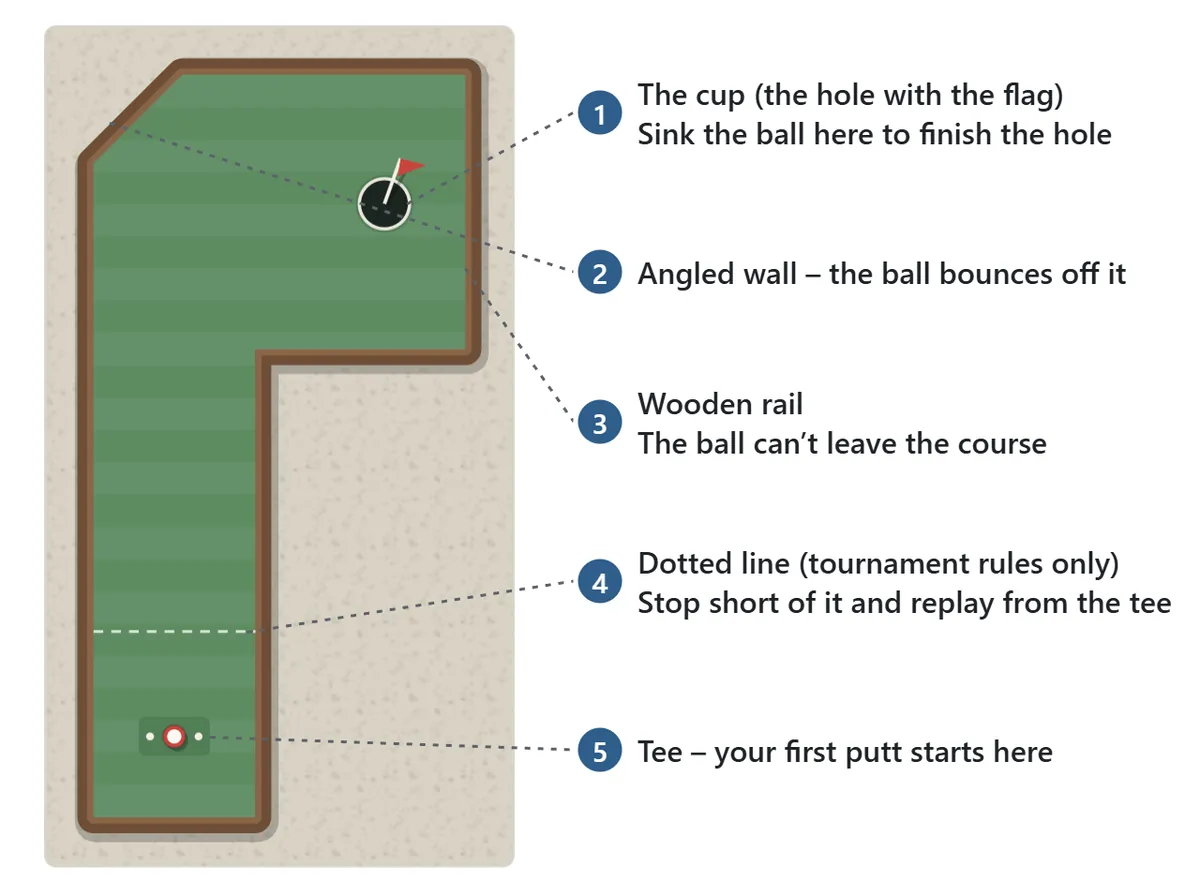
Every hole has a tee, where your first putt is taken, and a cup marked by a small flag. Wooden rails run all the way around the lane. The ball can never leave the course; it simply bounces back, which means a wall is often the quickest way around a corner. Each hole also has a par – the number of strokes a good player would expect to need – shown in the bar above the course.
How to putt: pull back and release
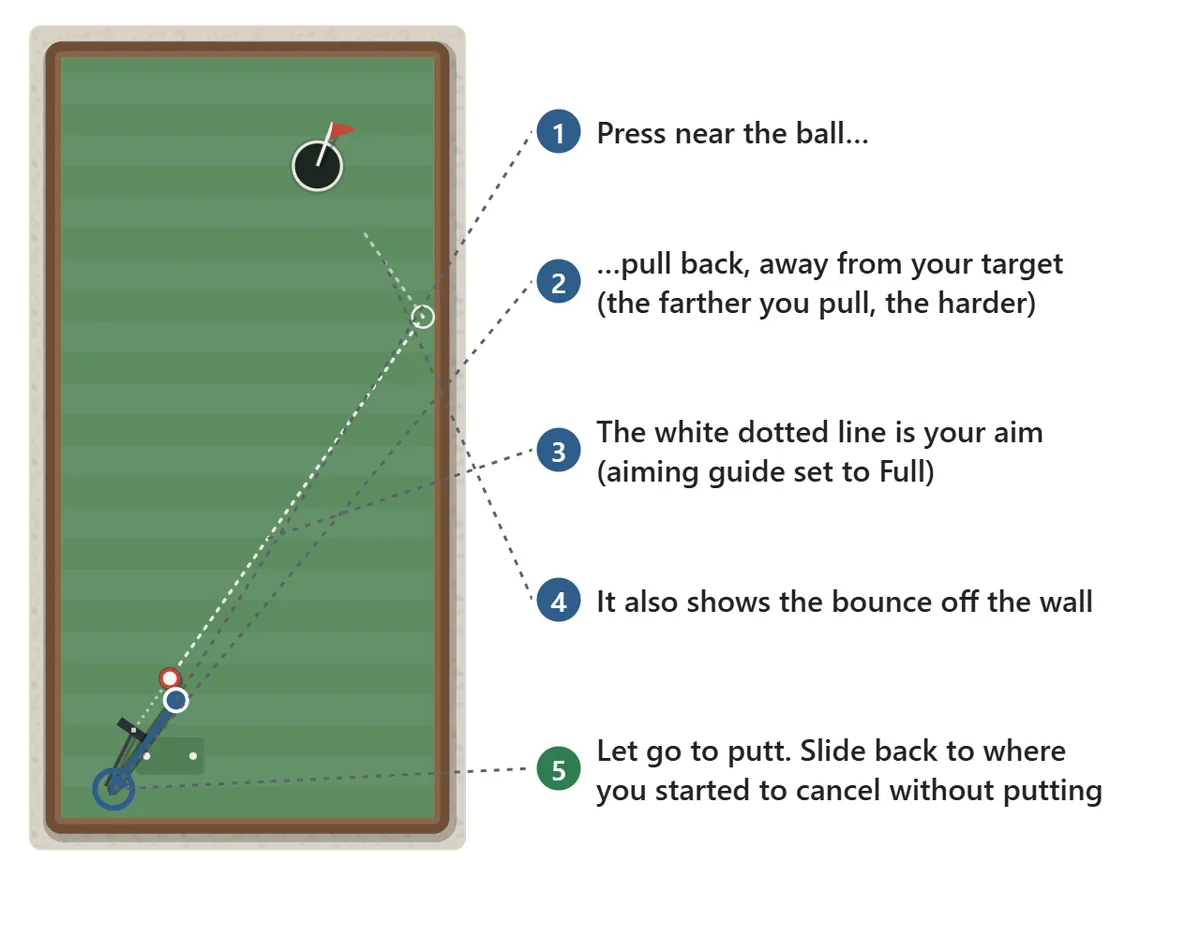
Press anywhere on the course with your finger or mouse, then drag in the opposite direction to where you want the ball to go – like drawing back a slingshot – and let go. The farther you pull, the harder you hit. Changed your mind? Slide back to the point where you started and release; nothing happens. A single tap or click without dragging just turns your aim toward that spot, which is handy for lining up a long putt.
If you prefer precise control, use the ‹ and › buttons (or the left and right arrow keys) to nudge your line, set the power with the slider, and press Putt. With the aiming guide on Full, a white dotted line shows your direction and how the ball will bounce off the first wall it meets. The length of the line is roughly how far the ball would roll on flat ground. Slopes and sand change that, so treat the guide as a helper rather than a promise.
Getting the ball to drop
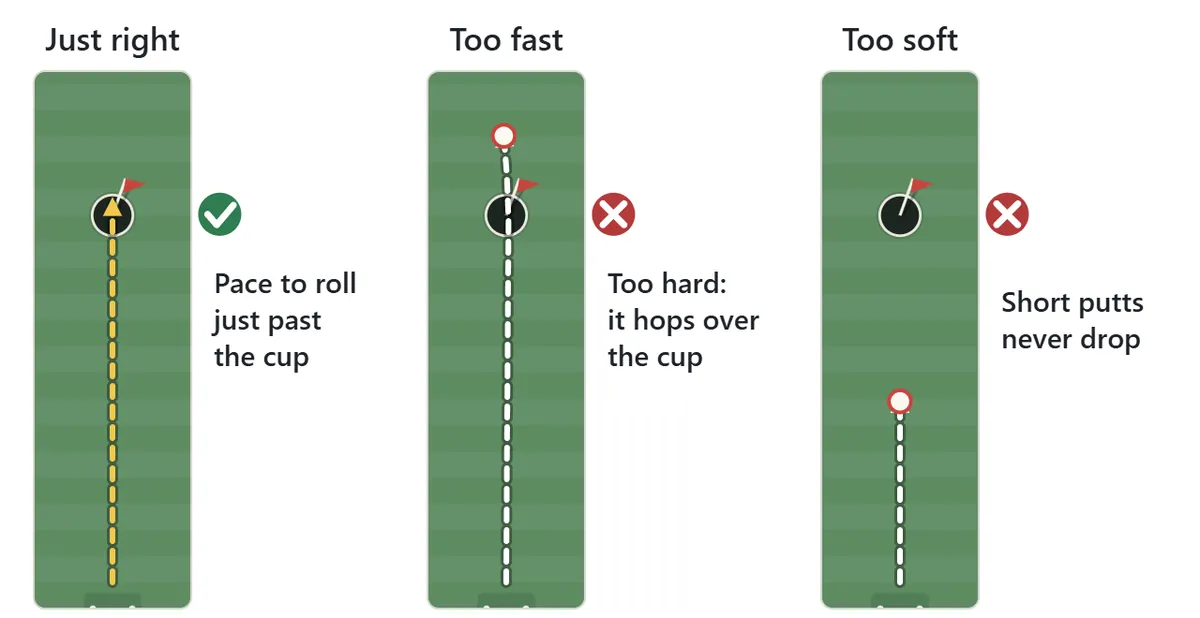
Rolling over the cup is not enough. A ball that arrives gently falls in, but a ball that is travelling too quickly clips the far edge and hops straight over. The best pace is one that would carry the ball a little past the hole if it missed. Hitting the center of the cup also helps: a putt that catches the middle can be a bit firmer and still drop, while one that only catches the edge needs to be dying.
Slopes, sand and water
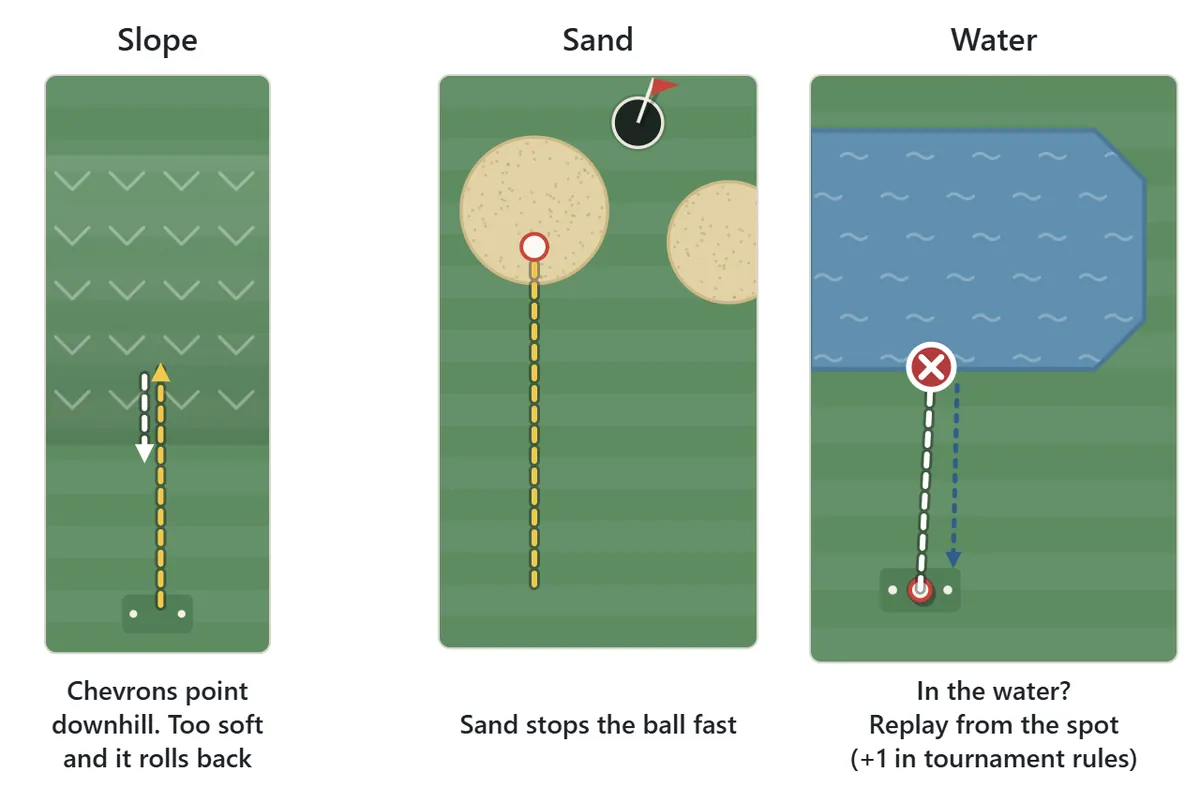
Slopes are shown with chevrons that point downhill. Putt up a slope too gently and the ball stalls and rolls back toward you. A ball crossing a slope sideways drifts toward the low side, so aim a little higher than the cup. Sand grabs the ball and stops it almost immediately – either hit hard enough to get through or go around it. If the ball ends up in the water, you play again from the spot you putted from. Under tournament rules the water also costs you a penalty stroke.
Windmills, sliding gates and tunnels
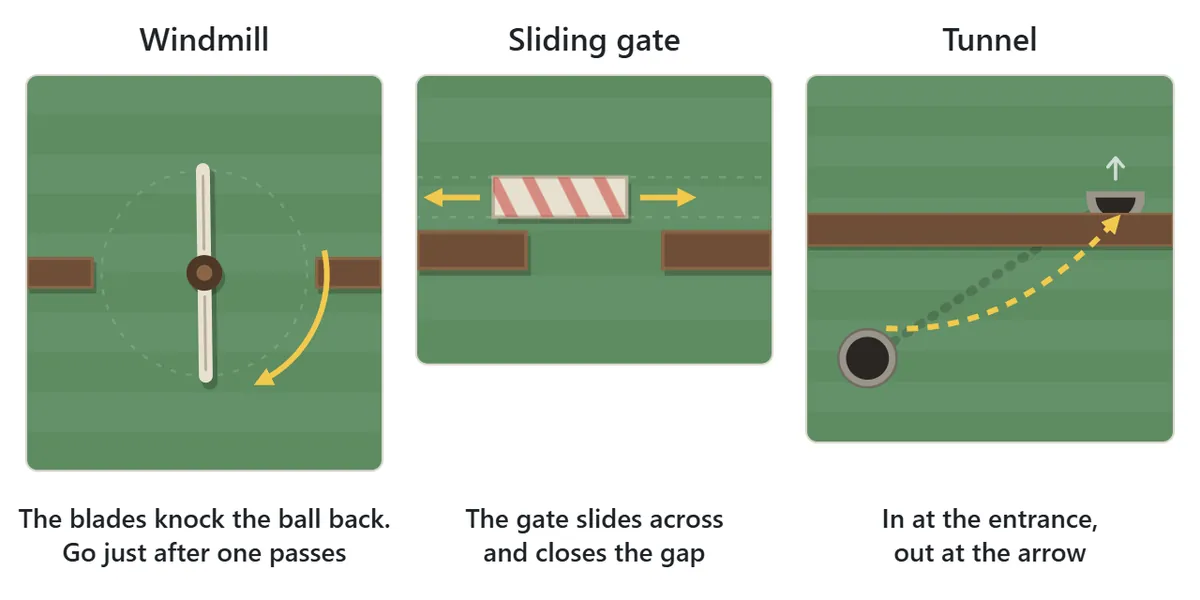
No mini golf course is complete without a windmill. On holes with turning blades or a sliding gate, timing matters as much as aim: hit a blade or the gate and the ball bounces back. Putt just after a blade has passed or as the gate moves clear of the gap. If your ball comes to rest right in the path of a moving obstacle, it is nudged a short way out of the way automatically. On tunnel holes, roll the ball into the entrance and it reappears from the exit marked by the arrow.
Keeping score
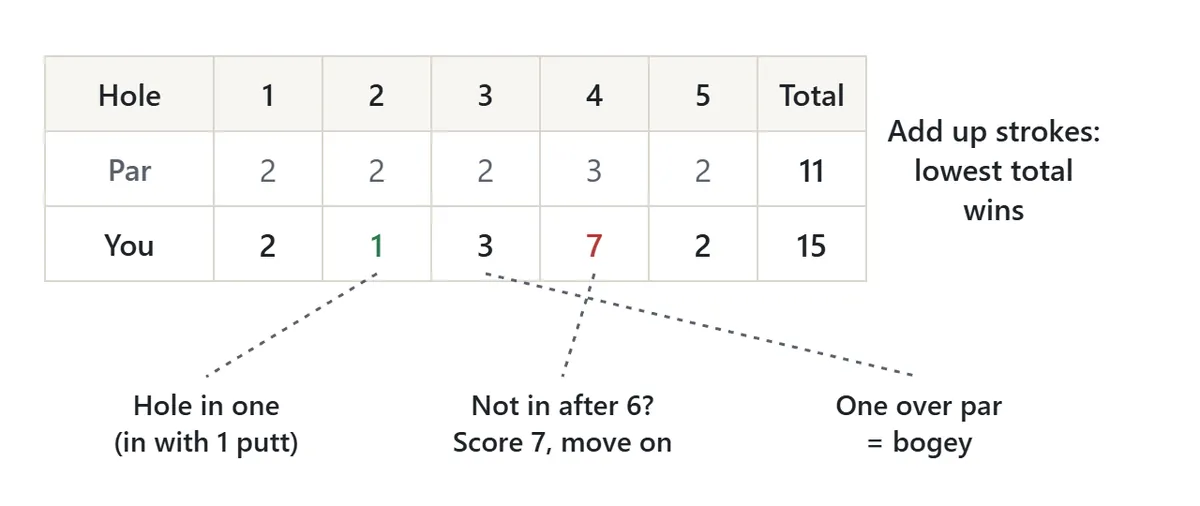
Every putt counts as one stroke, plus any water penalty. If the ball still isn’t in after six strokes, you are given seven for the hole and move on – a rule taken from competition minigolf that keeps the game flowing. One stroke under par is a birdie, level with par is a par, one over is a bogey, and holing out with your first putt is, of course, a hole in one. After each hole the scorecard pops up so everyone can compare; press Scores during play to check it at any time.
Mini golf rules: Casual or Tournament
| Situation | Casual | Tournament rules |
|---|---|---|
| Ball in the water | Replay from where you hit, no penalty | Replay from where you hit, plus one stroke |
| Dotted line in front of the tee | Not used | If the ball stops before the line, putt again from the tee (the stroke counts) |
| Maximum on a hole | Not in after 6? Score 7 | Not in after 6? Score 7 |
New players should start with Casual. Tournament rules follow the style of organized minigolf, where a timid first putt or a trip into the pond quickly adds strokes. Both use the seven-stroke maximum, so nobody gets stuck on one hole.
Courses and game modes
| Course | What to expect |
|---|---|
| Front 9 | Starts with a straight hole, then introduces a dogleg, posts, a slope, sand, water, a windmill, a tunnel and a hilltop cup – one idea at a time |
| Back 9 | Harder holes: zigzag walls, a valley, a sliding gate, an island green and a long final hole |
| 18 holes | The front nine and back nine in one round |
| Hole of the day | One hole that changes every day – come back and try to beat your score |
Choose Solo to chase your personal best, vs CPU to play against one to three computer golfers, or Pass & play to share one device among two to four people, taking turns hole by hole. Your best score for each course is saved on this device.
CPU levels
| Level | How it plays |
|---|---|
| Easy | Often misses its line and tends to hit too hard. Rarely thinks about slopes or banks. A friendly opponent while you learn the controls |
| Normal | Sometimes plays a clever bank shot, but still guesses the pace and misses. A fair match once you have a feel for the power |
| Hard | Reads slopes and times the windmill and gate. Still misjudges a putt now and then. A test for players who score around par |
Mini golf tips and tricks
1. Pace first: just past the cup
Most missed putts are a pace problem, not a line problem. Aim for a speed that would take the ball a little beyond the hole. A putt that stops short has no chance at all.
2. On long holes, lag it close
When the cup is around a corner or behind a wall, don’t force a heroic one-putt. Leave the ball somewhere with a clear, straight look at the hole and take the easy second putt. Two sure strokes beat four risky ones.
3. Make the walls work for you
The ball comes off a rail at roughly the same angle it went in. Use the guide line to see the rebound and play bank shots around corners – on many holes that is the shortest route.
4. Read the slope arrows
Chevrons point downhill. Be firm going up, gentle coming down, and when you putt across a slope, start the ball on the high side and let it curl toward the cup.
5. Watch moving obstacles once
Windmill blades and gates always move at the same speed. Let one full cycle go by, pick the moment the gap opens, and putt with that rhythm in mind.
6. Take the safe route around hazards
Water sends you back and sand stops you dead. A slightly longer path that stays dry usually costs fewer strokes than a daring shortcut that ends up wet.
Mini golf FAQ
Can I play on my phone?
Yes. The course is laid out in portrait, so you can hold your phone upright and putt with one finger. The buttons and slider under the course give you finer control if you need it.
What if I just can’t get the ball in?
After six strokes the hole ends and you are given seven. You never get stuck on the same hole.
The ball takes ages to stop – can I speed it up?
While the ball is rolling, a Fast-forward button appears where the Putt button was. On a keyboard, press F.
Can I stop and finish my round later?
Yes. The game saves before every putt. Open it again on the same device and browser and press Continue to pick up on the same hole with the ball where you left it.
How is this different from real mini golf?
The course is flat and viewed from above, so there are no ramps or jumps, and the ball can’t leave the lane. A ball that stops in the path of a windmill or gate is moved slightly aside – competition rules also let players move a ball a short distance away from an obstacle by hand.
A short history of mini golf
Putting-only golf has a long history. A course built purely for putting on the rolling turf at St Andrews in Scotland is often dated to 1867. Courses with obstacles, closer to what we know today, appeared in Britain and the United States in the early twentieth century, and by around 1930 miniature golf was a craze across America, with thousands of courses on rooftops and vacant lots. In the 1950s standardized lanes were designed in Switzerland, and organized minigolf competitions spread through Europe. Today it is a favorite at seaside resorts, parks and family fun centers around the world – and in Japan, where a version played on small outdoor courses is known as パターゴルフ (putter golf).