 Yorimichi Games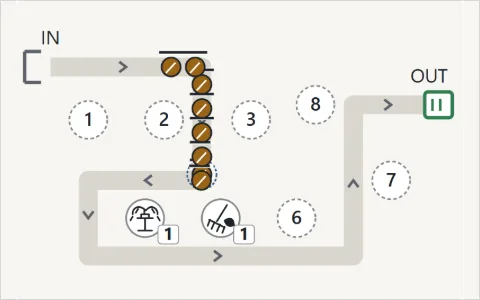
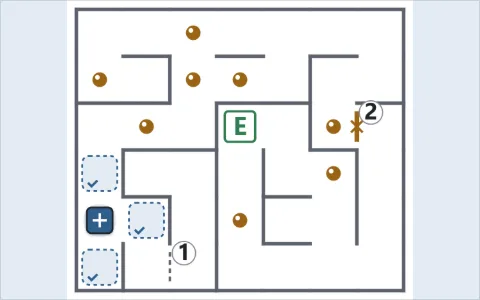
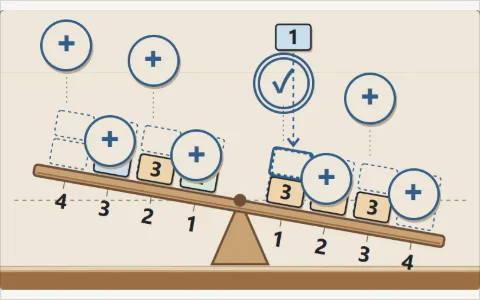
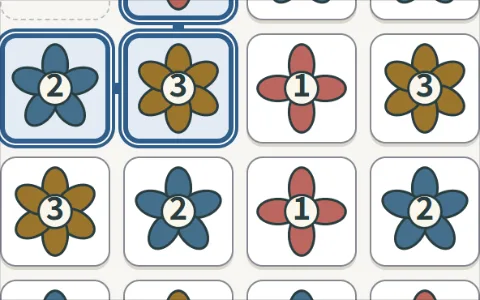
How to Play Screws & Planks
Screws & Planks is a one-player screw game. Wooden planks are stacked on a board with holes in it, and each plank is held in place by metal screws. Your job is to take the screws out one at a time and move them into empty holes, letting the planks drop away until the board is clear. A plank held by two or more screws stays put. When only one screw is left, the plank swings down on that screw like a pendulum. When the last screw comes out, the plank falls off the board. Clear every plank and you solve the puzzle.
It sounds simple, but every screw you take out has to go somewhere, and the holes are limited. Which plank to drop first, which screw to pull, and which hole to put it in are the decisions that make each level a real logic puzzle.
The board
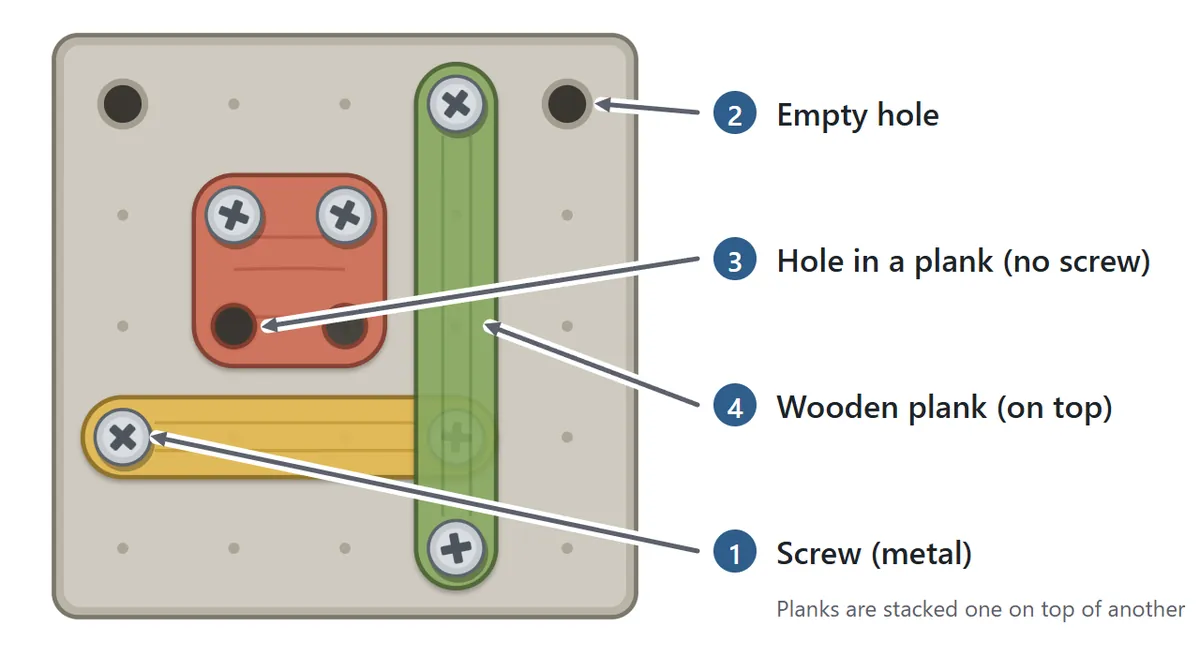
The dark circles on the grey board are holes that can take a screw. The small dots are spots with no hole. Each wooden plank has its own color and shape, and the planks are stacked from the bottom up. They are slightly see-through, so you can spot screws and holes hidden underneath. Planks have round holes of their own; a screw passes through a plank’s hole into the board. Some plank holes have no screw in them.
Moving a screw
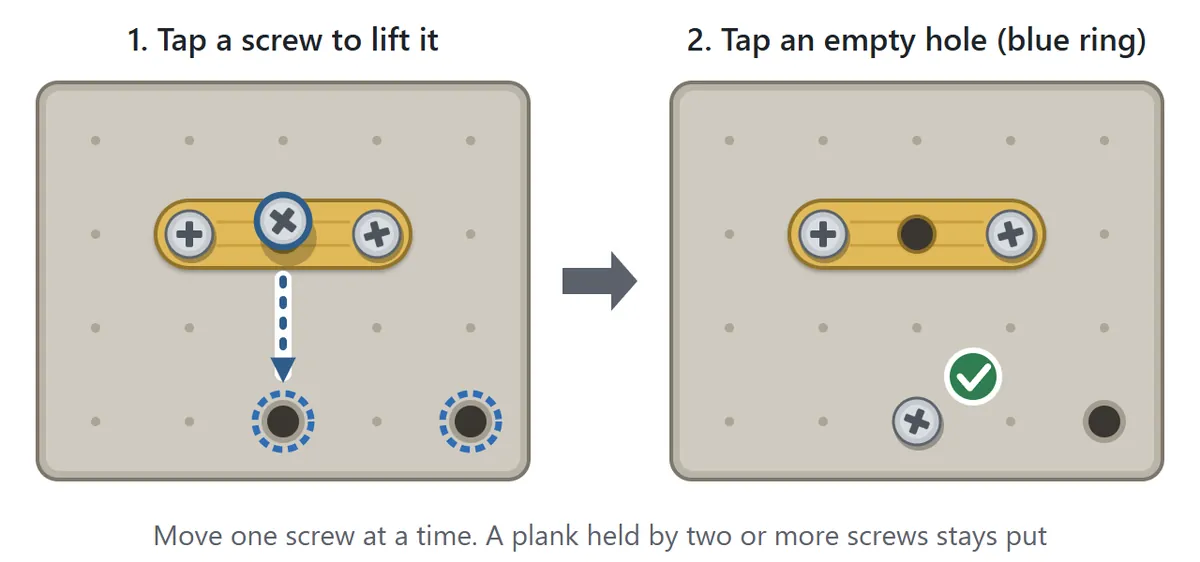
Tap the screw you want to take out and it lifts up. Every hole it can go into gets a blue dashed ring. Tap one of those holes and the screw goes in. That is one move. Tap the lifted screw again to drop it back where it was, at no cost. You can only hold one screw at a time. With a keyboard, use the arrow keys to move a frame between holes and press Space or Enter to lift or place a screw.
Screw game rules: which screws can come out
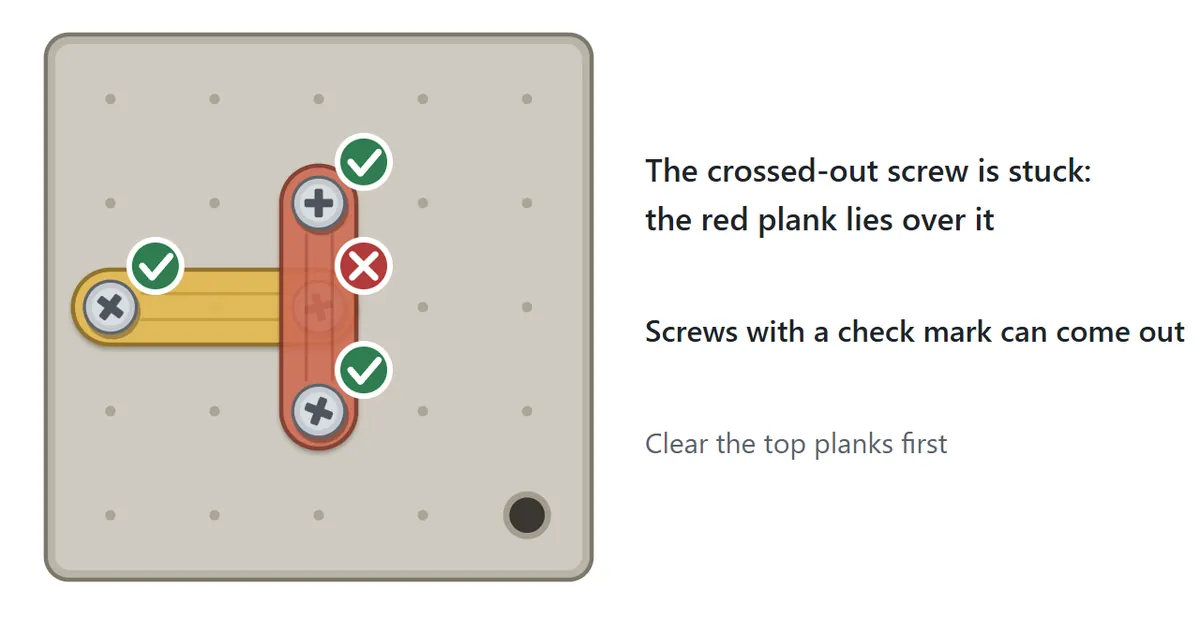
If another plank lies over a screw, that screw cannot come out. In the picture, the red plank sits on top of the yellow plank’s right-hand screw, so the red plank has to go first. If you tap a stuck screw, the game tells you which plank is in the way and makes that plank flash. Working from the top of the stack down is the basic idea.
Swinging and falling planks
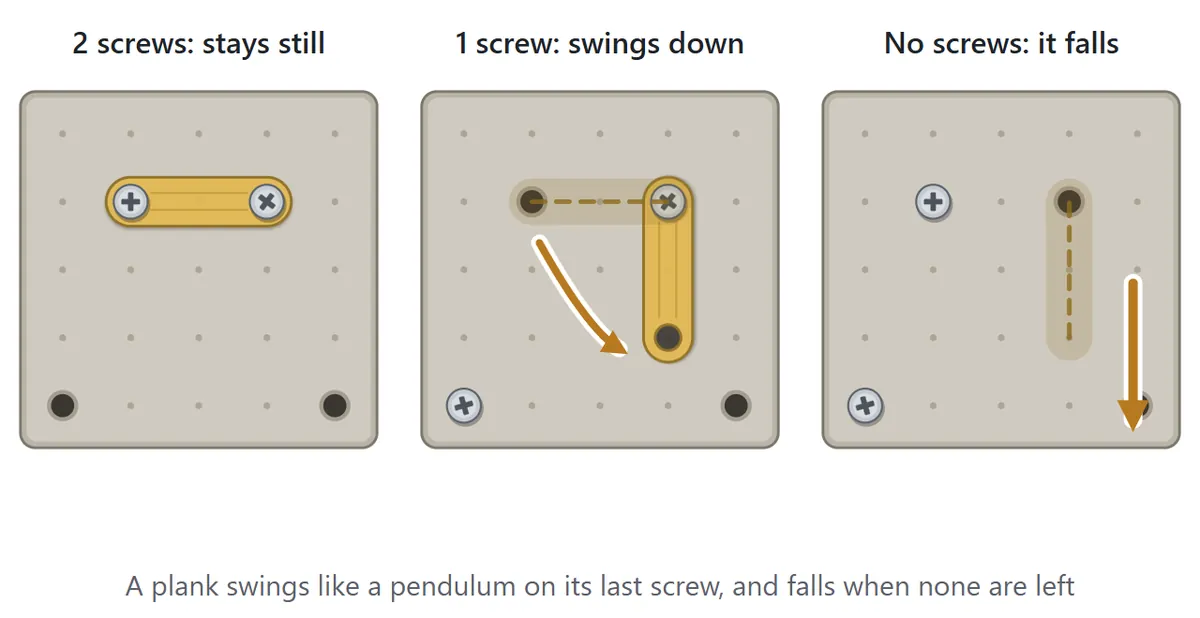
With one screw left, a plank pivots on it and swings until its heaviest point, the center of mass, hangs directly below the screw. A swinging plank can end up lying over other holes or screws, which changes what you can do next. Take out the last screw and the plank tumbles off the board. One screw sometimes holds two planks at once; move it and both of them react.
Which holes can take a screw
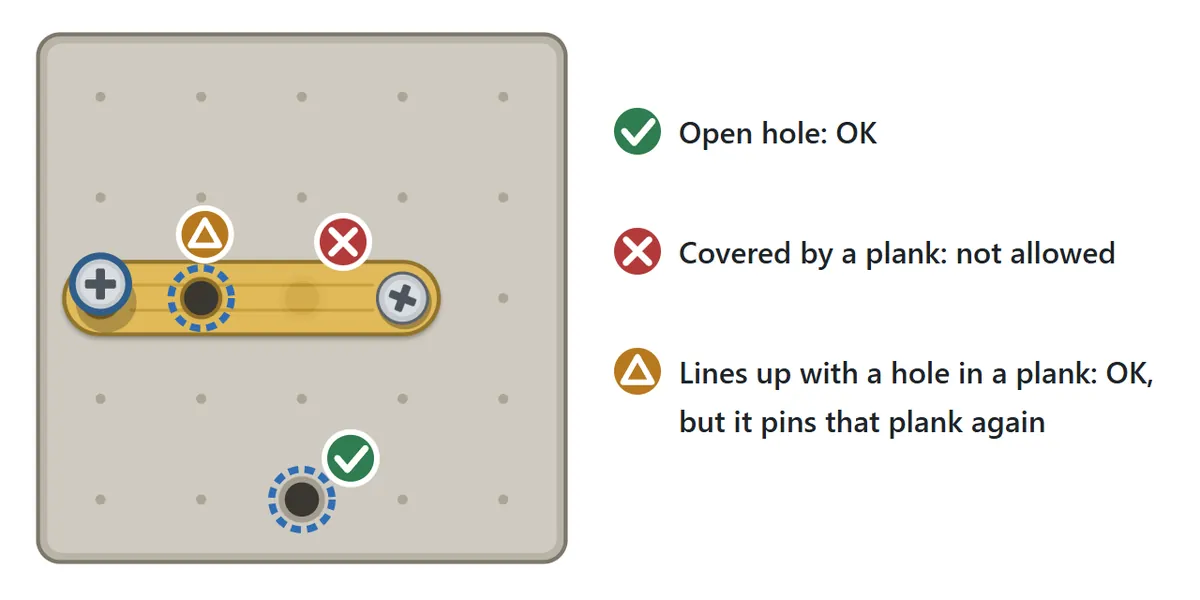
A screw can go into any empty hole that has no plank lying over it. A hole hidden under a plank is off limits. The exception is a board hole that lines up exactly with a hole in the plank above it: the screw can pass through, but then it holds that plank too. That can undo your progress, so choose your holes with care.
Solving and counting moves
When every plank has fallen, the level is solved. Each screw you move counts as one move. The result shows your move count and the fewest moves the level can be solved in. If no screw can move any more — usually because there is no open hole left — the game says you have hit a dead end. Use Undo to step back, or Restart to try the level again from the beginning.
Levels and the daily puzzle
| Level | Planks | What to expect |
|---|---|---|
| Easy (15) | 1–4 | Plenty of open holes. Learn how planks swing and fall |
| Normal (15) | 5–6 | Few open holes. The order of screws starts to matter |
| Hard (15) | 6–7 | Sometimes the only free holes line up with planks. Plan several moves ahead |
| Daily | 5–6 | A new puzzle every day, the same one for everyone |
Within each level, puzzles run roughly from easier to harder. If you are new to this kind of screw and plank puzzle, start with Easy #1 and work your way up. Every puzzle has been checked by computer search, so each one is solvable and the fewest-moves count is exact. Solved puzzles get a check mark in the puzzle list, and a star if you solved them in the fewest moves. The daily puzzle changes every day, and the game keeps track of how many days in a row you have solved it.
Strategy tips
1. Start with the top plank
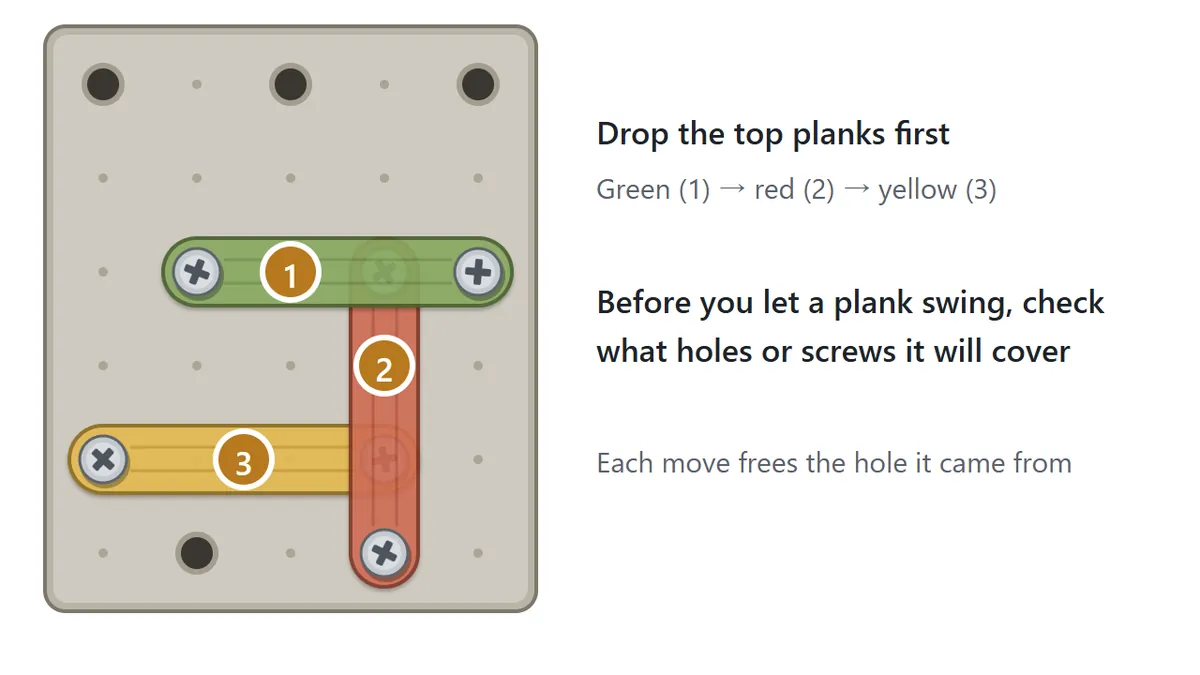
Before you touch anything, look at which plank lies over which screw. In the picture, the green plank covers one of the red plank’s screws, and the red plank covers one of the yellow plank’s screws, so the order is green, red, yellow. Because the planks are see-through, you can trace screws under the top layers. The message you get from tapping a stuck screw also tells you which plank is blocking it.
2. Count your open holes
Every screw you take out must go into another hole straight away. When there is only one open hole, each move turns the hole you just emptied into the next open hole. Shuffling screws along like this is the core technique of the game. Each time a plank falls, the holes that were hidden under it open up and give you more room.
3. Picture where a plank will swing
A plank on its last screw swings straight down below that screw. If it lands over an open hole or over another plank’s screw, you suddenly have fewer moves. Which of a plank’s two screws you pull first decides where it ends up, so imagine the swing before you commit.
4. Keep plank holes as a last resort
Putting a screw into a hole that lines up with a plank pins that plank again, and you will have to free it later. Use a truly open hole when you have one. On harder levels, though, pinning a plank for a moment can be the only way to park a screw — that is part of the challenge.
5. Loose screws are spares
When a plank falls, any screw that held only that plank stays in the board holding nothing. You can still move it anywhere. If a loose screw is sitting in a hole you need, move it out of the way.
6. Use Undo and Hint when you are stuck
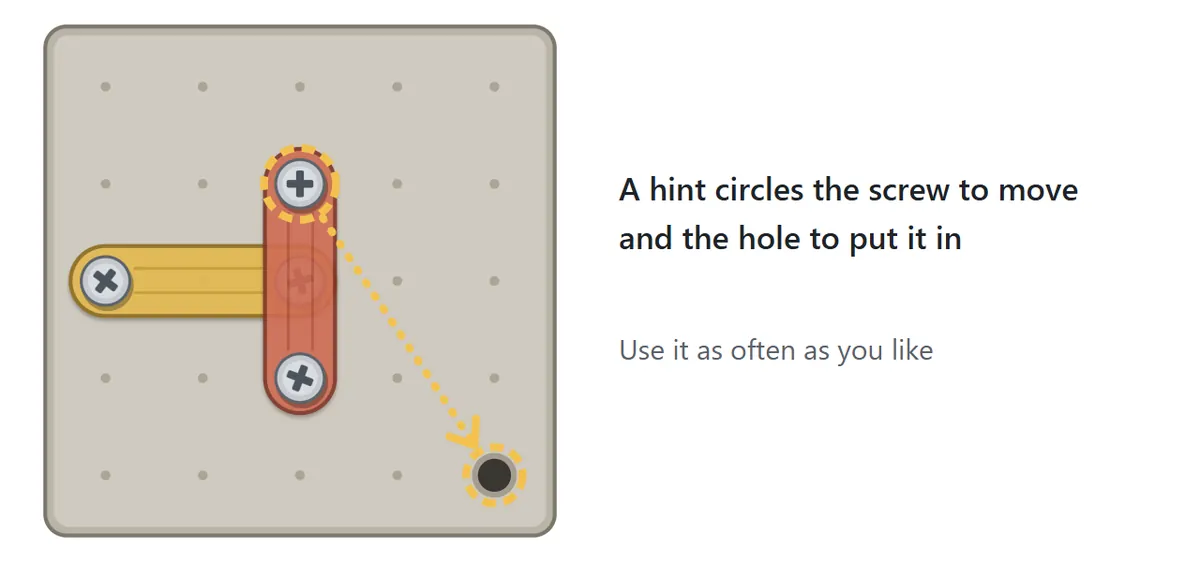
Undo (Z key) works as many times as you like. Hint (H key) searches for a solution and circles the next screw and the hole it should go into. Near the end of a level it also tells you how many moves are left at best. If your position can no longer be solved, the hint says so — step back one move at a time and look for where things went wrong.
Pivots, levers and pendulums
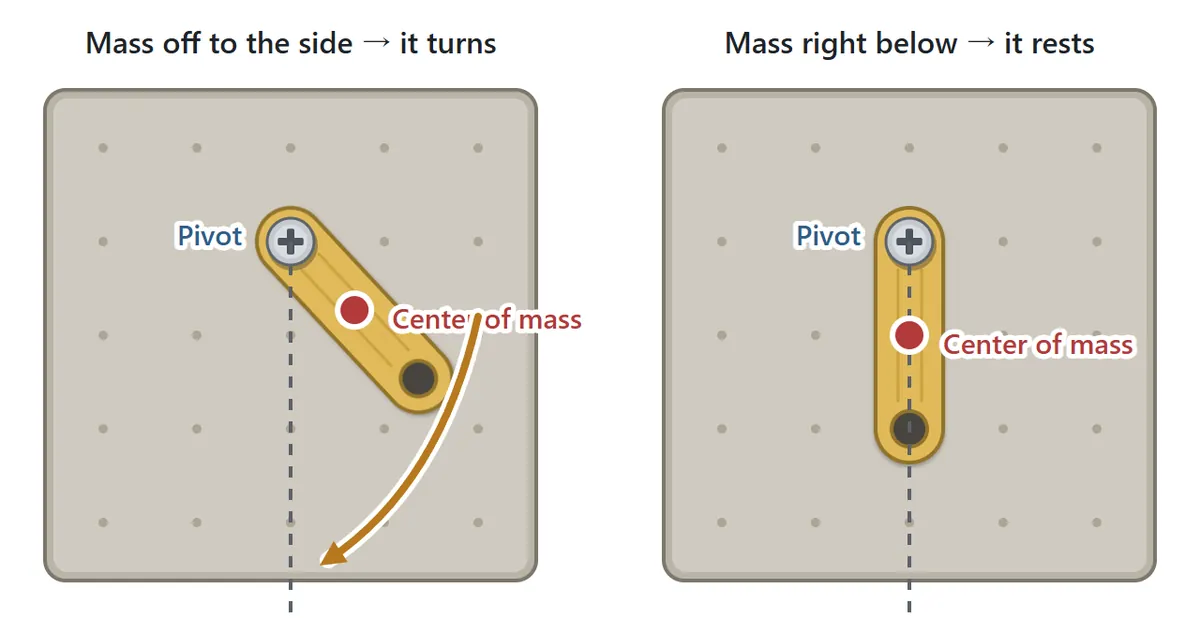
The planks in this game behave the way a science class describes levers and pendulums. When a plank hangs from a single screw, that screw is the pivot. The plank’s weight acts as if it were all gathered at one point, the center of mass. The farther that point sits to the side of the pivot, the stronger the turning effect, or torque. Once the center of mass is directly below the pivot, the torque is zero and the plank comes to rest.
That is why a long plank pinned near one end swings a long way, while a plank pinned at its middle hardly turns at all: the weight on each side balances. A second screw stops a plank from turning, which is why two screws hold it still. You can see the same idea in a balance toy, a hanging mobile, a pendulum clock or a door hinge. Try predicting which way a plank will swing and where it will stop before you pull a screw — it is a good way to get a feel for pivots and balance.
Screws & Planks FAQ
Can every level be solved?
Yes. All 45 levels and every daily puzzle have been checked by computer. If you put a screw in the wrong hole you can still get stuck partway through, so use Undo or Restart when that happens.
Do hints affect my score?
No. A hint only shows the next move. The result screen tells you how many hints you used, but your move count and personal best are unchanged.
What if a swinging plank lines up with a hole?
If one of its holes ends up exactly over a board hole, you can put a screw there and pin the plank in its new position. With two screws it stops moving again.
Is my progress saved?
Yes. Your current puzzle and moves are saved in your browser automatically, so you can come back and press Continue. Solved puzzles and personal bests are saved too. A daily puzzle in progress can be continued on the same day.
Is there sound?
Sound is off at first. Press “Sound: off” to hear effects when a screw goes in, when a plank falls and when you solve a level.
Do I need to sign up?
No. The game runs in your browser on computers, tablets and phones, with nothing to install and no account.
Where the screw-and-plank puzzle comes from
Puzzles about taking planks apart by removing screws in the right order became popular as phone games in the 2020s. Part of the appeal is the feel of familiar materials — wood and metal — and the satisfying click of a screw going home. The idea sits close to older mechanical puzzles such as wire disentanglement puzzles and interlocking wooden puzzles, where the whole challenge is working out where to start. Every level in this version was made for this site and checked by computer search.
More puzzles about order
If you like planning moves ahead, try the Car Escape Puzzle, where you slide cars to free the red one, or the Color Sort Puzzle, where making good use of empty space is the key.