 Yorimichi Games

How to Play the Car Escape Puzzle
The car escape puzzle is a one-player logic game set in a crowded parking lot. The lot is a 6×6 grid packed with cars and trucks, and your job is to get the red car out through the exit on the right. The catch is that every vehicle can only drive forward or backward in the direction it is facing. To clear the red car’s path you have to move the vehicles in its way, and to move those you often have to move other vehicles first. This kind of game is also known as a parking puzzle or car parking puzzle, and it belongs to the big family of sliding block puzzles. The only rule is “slide the cars forward and back”, so you can start playing right away, yet the harder levels will keep you thinking for a long time.
The board
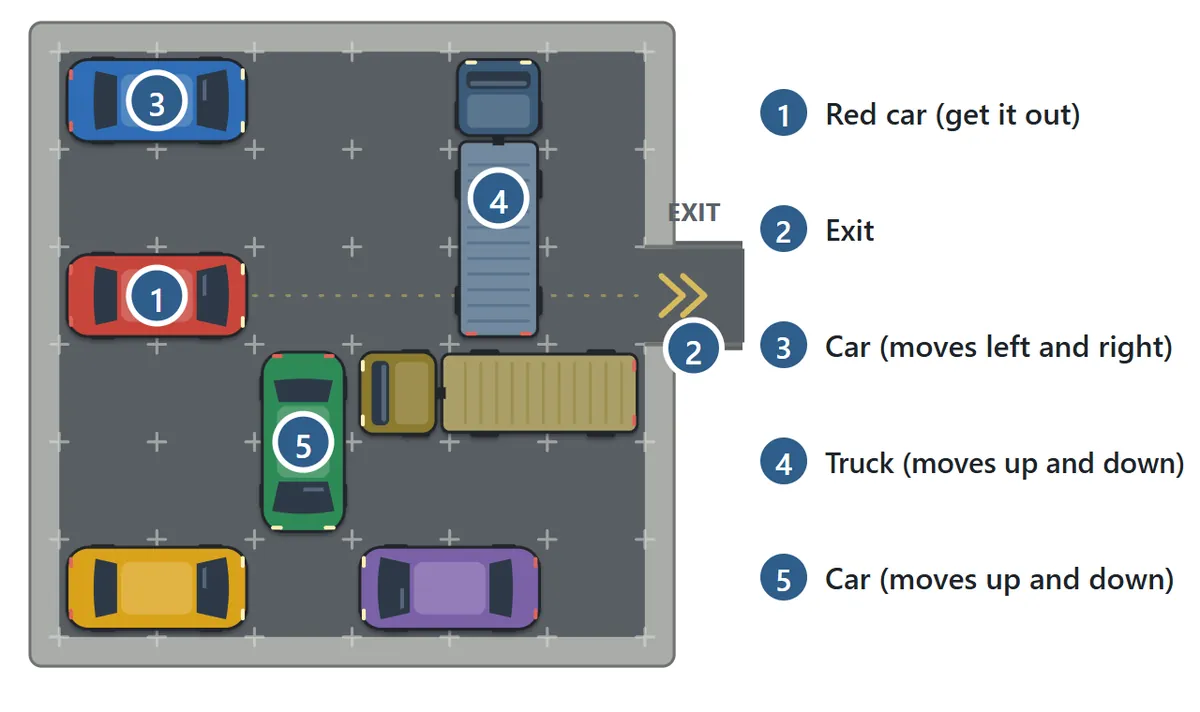
The parking lot is surrounded by walls, with a single opening in the right wall on the third row: that is the exit. The red car always sits in that row, facing the exit, and it has a white arrow badge on its roof so you can spot it even without color. Every other vehicle is either a car, two squares long, or a truck, three squares long. Vehicles parked sideways move left and right; vehicles parked up and down move up and down. A faint dotted line marks the red car’s lane.
Moving the cars
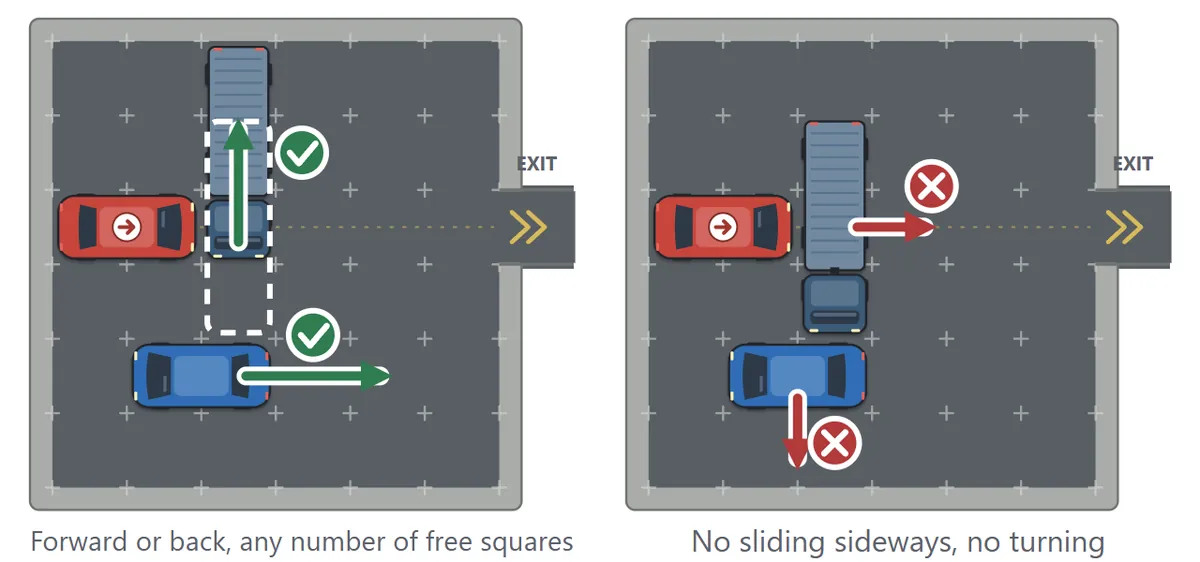
Grab a vehicle with your mouse or finger and drag it forward or back. If the squares ahead or behind are empty, you can slide it as far as you like in one go. You can also just press a vehicle. If it can only move one way, it moves one square in that direction. If it can move both ways, it is selected with a blue outline, and you then press the empty square you want it to move to.
With a keyboard, press the space bar to step through the vehicles (or Shift plus an arrow key to pick the vehicle in that direction), then use the arrow keys to move the selected vehicle one square at a time.
Parking puzzle rules: how moves are counted
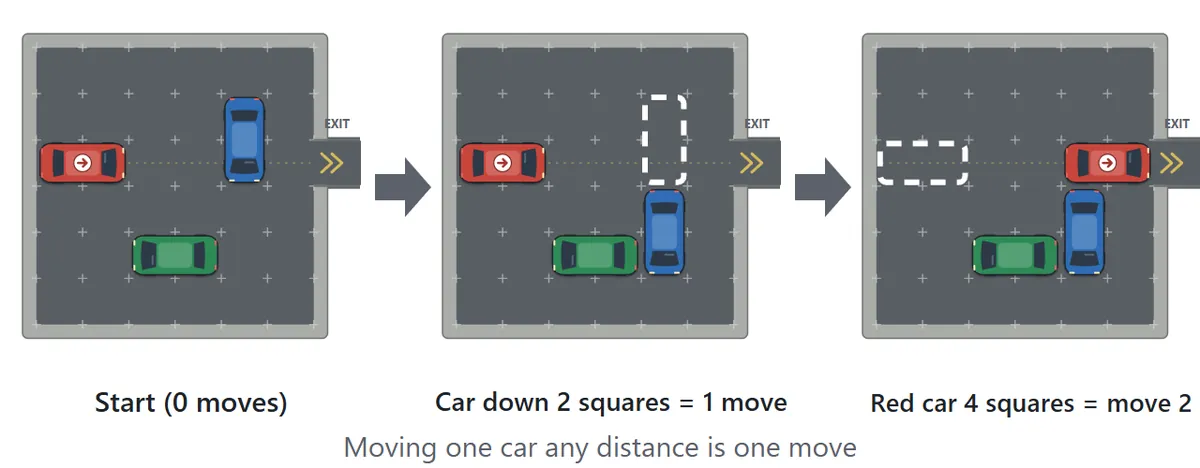
In this game, moving one vehicle is one move, however far it slides. Moving the same vehicle again straight away still counts as the same move; the count goes up only when you switch to a different vehicle. If you slide a vehicle back to where it started, that move is taken back and the counter goes down by one. The “Fewest” number shown for every puzzle uses this same way of counting, which is the usual one for this kind of puzzle.
When a car can’t move
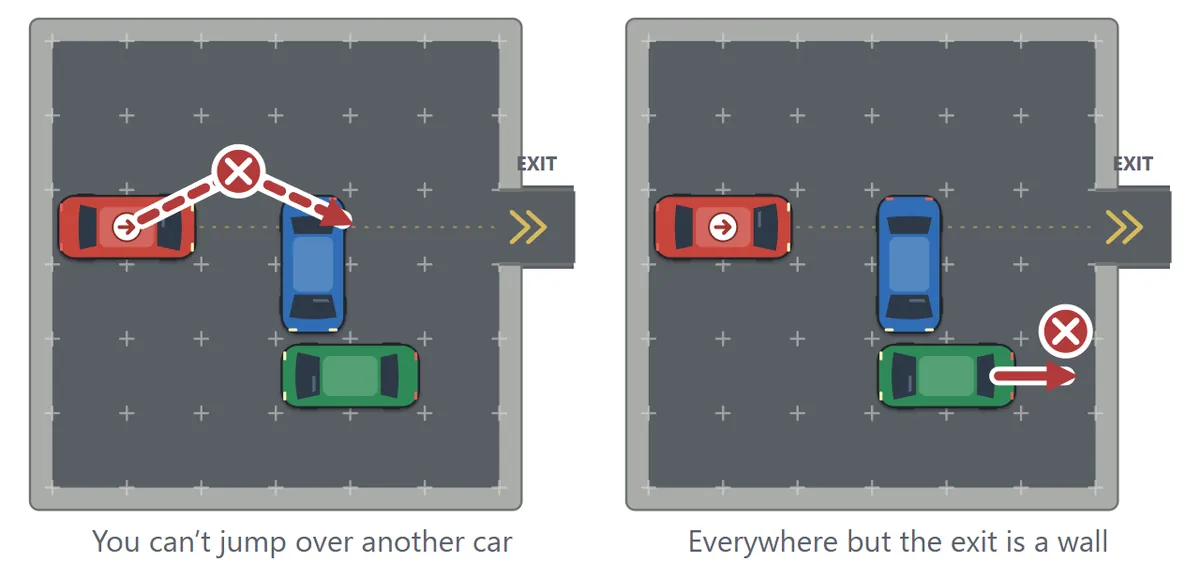
A vehicle can only move onto squares that are completely empty. It can’t jump over another vehicle, and it can’t turn around. Apart from the exit, the whole edge of the lot is a wall. If you try a move that isn’t possible, a short message above the board explains why, such as “The red car can’t move right – the truck is in the way”.
Getting the red car out
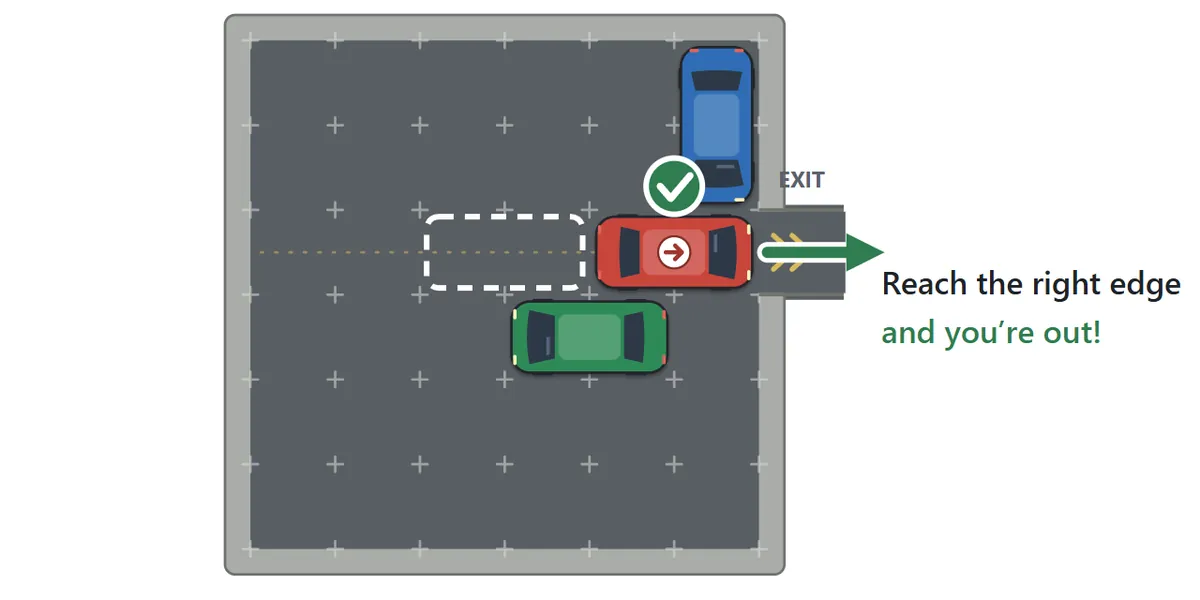
As soon as the way is clear, slide the red car all the way to the right. When it reaches the exit, it drives out of the lot and the puzzle is solved. You’ll see how many moves you used and the fewest moves possible for that puzzle, with a special note if you matched it. Your best score for every puzzle is saved, and puzzles you have solved in the fewest moves get a star in the puzzle list.
Levels and the daily puzzle
| Level | Fewest moves | What to expect |
|---|---|---|
| Easy (25) | 2–10 | Move one or two vehicles out of the way. Learn the basics |
| Normal (25) | 11–19 | Clearing a blocker means moving something else first |
| Hard (25) | 20–29 | The order of the trucks matters, and detours are common |
| Very hard (25) | 30–48 | Long chains of vehicles that must shuffle in turn |
| Daily puzzle | 10–24 | One a day, easier early in the week |
Inside each level, puzzles are sorted from the fewest moves to the most, but you can play them in any order. If you are new to parking puzzles, working through Easy from number 1 is the best way to learn the typical patterns. All 100 puzzles were made for this game. Every one of them was checked by a computer search over all possible positions, so each puzzle is guaranteed to have a solution, and the “Fewest” number really is the shortest one.
The daily puzzle changes every day. Everyone who plays on the same date gets the same puzzle, so you can compare move counts with friends or family. Your first attempt is saved as today’s record, and solving the daily puzzle on consecutive days builds a streak.
Car parking puzzle strategy: tips to get the red car out
1. Trace the chain of blockers
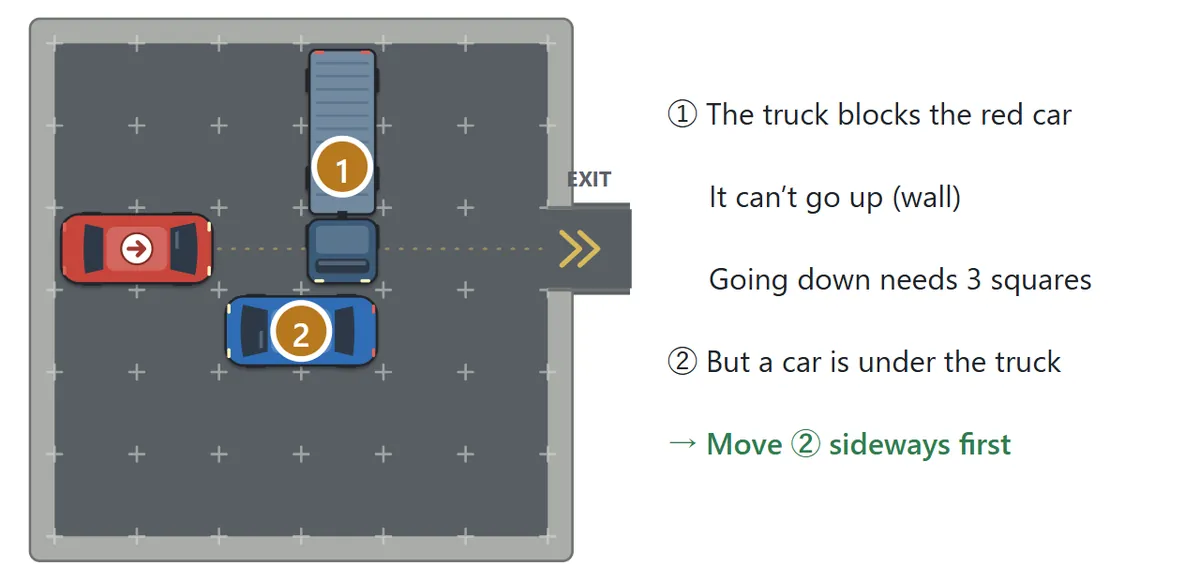
Start by looking at the vehicles between the red car and the exit. For each one, ask whether it needs to go up or down to open the lane, and then ask what is stopping it from doing that. In the picture above, truck 1 can’t go up because of the wall, so it has to go down three squares, but car 2 is sitting underneath it. So the first move is car 2, not the truck. Following this chain of “who is blocking whom” is the single most useful habit for solving these puzzles.
2. A truck needs three free squares
When a vertical truck blocks the red car’s row, it needs three free squares above or below it to get out of the way. In a column of only six squares, that is a lot of space. Decide early whether the truck will escape upward or downward, and then work on clearing that side.
3. Know which vehicles can move right now
At any moment, some vehicles can move and others are boxed in. When you feel stuck, look only at the vehicles that can move and try each one in your head. Shifting a car by a single square often opens a path for a completely different vehicle.
4. Don’t be afraid of detours
Harder puzzles often need moves that look like steps backward: pulling the red car to the left, or putting a car back where it just came from. These moves prepare the way for another vehicle. Instead of asking “does this move help the red car?”, ask “what will be able to move after this?”
5. Use Undo and Hint when you get stuck
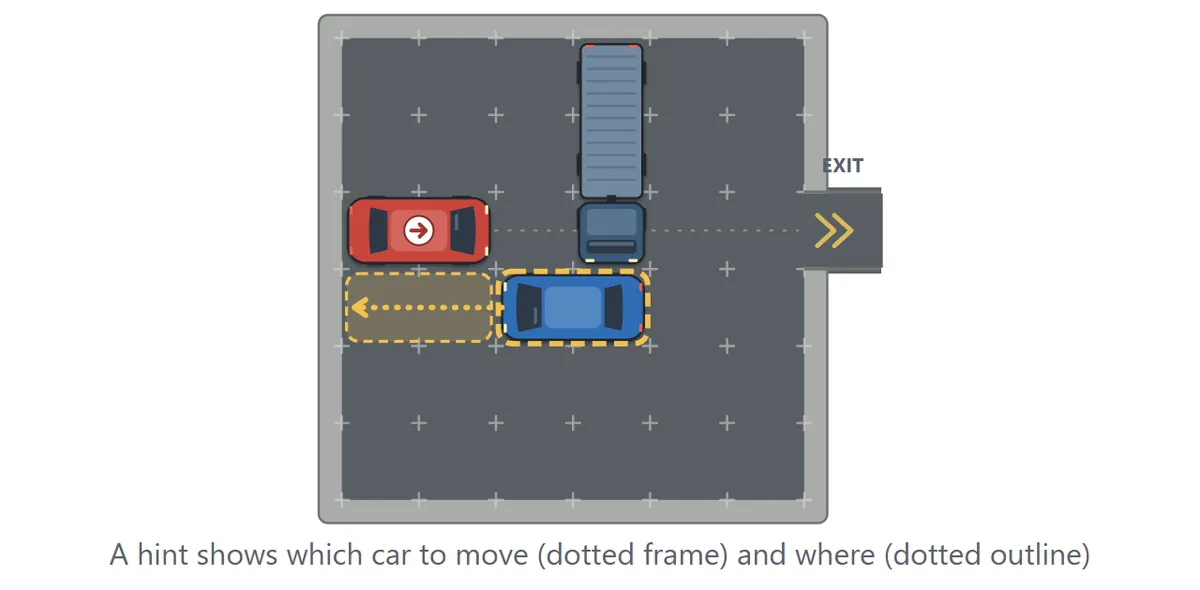
You can undo as many moves as you like with the Undo button or the Z key. The Hint button (or H key) works out the shortest solution from your current position and shows its next move: a dotted frame around the vehicle, an arrow, and a dotted outline where it should go, together with how many moves are left. Try to work out why the hint picked that vehicle; it will help you with the next puzzle.
6. Once it’s solved, go for the fewest moves
Solving a puzzle once is only half the fun. Your first solution often includes a few wasted moves, so try again and aim for the number shown as “Fewest”. It helps to slide each vehicle straight to where it needs to be rather than nudging it a square at a time and changing your mind.
Car escape puzzle FAQ
Can every puzzle be solved?
Yes. All 100 puzzles and every daily puzzle have been checked by computer. You also can’t get stuck for good: any move can be reversed, so you can always get back to the starting position. If you want a clean slate, press Restart.
Do hints affect my score?
No. A hint only shows you the next move. Your move count and personal best work the same way, and the result screen simply tells you how many hints you used.
How hard can a 6×6 parking puzzle get?
The longest puzzle in this game needs 48 moves. Researchers who searched every possible arrangement of a 6×6 board with only cars and trucks found that the hardest one needs 51 moves, so the very hard puzzles here are close to the limit.
What happens if I stop in the middle?
Your current puzzle and moves are saved automatically. Come back on the same device and browser and press “Continue” to pick up where you left off. Solved puzzles and personal bests are stored in your browser as well. A daily puzzle in progress can only be continued on the same day.
Is there sound?
Sound is off at first. Press “Sound: off” to hear the cars slide and a chime when the red car gets out.
History of sliding block puzzles
Puzzles in which you slide blocks of different sizes to bring one special block to an exit have been around since the early twentieth century, in wooden boxes and printed puzzle books all over the world. The version with cars that can only move along one direction is usually credited to the Japanese puzzle designer Nobuyuki (Nob) Yoshigahara, and it has since spread worldwide as board-and-car toys, puzzle books and phone apps. Because the rules are so simple and the board is so small, it is often used to practice step-by-step logical thinking. It also has a place in computer science: on larger boards, deciding whether such a puzzle can be solved at all is known to be PSPACE-complete, one of the hardest kinds of problem to compute.
More sliding puzzles
If you enjoy this game, try the 15 Puzzle, the classic sliding tile puzzle where you put the numbers back in order using a single empty square.