 Yorimichi Games

How to Play the 15 Puzzle
The 15 puzzle is the classic sliding puzzle: fifteen numbered tiles sit in a 4×4 frame with one square left empty. You slide tiles into the empty square, one after another, until the mixed-up tiles are back in order from 1 to 15. You can’t lift a tile out or jump over another one – sliding is the only move. The rules take ten seconds to learn, yet the puzzle has kept people thinking for 150 years. It works as a quick brain teaser, a relaxing number puzzle, or a serious challenge if you start chasing the fewest moves.
The start and the goal
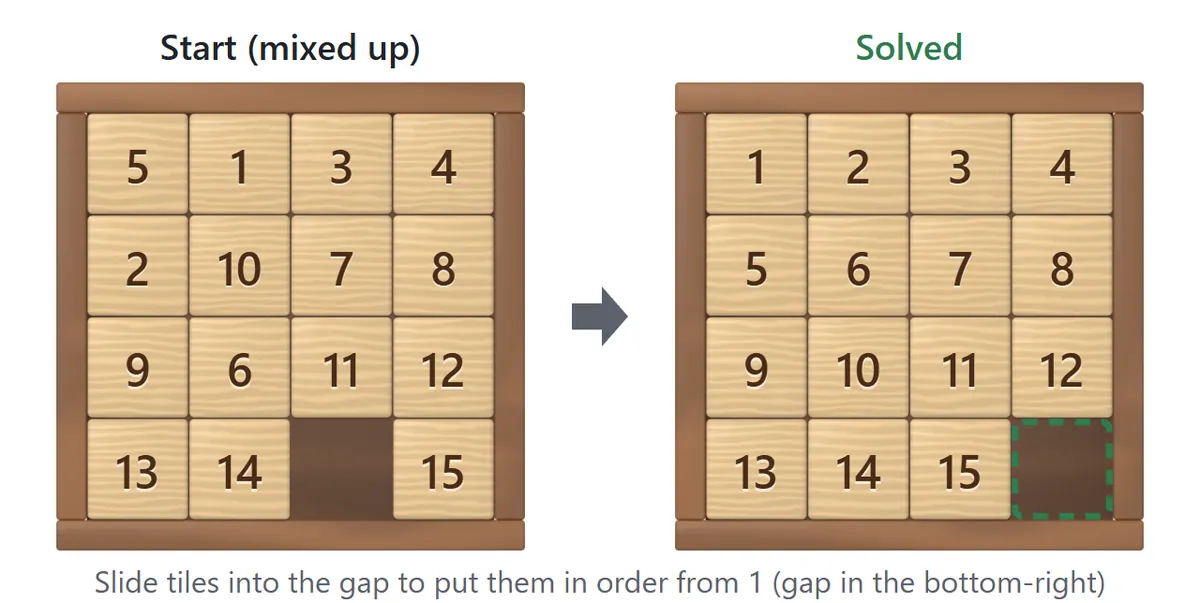
In the solved position the top row reads 1, 2, 3, 4 from left to right, the second row 5, 6, 7, 8, the third row 9, 10, 11, 12, and the bottom row 13, 14, 15, with the empty square in the bottom-right corner. Every game starts from a shuffled version of this layout.
How to move the tiles
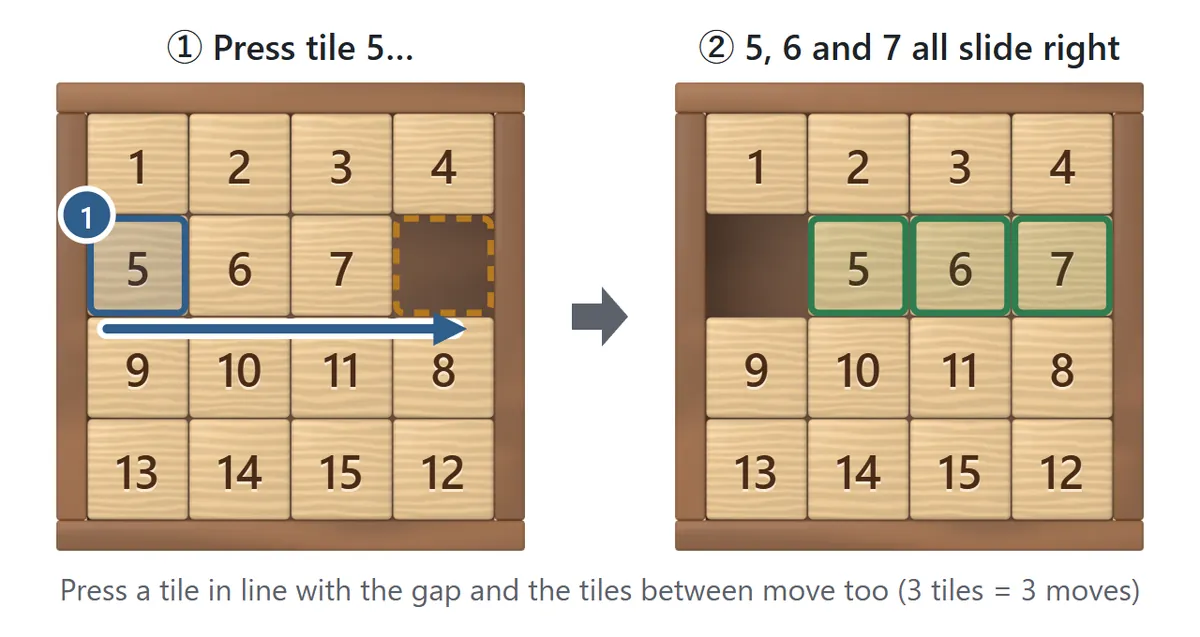
Any tile directly next to the empty square – above, below, left or right – can move. Press it and it slides into the gap. You can also press a tile further away, as long as it is in the same row or column as the gap: every tile between it and the gap slides along one square. In this game, each tile that moves counts as one move, so sliding three tiles at once counts as three moves.
You can also grab a tile with your finger or the mouse and drag it toward the gap. If you let go before it is halfway, it snaps back to where it was.
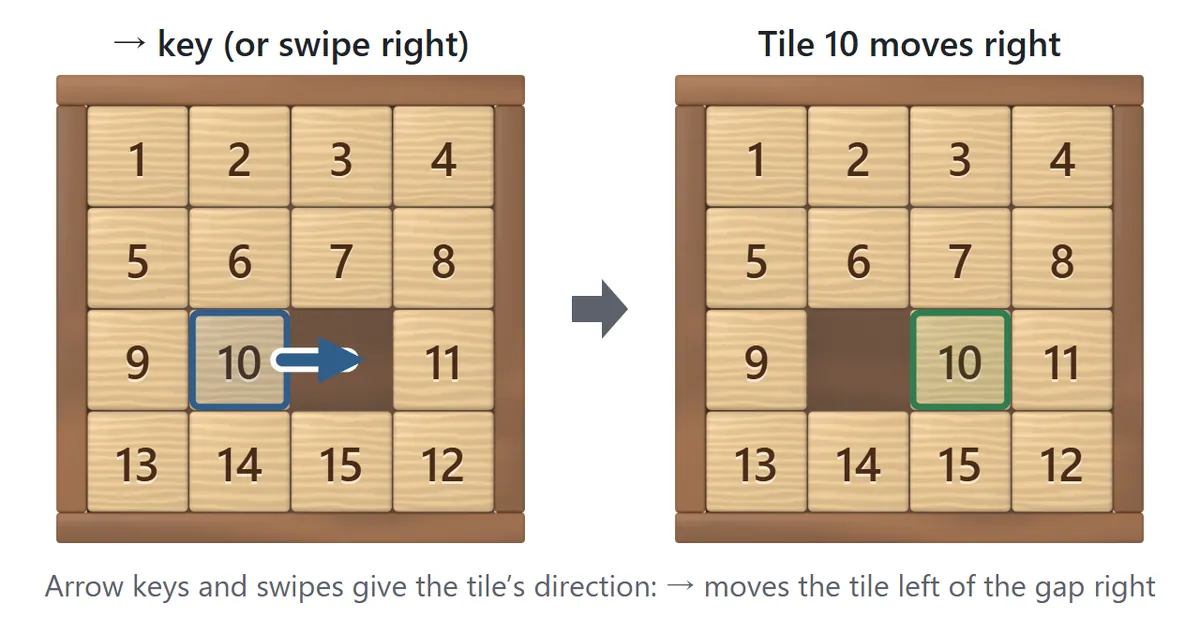
The arrow keys and swipes on the board work too. Both describe the direction the tile travels: right moves the tile on the left of the gap to the right, and up moves the tile below the gap upward, one square at a time.
The bar above the board shows your move count and time. The clock starts only when you make your first move, so feel free to study the board before you begin. “Undo” takes back your last move.
Sliding Puzzle Sizes, Puzzle Types and Picture Mode
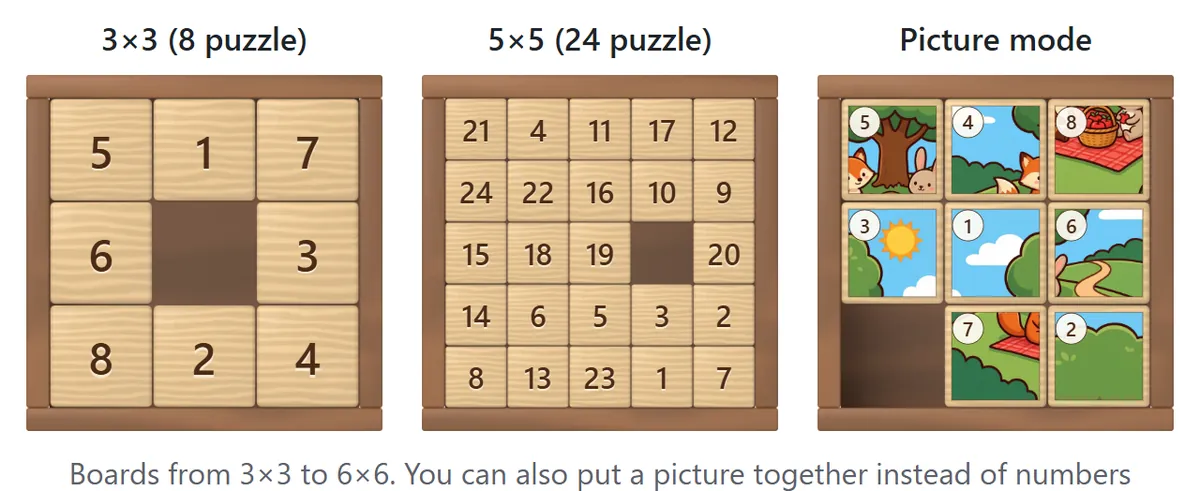
| Board | Tiles | What to expect |
|---|---|---|
| 3×3 (8 puzzle) | 8 | A good start. Any position can be solved in 31 moves or fewer |
| 4×4 (15 puzzle) | 15 | The classic. Any position can be solved in 80 moves or fewer |
| 5×5 (24 puzzle) | 24 | For when you’ve got the method down |
| 6×6 (35 puzzle) | 35 | A long, patient challenge |
There are three kinds of puzzle. “Random” picks an arrangement at random from all the ones that can be solved. “Quick mix” starts from the solved position and moves only a few tiles, so it can be finished in a handful of moves – ideal for your very first try. The “Daily puzzle” changes every day, and everyone who plays on the same day gets the same arrangement, so you can compare moves and times with friends and family.
Choose “Picture” and each tile shows part of an illustration instead of a number; solve the puzzle and the whole picture appears. You can keep small numbers in the tile corners as a guide while you get used to it, and the “Preview” button shows what the finished picture looks like.
Are Some 15 Puzzles Unsolvable?

Yes. Some arrangements can never be solved, however you slide the tiles. The most famous is the solved board with just 14 and 15 swapped. Sliding a tile into the gap can never swap exactly two tiles and leave everything else in place – each move changes the order of the tiles in a way that keeps a hidden “parity” the same, and a single swap would break it. In fact, if you put the tiles into the frame completely at random, exactly half of all arrangements are unsolvable.
How to Solve the 15 Puzzle: Step-by-Step Strategy
Step 1: Solve the top row first
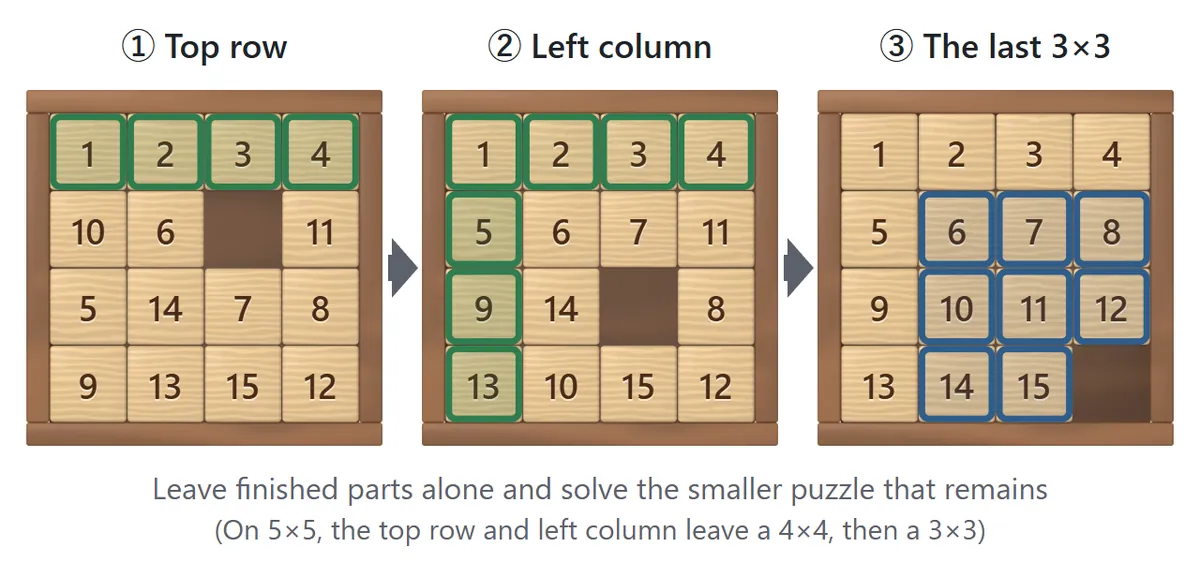
The most reliable method is to finish the top row (1 to 4) first, then the left column (5, 9 and 13), and never touch those tiles again. What remains is a 3×3 corner, which is just the 8 puzzle. The same idea works for 5×5 and 6×6: solve the top row and the left column, and the puzzle shrinks to the next size down, again and again, until only a 3×3 is left.
Step 2: Move the gap, not the tile
To bring one tile to its target square, think about where the gap needs to be rather than about the tile itself. If you want a tile to move right, first walk the gap around to the square on its right, then slide the tile across. Repeat, and the tile creeps one square at a time toward its target. When you walk the gap around, take the long way below rather than cutting through the tiles you have already placed.
Step 3: Insert the last two tiles of a row together
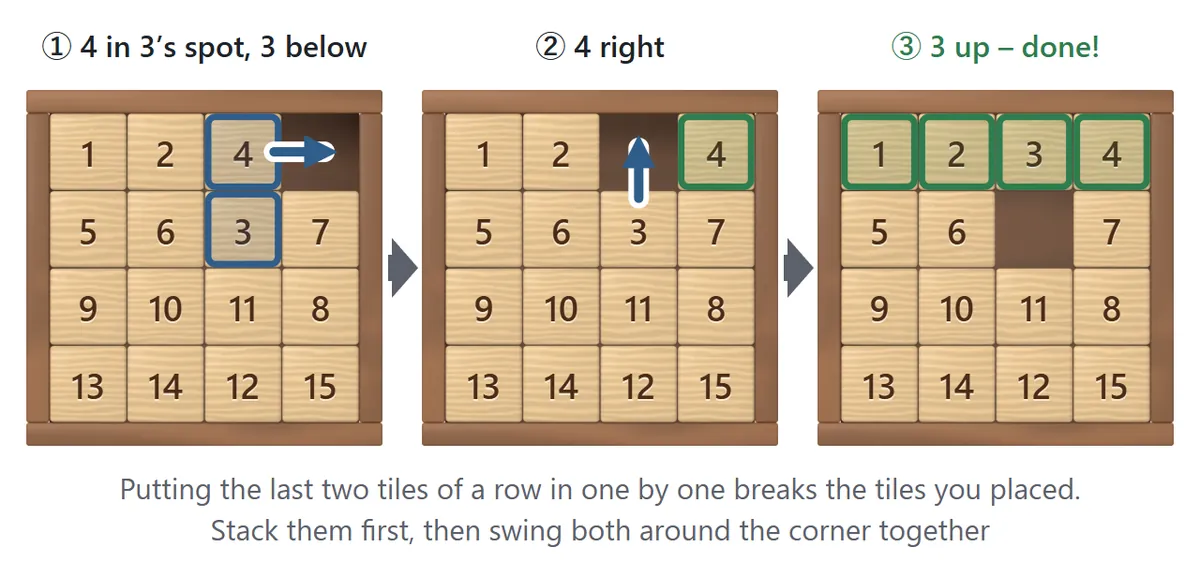
The last two tiles of a row – 3 and 4 in the top row – are where most beginners get stuck. Put 3 in place first and there is no way to fit 4 into the corner without knocking 3 out again. The trick is to set them up as a pair: place 4 where 3 belongs and 3 directly underneath it, with the top-right square empty. Then slide 4 right and 3 up, and both drop into place as if they had swung around the corner. The last two tiles of the left column (9 and 13) go in the same way, turned on their side.
Step 4: Rotate the last 3×3 into place
Once only a 3×3 area is left, it helps to stop moving tiles one by one and start thinking in circles. On 4×4, put 6 in place, then 7 and 8 with the pair trick from Step 3. In the final two rows of three, arrange 10, 11, 12, 14 and 15 so that they are in the right order around a loop, then run the gap around that loop clockwise or counterclockwise until everything clicks into position.
15 Puzzle Tips for Fewer Moves
Plan where the gap ends up
Once you can solve the puzzle reliably, try to do it in fewer moves. After you deliver a tile, notice where the gap has ended up, and try to finish each step with the gap close to the next tile you need. Most wasted moves come from walking the gap across the board and back again.
Slide rows and columns in one go
Pressing a tile that is several squares away from the gap moves the whole line at once. It doesn’t save moves – each tile still counts – but it saves time, which matters if you are racing the clock.
Chase the shortest solution on 3×3
On the 3×3 board, the game works out the shortest possible solution for every puzzle and tells you when you finish. Matching it exactly is a great exercise in looking ahead.
Use hints when you are stuck
Press “Hint” and the next tile to move is framed with a dashed line, along with the direction to move it. Press “Hint” again and the game makes that move for you. On 3×3 the hint follows the shortest solution; on larger boards it follows a plan that gets you to the finish quickly. Games in which you use a hint or undo don’t count toward your personal best.
FAQ
What is the fewest number of moves?
It depends on the arrangement. Every position of the 3×3 8 puzzle can be solved in 31 moves or fewer, and every position of the 4×4 15 puzzle in 80 moves or fewer. On 3×3, this game tells you the shortest solution for your puzzle when you finish.
How are moves counted when several tiles slide at once?
Each tile that moves counts as one move, so sliding three tiles together is three moves. That is the same as moving them one at a time, so the way you slide never changes your move count.
What if I get stuck?
Use a hint to see your next move.
Is the daily puzzle the same for everyone?
Yes. On the same day, each board size has one arrangement that everyone gets. The date comes from your device. Your first attempt is saved as today’s record, and solving the daily puzzle on consecutive days builds a streak.
Can I stop and continue later?
If you come back on the same device and browser, “Continue” in the settings resumes your board, moves and time where you left off. Personal bests for each board size and puzzle type are also saved on this device. Sound is off at first; press “Sound: off” to hear the tiles slide and a chime when you solve the puzzle.
History of the 15 Puzzle
The 15 puzzle was invented in the United States in the 1870s, and is usually credited to Noyes Chapman, a postmaster in upstate New York. Around 1880 it became a nationwide craze, sold in small wooden boxes and played everywhere from offices to trains. The famous puzzle maker Sam Loyd later claimed he had invented it and offered a large prize to anyone who could solve the version with 14 and 15 swapped, but historians now believe he had nothing to do with its invention or its success. In any case, the prize was safe: mathematicians had already proved in 1879 that the swapped position can never be solved. The question of why half of all arrangements are impossible still makes the puzzle a favorite example in mathematics and computer science classes, and sliding puzzles of every size and shape are still made today.