 Yorimichi Games
How to play Color Sort Puzzle
Color Sort Puzzle is a one-player logic game played with a row of test tubes. At the start, every tube holds a jumble of colors. Your job is to move colors from tube to tube until each tube contains just one color. Each tube holds up to four units, and every color appears exactly four times, so a finished tube is always a full stack of a single color. You can only ever move the color on top of a tube, and you can only put it into an empty tube or onto the same color. That is the whole rule set. It takes a minute to learn, but as the number of colors grows, the order of your moves starts to matter a lot – one careless pour can leave you with nowhere to go.
Reading the board
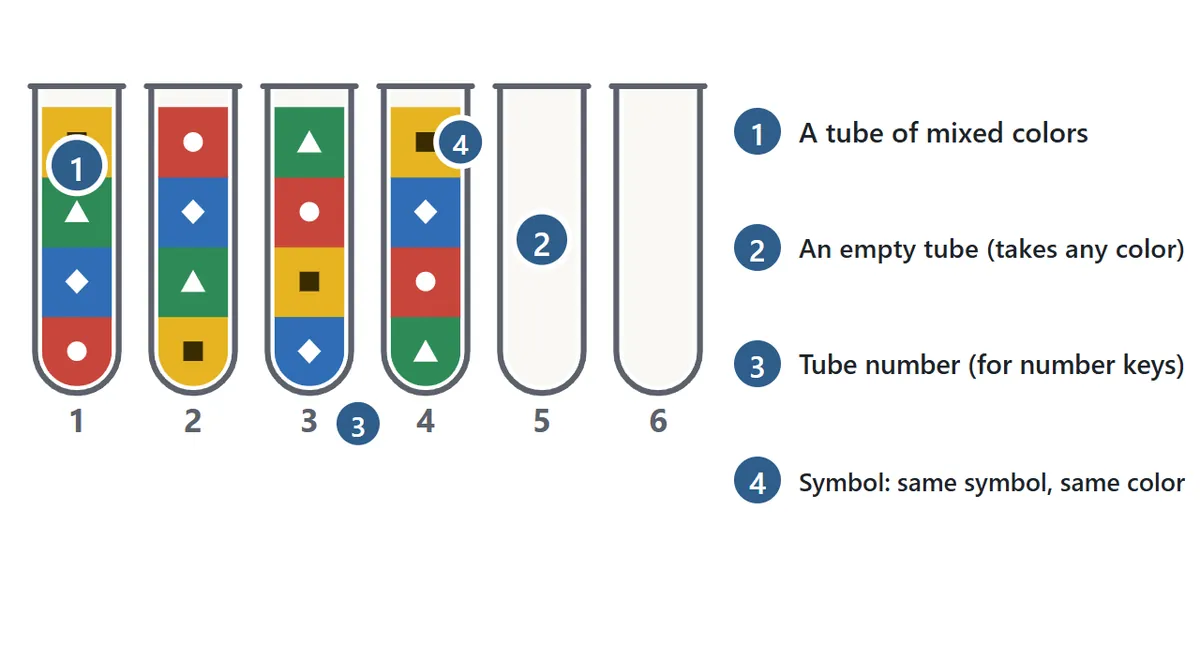
The tubes are laid out in one or two rows and numbered from 1. Every color also carries its own symbol – red has a circle, blue a diamond, green a triangle, and so on – so you can always tell colors apart even if some of them look alike to you. Puzzles use anywhere from 3 to 12 colors, and every puzzle starts with two empty tubes.
Making a move
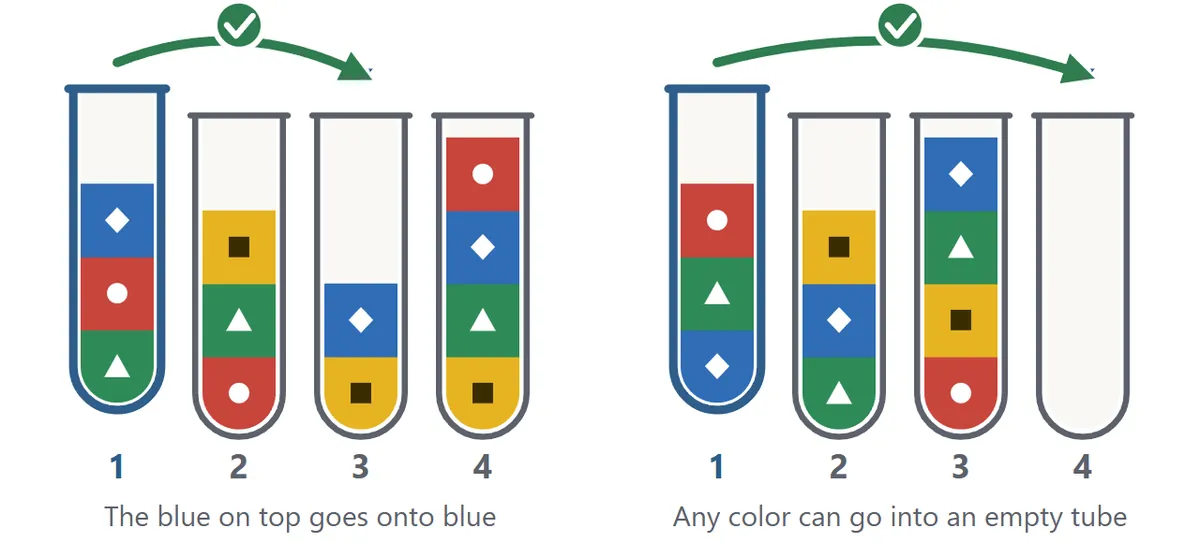
Tap the tube you want to pour from. It lifts up slightly, and every tube that can accept the color shows a small ▼ mark. Then tap the tube you want to pour into. You can also drag a tube straight onto another one. To cancel a selection, tap the same tube again. On a keyboard, press a number key to pick a tube and another number key to choose where it goes (0 means tube 10); the arrow keys and Space reach every tube, including tube 11 and above.
When a move is not allowed
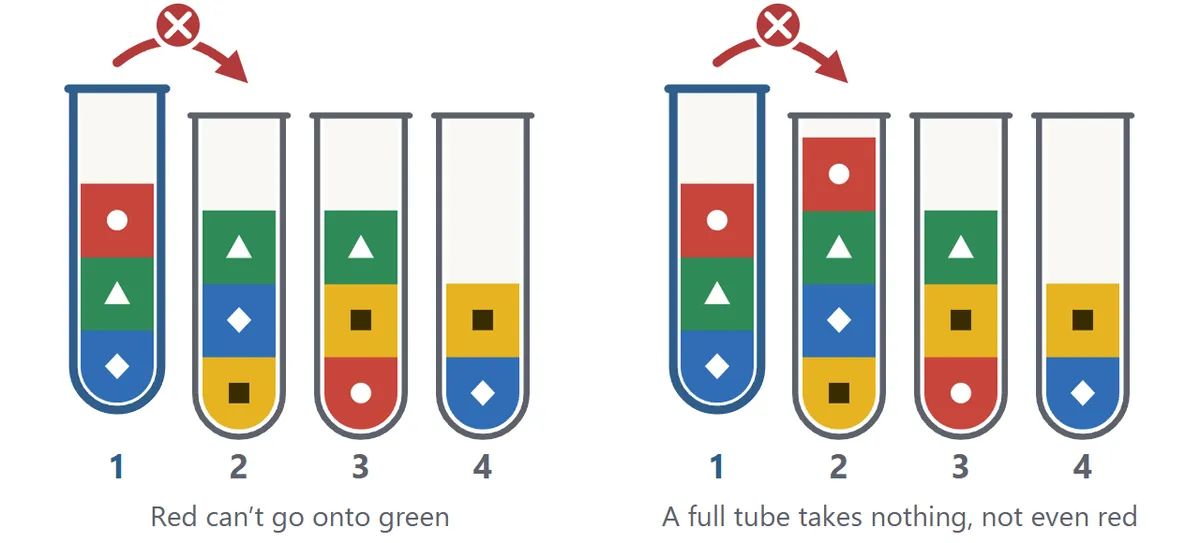
A color can’t go onto a different color, and nothing fits into a tube that already holds four units. If you try, the game tells you why – for example “The top of tube 3 is green (triangle), so red (circle) can’t go there” – and selects the tube you tapped instead, so you can keep going. Colors lower down in a tube stay locked until everything above them has been moved out.
Color sort rules: pour mode and ball mode
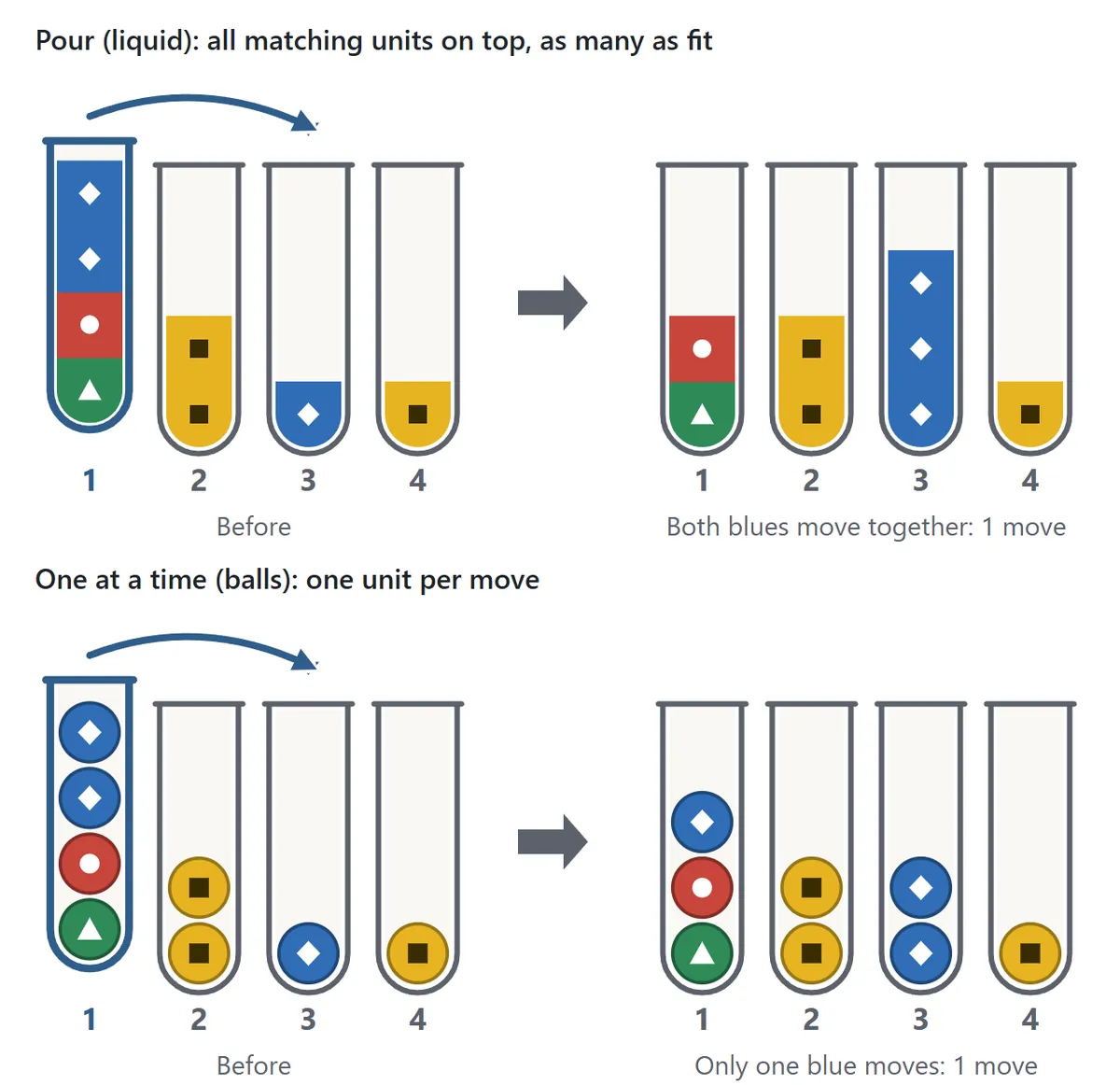
There are two common ways to play this kind of sorting puzzle, and you can pick either one under “Style”:
| Style | What moves in one turn |
|---|---|
| Pour (liquid) | All the matching units on top, as many as fit; the rest stay behind |
| One at a time (balls) | Exactly one unit |
In pour mode the colors look like layers of liquid. If the top of a tube has two or three units of the same color in a row, they all move together – as long as the target tube has room. If there isn’t enough room, the tube you pour into fills up and the rest stays where it was. In ball mode the colors are drawn as balls and each move shifts a single ball. Either way, one transfer counts as one move. The puzzles are the same in both styles, but the fewest possible moves are different, so your records and stars are kept separately for each style.
Winning and earning stars
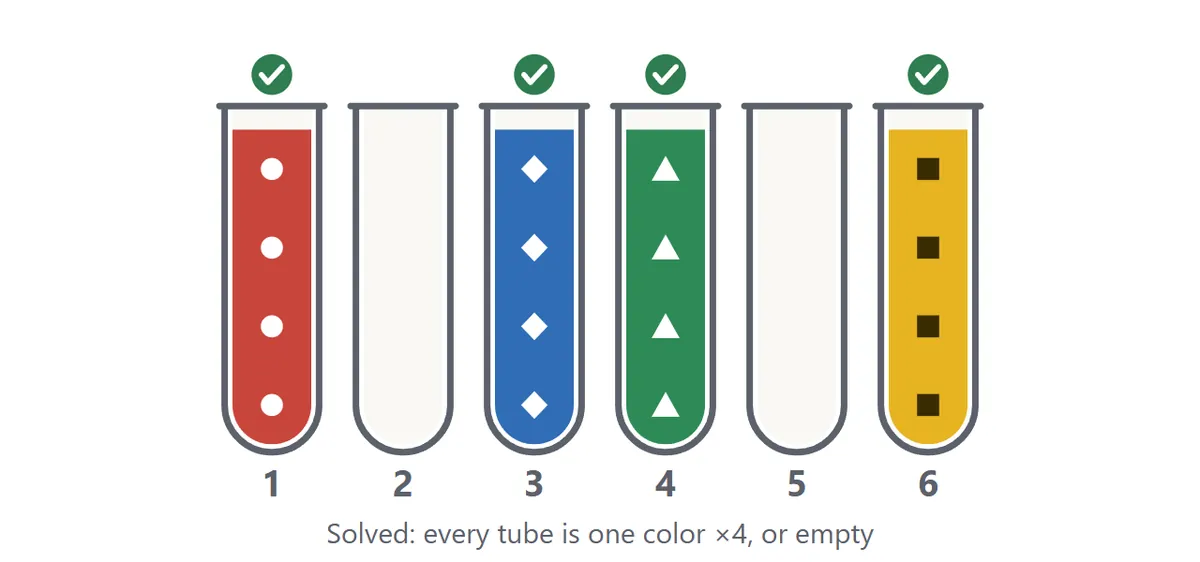
As soon as a tube holds four units of one color, a green check mark appears above it. Sort every color and you’ve solved the puzzle. Your result is rated with up to three stars: three stars for matching the fewest possible moves, two stars for staying within roughly 30 percent of that number, and one star for any other solve. Using a hint caps the rating at two stars, and adding an extra tube caps it at one. The fewest possible number of moves is always shown next to your move counter, so you know what you’re aiming for.
Levels and the daily puzzle
| Level | Colors and tubes | Fewest moves (pour) |
|---|---|---|
| Easy (40) | 3–6 colors, 2 empty | 6–21 |
| Normal (40) | 7–9 colors, 2 empty | 18–30 |
| Hard (40) | 10–12 colors, 2 empty | 29–40 |
| Daily puzzle | 5–9 colors, 2 empty | One per day |
Within each level, puzzles go from fewer colors to more, and from easier to harder. You can start anywhere, but if you are new to sorting puzzles, working through Easy from #1 is the quickest way to get a feel for how empty tubes should be used. Every puzzle has been checked by a computer search: each one is solvable in both styles, and the fewest-move count shown is exact.
The daily puzzle changes every day and is the same for everyone who plays on that date, so it’s easy to compare scores with friends or family. Mondays are lighter, and the puzzles grow toward the weekend. Solve it on consecutive days to build a streak.
Color sort puzzle tips and strategy
1. Treat empty tubes as your most valuable resource
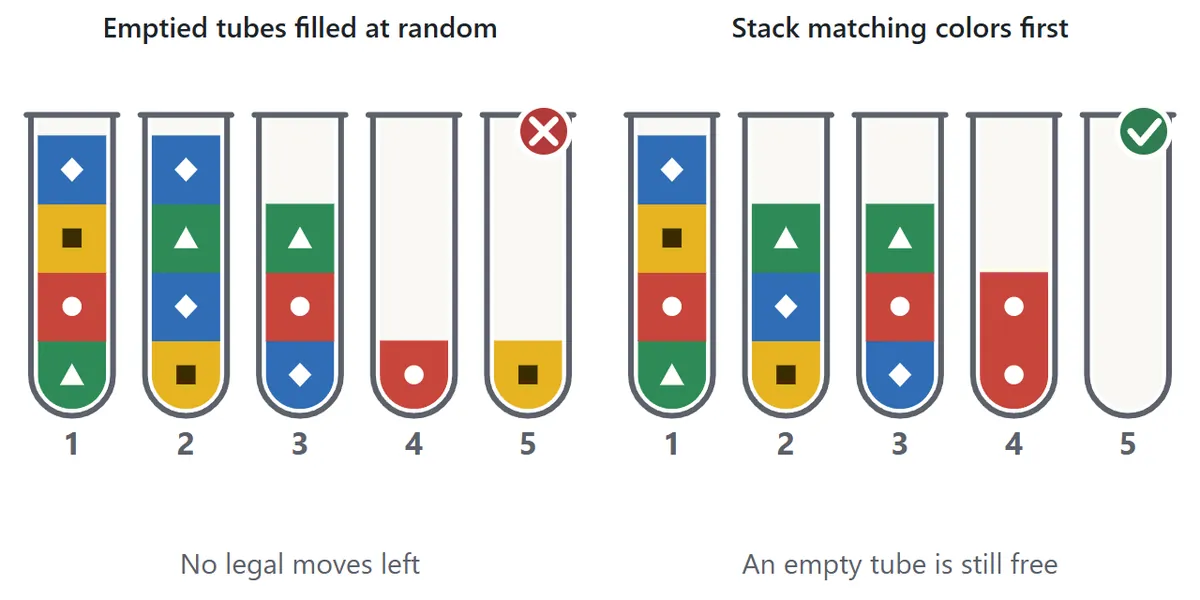
An empty tube accepts any color, which makes it the most flexible spot on the board – and the easiest one to waste. Fill both empty tubes without a plan and you’ll soon run out of legal moves. Before you touch an empty tube, look for tubes whose top colors already match and stack those first. Use an empty tube when moving a color into it uncovers something useful underneath and opens up the next few moves.
2. Finish the colors that are almost done
When you aren’t sure where to start, go for the color that is already easiest to reach: one that sits near the top of several tubes, or one that already has two or three units stacked together. Every finished tube is a tube you never need to think about again. Colors buried at the bottoms of tubes are the opposite – they can only be moved once everything above them is gone, so leave them for later.
3. Watch the bottom colors
The color at the bottom of a tube tends to become that tube’s final color. If the same color sits at the bottom of two different tubes, one of those stacks will eventually have to be moved out completely. A tube that has been cleared down to its bottom color works almost like an empty tube for that color, so creating one gives you an extra place to collect it.
4. In pour mode, count the free space
If three units of a color are on top of a tube but the target only has room for one, two of them stay behind and the color ends up split across two tubes. Reuniting it later costs extra moves. Before you pour, check that the free space in the target matches the number of units you want to move.
5. Use Undo and Hint when you are stuck

Undo (Z) is unlimited, so feel free to back up a few moves and try a different order. Hint (H) shows the next move of a shortest solution from your current position, with dotted frames and an arrow, and tells you how many moves are left. If your current position can no longer be solved, the hint tells you that too. When you’re truly stuck, “Add a tube” gives you one extra empty tube per puzzle.
6. Replay for three stars
Solving a puzzle is only half the fun. Once you know the solution, try it again and aim for the fewest moves shown in the status bar. Look for places where you split a color into several small pours, or moved a color into an empty tube only to move it straight back out – those are the moves to cut.
Color Sort Puzzle FAQ
Can every puzzle be solved?
Yes. All 120 puzzles and every daily puzzle have been checked by computer in both pour mode and ball mode, and the fewest-move count is exact. Moves can’t always be reversed, though, so it is possible to reach a position that can no longer be solved. If that happens, use Undo or Restart.
What happens when I use a hint?
You see the next move of a shortest solution. A puzzle solved with hints earns at most two stars, and the result screen shows how many hints you used.
How many extra tubes can I add?
One per puzzle. Press the button twice to confirm. If you solve a puzzle with the extra tube, it earns one star. Restarting the puzzle removes the extra tube and lets you add it again.
Some colors look alike to me
All twelve colors carry their own symbol: circle, diamond, triangle, square, star, hexagon, cross, heart, moon, drop, ring and X. The same symbol always means the same color, and messages about blocked moves name both the color and the symbol.
Is my progress saved?
Yes, in your browser on this device. Your current puzzle and moves are saved automatically, so you can close the page and press “Continue” later. Solved puzzles, stars and personal bests are saved separately for each style. A daily puzzle can only be continued on the same day. No account or sign-up is needed.
Does it make sound?
Sound is off by default. Press “Sound: off” to hear effects when you move a color, finish a tube or solve the puzzle.
Where color sorting puzzles come from
Puzzles in which you move colored balls or liquid between tubes became hugely popular as smartphone games around 2020. They come in two main flavors – moving balls one at a time, or pouring liquid so that matching layers flow together – but both share the same core rules: only the top can move, and it can only go onto the same color or into an empty tube. Computer scientists in Japan later showed that deciding whether a large sorting puzzle of this kind can be solved at all is a genuinely hard problem, even though each individual rule is simple. That mix of simple rules and deep planning is exactly what makes a short session so satisfying.
More puzzles to try
If you like planning moves where only the top piece can move, try the Tower of Hanoi, where disks are moved one by one between three pegs. For more sliding-and-planning fun, the Car Escape Puzzle asks you to clear a path for a red car through a crowded parking lot.
If you like telling colors apart, try the Color Test, where you find the one square that is a slightly different shade.