 Yorimichi Games

How to Play Four in a Row
Four in a Row is a two-player strategy game played on a board that stands on its edge. Players take turns dropping a disc into one of the columns, and the disc slides down until it rests on the bottom or on top of another disc. The first player to line up four discs of their own color — horizontally, vertically or diagonally — wins the game. Because the discs stack up from the bottom, the real question on every turn is not “where do I want to play?” but “which column do I drop into, and what does that open up above it?”
A game takes only a few minutes and you can learn the rules in less than one. On this page you can play Four in a Row online for free against the computer at three levels, or with a friend taking turns on the same phone, tablet or computer. There’s nothing to install and no account to create.
Choose a column and drop your disc
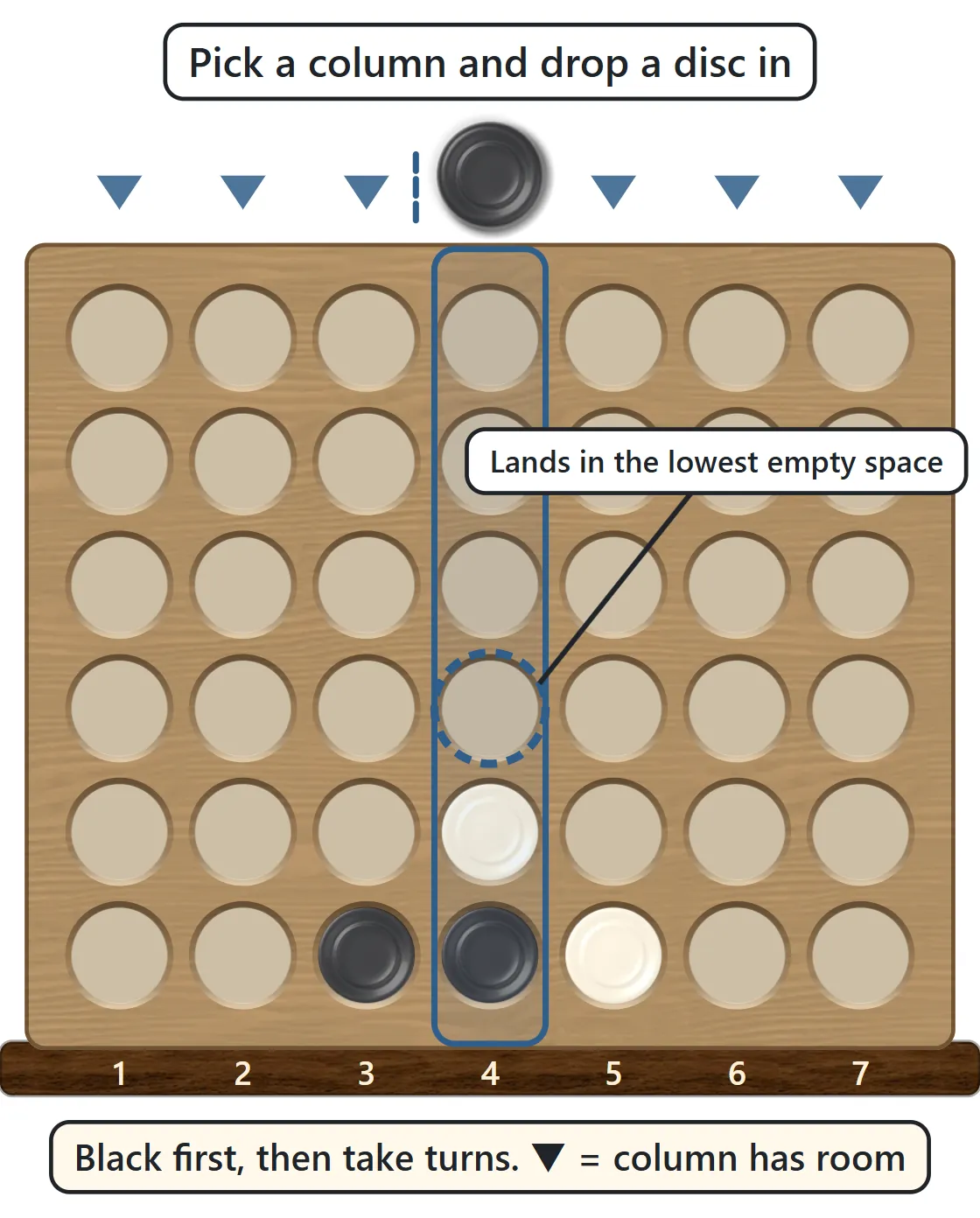
The standard board has 7 columns and 6 rows, which makes 42 spaces. On your turn, pick one column. Your disc drops straight down and stops in the lowest empty space of that column — you can never leave a disc floating above an empty space. Black drops first, then White, and the players keep alternating one disc at a time. Once a disc is in the board it stays there for the rest of the game: nothing is ever moved or captured.
In this game, the ▼ marks above the board show which columns still have room. You can click or tap anywhere in a column to drop into it. With a mouse, hovering over a column shows a faint preview of where your disc will land. On a keyboard, press the number keys (1–7 on the standard board) to drop into that column at once, or use the arrow keys to move the yellow frame and press Enter.
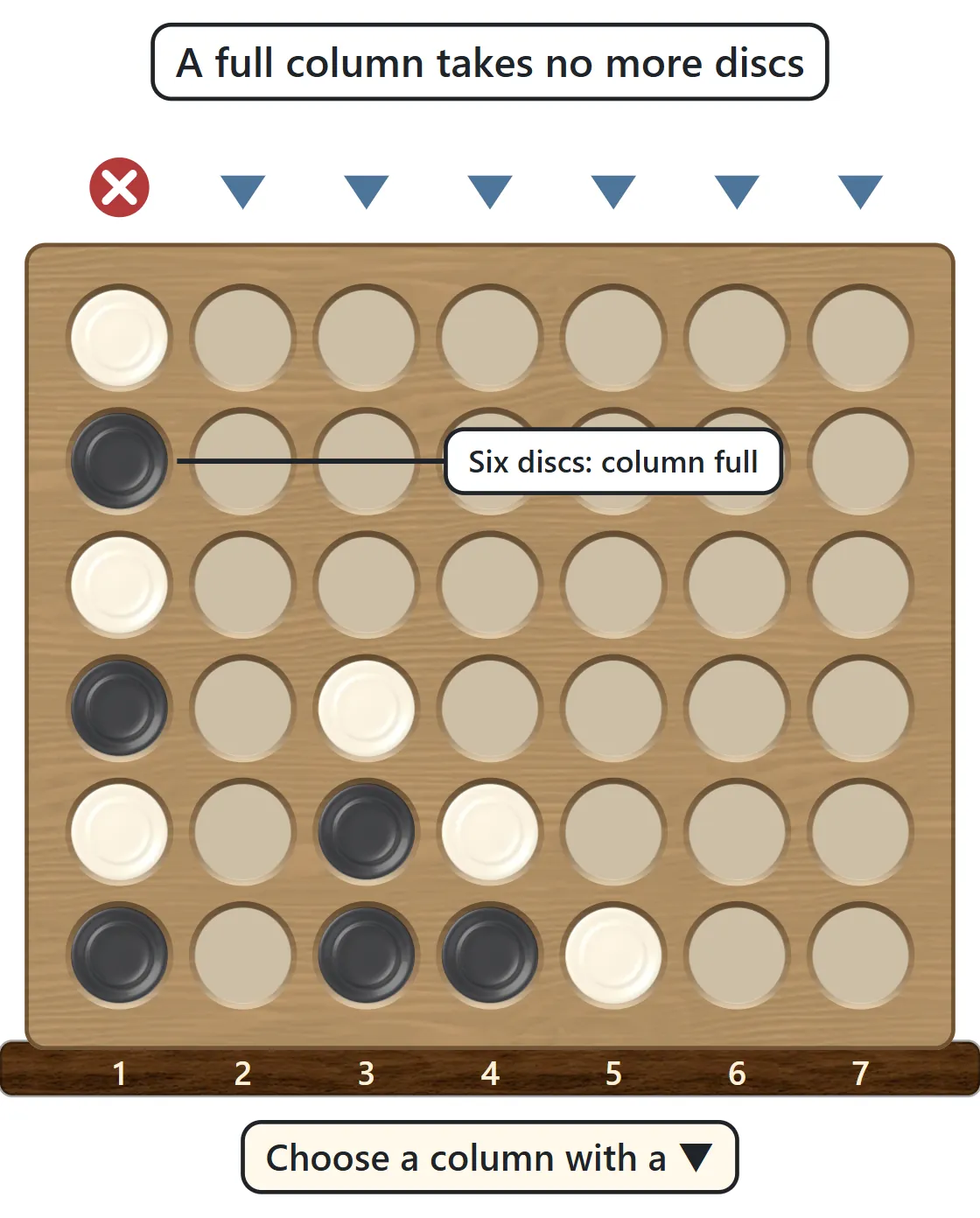
Each column holds six discs. When a column is full you can’t drop into it any more, so choose from the columns that still show a ▼.
Line up four to win
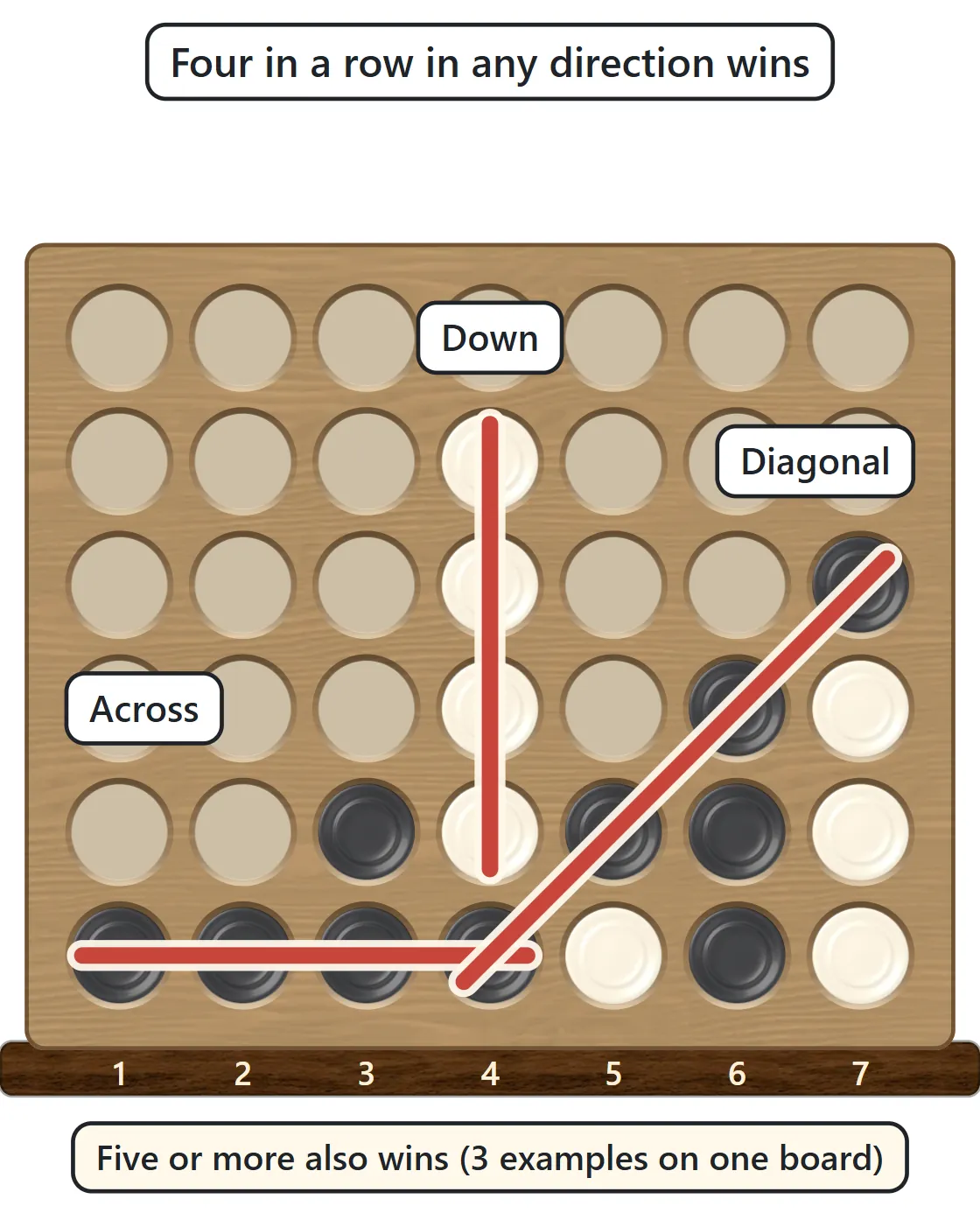
You win as soon as four of your discs sit next to each other in a straight line with no gaps: across a row, down a column, or along either diagonal. An empty space or an opponent’s disc in the middle breaks the line. Five or more in a row also counts as a win. When someone wins, the game draws a red line through the winning discs; if a single drop completes two lines at once, both are marked.
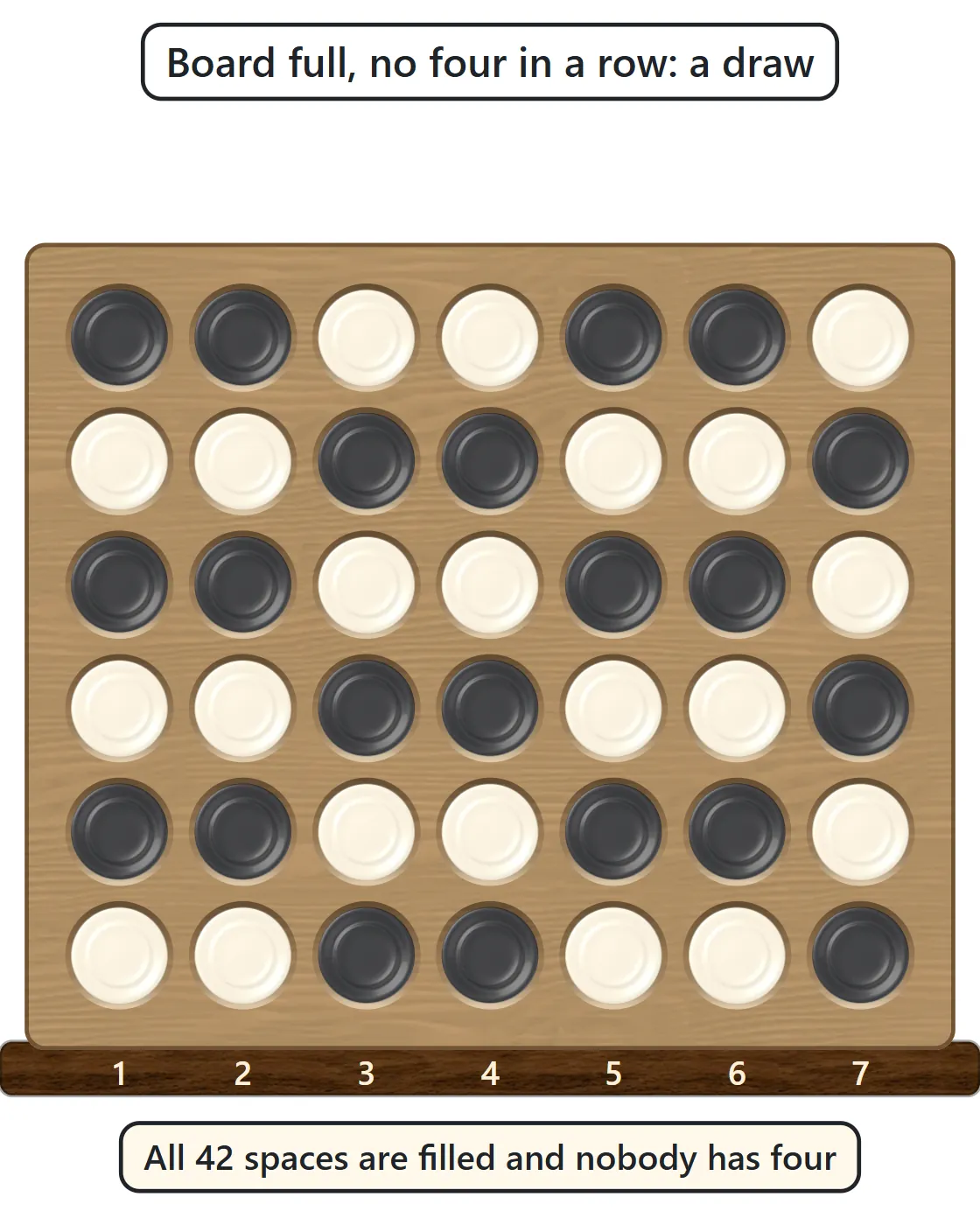
If all the spaces are filled and neither player has made four in a row, the game ends in a draw. There is no passing: as long as at least one column has room, you must drop a disc somewhere, even when every choice looks bad.
Four in a Row Rules: Board Sizes and No Gravity
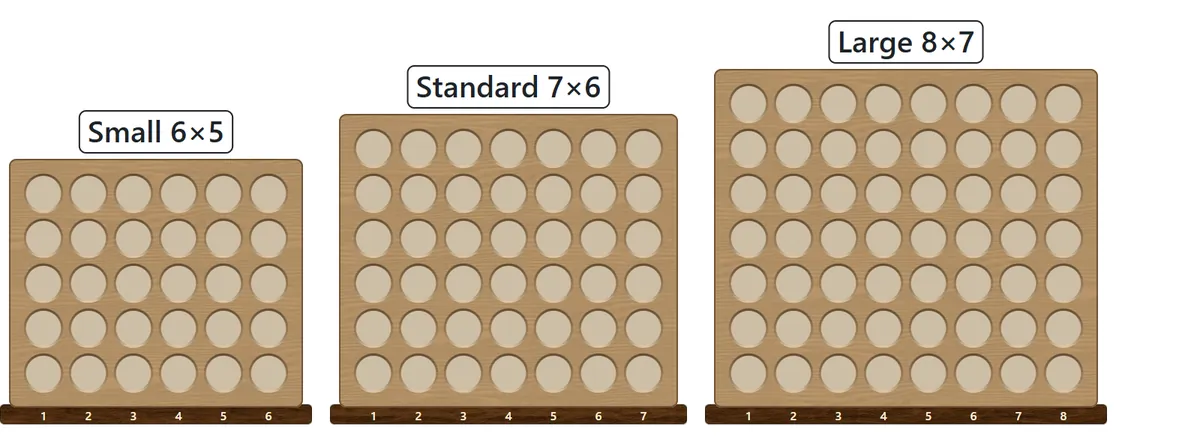
The 7×6 board is by far the most common, but people also play on other sizes, and there is an older paper-and-pencil style where nothing falls at all. You can pick one of four rule sets here, or choose “Custom” to combine any board size with either way of placing discs.
| Rule set | Board and placing | What it’s like |
|---|---|---|
| Standard | 7×6, drop into a column | The classic size most people play |
| Small | 6×5, drop into a column | Quick games; perfect play ends in a draw |
| Large | 8×7, drop into a column | More room, longer and deeper games |
| No gravity | 7×6, any empty space | Paper-and-pencil style; big edge for the first player |
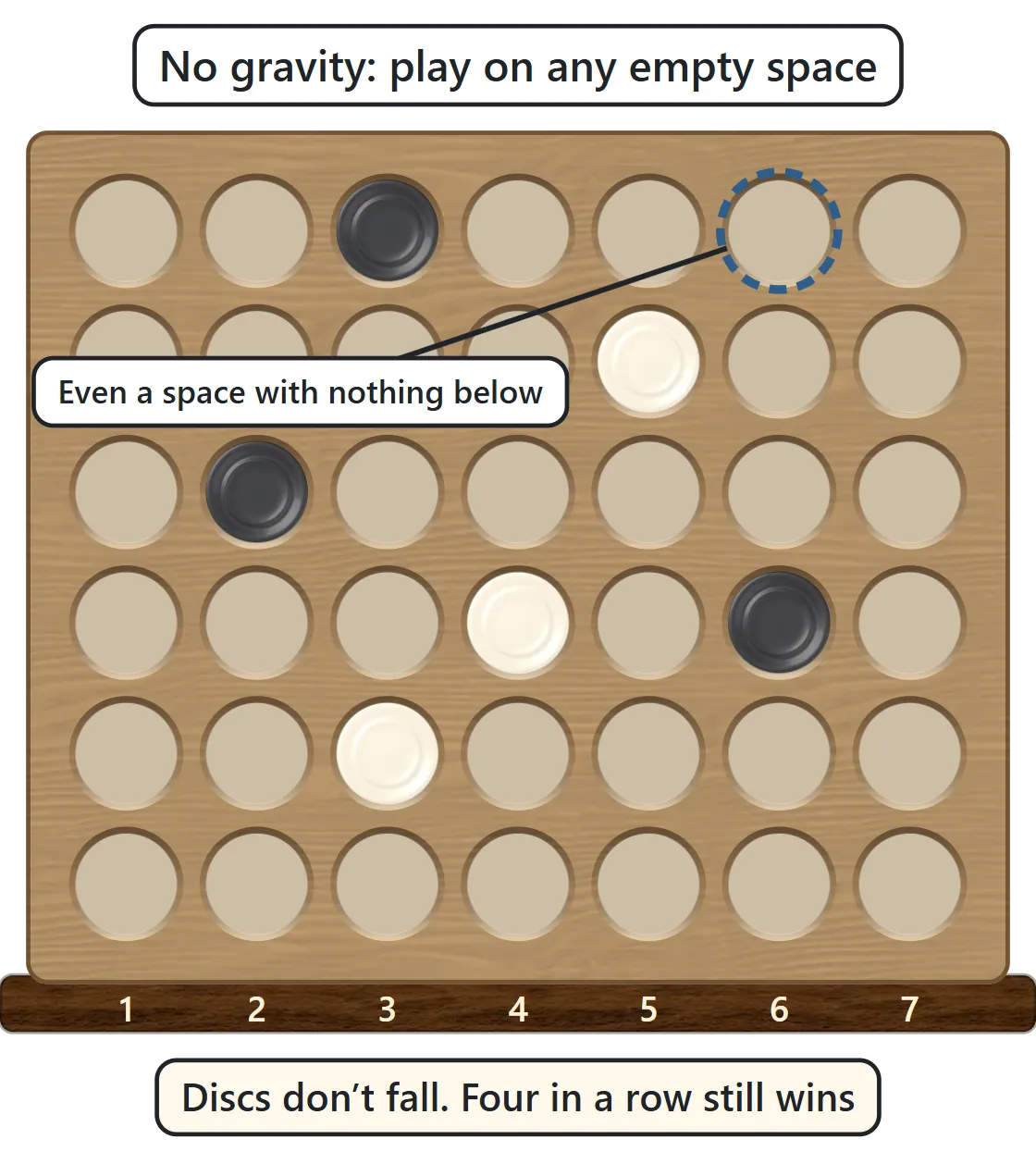
In the no-gravity version, discs don’t fall. You may place a disc on any empty space, including the very top row on your first move. Four in a row still wins and a full board is still a draw. Because you can play anywhere, the first player has a much easier time attacking: if you leave an open two (two in a row with plenty of room on both sides) alone, it can become an open three on the next move, and an open three can’t be stopped. It is a good way to practise thinking about defence first.
Four in a Row Strategy: How to Win
1. Take the center column
A disc in the middle column can be part of a horizontal line in either direction and of both diagonals, so it simply belongs to more possible fours than a disc on the edge. That is why the classic opening move is the center column. If you go first, starting in the middle gives you the best chances; if you go second, don’t let your opponent have the center all to themselves.
2. Never miss a threat
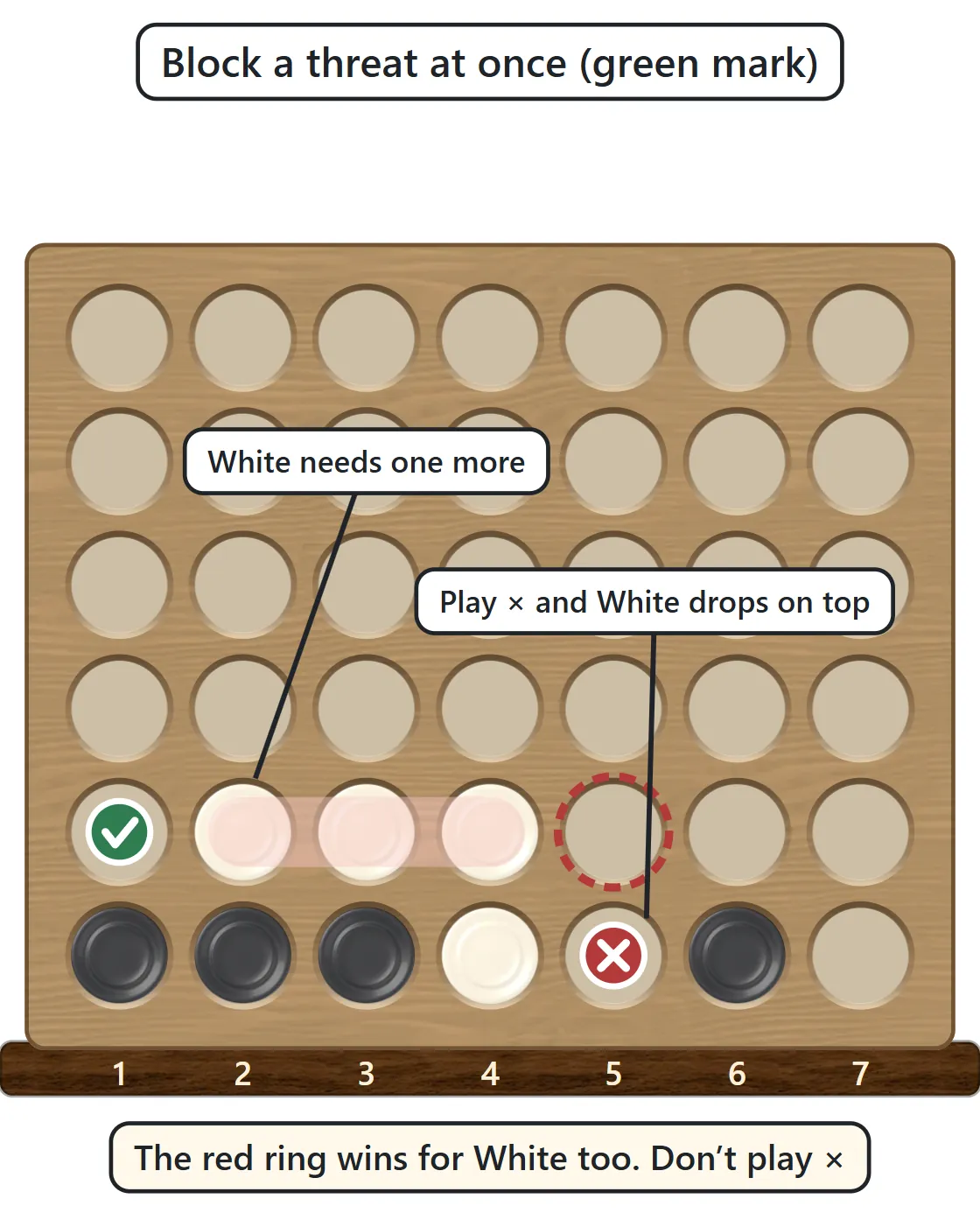
A threat is a space that would complete four in a row. If your opponent has three in a line and the fourth space is playable, drop into it immediately. Vertical threes are easy to spot, but horizontal and diagonal ones — and “split” threes with a gap in the middle — are easy to overlook. Before every move, get into the habit of asking: “If I play here, where can my opponent drop next, and does any of those spaces win for them?”
3. Don’t play directly under your opponent’s winning space
This is the idea that makes the game different from other line-up games. A threat whose space is floating above an empty square isn’t dangerous yet — nobody can reach it. But the moment someone drops a disc into the square right below it, the threat becomes playable. If you are the one who fills that square, your opponent simply drops on top and wins. When every column seems risky, keep the space under their threat empty and fill other columns first.
4. Make two threats at once
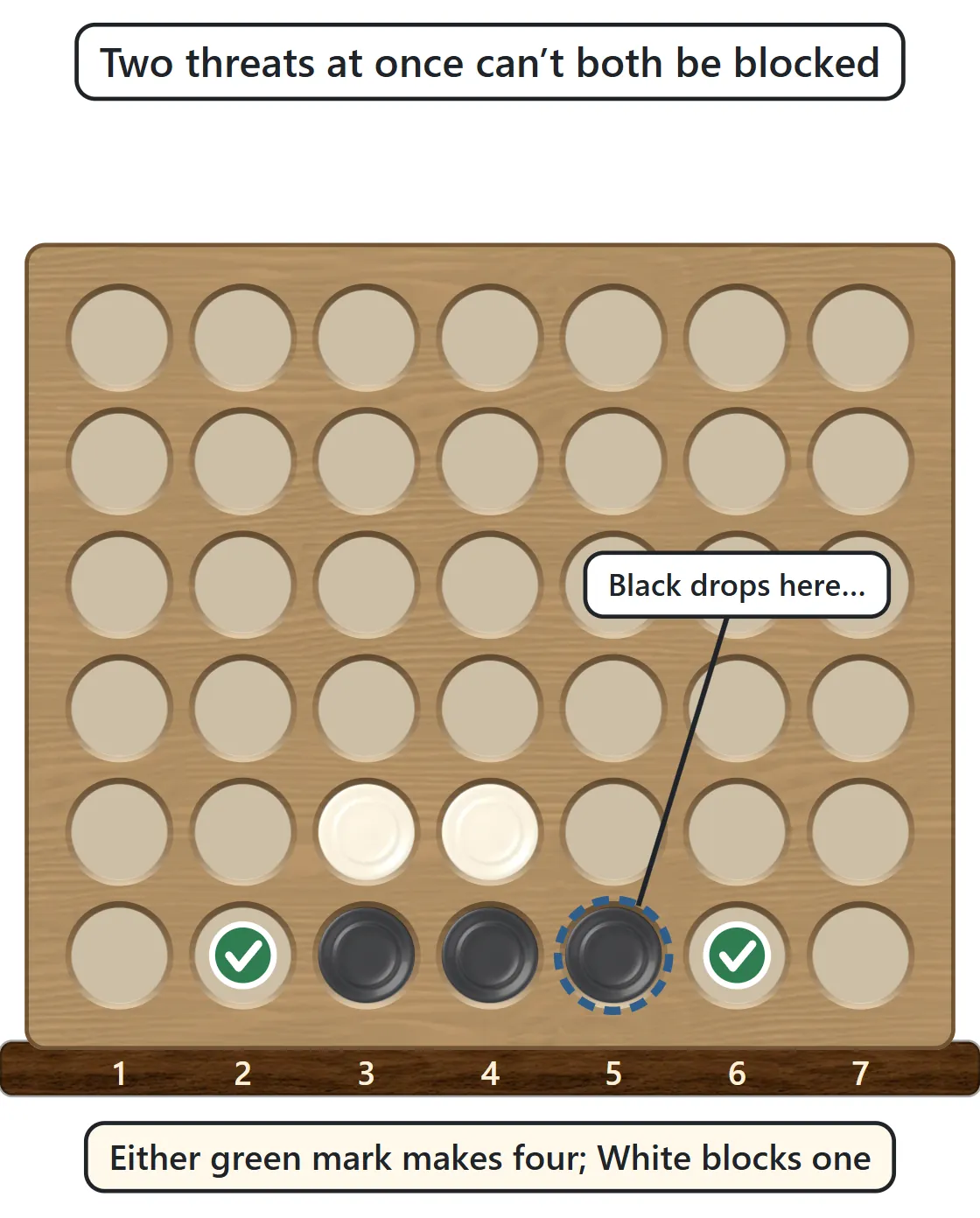
Your opponent can only block one space per turn. If you create two different winning spaces with a single move, one of them will survive and you win. The simplest example is three in a row on the bottom row with both ends open. More often it’s a horizontal and a diagonal line that meet at the same point. Look for moves that add to two of your lines at the same time — and, just as important, stop your opponent’s twos early before they can grow into a double threat.
5. Think about which row a threat is on
Late in the game, both players are trying not to play under the other’s threats, and it turns into a waiting game over who runs out of safe moves first. Experienced players count rows from the bottom: a threat on an odd row (1st, 3rd, 5th) tends to help the player who went first, while a threat on an even row (2nd, 4th, 6th) tends to help the player who went second. Strong players plan their threats with this in mind so that, when the board fills up, their opponent is forced to play underneath a winning space.
6. When you go second, defend first
As White, you will spend the early moves stopping Black’s lines more often than building your own. If Black uses the center column, play right above or next to those discs to keep their lines from spreading. Try to block in places that also start a line of your own; those small twos often turn into real counter-threats once the board gets crowded.
Four in a Row FAQ
Is it better to go first or second?
Going first is an advantage. On the standard 7×6 board, it was shown by computer analysis in 1988 that the first player can always win with perfect play, starting in the center column. Perfect play means reading a very long way ahead, though, so between people either side can win. For a fair series, swap who goes first after each game. On the small 6×5 board, perfect play from both sides ends in a draw.
Can the game end in a draw?
Yes. If all the spaces are filled and neither player has four in a row, it’s a draw.
Which computer level should I choose?
If you are new to the game, start with Easy. It often doesn’t look closely at the board, forgets to block your threes and sometimes drops a disc almost anywhere — so once you have three in a row, go for the fourth. When that feels comfortable, move up to Normal. It usually blocks your threes and builds its own lines, but it still overlooks things now and then. Hard reads several moves ahead and tries to set up two threats at once. It rarely misses anything, so you need to build your own lines while carefully blocking every three it makes.
Can I undo a move or get a hint?
Yes. With Undo turned on in the settings, the Undo button takes back your last move (the computer’s reply is taken back too). Press Hint to see, with a dashed blue outline, the column a deep search would choose. The number of hints and undos you used is shown on the result screen.
Can two people play on one device?
Yes. Choose “A friend” as the opponent and pass the device back and forth. Black drops first, and the bar above the board always shows whose turn it is. In two-player games, Undo takes back one move at a time. If you stop in the middle, you can pick up where you left off with Continue, as long as you use the same browser on the same device.
How is this different from Gomoku?
In Gomoku you can place a stone on any empty point of a flat board, and you need five in a row. In Four in a Row the discs fall, so each column offers only one playable space at a time. That is what creates ideas like “don’t fill the square under your opponent’s threat”, which don’t exist in Gomoku. The no-gravity rule set feels more like a small Gomoku with four in a row instead of five.
History of Four in a Row
Games about getting your pieces in a line are very old and are found all over the world, from three-in-a-row games scratched on stones to Gomoku played on a Go board. The vertical version, where pieces are dropped into an upright frame, became widely known in the 1970s when it was sold as a toy in the United States, and it has been a family favourite in many countries ever since. Similar games with pieces slotted into a wooden frame are said to have existed even earlier.
Four in a Row is also famous in computer science. In 1988 two researchers, working independently, proved that the first player wins the standard game with perfect play, and the game is still a popular example for teaching how computers search ahead through possible moves. For people at the table, though, the fun is the same as ever: spotting the threat your opponent missed, and making them drop the disc that lets you win.