 Yorimichi Games
How to play Yacht (the dice game)
Yacht is a dice game for one or more players that needs nothing more than five ordinary dice and a score sheet. On your turn you roll the dice up to three times, trying to make a useful combination such as three of the same number, a run like 2-3-4-5, or the best roll of all: five of a kind, which gives the game its name. You then write your result into one empty category on the score sheet. Every category can be used only once, so a game of Yacht is really a series of small decisions about what to chase and where to put each roll. When every player has filled every category, the highest total wins.
The game above plays the most familiar English-language scoring by default (13 categories). You can switch to the 12-category version that is common in Japan, to the original Yacht rules from the 1930s, or set every rule yourself. Play against one to three computer opponents, pass one phone or tablet around for 2–4 people, or play alone and try to beat your personal best.
1. Roll, keep, and roll again
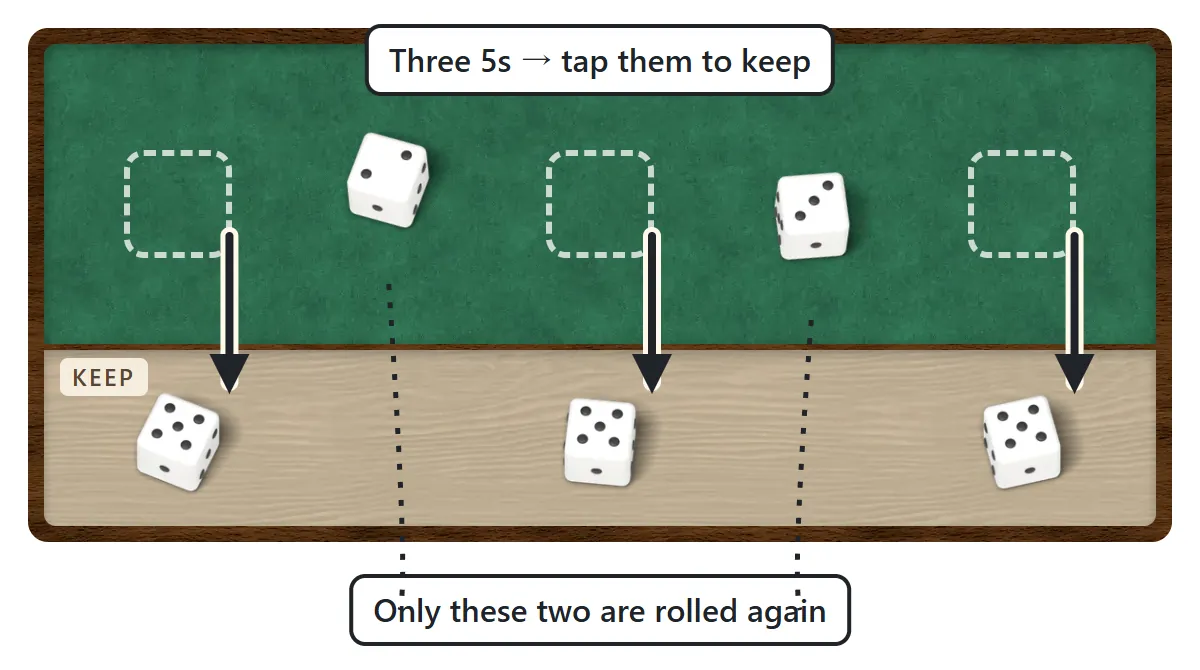
Each turn starts with a roll of all five dice. Look at what came up and decide which dice are worth keeping. In this game you tap (or click) a die to slide it down to the Keep row; press Roll and only the dice still on the felt are thrown again. After the second roll you can change your mind completely: keep different dice, or bring kept dice back into play by tapping them again. Then you may roll a third and final time.
You never have to use all three rolls. If your first roll is already a Large Straight, stop and score it. Rolling again can only make a finished combination worse.
2. Choose a category on the score sheet
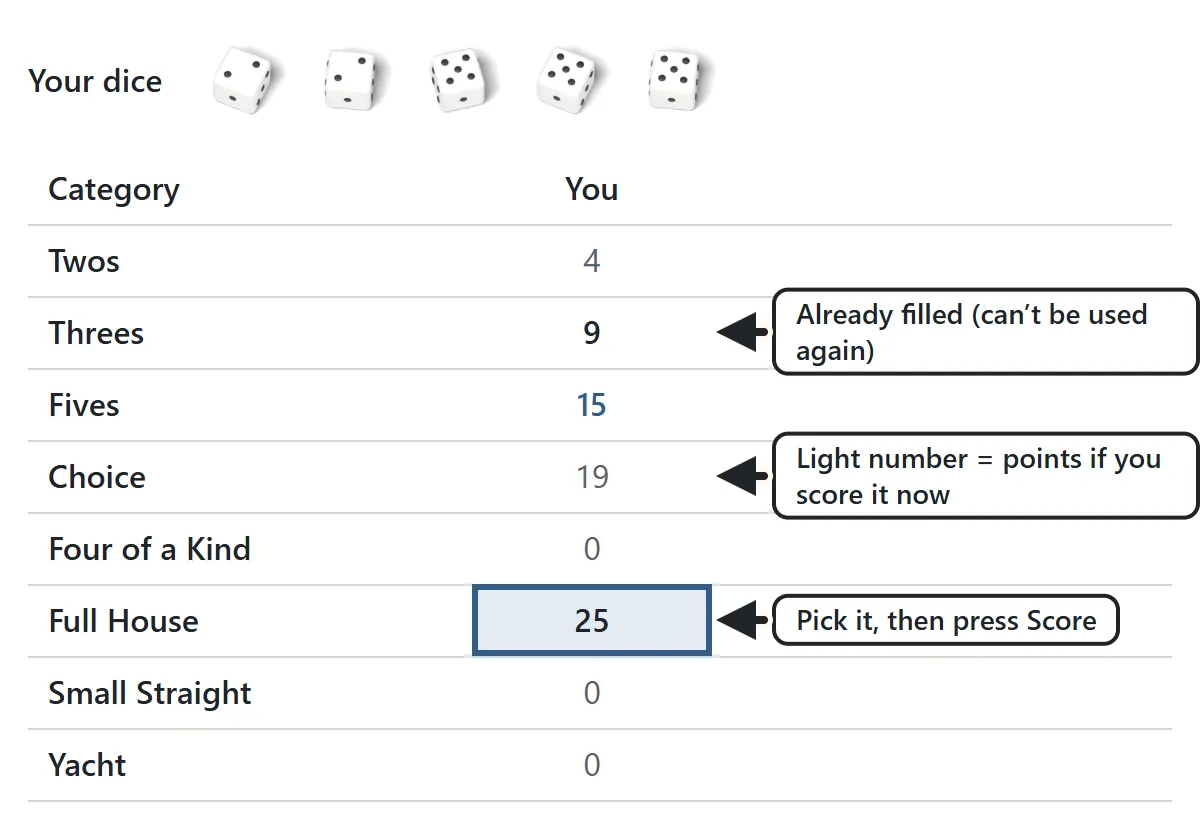
When you are done rolling, you must score the dice in exactly one empty category. The game shows, in light grey, how many points each open category would give you right now; good options are highlighted in blue. Tap a category to select it, then press the button under the dice (or tap the same category again) to confirm. Once a category is filled it stays filled, so the score cannot be changed later. With 13 categories the game lasts 13 rounds; with the 12-category rules it lasts 12.
Yacht scoring: the categories
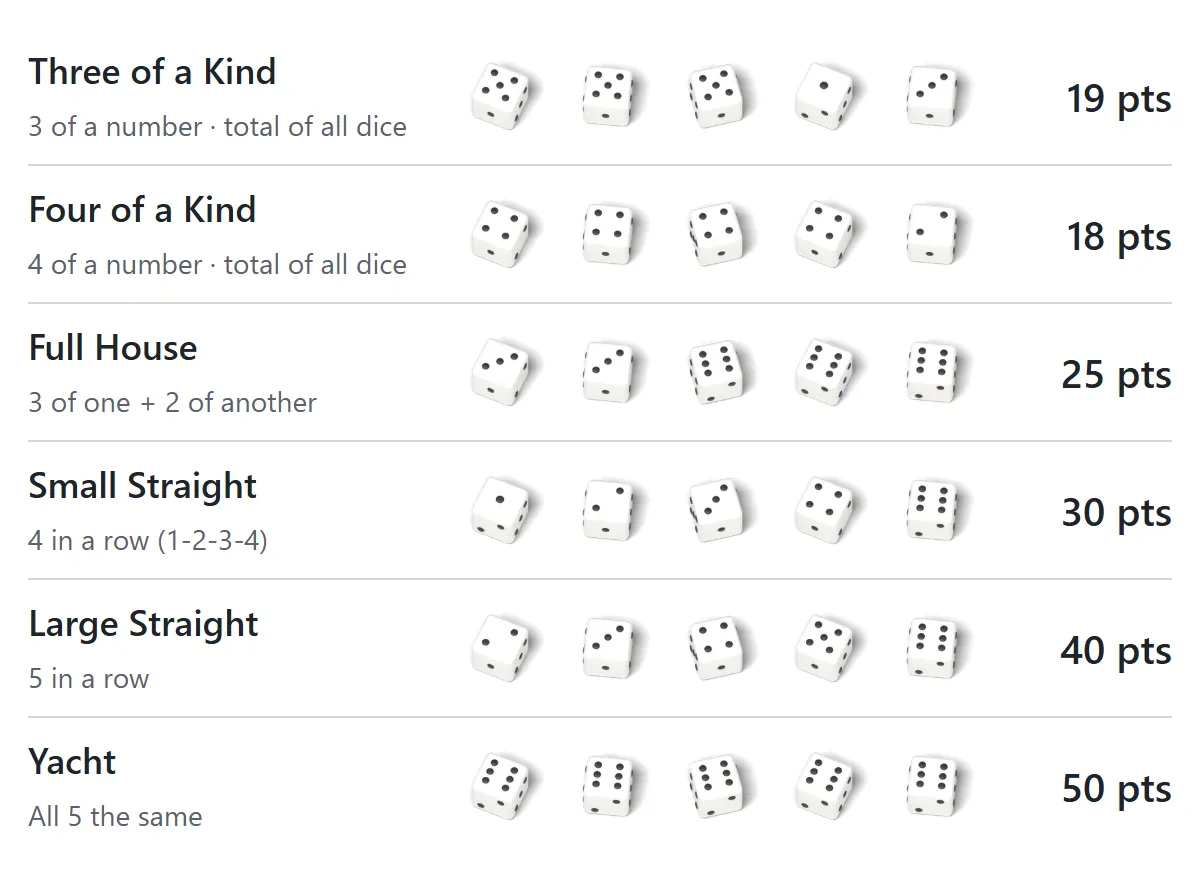
| Category | What you need | Points (13 categories) |
|---|---|---|
| Ones to Sixes | Anything | Total of that number only (three 5s = 15) |
| Three of a Kind | At least three dice the same | Total of all five dice |
| Four of a Kind | At least four dice the same | Total of all five dice |
| Full House | Three of one number and two of another | 25 |
| Small Straight | Four numbers in a row, e.g. 3-4-5-6 | 30 |
| Large Straight | Five in a row: 1-2-3-4-5 or 2-3-4-5-6 | 40 |
| Yacht | All five dice the same | 50 |
| Choice | Anything | Total of all five dice |
The order of the dice does not matter, and a combination can be scored anywhere it fits. A Large Straight also counts as a Small Straight, and five of a kind also satisfies Three of a Kind, Four of a Kind and its number category. By default, five of a kind is not a Full House, but you can allow it in the rule settings. If the dice do not meet a category’s requirement you can still put them there, but you score zero.
Upper section bonus: reach 63 in Ones to Sixes
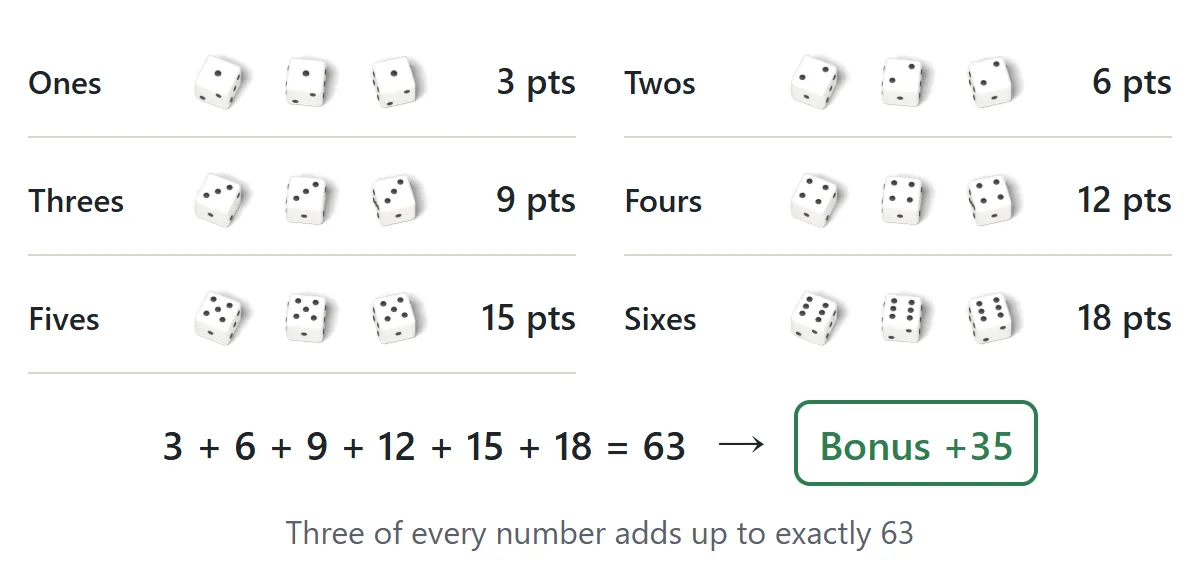
The six number categories (often called the upper section) carry a bonus. If their total reaches 63, you earn 35 more points. The target is not random: 63 is exactly what you get with three of every number (3 + 6 + 9 + 12 + 15 + 18). The Subtotal row of the score sheet shows your total against the target (for example 40/63), a ✗ once the bonus can no longer be reached, and +35 when you have it. Falling one die short in Ones or Twos costs very little, while an extra five or six makes up for a lot, so the bonus is usually won or lost on the big numbers.
Scoring zero: when nothing fits
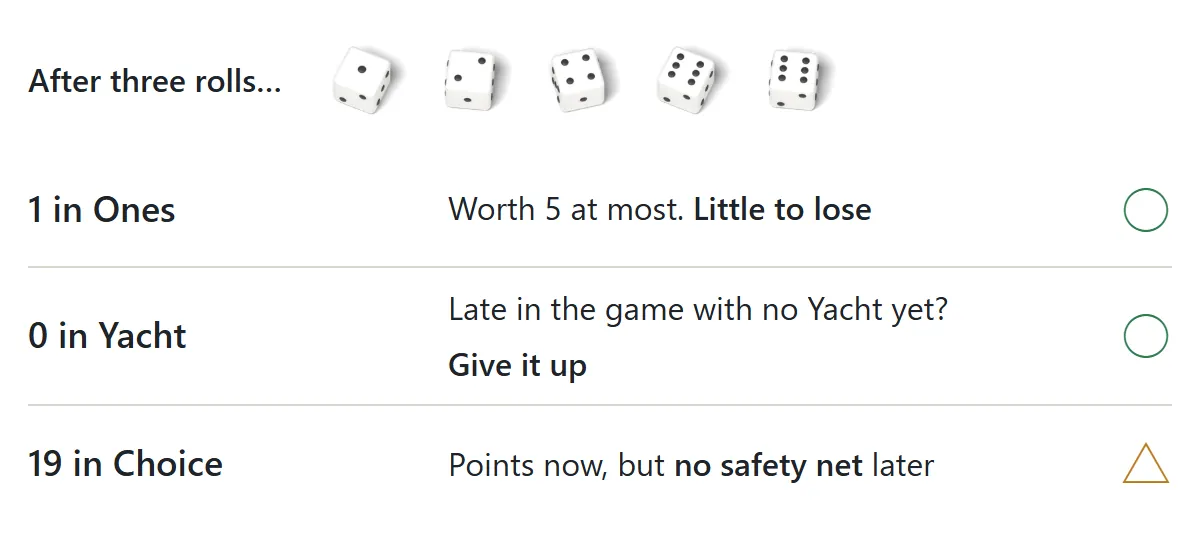
You must fill a category every turn, even when your final roll is useless. Players call this “scratching” a category: you enter the dice in a box where they score little or nothing. Choosing what to sacrifice is where most games of Yacht are won and lost. Ones is a classic dumping ground, because it can never be worth more than 5. Late in the game, an empty Yacht box that you have little chance of filling is another good candidate.
Extra Yachts and the wild card rule
In the 13-category rules, rolling another five of a kind after you have already scored 50 in the Yacht box earns a 100-point bonus. You still fill a category that turn. If the matching number category (for example Fours, if you rolled five 4s) is already used, the extra Yacht also works as a wild card: you may enter it in Full House, Small Straight or Large Straight for the full 25, 30 or 40 points. If you scratched the Yacht box with a zero, later Yachts earn no bonus.
Yacht rules variations
Five-dice games have been played for a long time and in many places, so the exact scoring changes from one box, book or family to the next. The game offers three ready-made rule sets and a Custom option where you choose each rule separately.
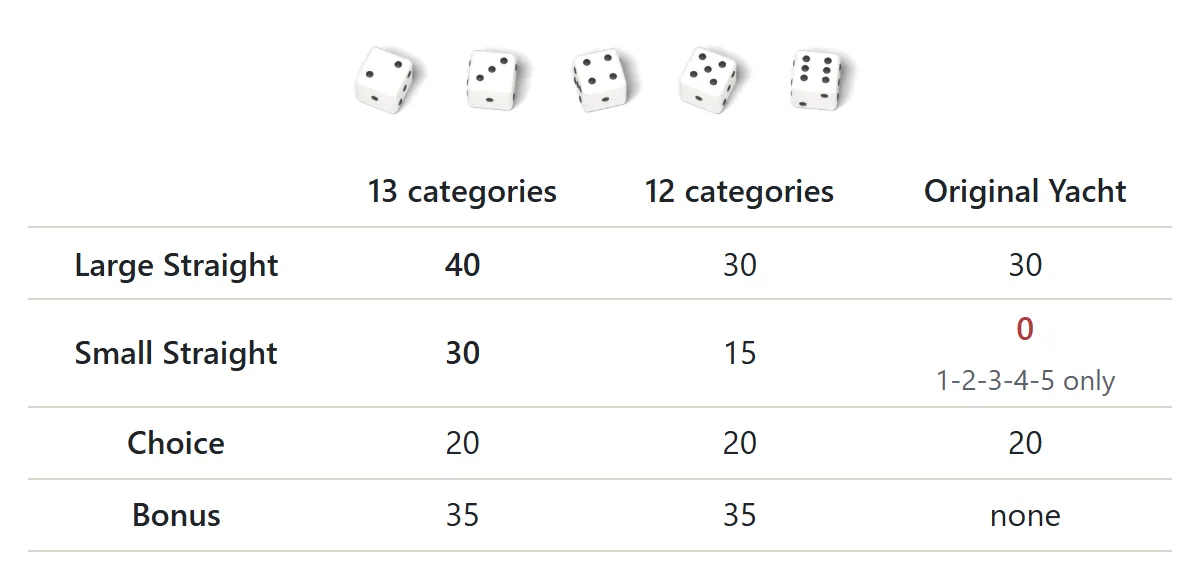
| Rule | 13 categories (default) | Other versions |
|---|---|---|
| Categories / rounds | 13, including Three of a Kind | 12 (no Three of a Kind) |
| Full House | 25 points | Total of all dice |
| Four of a Kind | Total of all dice | Original Yacht: total of the four matching dice |
| Straights | Small 30 · Large 40 | 12 categories: 15 · 30. Original Yacht: exactly 1-2-3-4-5 and 2-3-4-5-6, 30 each |
| Bonus at 63 | 35 points | Original Yacht: none |
| Extra Yachts | +100 and wild card | No bonus; just fill a category |
The 12-category version is the way Yacht is most often played in Japan, where it appears in a popular collection of classic games. It keeps the 63-point bonus but has no Three of a Kind, scores Full House as the total of the dice, and pays less for straights. The Original Yacht rules follow the game as it was described in a 1938 American book of games: there is no bonus at all, Four of a Kind scores only the four matching dice, and the two straights are fixed sequences rather than any run. In Custom you can also make five of a kind count as a Full House, change the bonus to 50, or play the strict house rule where a die you have kept cannot be rolled again during that turn.
Yacht dice game strategy: tips to score higher
1. Aim for three of each number
Since three of every number is exactly 63, treat three as par for Ones to Sixes. Scoring four Sixes puts you six points ahead of par; scoring only two Fives leaves you five behind. Keeping this running balance in mind tells you when you can afford a weak Ones and when you need to push for a fourth Six. The bonus is worth as much as a Small Straight plus change, so do not give it up lightly.
2. Decide what you are chasing after the first roll
If you roll a pair or three of a kind, the usual play is to keep them and go for more of that number. If you already have three or four numbers in a sequence, go for a straight. What tends to fail is keeping a little of everything: two dice toward a straight and a pair toward a Full House usually ends with nothing at all.
3. Save Choice as your safety net
Choice accepts any roll, which makes it tempting to use early. Try not to. Later in the game you will have a turn where a good-looking roll fits nowhere, and an empty Choice box turns a disaster into 20-something points. Using it early on a mediocre 18 costs you that insurance.
4. Keep high numbers for the combination categories
Three of a Kind, Four of a Kind and Choice all score the total of the dice, so the same combination is worth far more with Sixes than with Twos. Three 2s might be better placed in Twos (where 6 is a solid score) than in Three of a Kind (where it may only make 12). With the 12-category rules the same is true of Full House.
5. Go for open-ended straights
With 2-3-4-5 kept, either a 1 or a 6 completes a Large Straight, so each die you roll has two chances to hit. With 3-4-5-6 only a 2 works. When you have a choice, keep the middle of the run. For a Small Straight, remember that 3 and 4 appear in every possible four-in-a-row, so they are the most valuable dice to hold.
6. Plan where the zeros will go
Most games include at least one zero. Decide early which boxes you are willing to give up: Ones is cheap, and in the late rounds a Yacht box you have not filled is often the right sacrifice, since the chance of rolling five of a kind in a single turn is only about 4.6%. Scratching a straight you need a lucky roll to make can also be better than wrecking your bonus.
Yacht dice game FAQ
How many players can play?
Against the computer you can play with one, two or three CPU opponents. In pass-and-play mode, 2–4 people share one device and take turns. Solo mode is a single-player game in which you try to set a new personal best for each rule set.
What is a good score in Yacht?
With the 13-category rules, a total of around 200 is a solid game, and 250 or more usually needs a Yacht or two. Scores vary a lot from game to game because the dice decide so much, which is exactly why the solo mode keeps your best result for each rule set.
Can one roll count for more than one category?
No. A roll often fits several categories (5-5-5-2-2 is a Full House, Three of a Kind, Fives and Choice), but you choose only one. The light numbers on the score sheet make it easy to compare the options before you decide.
Can I re-roll a die I kept earlier?
Yes. Keeping is decided fresh before every roll, so you can release a kept die by tapping it again. If you prefer the stricter house rule, turn on “Once kept, a die stays kept for the rest of the turn” in the rule settings.
How strong is the computer?
Easy simply keeps whatever number it has the most of and often scores a roll without re-rolling. Normal thinks about which dice to keep but tends to take the biggest score available right now. Hard plans its categories ahead and plays for the bonus, though even Hard makes the occasional loose choice. The dice are always fair, so an upset is never far away.
Can I stop and continue later?
Yes. The game saves after every move. Open the page again on the same device and browser and press Continue.
Is there sound?
Sound is off at first. Press “Sound: off” below the game to hear the dice roll and land.
History of Yacht
Games in which players roll five dice and try to make scoring combinations are old and widespread. Generala is played across Latin America, and many dice games borrow their combinations from poker hands. Yacht itself appears in print in The Complete Book of Games, published in the United States in 1938, which describes twelve categories, straights worth 30, no bonus, and a Yacht worth 50. Over the following decades, families and game makers added the upper bonus, a Three of a Kind box, fixed values for the Full House and straights, and extra points for repeated Yachts. That is why the game is still played with slightly different rules from country to country, and why this version lets you choose.