 Yorimichi Games
How to play Shut the Box
Shut the Box is a classic dice game played with a wooden box of numbered tiles, usually 1 to 9, and a pair of dice. On your turn you roll the dice and flip down (“shut”) tiles that add up to the number you rolled. You keep rolling and shutting until you roll a total you can’t make with the tiles still open. Whatever is left standing is your score, so the goal is to finish as low as possible. Shut every tile and you have “shut the box”, the best result in the game: a score of zero.
You can play it alone to beat your own best score, or with other people, where the lowest score wins. It takes only a minute or two per turn, which makes it a good quick game between other activities, and it is full of mental addition.
1. Roll the dice and add them up
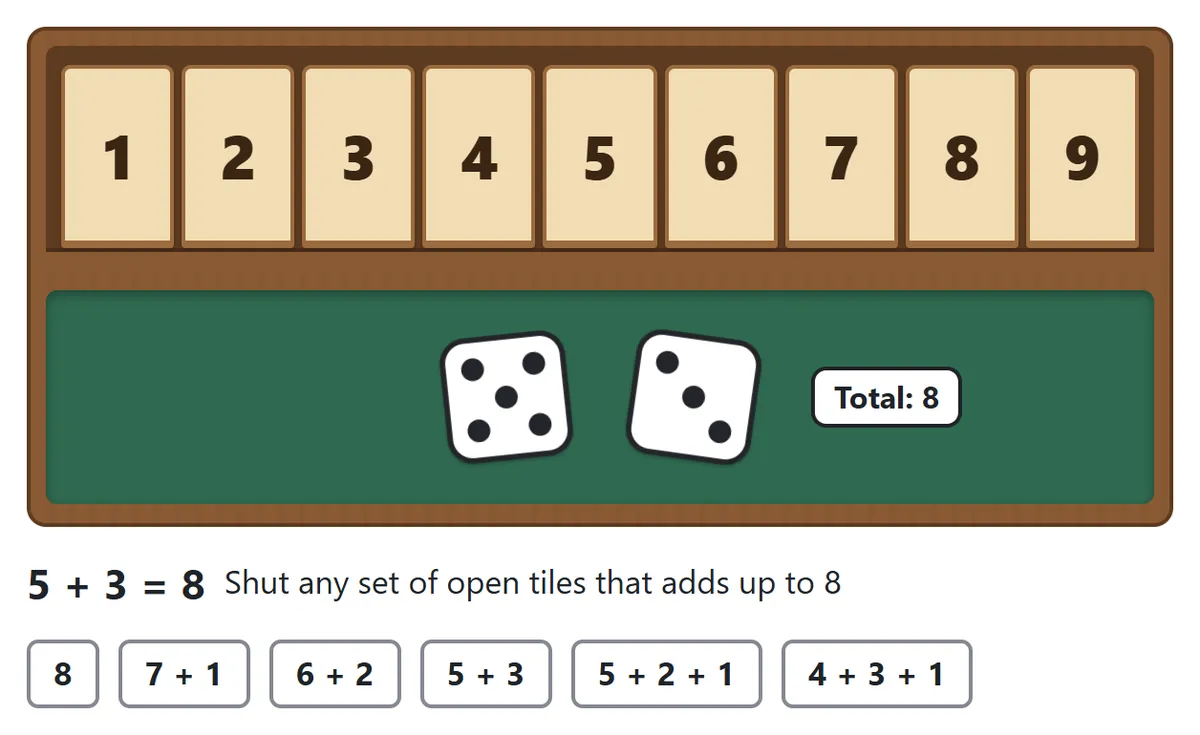
At the start of a turn every tile is open. Roll both dice and add the two numbers together. If you roll a 5 and a 3, your total is 8. Now choose open tiles whose numbers add up to exactly 8: the single 8 tile, or two tiles such as 7 and 1, 6 and 2 or 5 and 3, or three tiles such as 5, 2 and 1 or 4, 3 and 1. You don’t have to shut the tiles that match the numbers on the dice. Only the total matters.
In this game you tap tiles to select them, and the equation appears under the box, such as “5 + 3 = 8”. When your selection matches the dice total, press Shut. You can also tap one of the buttons in the “Tiles you can shut” list.
2. Shut the tiles and roll again
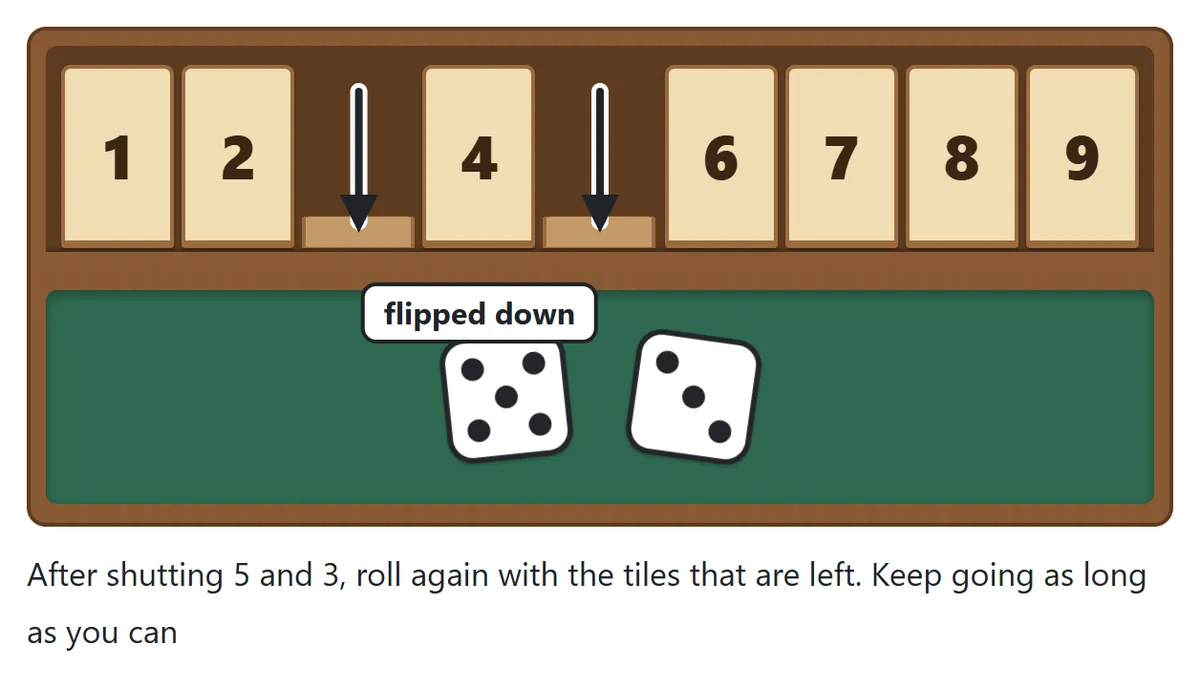
The tiles you choose flip down and stay down for the rest of your turn. Then you roll again and make the new total from the tiles that are still open. You keep going for as long as you can make the total. If there is at least one way to make it, you must shut something; you can’t skip a roll.
3. When you can’t make the total, your turn ends
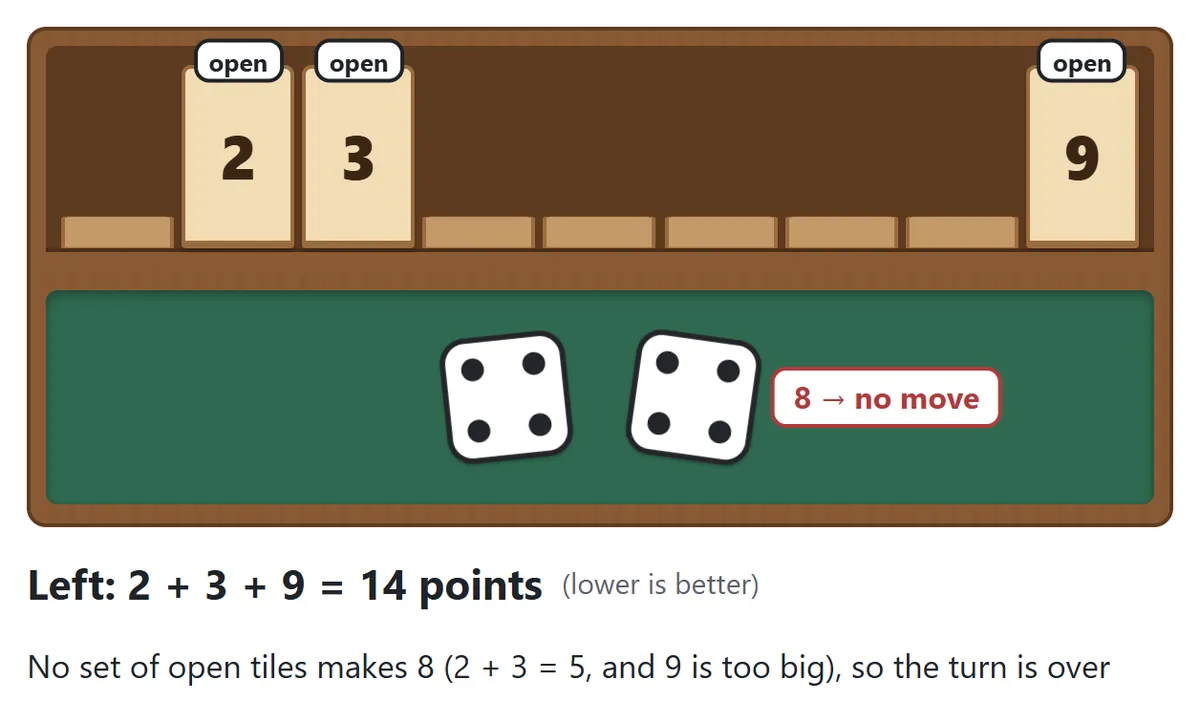
As soon as you roll a total that no set of open tiles can make, your turn is over. Add up the open tiles to get your score. In the picture, 2 + 3 + 9 = 14 points. If you shut every tile, you score zero.
4. Rolling one die
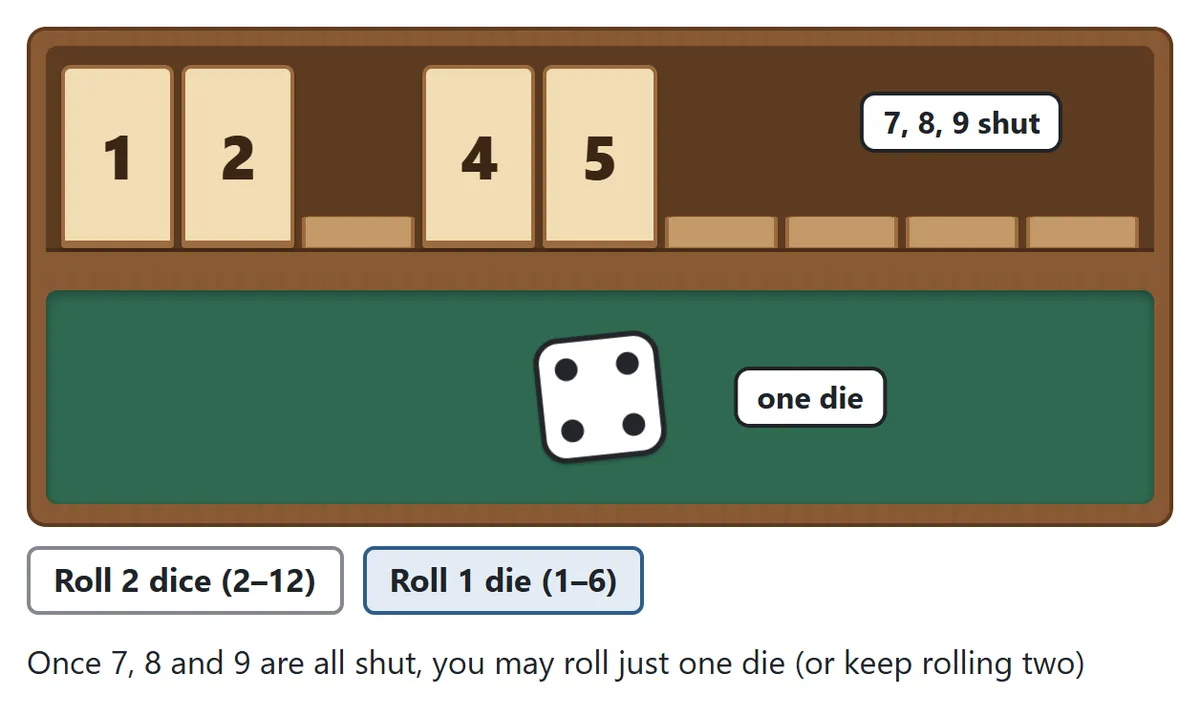
When the 7, 8 and 9 tiles are all shut, you may choose to roll just one die instead of two. It is your choice each time, made before you roll. One die gives you totals from 1 to 6, which is handy when only small tiles are left. With 1 and 2 left, for example, two dice can only finish the job with a total of exactly 3, while one die can hit 1, 2 or 3.
5. Playing with two or more players
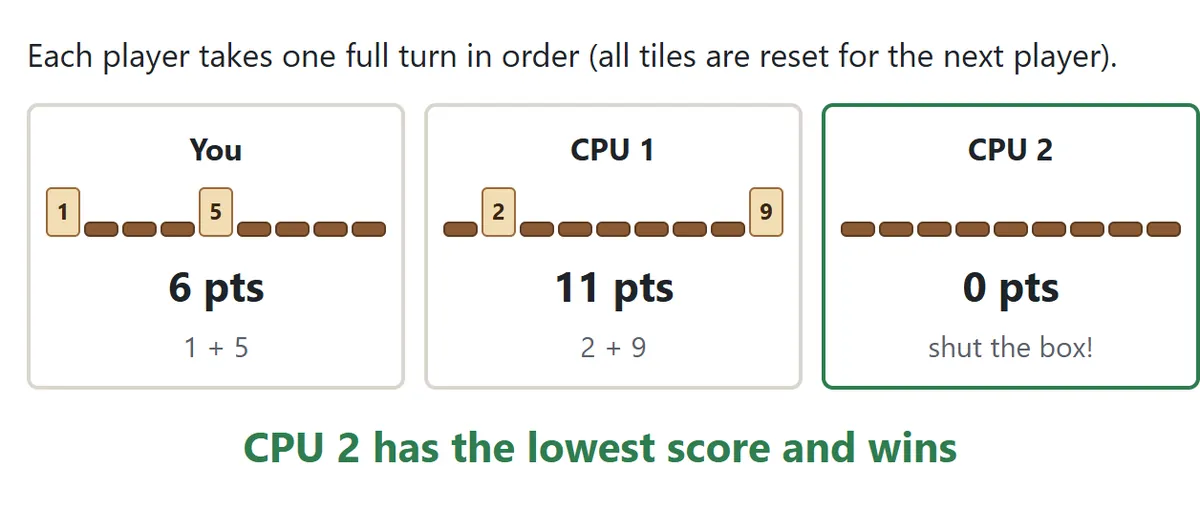
With more players, each person plays one complete turn in order, and all the tiles are reset before the next player starts. After everyone has played, the lowest score wins, and equal scores share the place. Choose 3 or 5 rounds to add up several turns and compare totals. On this page you can play against one to three computer opponents, or pass a single phone, tablet or Chromebook around for 2 to 4 people.
Shut the Box rules and variations
Because Shut the Box has been played for a long time in many places, there are several versions of the rules. You can pick one of four sets here, or choose Custom to change each rule yourself.
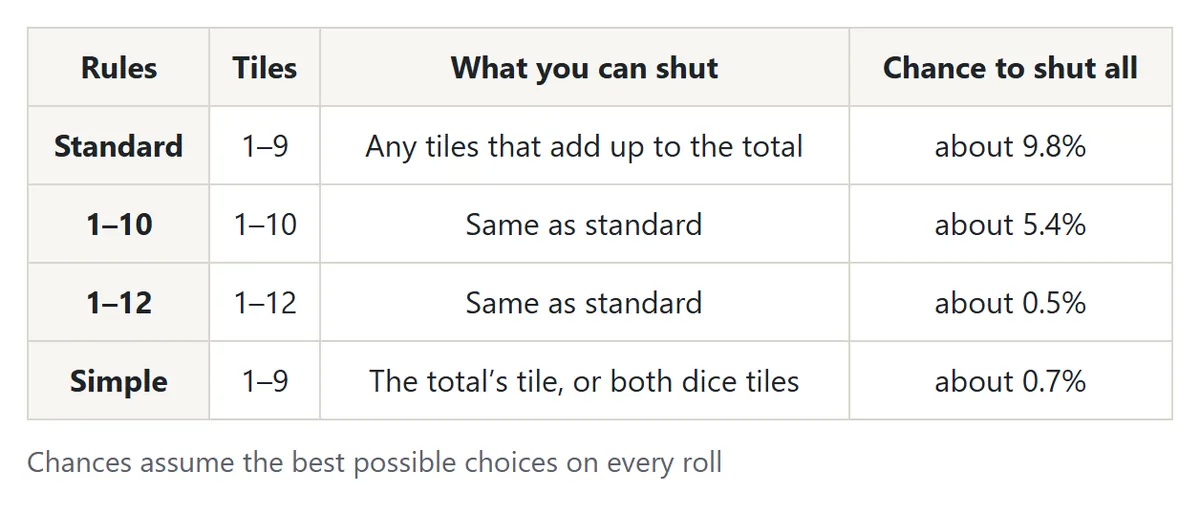
| Rules | Tiles | What you can shut |
|---|---|---|
| Standard | 1–9 | Any open tiles that add up to the total |
| 1–10 and 1–12 | 1–10 or 1–12 | Same as standard; one die only after 7 and up are shut |
| Simple | 1–9 | The tile for the total, or the tiles for both dice (5 and 3: “8” or “5 and 3”) |
Under “Customize the rules” you can also change these:
- Scoring. Besides adding up the open tiles, you can read them as digits from smallest to largest (1, 5 and 9 left is 159 points) or simply count how many tiles are open. With digit scoring, every extra tile adds a whole digit, so shutting as many tiles as possible matters most.
- Rolling one die. Optional once the 7, 8 and 9 are shut (standard), required whenever the open tiles add up to 6 or less, or never allowed.
- Instant win. With two or more players, whoever shuts the box wins on the spot, and the remaining players don’t roll.
Shut the Box as a math game
Every roll asks the same question: which numbers add up to this total? Working out that 8 can be 7 + 1, 6 + 2, 5 + 3, 5 + 2 + 1 or 4 + 3 + 1 is practice in breaking a number into parts, the skill teachers call number bonds or decomposing numbers. Adding the dice, finding the combinations and totaling the leftover tiles means dozens of quick calculations in a single game, without it feeling like a worksheet.
Start with the list of possible sets switched on so you can see every way to make the total. Once that feels easy, switch to “How many” and find the sets yourself, then turn the help off completely. For younger players, the Simple rules keep each choice small: either the tile for the total or the two tiles that match the dice. On a classroom screen, splitting the group into two teams that take turns works well.
Shut the Box strategy and tips
1. Shut the big tiles first

The 7, 8 and 9 can only be shut with two dice, and high totals like 10, 11 and 12 don’t come up very often. Small tiles stay useful: they can be combined with others or shut on a small roll later. When in doubt, pick the set that includes the biggest number.
2. Use as few tiles as possible
For the same total, shutting one or two tiles keeps more small tiles open for later. Using up 1, 2 and 5 together to make 8 often leaves you stuck when a 2 or 3 comes up.
3. Know which totals are likely
With two dice, 7 is the most common total (6 ways out of 36), 6 and 8 come next (5 ways each), and 2 and 12 are the rarest (1 way each). Leaving tiles that can make the middle totals gives you the best chance of surviving the next roll.
4. Don’t switch to one die too early
One die is not always better. While the open tiles still add up to 7 or more, two dice can clear several tiles at once. With 1, 2, 4 and 5 open, two dice actually give a lower expected score than one. Switch to a single die when only small tiles are left.
5. Watch the score to beat
When you play after someone else, you already know the score you need to beat. If the best score so far is 12, you only need 11 or less, so there is no reason to take risks chasing a perfect zero. If someone scored 2, you need to aim for the moves that give the best chance of shutting everything.
Shut the Box FAQ
Can I pass if I don’t like my roll?
No. If any set of open tiles makes the total, you must shut one of those sets. Which set you choose is up to you.
Do I have to shut the numbers shown on the dice?
Not in the standard rules. Any open tiles that add up to the total will do: with a 5 and a 3 you can shut 5 and 3, the 8, or 6 and 2. Some people play that only the total’s tile or the dice numbers can be used; that is the Simple option here.
What are the odds of shutting the box?
Even with the best possible choice on every roll, you will shut all nine tiles only about one game in ten under the standard rules. Scores in single digits are a good result. With twelve tiles, shutting the box is much rarer.
Which CPU level should I choose?
Easy tends to use up its small tiles first and is a comfortable opponent for your first games. Normal looks one roll ahead and keeps tiles that are easy to use next time. Hard plans all the way to the end of its turn and also plays to beat the score in front of it. The dice are always random, so upsets happen at every level.
What is the daily dice mode?
Everyone who plays on the same day gets the same rolls in the same order, using the standard rules. Your choices are the only difference, so you can compare scores with friends and family.
Can I stop and continue later? Is there sound?
Yes. Open the page again on the same device and browser and press Continue. Sound is off at first; press “Sound: off” to hear the tiles clap down and the dice roll.
Where does Shut the Box come from?
Nobody knows exactly where Shut the Box began. Stories place it with sailors in northern France, or on the Channel Islands between France and England, and some accounts claim it is centuries old. What is clear is that it became widely played in Britain from the 1960s on, and wooden boxes with hinged number tiles are still sold today. You don’t need the box, though: write the numbers 1 to 9 on paper, cross them out instead of flipping them down, and a pair of dice is all you need. Its mix of quick addition and simple probability has also made it a favorite in math classes.