 Yorimichi Games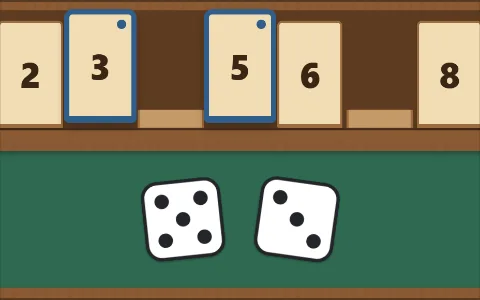
How to use this online dice roller
This page lets you roll dice right in your browser. You can roll a single die or up to ten dice at once, and the total appears the moment they land. Besides the standard six-sided die, you can pick a D4, D8, D10, D12 or D20. Use it when the dice from a board game have gone missing, when a class needs a quick probability experiment, or when a group needs something to talk about. There is nothing to install and no account to create.
Roll a die or roll several dice
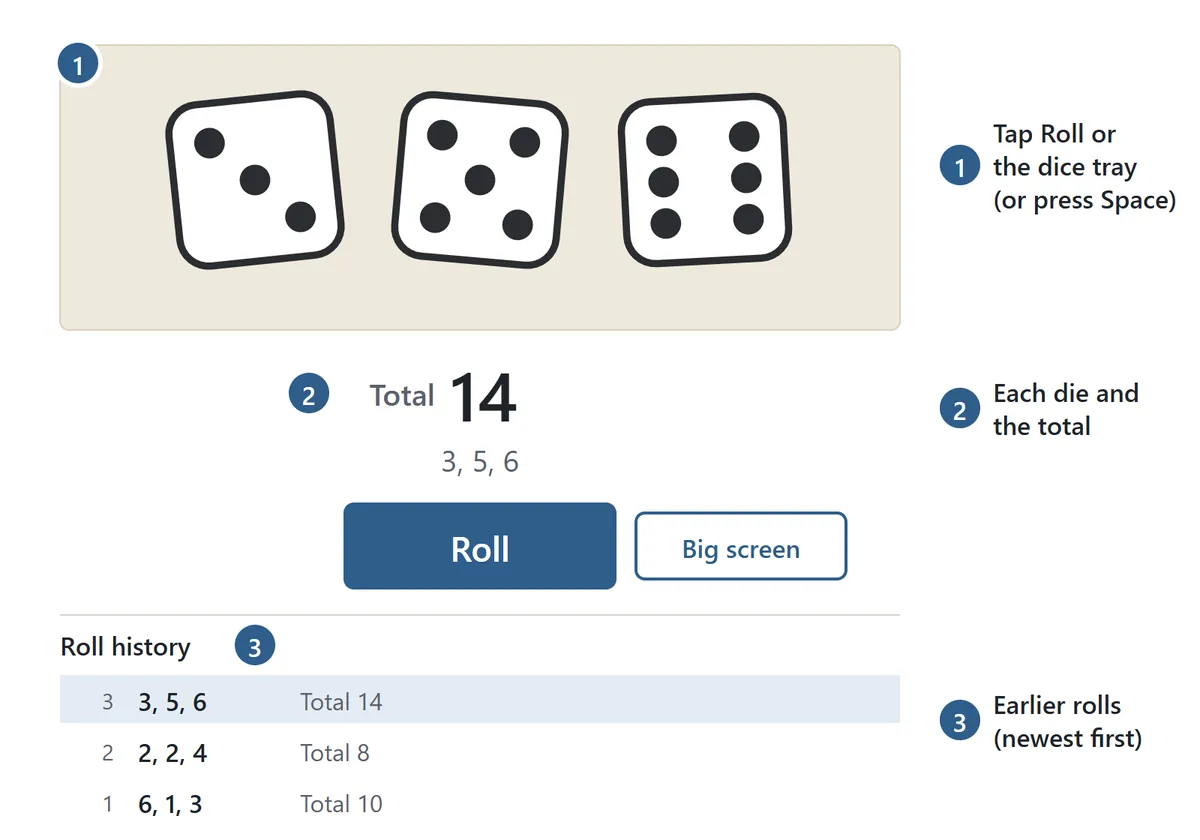
Choose how many dice you want and how many sides they have, press Start, then press Roll. You can also tap or click anywhere on the dice tray, and on a computer the Space bar works too. The dice bounce and spin for a moment, then settle. Underneath you will see the total in large type and each die's number in a smaller line, so you never have to add them up in your head.
Every roll is added to the roll history, newest first, and the last 50 rolls are kept. That is handy in a board game when someone asks what was rolled a moment ago, or when you want to count how many times a number has come up. The history is saved on your device, so if you close the page you can press Continue later and pick up where you left off. To wipe it, press Clear history twice.
D4, D6, D8, D10, D12 and D20 dice
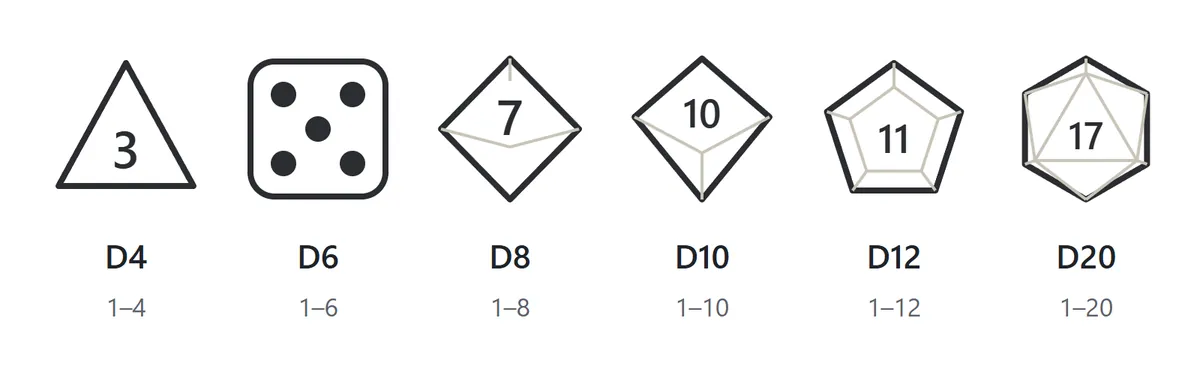
You can roll anywhere from one to ten dice. The six-sided die shows traditional pips; the others show a number inside an outline of their shape. Whatever you choose, every number from 1 up to the number of sides is equally likely. The 6 and 9 on the larger dice are underlined, just like on real polyhedral dice, so they are easy to tell apart.
| Die | Numbers | Good for |
|---|---|---|
| D4 | 1–4 | Slower board games, choosing one of four players |
| D6 | 1–6 | Almost every board game, dice games and probability lessons |
| D8, D10, D12 | 1–8, 1–10, 1–12 | Picking a group or a number from a small range |
| D20 | 1–20 | Tabletop role-playing games, picking from a larger range |
Big screen mode for projectors and game nights
Press Big screen (or the F key) and the dice and total fill the whole screen. On devices that support it, the page goes full screen, so you can put it on a projector or a TV and everyone in the room can watch the same roll. Press Exit big screen or Esc to go back. Sound starts off, so the page will not suddenly make noise in a classroom or a quiet office; press Sound: off if you would like to hear the dice.
Icebreaker dice: conversation starters

Switch the mode to Icebreaker dice and a list of six topics appears, one for each number on the die. Roll the die, talk about the topic that comes up, then pass the turn to the next person. It works well for introductions, the first meeting of a club, family dinners and team meetings.
There are four ready-made topic sets: Getting to know you, School, At home and What if. They stick to easy, friendly subjects that anyone can answer, such as a favorite food or a place you want to visit. Choose Write your own to type six topics of your own, for example review questions after a lesson or warm-up questions for a workshop. Your topics are stored only on your device.
Dice probability experiment
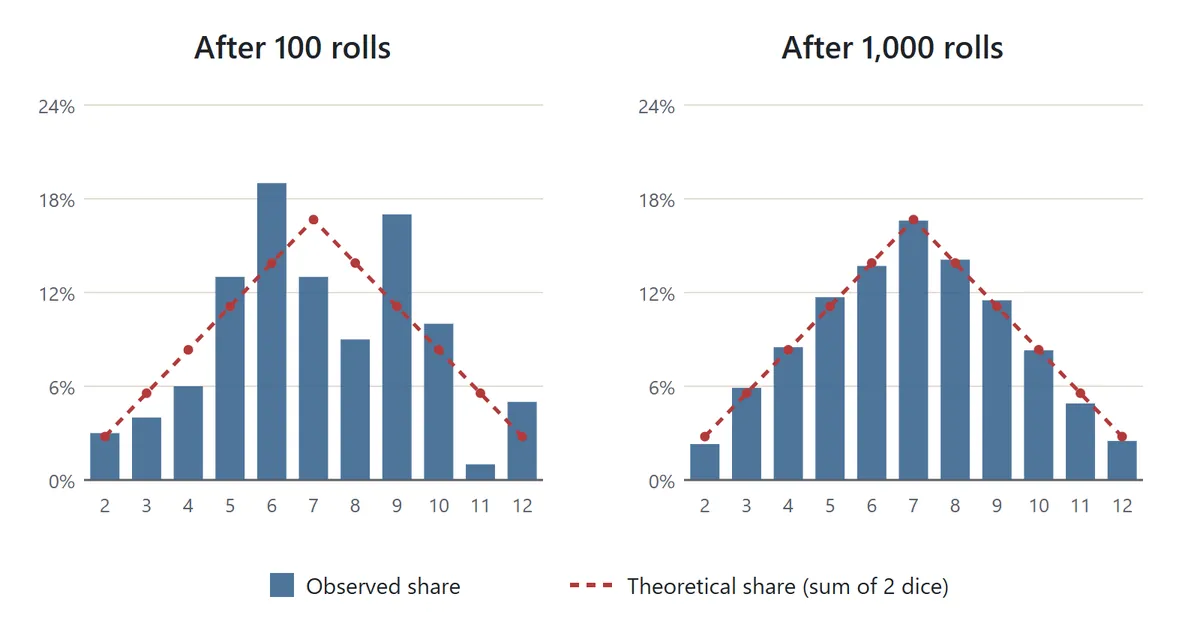
In the probability experiment you roll 1, 10, 100 or 1,000 times with one press and watch the results build up on a chart. You can roll one die or record the sum of two or three dice. Blue bars show how often each result has actually come up; the red dotted line shows the theoretical probability. Open Show the numbers for a table of counts and percentages.
After 10 or even 100 rolls the bars jump around and rarely match the line. Keep going to 1,000 or 5,000 rolls and they settle down, hugging the dotted line more and more closely. This is the law of large numbers: repeat a random experiment many times and the share of each outcome moves toward its probability. It makes a clear, hands-on demonstration for a math lesson on probability.
Why opposite sides of a die add up to 7
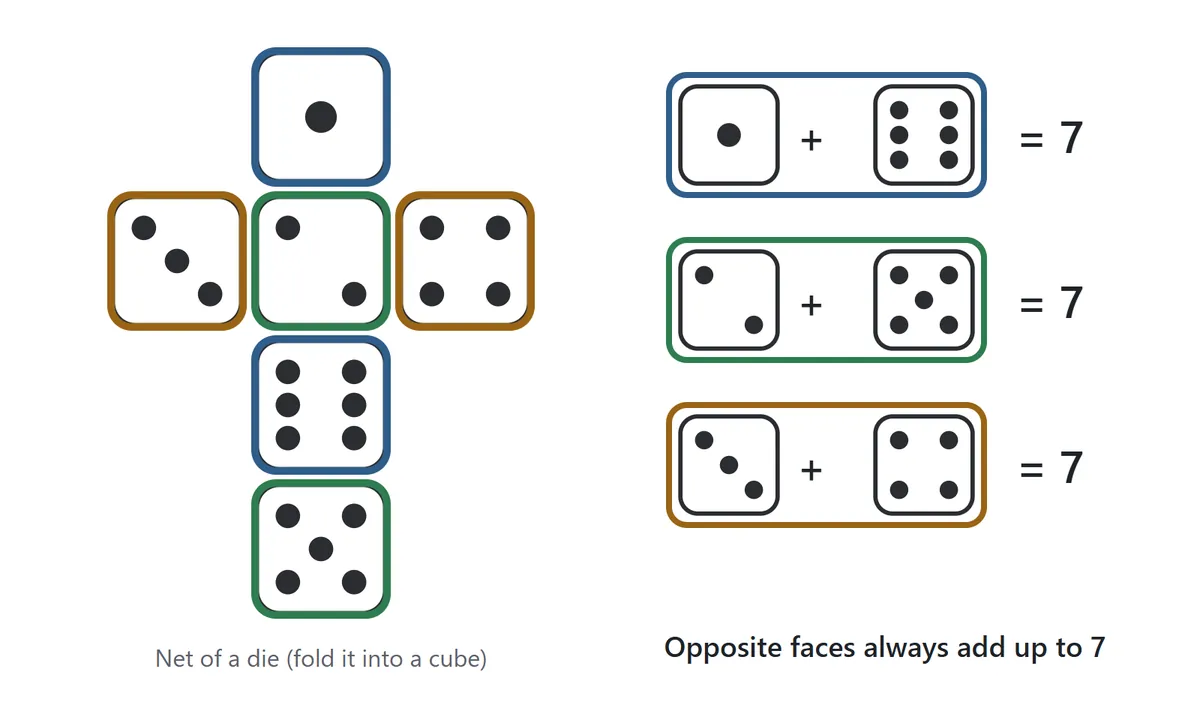
On a standard six-sided die, the numbers on opposite faces always add up to seven: 1 is opposite 6, 2 is opposite 5, and 3 is opposite 4. Because of this, the 1, 2 and 3 faces meet at a single corner. Looking at that corner, the numbers 1, 2, 3 can run either clockwise or counterclockwise, so dice come in two mirror-image versions. Western dice and Chinese dice traditionally use opposite versions.
Knowing the rule lets you read the bottom of a die from its top: if 2 is on top, 5 is underneath. It also shows up in geometry puzzles about cube nets, and folding a paper net yourself is a nice way to check it.
Dice probability: what are the odds?
One die: every number is 1 in 6
With one fair die, each number from 1 to 6 has the same chance: one in six. Earlier rolls make no difference. Even after five sixes in a row, the chance of another six is still one in six. The feeling that a number is "due" is a well-known mistake called the gambler's fallacy.
Two dice: 7 is the most likely total
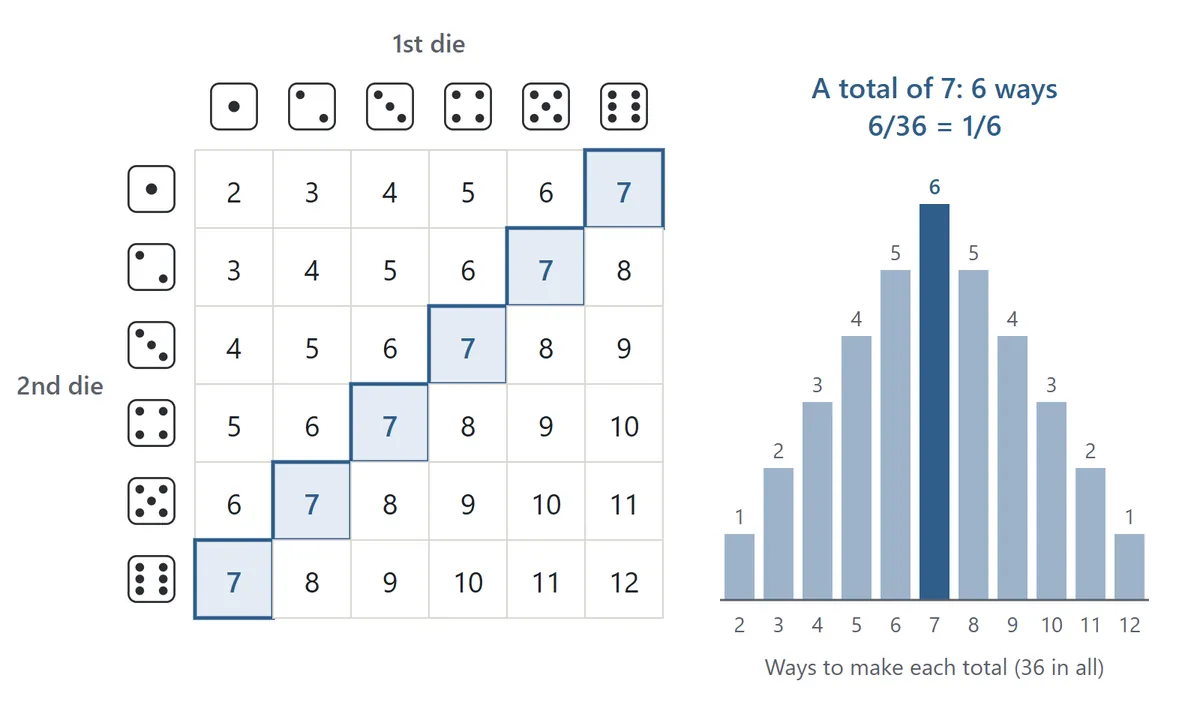
Two dice can land in 6 × 6 = 36 different ways. Six of them add up to 7 (1+6, 2+5, 3+4, 4+3, 5+2 and 6+1), so the chance of rolling a 7 is 6 in 36, or 1 in 6, higher than any other total. A 2 (double ones) or a 12 (double sixes) can only happen one way each, a chance of 1 in 36. Pick Sum of 2 in the probability experiment and roll 1,000 times: the chart forms a triangle peaking at 7.
Three dice: is 9 or 10 more likely?
With three dice, a total of 9 and a total of 10 can each be made from six different combinations, so they look equally likely. Count every order, though, and 9 comes up in 25 of the 216 possible rolls while 10 comes up in 27. Ten is slightly more likely. This puzzle is said to have been put to Galileo Galilei, who worked out the answer. Choose Sum of 3 and roll a few thousand times to see the small difference for yourself.
Using the dice roller for board games
For a race game such as snakes and ladders, set one six-sided die and take turns pressing Roll. The roll history makes it easy to settle any argument about what was rolled. For younger players a D4 makes pieces move more slowly, so the game lasts longer.
For dice games that use five dice, set five dice and roll them together. The roller also fills in when a game is short of dice or one has rolled under the sofa. To pick someone at random, choose the die closest to the group size (a D8 for eight people, a D12 for twelve) and roll again if the number is higher than the number of people, so everyone has the same chance.
Dice roller FAQ
Is this dice roller really random?
Yes. Each number comes from the cryptographic random number generator built into your browser, and the page is designed so every face is equally likely. Earlier rolls and the number of rolls have no effect. You will sometimes see the same number several times in a row, but that happens with real dice too.
Can I turn off the rolling animation?
If your device has Reduce motion turned on, the animation is shortened and the result appears almost immediately.
Does it make sound?
Sound is off at first. Press Sound: off to turn it on, and you will hear the dice rattle and land.
Does it work on phones, tablets and Chromebooks?
It does. It runs in any modern browser on phones, tablets, laptops, Chromebooks and iPads, with no app to install.
Why does the D10 go from 1 to 10 instead of 0 to 9?
Many real ten-sided dice are numbered 0 to 9, but this roller shows 1 to 10. If you need 0 to 9, simply read a 10 as 0.
A short history of dice
Dice are among the oldest gaming tools, and no one knows exactly where they began. Some of the oldest known dice were found with a board game set at the Burnt City, an archaeological site in south-eastern Iran, and are thought to date from around 2800 to 2500 BCE. Early dice have also turned up at sites of the Indus Valley civilization and in ancient Egypt, and several regions may have developed them independently. One theory is that dice grew out of knucklebones, small animal bones that were thrown in games.
Dice reached Japan from the Asian mainland around the late seventh century, as part of a board game set. Japanese dice are known for a large red pip on the one face. Over thousands of years dice have been used for games, fortune-telling and decision making, and today they are just as familiar as a simple tool for learning about chance.