 Yorimichi Games
A free bingo caller and bingo game in your browser
This page does two jobs. The bingo caller is a random number generator built for hosting a game: it draws the balls one at a time with no repeats, shows the latest number in a big ball, and keeps a board of every number called so far. Plug a laptop into a projector or TV and the whole room can follow along. The card game lets you play bingo yourself against one to three computer players. Everything runs in the browser, with nothing to install and no account to create, and you can print as many unique bingo cards as you need for your event.
How to play bingo
Bingo is one of the simplest games there is, which is exactly why it works so well for mixed groups of all ages. Each player gets a card of numbers. A caller draws numbers at random and reads them out, players mark the ones that appear on their card, and the first person to complete the winning pattern shouts “Bingo!”. The rules below are for 75-ball bingo, the version played across North America and the one used by this game’s cards.
The bingo card

A 75-ball bingo card is a grid of five columns and five rows. The letters B, I, N, G and O head the columns, and each column only uses its own range: B holds numbers 1 to 15, I holds 16 to 30, N holds 31 to 45, G holds 46 to 60 and O holds 61 to 75. The numbers are arranged differently on every card, so no two players have the same chances in the same order. The square in the very center has no number; it is the FREE space and counts as already marked. Any line that runs through the center therefore needs only four more numbers.
Calling the numbers and marking your card
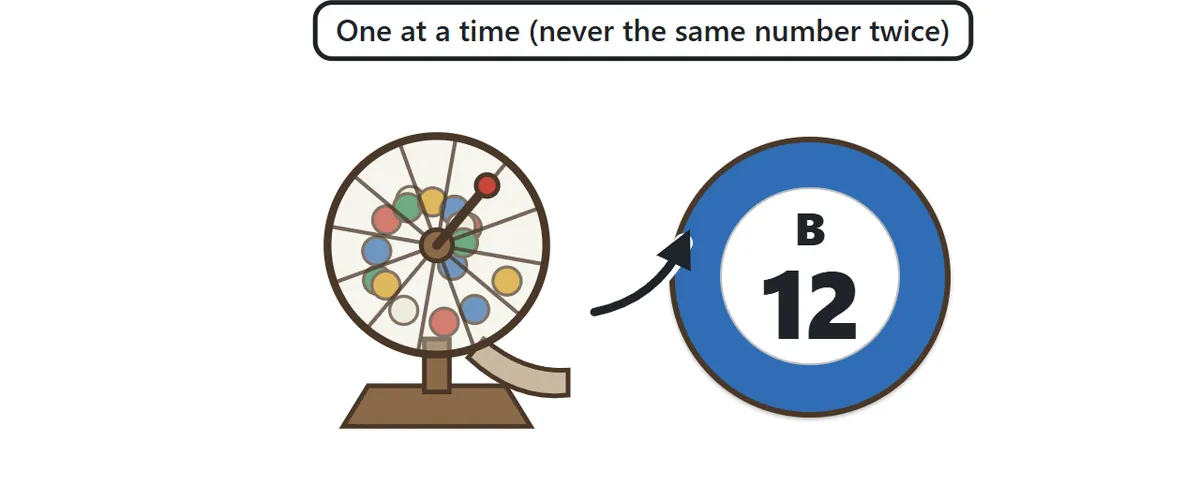
The caller spins the cage, takes out one ball and reads it aloud, usually with its letter, such as “B-12” or “O-69”. Every number from 1 to 75 is in the cage exactly once, so no number can be called twice. Our caller shows the letter on the ball too, which helps players find the right column quickly.
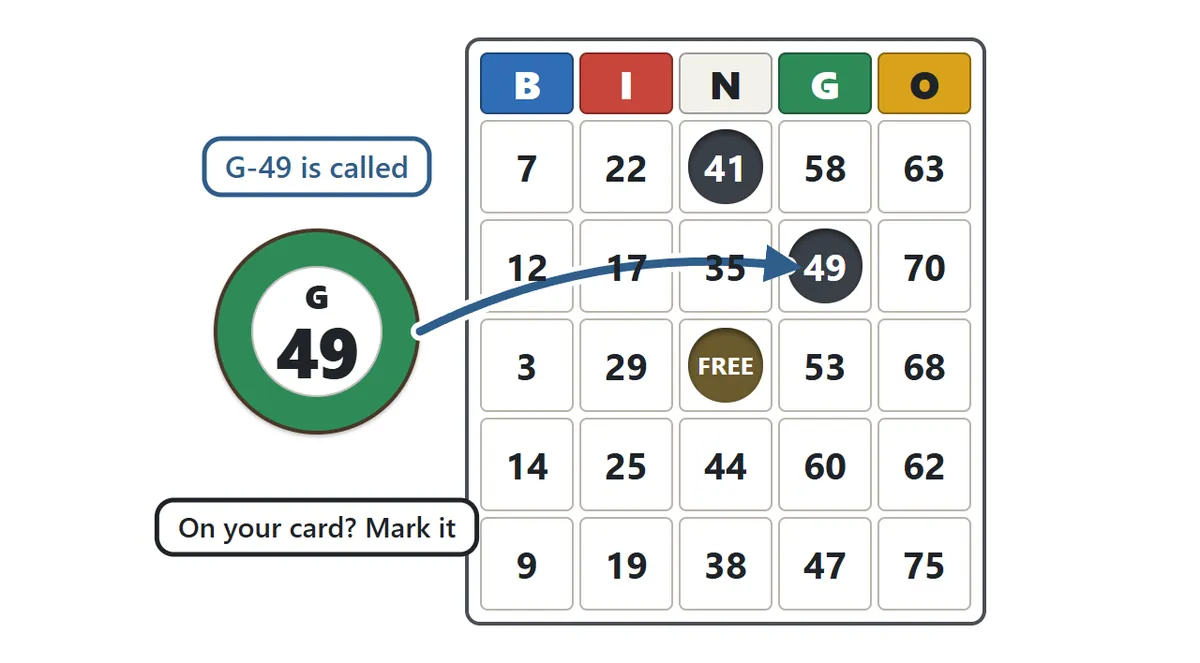
When a number is called, look for it in that letter’s column on your card. If it is there, mark it with a dauber, a pen, a bean or a coin. If it is not, simply wait for the next call.
Five in a row wins: rows, columns and diagonals
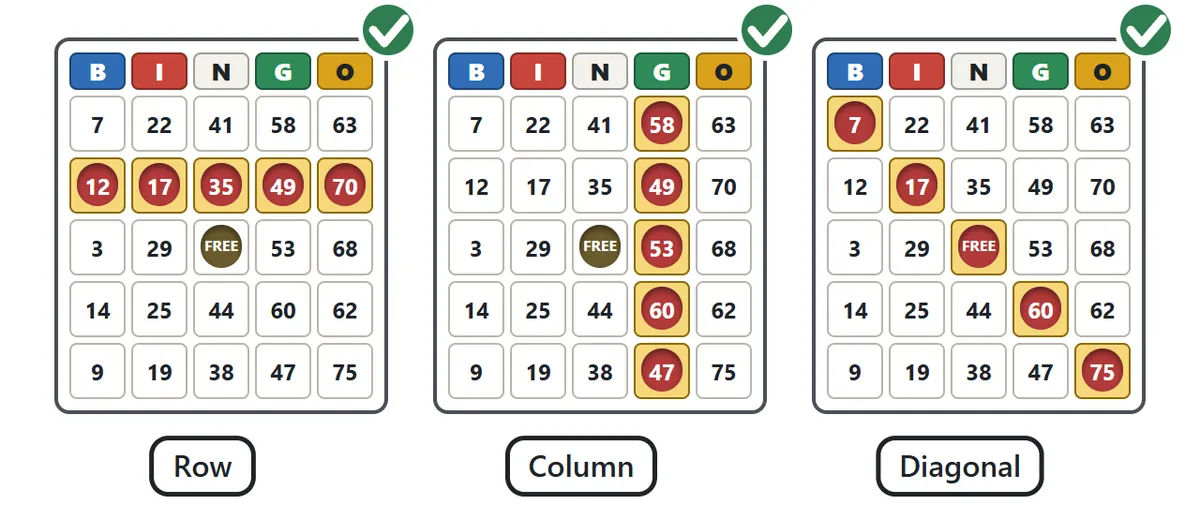
The classic winning pattern is a line of five marks: across a row, down a column or corner to corner along a diagonal. That gives twelve possible lines on every card (five rows, five columns and two diagonals). As soon as you complete one, call out “Bingo!” before the next number is drawn. The caller then checks your card against the board of called numbers. In the card game on this page you press the BINGO! button instead.
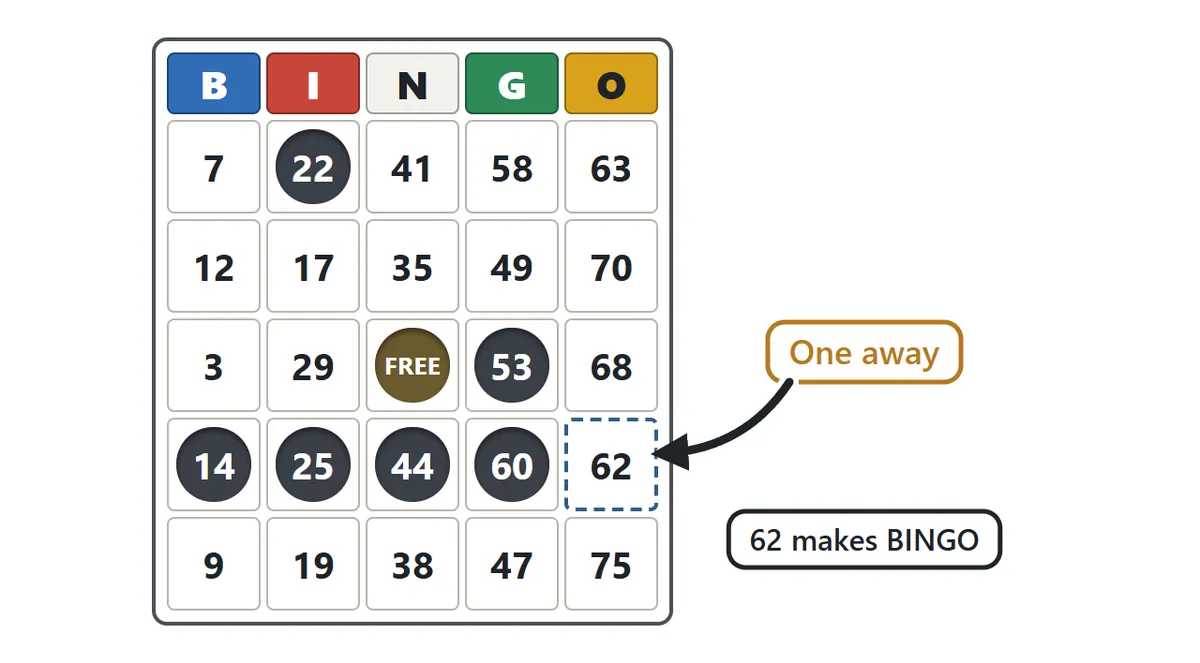
When a line needs only one more number, you are “one away” (some players say they are “waiting” or “set”). The game highlights those squares with a dotted outline so you can see which numbers would win it for you. In Japan it is common for players who are one away to raise a hand or call it out, which adds a lot of excitement at parties.
75-ball vs 90-ball bingo
There are two main kinds of bingo in the English-speaking world. They share the same idea but use different cards and numbers.
| 75-ball (American) | 90-ball (British) | |
|---|---|---|
| Numbers | 1–75 | 1–90 |
| Card | 5×5 grid, FREE center | 9×3 ticket, 15 numbers |
| Usual wins | A line, or a set pattern | One line, two lines, full house |
A 90-ball ticket has nine columns and three rows; each row has five numbers and four blank squares, and the columns run 1–9, 10–19 and so on up to 80–90. Players usually win in stages: first one line, then two lines, then a full house (all fifteen numbers). The caller on this page supports both games: choose 1–75 for American-style cards or 1–90 for British-style tickets. The printable cards and the card game use the 75-ball format.
How to use the bingo caller for a party or event
Choose Bingo caller and press Start. Each press of Spin turns the cage, shuffles the numbers on the ball and stops on one number. The board below marks every number that has been called and highlights the most recent one, which makes checking a winning card quick and fair.
- Big screen: made for a projector or a TV connected to a laptop. It fills the screen with the current ball and the full board. Press the space bar to call the next number, so you can host from the keyboard.
- Undo last: took an extra spin by mistake? Undo takes back the last number. It only works when pressed twice, so a stray click won’t change anything.
- Continue: the numbers are saved after every spin. If the page is closed or reloaded in the middle of an event, open it again in the same browser and press Continue.
- Spin animation: Long (about 3 seconds) builds suspense; Short (about 1 second) keeps a big game moving; None shows the number at once.
- Numbers: 1–75 for standard B-I-N-G-O cards, 1–90 for British-style tickets.
- Sound: off by default. Press “Sound: off” to hear the spin and the ball.
Print bingo cards (a free bingo card generator)
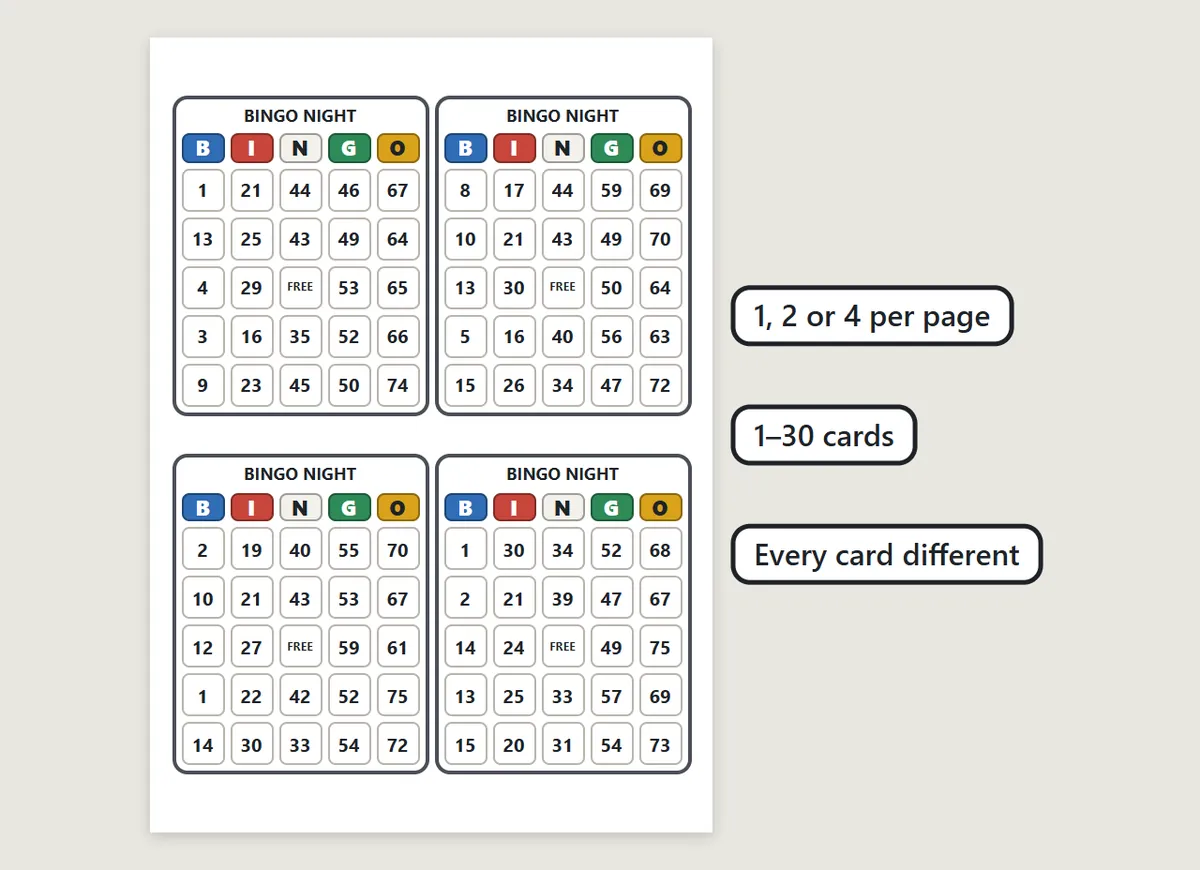
Press Print cards on the caller screen to open the card generator. Choose from 1 to 30 cards, one, two or four per page, on US Letter or A4 paper. You can put your event’s name at the top of each card and number the cards so you can tell them apart. No two cards in a set share the same numbers in the same places, and the cards print clearly in black and white. The page keeps a set number in its address, so you can print exactly the same set again later.
Play bingo against the computer
Choose Play with cards to get your own card and play against one, two or three computer players, each with their own card. There are two ways to mark your card.
With Automatic, each press of “Draw a number” calls one number and marks it on every card for you. When you are one away, a message pops up, and when you complete a line you press BINGO! to claim the win. You decide when to draw, so you can play at your own pace.
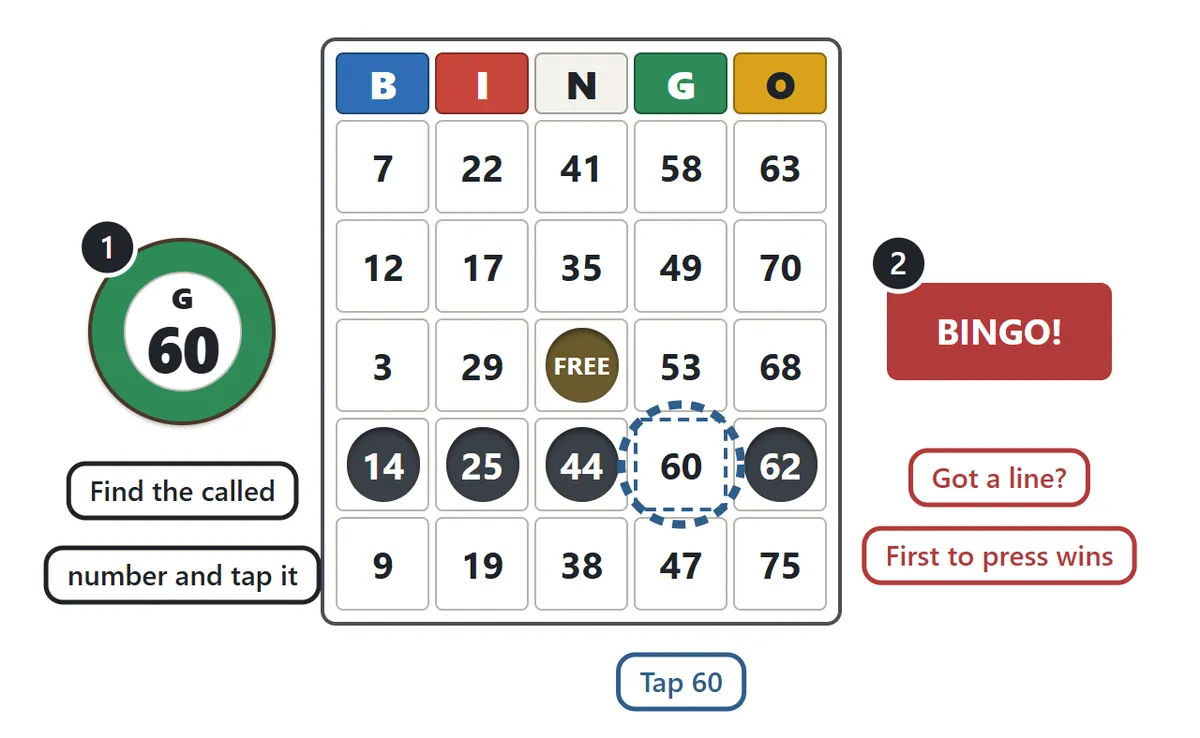
With Mark them yourself, numbers are called automatically every few seconds and you have to find and tap them on your card. You can still mark a number that was called earlier. When you have a line, press BINGO! before the computer does. The computer marks its cards instantly but takes a moment to call bingo, so a quick eye can beat it. Choose a slow, normal or fast calling speed, and pause whenever you need to.
Tips for hosting a great bingo game
1. Call the letter with the number
Saying “B, twelve” rather than just “twelve” tells players which column to look at, which speeds everything up. The caller displays the letter on every ball, so you can simply read it out.
2. Announce the pattern before you start
A single line is quick and easy for a first game. For later rounds you can make it harder: four corners, an X through the center, or a blackout (every square). The caller simply keeps drawing, so any pattern works; just check the winning card against the board of called numbers.
3. Plan prizes and rounds
The more players there are, the sooner someone wins. With a big group, the first bingo can come after twenty or so numbers. Decide in advance how many prizes each round has and whether you keep playing after the first winner.
4. Keep the board on a big screen
People miss calls, especially in a noisy room. With the board showing on a projector, anyone can check what has been called without stopping the game.
5. Search by column when playing yourself
In the speed game, look at the letter on the ball first and scan only that column of your card. It is much faster than reading the whole card, and when you see a complete line, press BINGO! straight away.
Bingo FAQ
What does the FREE space mean?
It is a square that counts as marked from the start. The four lines through the center (the middle row, the N column and both diagonals) need only four called numbers each.
What happens if two people call bingo at the same time?
There is no single rule. Many hosts split the prize or play a quick tie-breaker. Decide before the game starts. In the card game on this page, everyone who completes a line on the same number wins.
Are the numbers really random?
Yes. Each spin picks one of the numbers that have not been called yet, each with the same chance, and a number that has been drawn will not come up again.
Can I use it for 90-ball bingo?
Yes. Choose 1–90 in the settings and the board shows all 90 numbers in rows of ten. You will need your own 90-ball tickets, because the card printer makes 75-ball cards.
Will I lose the numbers if the page closes?
No. The called numbers, and any card game in progress, are saved in your browser. Open the page again on the same device and press Continue.
Which computer level should I choose?
Bingo is pure luck, so on Normal nobody can predict who will win. If you would like to win more often, choose Easy.
Does it work on phones and tablets?
Yes. Just tap the buttons. If you are running an event from a phone or tablet, turn off auto-lock so the screen stays on.
A short history of bingo
Bingo grew out of a lottery game played in Italy around 1530. In the 18th century it spread to France, where a game called le lotto used cards of three rows and nine columns with numbers from 1 to 90, the ancestor of today’s 90-ball tickets. In the United States in the 1920s the game was played at fairs as “beano”, with dried beans used to mark the cards, and it soon became known as bingo. The 5×5 card with a free center became the standard American version, while the 90-ball game stayed popular in Britain and much of the Commonwealth. Today it is a favorite at parties, community events and family gatherings all over the world.