 Yorimichi Games
How to play Liar’s Dice online
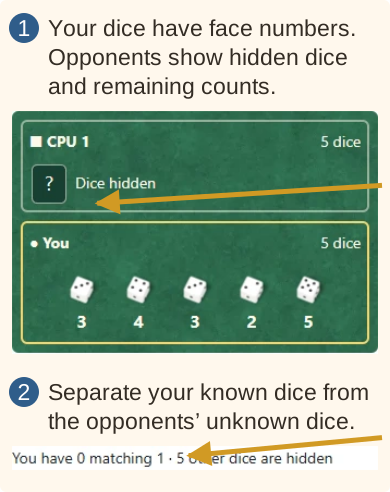
Liar’s Dice is a game of hidden information, estimation and bluffing. You see your own dice, but every call refers to the dice held by everyone still in the round. You might know that you hold two fours, then decide whether another four is likely to be hidden elsewhere. The next player must raise that claim or challenge it. You never need to announce exactly what you rolled. A convincing call can be supported by your own dice, by a reasonable estimate, or by a bluff.
Choose computer play for one person against one, two or three computer opponents. Choose pass-and-play to share one device between two to four people. Five starting dice gives a longer match; two or three makes a shorter one. Basic rules and two players are a comfortable first match. Everyone rolls one die to choose the first opener. The highest roll starts, and only the tied highest players roll again. Those selection rolls do not become your hidden dice.
At the beginning of each round, everyone rolls all their remaining dice. In computer play, your dice stay visible while the other seats show their hidden dice counts. In pass-and-play, the screen hides the previous hand before the device changes hands. The next person should take the device, ask everyone else to look away, and press Reveal my dice. Keeping that handover routine makes the game much easier to follow.
Liar’s Dice rules: calls and challenges
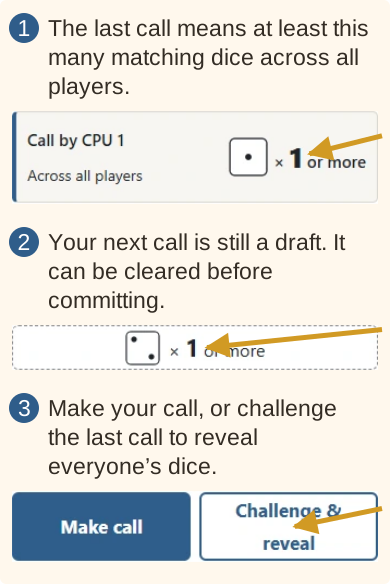
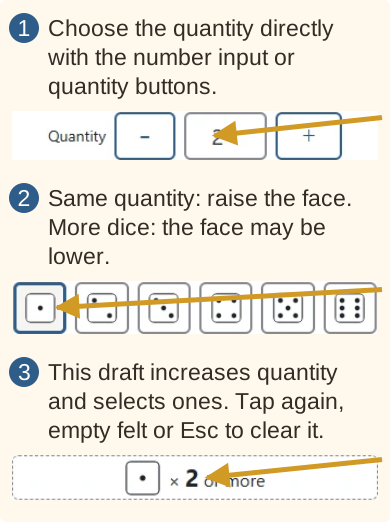
A call combines a quantity with a face, such as at least three fours. It describes the combined dice across every active seat, not just the caller’s hand. If there are five fours in total, a call of three fours is still true: the claim means at least three. Tap one of your dice or a face button, then choose a quantity button or type the quantity directly. Press Make call to commit it. Until then, tapping the selected face again cancels your draft. The previous claim remains on the table so that you can compare your choice before committing.
Raise a call by increasing the quantity, or keep its quantity and increase the face. After two threes, two fours is legal. After two fives, three twos is also legal because quantity takes priority. You cannot repeat a call, reduce its quantity, or keep the quantity while lowering the face. The quantity cannot exceed the total dice still in play. A disabled Make call button means that the selected combination is not a legal raise. There is no pass action.
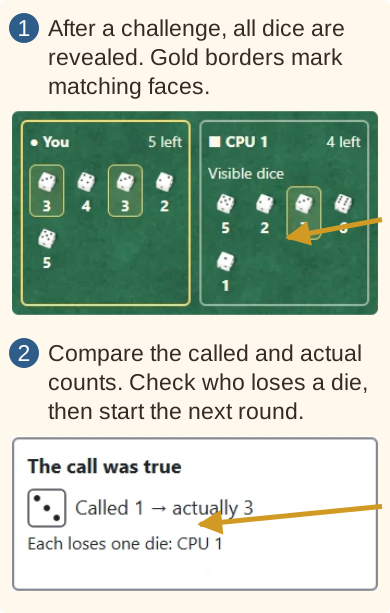
Choose Challenge when you think the previous call is too high. Every hand is revealed, and the matching dice are counted. If the total is below the call, the caller loses one die. If it meets or exceeds the call, the challenger loses one die. Equality therefore supports the original call. Read the reveal panel, compare each hand, and choose Next round to roll the remaining dice again. A player with no dice is out. The last player with dice wins the match.
Wild ones, locked faces and exact calls
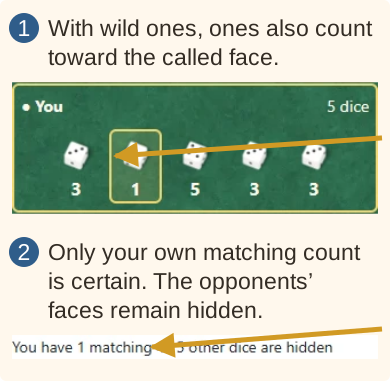
Basic counts every face normally. A claim about fours counts fours only, and a claim about ones counts ones only. Wild ones adds every one to a call about a face from two through six. A hand with two fours and a single one therefore contributes three dice to a call about fours. A call about ones still counts ones alone. A die is never counted twice. In an ordinary wild round, the opening call must use a face other than one.
The Wild ones preset uses the same quantity-first ordering as Basic. There is no half-quantity conversion when switching to ones, and no special doubling when leaving ones. Different groups may use those other conventions, so check the rules before playing somewhere else. Here, raising the quantity always allows a lower face, while an unchanged quantity requires a higher face. This keeps the sequence of calls consistent across ordinary rounds.
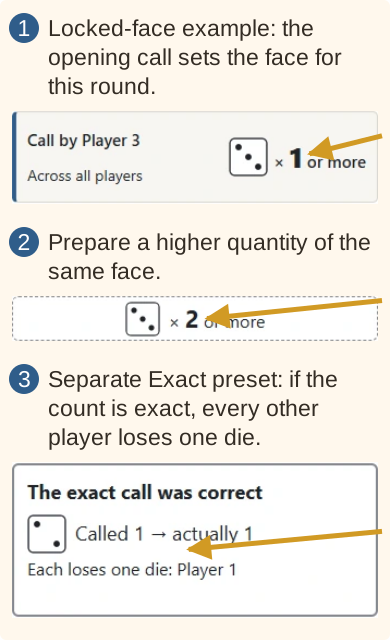
Locked face adds a special round when an opener has one die and at least three players remain. Ones are ordinary during that round, and the opener may choose one as the face. After the opening call, everyone must retain its face and raise only the quantity. If the opener calls one three, later calls can be two threes or three threes, but cannot become fours. Once only two players remain, locked-face rounds stop and ordinary wild rules continue.
Exact call adds an alternative to Challenge. Choose Exact when you think the actual count equals the previous call, with no extra matching dice. If you are right, every other active player loses one die. If the total is either lower or higher, you alone lose one die. This preset counts ones normally and rotates the next opener to the next surviving seat after the previous opener. The other presets let the player who lost a die open next, or their next surviving neighbour if they were eliminated.
Custom lets you combine wild ones, locked faces, exact calls and the next-opener rule. Locked faces require wild ones, since they are an exception to those ordinary rounds. The setup summary stays above the game so that everyone can check the selected conditions. These rules do not restore lost dice, remove a number of dice equal to a counting difference, allow mid-round rerolls, or allow a player to interrupt another player’s turn.
Liar’s Dice strategy and beginner tips
Separate certainty from expectation. If you hold two sixes, you know that at least two sixes exist. A call of three sixes needs one more from somebody else. Keeping that distinction clear helps you decide whether a call is safe or depends heavily on unseen dice. The Hint button estimates how many matching dice might exist using your own hand and the remaining dice count. It does not reveal another player’s dice and cannot guarantee the result.
Recalculate when the table gets smaller. A call of three fours means something very different with ten dice in play than with three. Under Basic rules, each unknown die has a one-in-six chance of matching a chosen face. In an ordinary Wild ones round, a face from two to six has a one-in-three chance because its own face and one both count. These are average chances, not promises. Small hands often contain uneven clusters.
Watch which raises remain available. Increasing the face can keep the quantity low for another turn, but reaching six leaves the next person needing more dice. A useful face in your own hand is only part of the decision: the next player’s possible choices also matter. During a locked-face round, nobody can change the face, so increasing quantities reach uncertain territory quickly. Read the round message carefully when that exception is active.
Do not challenge solely because a call looks bold. The caller may hold a cluster you cannot see. Equally, a confident-looking call does not prove that the dice support it. Compare recent calls in the history with the remaining dice counts. Patterns can suggest a possibility, but each new round rolls every surviving die again. A face that appeared frequently last round does not become more likely on the next roll.
Use Exact more cautiously than Challenge. Challenge only needs the total to fall below the call. Exact must match a single count, and both too few and too many dice make it fail. If your feeling is simply that the claim is too large, Challenge matches that idea. Reserve Exact for moments where your own information and a small number of unknown dice give you a specific reason to expect equality.
After a reveal, look for the reason your estimate differed from reality. Perhaps you forgot to include wild ones, relied on a large-table estimate after several eliminations, or confused at least with exactly. That brief review is more useful than trying to remember every roll. Easy computer play gives room to learn the call sequence. Normal asks you to reconsider thin raises, while Hard rewards closer attention to the remaining dice and the options you leave to the next seat.
Liar’s Dice FAQ and controls
Can I call a face I do not hold? Yes. Your claim concerns everyone’s dice, so your own hand need not contain that face. Can I know whether a call is true before challenging? Only when your own dice already prove the minimum. Otherwise you combine known information with a guess about the hidden hands. The reveal determines the actual total, rather than how confident a player sounded.
Can the same quantity use a different face? In an ordinary round, only a higher face is allowed. Increasing the quantity allows any face. A locked-face round does not allow the face to change at all. What happens after elimination? A player whose count reaches zero no longer takes turns. If you are eliminated in computer play, you can still inspect each reveal and continue the remaining match until the final winner is known.
Can I continue later? The same device and browser can resume a saved match with Continue. The Japanese and English pages share that match, so changing language does not start over. Browser settings that block storage, or clearing browser data, can remove the saved state. Pass-and-play always returns with the hand hidden until the correct person reveals it. The save does not include names, messages or information sent to another service.
Tap your own dice or a face button, then choose a quantity button or type the number directly. The current call and your uncommitted draft are separate. Make call commits that draft; Challenge & reveal judges the previous player’s call. Tap the selected face again, empty space on the board, Clear draft or Esc to cancel an uncommitted draft. Calls and reveals cannot be undone. Continue CPU lets you review a computer call before advancing another computer. Pause, sound and settings are below the board. P pauses or resumes. On a keyboard, number keys one through six select a face, the up and down arrows change quantity, Enter makes a call, C challenges, and E makes an exact call when enabled. When a form control or button has focus, its normal keyboard behaviour takes priority. Sound begins off and can be toggled with the sound button. Settings lets you pause and change the setup; Continue returns to the saved match.
About this hidden-dice game
Games that combine hidden dice with increasing claims appear in several regional traditions and groups of friends. Liar’s Dice is a widely used English name, while Dudo names a related South American tradition. A familiar name does not guarantee identical rules: wild faces, exact calls and the next opener can all change how a round feels. Agreeing on a preset before starting gives everyone the same expectations. This version offers computer opponents and local pass-and-play on a shared device.
Preset quick reference
| Preset | Ones and exceptions | Next opener |
|---|---|---|
| Basic | Ordinary ones | Die loser |
| Wild ones | No opening ones | Die loser |
| Locked face | 3+ remain; opener has one | Die loser |
| Exact call | Correct: everyone else loses one | Next surviving seat |