 Yorimichi Games
How to play xiangqi
Xiangqi, often called Chinese chess, is one of the most played board games in the world. You see it in parks and on street corners all over China and Vietnam, and it is a cousin of Western chess and Japanese shogi: all of them grew out of the same family of ancient war games. Two players, Red and Black, each command sixteen pieces and take turns moving one piece at a time. The goal is to trap the opposing general, just as you checkmate the king in chess.
Xiangqi has its own flavor, though. The pieces stand on the points where lines cross, not inside squares. A river splits the board in two, each general is confined to a small palace, and the cannon captures by jumping over a piece. This page lets you play against the computer at three levels or against a friend on the same device. When you pick a piece, blue dots show every point it can reach, and if you tap a point it cannot reach, the game explains why — for example, “the horse is hobbled.” That makes it a gentle way to learn the rules by playing.
The board and the starting position
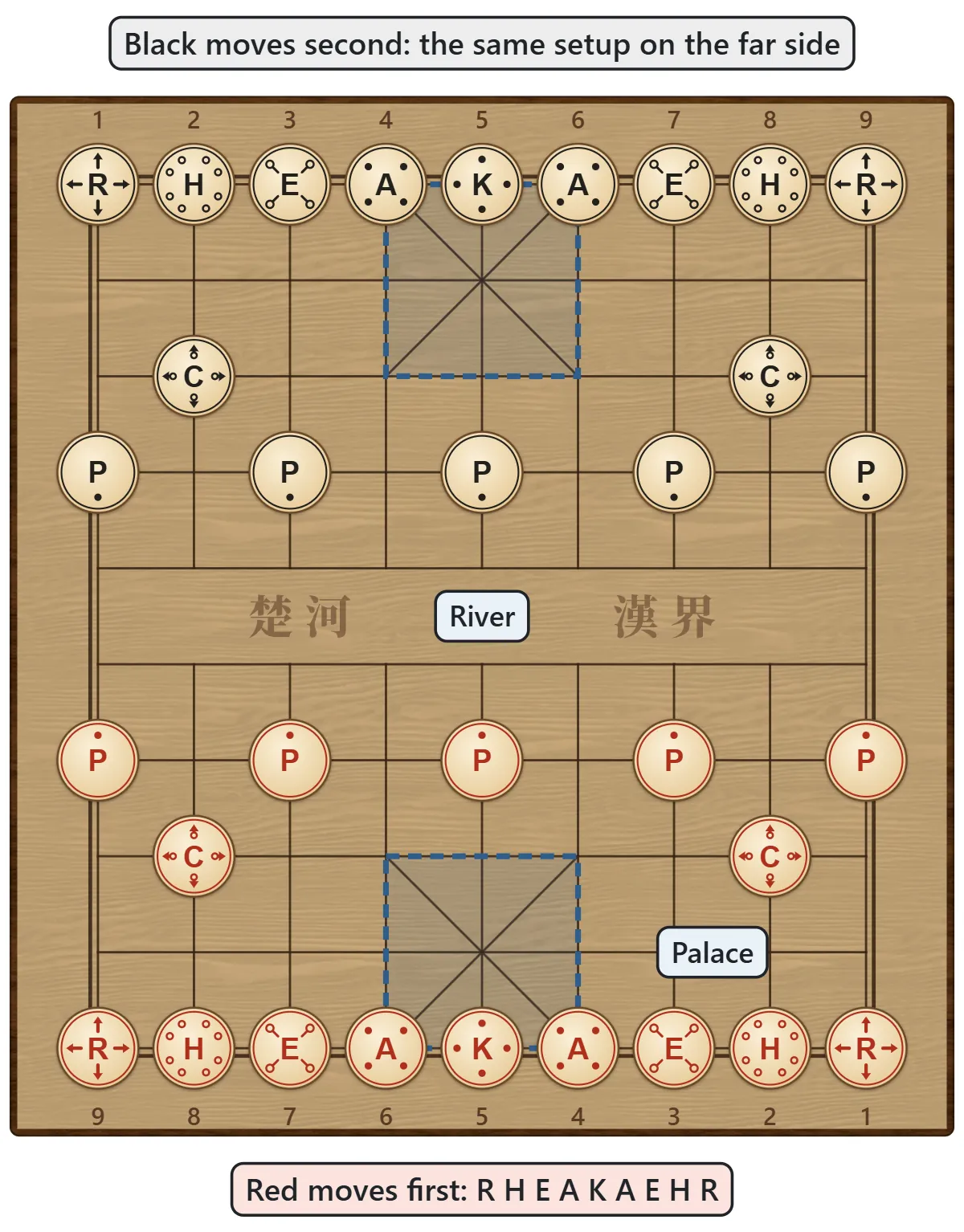
The board has nine vertical lines (files) and ten horizontal lines (ranks), which gives 90 points. The gap across the middle, where the vertical lines stop, is the river. It usually carries a short inscription in Chinese characters that refers to the ancient war between the states of Chu and Han. At each end there is a 3×3 area marked with an X: this is the palace. The general and its two advisors can never leave their palace.
Each player has sixteen pieces of seven kinds. On the back rank, from left to right: chariot, horse, elephant, advisor, general, advisor, elephant, horse, chariot. Two ranks in front of the horses stand the two cannons, and on the rank next to the river stand five soldiers on every other point. Black mirrors this setup on the far side. The two sides use slightly different characters for some pieces, but pieces of the same kind move the same way for both colors. Red always moves first.
How the pieces move (xiangqi rules for each piece)
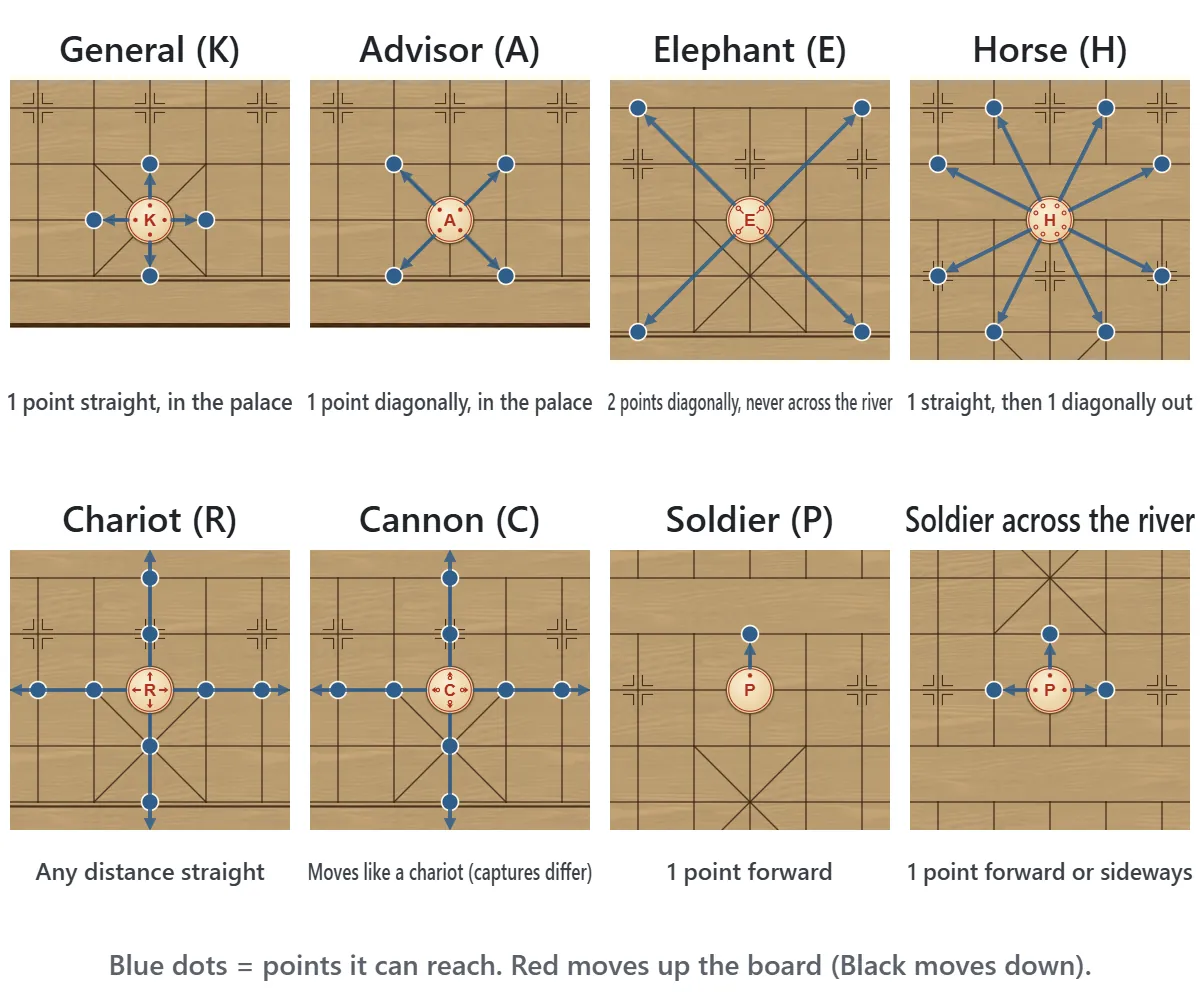
On your turn you must move one piece; you cannot pass. If an enemy piece stands on a point your piece can move to, you capture it and take its place. Captured pieces leave the game for good — unlike shogi, you can never drop them back onto the board.
| Piece | How it moves |
|---|---|
| General (K) | One point up, down, left or right. Never leaves the palace |
| Advisor (A) | One point diagonally. Never leaves the palace, so it only ever uses five points |
| Elephant (E) | Exactly two points diagonally. Cannot jump the point in between, and cannot cross the river |
| Horse (H) | One point straight, then one point diagonally outward. Blocked if the first point is occupied |
| Chariot (R) | Any distance straight, like a rook in chess |
| Cannon (C) | Moves like a chariot, but captures only by jumping exactly one piece |
| Soldier (P) | One point forward. After crossing the river, also one point sideways. Never backward |
There is no promotion in xiangqi. The only piece that changes is the soldier, which gains its sideways step once it reaches the far side of the river. A soldier that reaches the last rank can still move sideways along it.
Three rules that trip up beginners
The hobbled horse
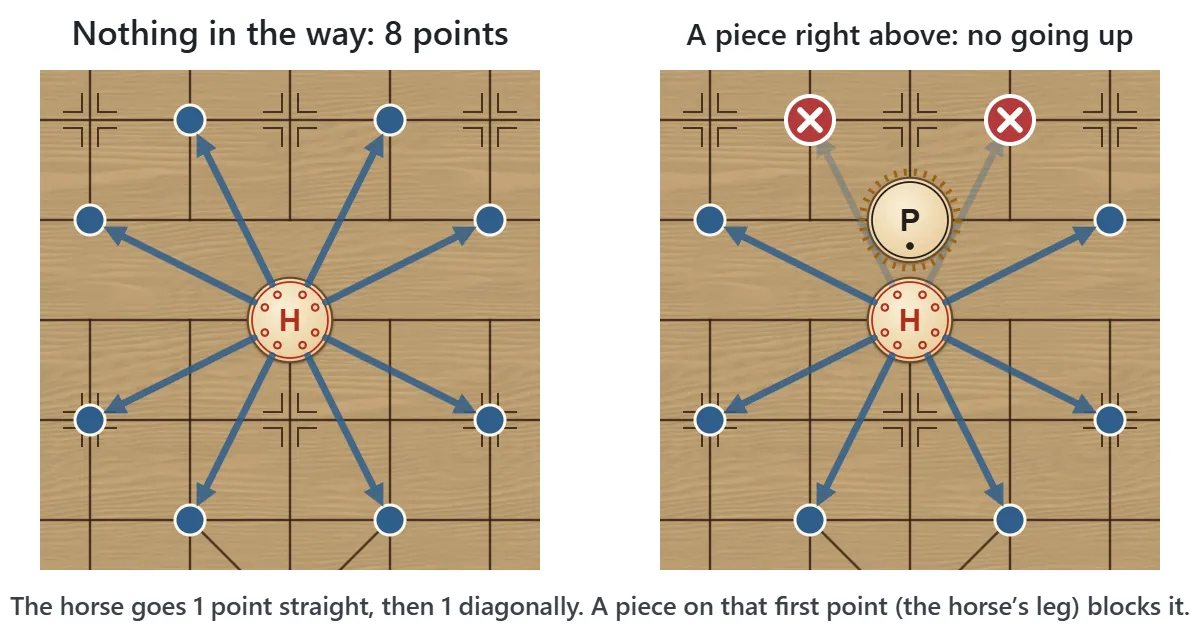
The horse moves in the same L shape as a knight in chess, but it does not jump. Think of the move as one step straight, then one step diagonally outward. If the first point is occupied — by either side — the horse cannot go that way. This is called hobbling the horse’s leg. Because of this rule, one horse can sometimes attack another horse that cannot attack back. With the move guide on, the game marks the piece that is hobbling your horse.
The elephant’s eye and the river
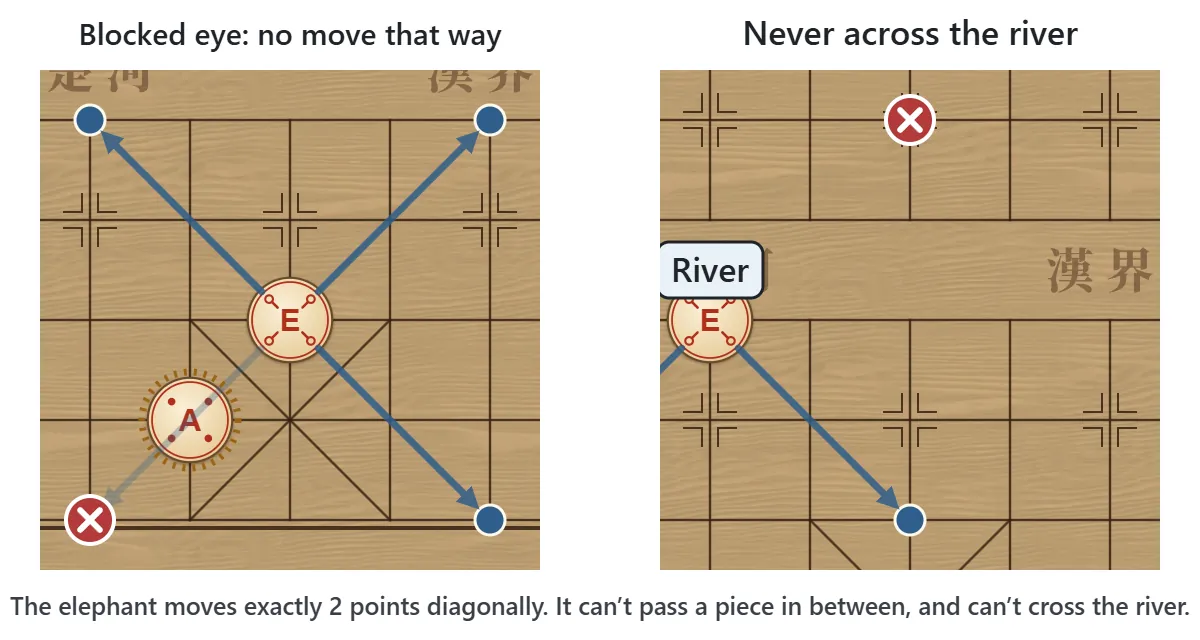
The elephant moves exactly two points diagonally, like the corners of a 2×2 square. If the point in between, the elephant’s eye, is occupied, it cannot go that way. Elephants can never cross the river, so they only ever use seven points on their own side. They are purely defensive pieces that protect the general.
How the cannon captures
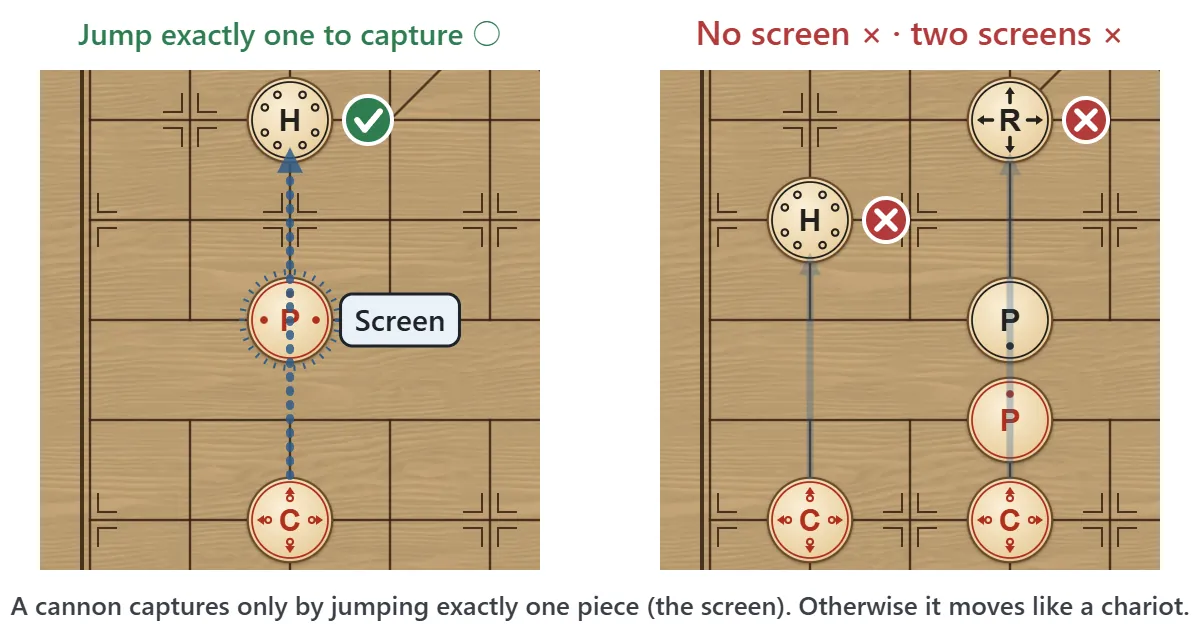
The cannon moves like a chariot when it is not capturing. To capture, it needs exactly one piece of either color — called the screen — between itself and its target, and it jumps over the screen to take the target. With no piece in between, or with two or more, it cannot capture. It also cannot jump over anything when it is not capturing. From the starting position, the cannons can already use the soldiers and horses as screens, so watch out for them from the very first moves.
The flying general rule
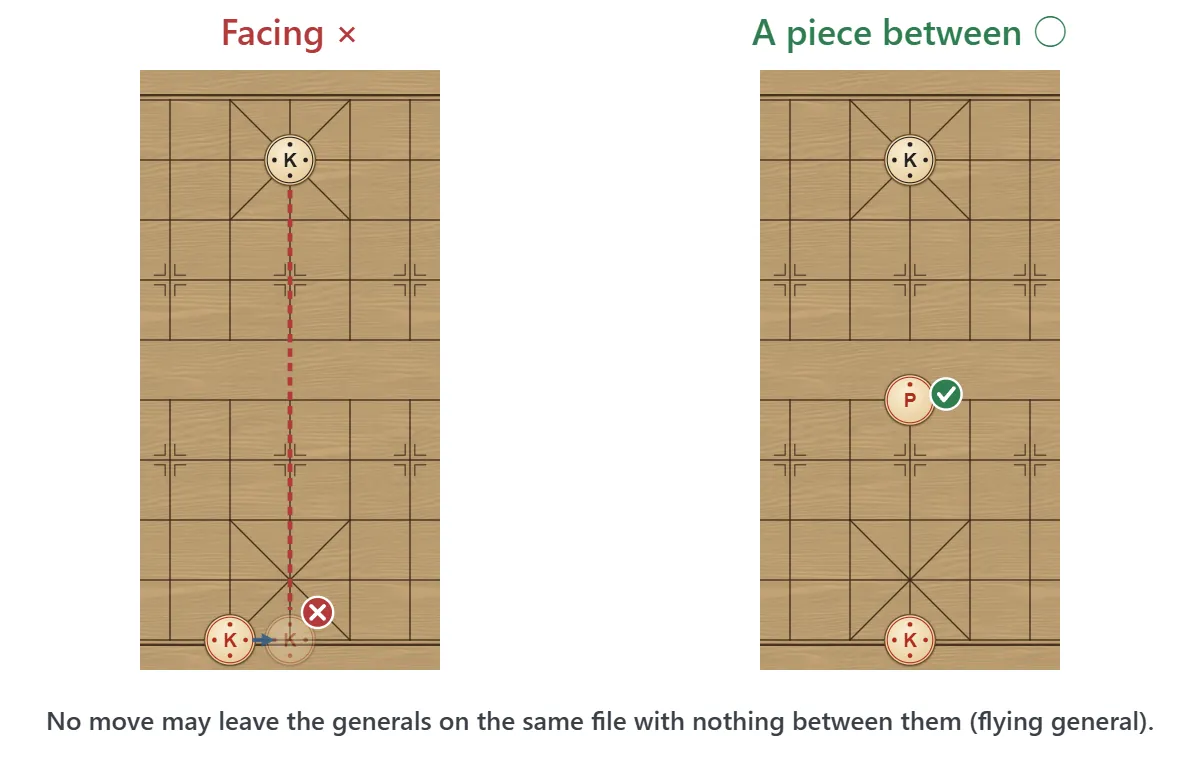
The two generals may never face each other on the same file with nothing in between. Any move that would create this — stepping the general onto the open file, or moving away the only piece standing between them — is illegal, and this game simply does not allow it. Players call this the flying general rule: you can imagine each general firing down an open file like a chariot. In the endgame it becomes a powerful weapon, because your own general can take away an escape route from the enemy general without moving close to it.
Check, checkmate and stalemate

A move that threatens to capture the enemy general is a check. When you are in check you must get out of it at once: move your general, capture the checking piece, or block the line. Against a cannon there is a fourth option — move the screen away. If there is no way out, it is checkmate and you lose.
Unlike Western chess, stalemate is a loss in xiangqi. If it is your turn and every move would leave your general open to capture, you lose even if you are not in check.
Repetition, perpetual check and perpetual chase
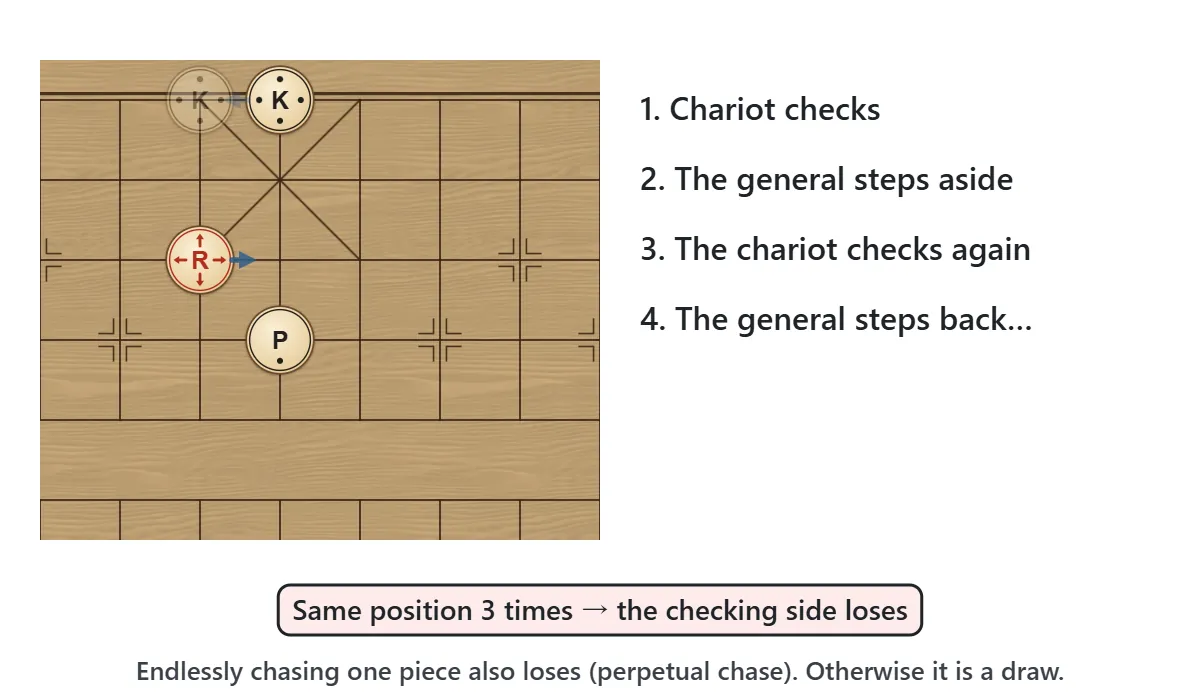
In chess, endless checking is a common way to save a lost game with a draw. Xiangqi forbids it. In this game, when the same position (the same pieces on the same points, with the same side to move) appears for the third time, the moves in that cycle decide the result:
- If one side gave check with every move, that side loses (perpetual check).
- If one side kept attacking an unprotected enemy piece with every move, that side loses (perpetual chase).
- If both sides kept checking, or neither side broke a rule, the game is a draw.
The game warns you when a position repeats for the second time, so you can change your move in time. Two more draw rules apply: if no piece is captured for 60 moves by each side, and if neither side has any attacking piece left (chariot, horse, cannon or soldier), the game is drawn.
Reading xiangqi notation
The move list under the board uses WXF notation, the standard way to write xiangqi moves in English. A move like C2=5 has four parts: the piece letter, the file it starts on, the direction, and a number. Files are counted from each player’s own right, from 1 to 9. The direction is + for forward, - for backward and = for sideways. For a piece moving straight forward or backward, the number is how far it moves; for a sideways or diagonal move, it is the file it lands on. So C2=5 means “the cannon on file 2 moves across to file 5,” the most popular first move in xiangqi, known as the Central Cannon. When two identical pieces share a file, + and - after the letter mark the front and rear one (R+=5). If you prefer, switch the notation to coordinates (Ch3-e3), which name each point from a1 in Red’s lower left corner to i10.
Move guide, hints and undo
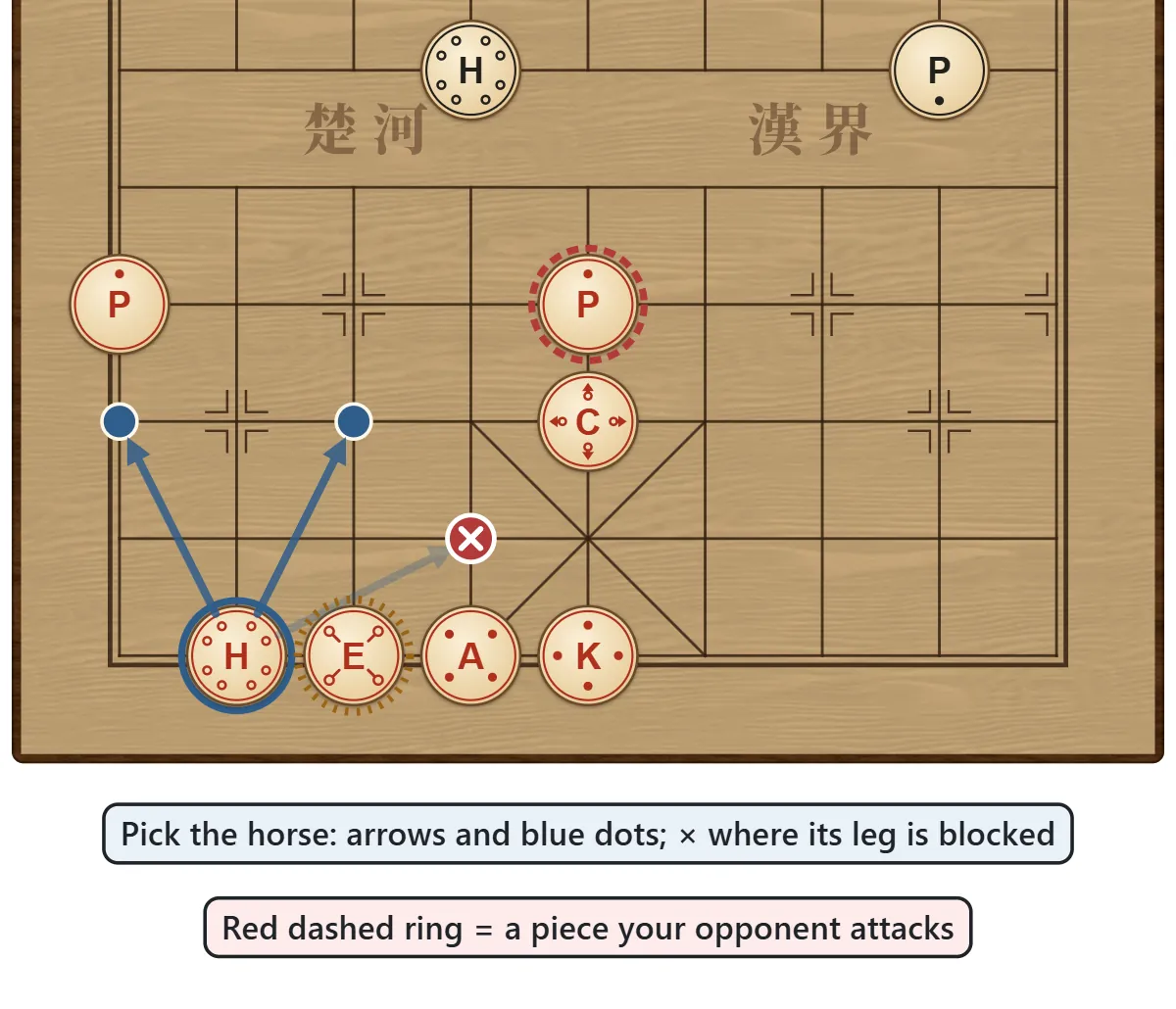
With the move guide on, picking a piece draws arrows to its moves, marks the piece that hobbles a horse or blocks an elephant’s eye, and circles any of your pieces the opponent is attacking. Hint shows a good move with a green arrow, and Undo takes back the computer’s reply together with your move. The letter pieces show their own moves with small marks, so friends who cannot read Chinese characters can play straight away; switch to traditional pieces any time in the settings.
Xiangqi strategy: tips for beginners
1. Get your chariots out early
The chariot is the strongest piece in xiangqi — often said to be worth a horse and a cannon together. It starts in the corner with no room to move, so open a path for it early by advancing the edge soldier or developing the horse beside it. Then keep it safe: losing a chariot for less is usually decisive.
2. Watch the cannon’s screens
A cannon needs exactly one piece between itself and its target. A piece of yours standing in front of a valuable piece can become the screen that lets the enemy cannon capture it. Check every line an enemy cannon looks down before you move.
3. Keep your horses free
Horses are easily hobbled, often by your own pieces. Give them open points around them. In the other direction, placing a piece next to an enemy horse is a cheap way to shut it down.
4. Push soldiers across the river, then stop
A soldier that has crossed the river can move sideways and becomes a real attacker near the enemy palace. But soldiers never move backward, so one that runs all the way to the last rank loses most of its power. A soldier sitting just in front of the enemy palace is often at its strongest.
5. Value your advisors and elephants
They never leave home, but they block the lines and points that enemy chariots and horses use to check your general. Lose them cheaply and you will find your general mated quickly in the endgame.
6. Use your general in the endgame
Thanks to the flying general rule, your general controls its whole file. In the endgame, step it sideways to take an escape file away from the enemy general; even a single chariot or soldier can then deliver mate.
Xiangqi FAQ
How is xiangqi different from chess?
The pieces stand on points, the board has a river and two palaces, the cannon captures by jumping, soldiers never promote, the generals may not face each other, and stalemate is a loss rather than a draw. Endless checking is not allowed either. If you know chess, the chariot is the rook and the horse is a knight that can be blocked.
How strong is the computer?
Easy often misses captures and leaves pieces hanging, so it is a good first opponent. Normal sometimes looks ahead and wins material in exchanges; once you know the moves you can beat it more often than not. Hard calculates more and quickly punishes loose pieces, especially your chariots and horses.
Can I play as Black?
Yes. Choose Black under “Your side” and the board turns around so your pieces are at the bottom; the computer moves first as Red. Random picks a side for you each game.
What do the messages about blocked moves mean?
When you pick a piece and tap a point it cannot reach, the game tells you why: the horse is hobbled, the elephant’s eye is blocked, the cannon has no screen, the move would leave the generals facing each other, and so on. Tapping a few points on purpose is a quick way to learn the rules.
Can I stop and continue later?
Yes. On the same device and browser, press Continue to pick up where you left off, move list included. Sound is off at first; press “Sound: off” to turn it on.
A short history of xiangqi
Many historians think xiangqi descends from chaturanga, the ancient Indian game that also gave rise to Western chess, while others argue it developed within China; the question is still open. The game took on a form close to today’s during the Song dynasty, roughly a thousand years ago. The inscription on the river recalls the struggle between Liu Bang of Han and Xiang Yu of Chu at the end of the third century BC. Today xiangqi is played by many millions of people in China, Vietnam and Chinese communities around the world, with professional leagues and international championships.