 Yorimichi Games
Usunoro rules and setup
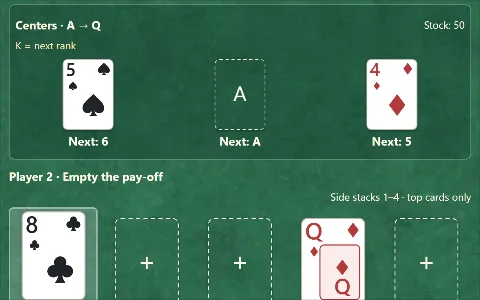
Usunoro is a Japanese card-passing game in which players collect four cards of one rank and race to take a shared token. This version always has four seats. It uses sixteen cards: the ace, two, three and four in all four suits. Each player receives four cards. Three tokens sit in the middle, one fewer than the number of players. There are no jokers, draw pile or discard pile.
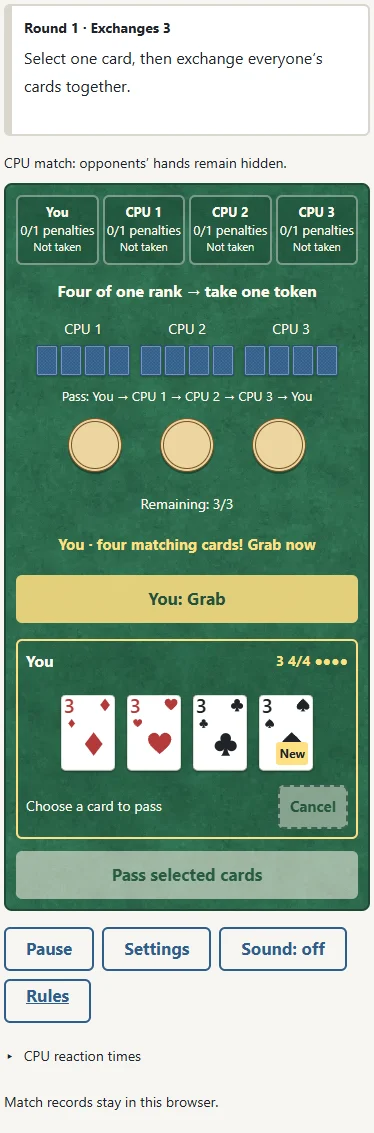
Try to collect all four cards of the same rank. The ace of spades, ace of hearts, ace of clubs and ace of diamonds form a matching hand. Four cards of one suit are not the goal, and high ranks have no advantage over low ranks. Choose which rank to keep and pass an unwanted card to the next seat.
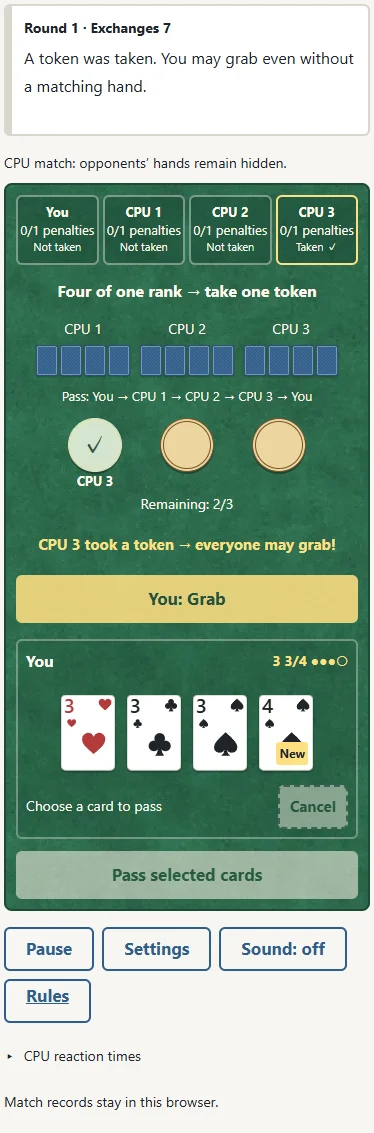
Because there are only three tokens, one player will be left without one. The first grab requires a matching hand. After a legal first grab, everyone else may take a token even if their cards do not match. You therefore need both a collecting plan and attention to the shared tokens.

Passing one card simultaneously
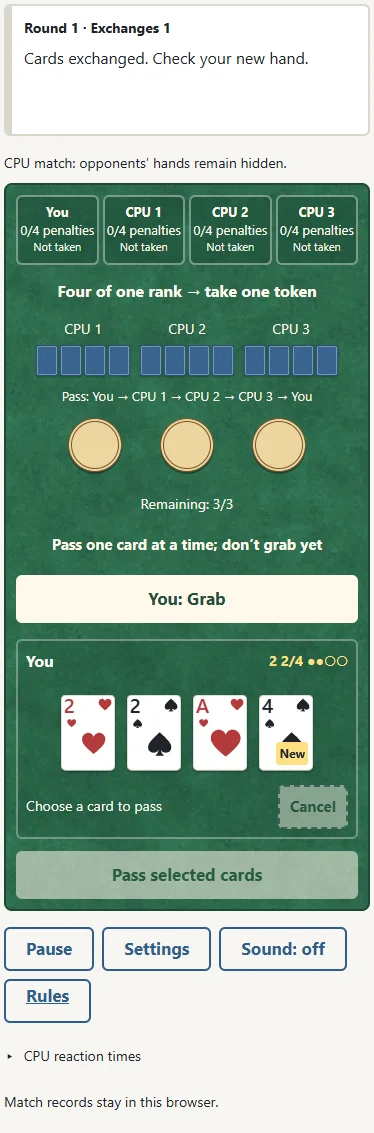
Select one card in your hand. Its border marks it as the card you intend to pass. Tap it again, tap blank space, press Escape or use that hand’s Cancel button to deselect it. Exchange passes one card from every seat at the same time. Each person receives the card chosen by the previous seat, leaving everyone with four cards. All choices use the hands from before the exchange. A newly received card cannot be passed onward within that same exchange.
The default direction follows seats one, two, three, four and back to one. You may also choose the reverse direction in settings. In either direction, every player sends exactly one card and receives exactly one card. The same sixteen physical cards remain in play throughout the round.
Usually, keep the rank you already have most of. With three twos and an ace, passing the ace leaves you waiting for the last two. With two pairs, decide which pair to keep. If the same cards keep circulating, another collecting plan may become useful. Once someone takes the first token, card passing stops and the other players concentrate on grabbing.
The first grab and the follow-up race
Press your own Grab button when your four cards share one rank. In CPU mode, you can also tap a central token directly. This is allowed immediately after the initial deal if you already have a complete set. When the first legal token is taken, all other players may grab regardless of their hands. Watch the remaining-token count and the Taken labels beside the seats. Each player can take only one token; repeated presses cannot collect extras.
Grabbing first without a matching hand is an early grab. That player receives one penalty and the round ends. No additional player is penalized for that round. After a legal first grab, however, matching cards are no longer required. Knowing which condition currently applies is more useful than tapping repeatedly.
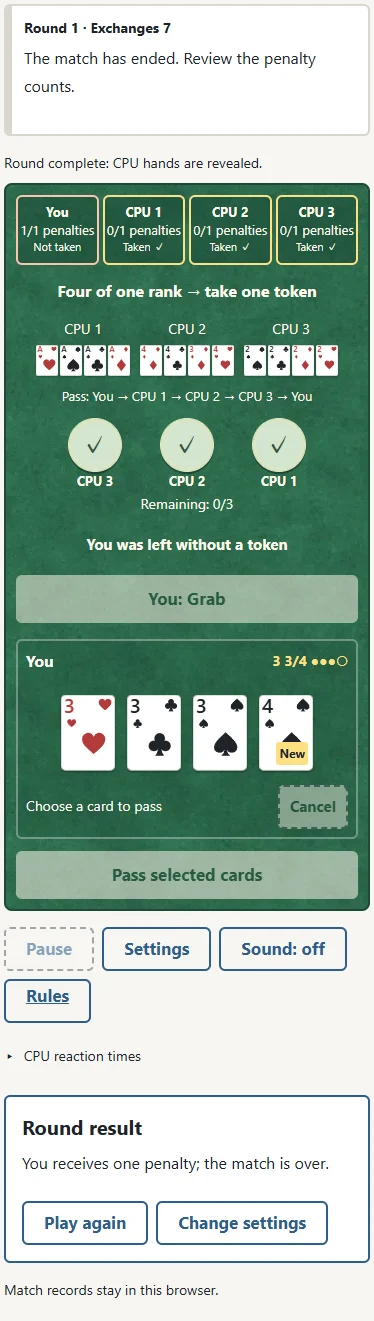
When three players have tokens, the remaining player receives a penalty. A short match ends after one penalty. The standard match continues with fresh deals until someone reaches four penalties. The result describes this card game only. It does not label a player’s character or general ability.
CPU difficulty and reaction timing
A CPU match has you and three computer players. Opponent hands stay face down until the round ends. Each CPU selects a passing card from its own hand, generally keeping the rank it holds most of. Tied collecting plans may lead to different choices. The CPUs do not inspect your hand to withhold cards you need, and changing difficulty does not select a different deal or replace cards.
Difficulty changes reaction times, not the passing policy. Easy uses 650–1050 milliseconds for a first grab and 550–1000 milliseconds for a follow-up. Normal uses 590–990 and 490–940 milliseconds. Hard uses 540–940 and 440–880 milliseconds. One thousand milliseconds is one second. The selected ranges also appear beside the board.
Timing begins after a new hand is displayed. Follow-up timing begins after the first token grab becomes visible. Reducing motion does not shorten these waits. Pausing, opening settings or leaving the tab stops the active clock. On resuming, the same remaining waits continue, so the CPUs do not finish a race while the game is hidden.
Two players on the same device
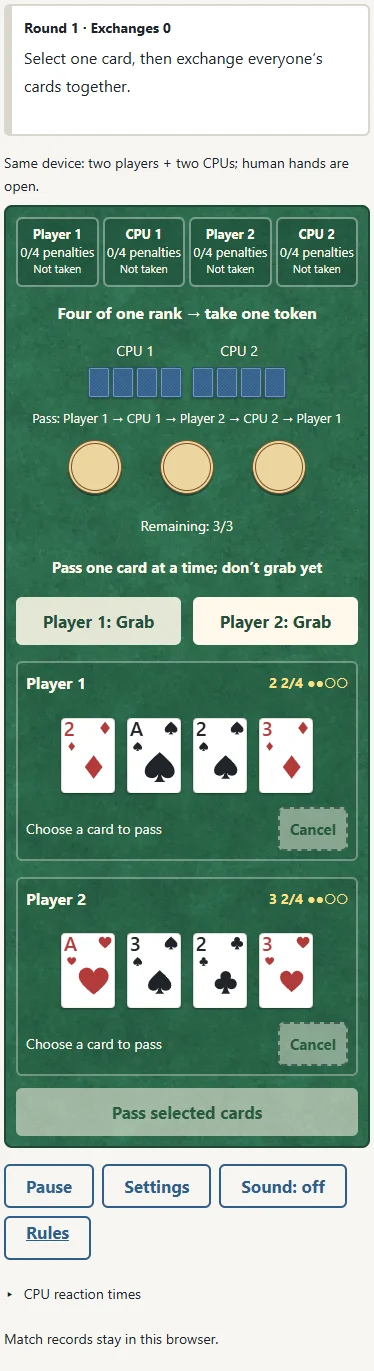
Same-device play uses two human players and two CPUs. Both human hands are openly visible. This is an open-hand version for a shared screen, rather than a secret-hand game where players pass the device back and forth. You can see the other human’s collecting plan and react to the same central display. The two CPU hands remain hidden during the round.
Each person selects a card in their own hand. Exchange becomes available when both choices are ready. Separate Player 1 and Player 2 buttons handle grabbing. On a keyboard, F is Player 1 and J is Player 2. On a touch screen, each player uses a separate button; neither needs to drag the same small object through the other person’s fingers.
Inputs are handled in arrival order, including nearly simultaneous human presses. CPU events with exactly equal times use an order derived from the deal rather than a permanent preferred seat. If a grab remains unfinished for eight seconds, the round is void with no penalty. Continue with a fresh deal instead of assigning an arbitrary loser when players have stopped responding.
Saved progress and tips
The browser saves your cards, penalties, taken tokens and remaining reaction waits. Continue restores the same situation and displays it before the clock starts moving. Japanese and English pages share this save. Changing devices or clearing browser storage does not transfer it. After a round, nothing deals automatically: press Next round when you are ready.
Begin by finding the rank you hold most of and choosing one unwanted card. After checking your hand, look back at the central tokens. You can still take one without a set if you notice the first grab quickly. Looking only at the tokens can also make you miss your own matching hand. The game asks you to divide attention between collecting and reacting.
A round that reaches one hundred exchanges without a conclusion is void and receives no penalty. If cards simply circulate, try a different collecting plan. Do not depend only on sound: use the visible token count and Taken labels to know whether the follow-up condition has begun.
Usunoro FAQ
Do I collect one suit?
Collect four of one rank. The four cards may have different suits.
Can I grab without a set?
Yes, after another player makes a legal first grab. Before that, you need four matching ranks.
Can two people play?
Same-device mode adds two CPUs to two human players, keeping four seats. Human hands are open.
Do reaction waits continue while paused?
No. The clock resumes with its remaining waits after the board is displayed again.