 Yorimichi Games
Egyptian War rules: what is Slap?
Egyptian War is a fast card game in which players reveal cards from face-down stacks and watch for patterns in the central pile. It is also described under names such as Slap and Egyptian Ratscrew. This page uses an ordinary 52-card deck without jokers and supports two players. Each begins with 26 cards. Neither player may inspect the order of their own stack, and the computer does not inspect either private stack before a card is revealed.
The aim in the full game is to collect all 52 cards. Court cards create challenges, while particular rank sequences allow either player to collect the pile. A slap on this page means a gentle press of your own button. You do not need to strike the screen or reach across another player's hands.
Deal, reveal and collect the pile
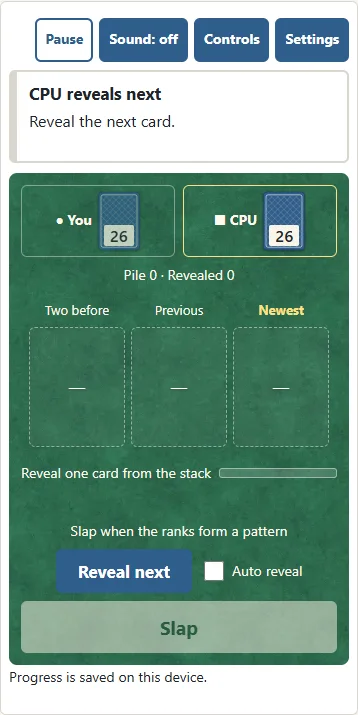
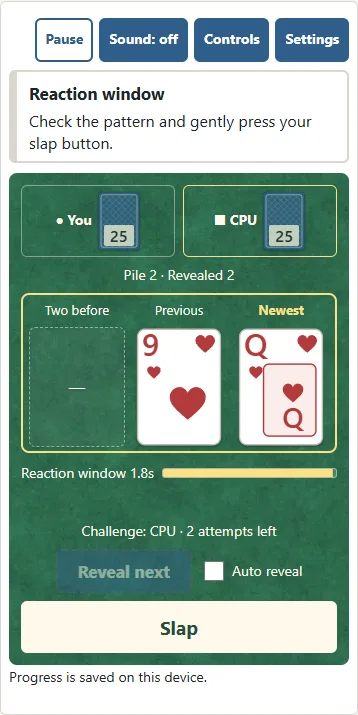
Shuffle the complete deck and divide it into two equal face-down stacks. The first player is chosen at random on this page. Reveal only the top card of the active stack. A number card from two through ten normally passes the revealing turn to the other player. The newest three cards use fixed positions labelled Two before, Previous and Newest, with the newest on the right. The pile counter includes older cards as well as any cards buried by a false-slap penalty.
When you collect the pile, add it underneath the cards still in your stack. You reveal the next card as well. Collection does not let you rearrange the cards to create a useful pattern. This implementation puts buried penalty cards first, followed by the ordinary pile from oldest to newest, at the bottom of the winner's stack. Remaining private cards therefore come before newly collected cards. The same collection order is used for both players and all CPU levels.
Face-card challenges: jack, queen, king and ace
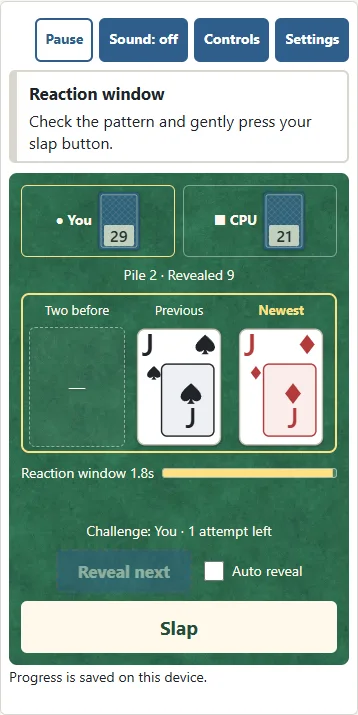
A jack gives the next player one chance to reveal another jack, queen, king or ace. A queen gives two chances, a king gives three, and an ace gives four. During a challenge, the responding player continues revealing cards rather than alternating after every number card. If a queen is followed by one number card, the responder still has one attempt. If the second card is another number, the player who revealed the queen is entitled to the pile.
A new court card or ace replaces the old challenge. For example, a jack revealed during a queen's challenge starts a new one-card challenge for the other player. Unused attempts are not carried forward or added together. If the responder runs out of cards before answering, the last challenger is entitled to collect after the reaction opportunity on the final card. A valid slap can override this entitlement, including when the challenge has just failed. Always check the visible pattern before assuming the pile belongs to the challenger.
When can you slap? Doubles and sandwiches
The standard preset has two slap conditions. A double is two consecutive cards of equal rank, such as seven followed by seven or queen followed by queen. Suits and colours do not matter. A sandwich is a three-card sequence whose first and last ranks match while its middle rank differs. Five, king, five and jack, two, jack are examples. Three equal cards already contain a double; they are not counted as a different sandwich under this definition.
Either player can slap, regardless of who revealed the current card. A player with no cards can still collect a valid pile and return to normal play. Slapping has priority over a failed court-card challenge. Once another card covers a pattern, the earlier pattern is no longer the current reason to slap. Inspect the present top cards rather than a combination that has disappeared underneath the pile. The page does not label a correct pattern before the reaction window; recognising it is part of the game.

False slaps, buried cards and input order
If you slap when none of the enabled conditions applies, take one card from the top of your own stack and bury it face down under the central pile. The two-card penalty setting increases this to two cards. If fewer cards remain, bury only what you have. A player with an empty stack cannot contribute a penalty card, and the game does not invent cards or borrow from a future collection. Buried cards are counted in the pile but are excluded from the visible pattern, including the top–bottom condition.
Each player can receive only one false-slap penalty during the reaction window for one revealed card. This prevents a repeated button press from unexpectedly burying several cards. The next reveal opens a fresh opportunity. After someone has collected the pile, later input cannot win that same pile. The browser processes arriving input events in order. Physical rules about fingers, overlapping hands or pulling the top card do not apply. Input speed can depend on the device, so shared-device players should agree to use comparable controls.

Optional slap conditions and rule differences
Choose Doubles only for a simpler recognition game, or choose Custom to enable each additional condition. Top–bottom means the newest visible card has the same rank as the first ordinary face-up card of the current pile. A buried penalty card is not that first face-up card. Adds to ten means the newest two cards total ten, with ace valued at one. Only ace through nine qualify: three and seven or ace and nine work. This page does not include the version with a court card between the two numbers.
King–queen allows the newest two cards to be a king and queen in either order. These extra conditions are off in the standard preset. Jokers, four-card runs, wraparound sequences, immediate victory on triples and physical penalties are not used here. References describe different selections of these rules. Bicycle lists several patterns and a one- or two-card false-slap penalty; the Djeco booklet emphasises doubles and court-card contracts. The authored Oxymoron page and its collected variation notes describe other penalties and sandwiches. Agree on the active conditions before starting.

Full-deck games and short games
In a full-deck game, the winner is the player who holds all 52 cards after a collection. An empty stack alone does not always mean immediate defeat because an eligible slap can bring that player back. The standard setup on this page offers a 100-reveal short game; you can also choose 200 reveals or the full-deck ending. The short game is an explicitly separate screen format rather than an alternative claim about the ordinary all-cards rule.
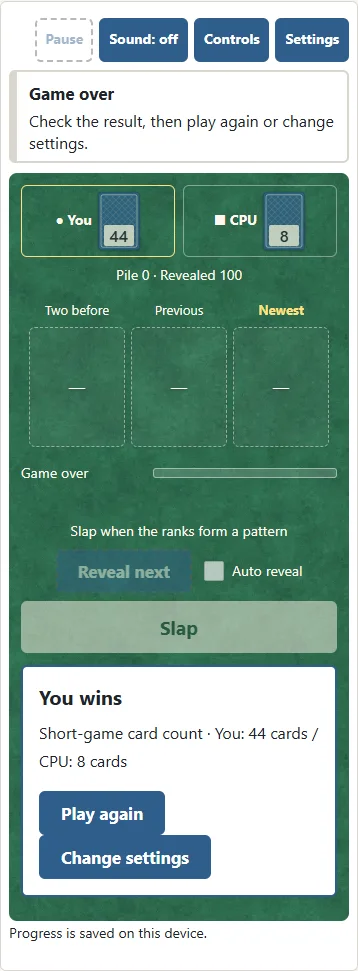
After the final reveal in a short game, finish its reaction window first. If a pile remains, give it to the entitled challenger, or otherwise to the player who revealed the last card. Then compare stack sizes. Equal totals are a draw. In full-deck play, an identical ordered position appearing three times is a draw, and so is a position with both private stacks empty and no player entitled to the pile. These ending agreements avoid continuing an unchanged cycle indefinitely. They do not alter the shuffle or choose cards for either player.
Computer play and reaction timing
Press the highlighted stack or Reveal next to expose one card. A reaction window lasts about 1.8 seconds, shown by the yellow remaining-time bar. During that interval, check the pattern and press Slap if appropriate. You cannot reveal another card until the window is settled. Computer reaction starts after the newly revealed card has been rendered, using the public pile only. A CPU may miss an eligible pattern or make a false slap. Easy is generally slower and less attentive, Normal more alert, and Hard faster and more accurate. There is no promise that a particular level produces a fixed human win rate.
Automatic revealing starts switched off. With it off, take your time between reaction windows and press Reveal next when ready. Turning it on reveals the next card after a short interval, but still gives every revealed card its own reaction opportunity. Changing this setting during a reaction window leaves its remaining time unchanged. Opening settings stops the timers. Moving to a hidden browser tab also pauses play. Returning through Resume starts a fresh reaction window rather than letting a computer collect cards while you were away. The saved state contains cards and rules, not an already-expired wall-clock deadline.
Safe shared-device controls
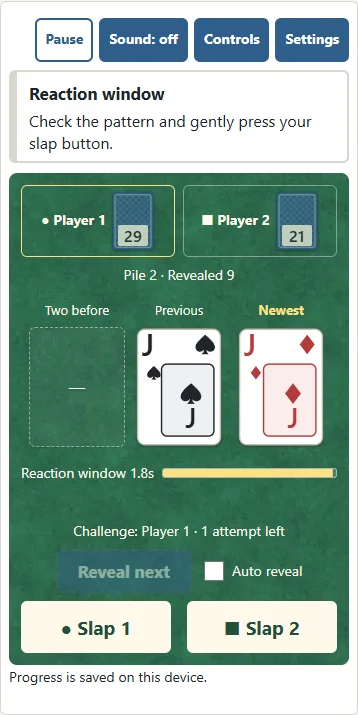
In pass-and-play mode, both players have separate slap buttons. Player 1 uses the left button and Player 2 the right button. You do not compete for one small central target. When the role of revealing cards changes, a confirmation appears. Put the device down or pass the revealing role, check that both players are ready, and confirm. No reaction timer runs while that confirmation is waiting, and an accidental touch during the pause is not a slap.
On a computer, F is Player 1's slap key and J is Player 2's key in shared-device mode. Space reveals the next card when the page itself has focus. Keyboard auto-repeat is ignored. Choose one input method each and avoid pressing the other player's control. Touch gently: the software recognises a button activation, not physical pressure. The face-down stacks remain hidden, so neither player needs to pass the device to inspect a private hand. The confirmation is about being ready to reveal together.
Two controls and the result
Strategy and common questions
Watch rank before colour or suit. Keep the previous card and the card before that in mind so you can distinguish a double from a sandwich. Count court-card attempts separately from the slap pattern: the last failed response can still create a valid slap. A large pile is tempting, but an early press without a recognised condition gives away a penalty card. Practising correct recognition on small piles is more useful than pressing blindly whenever the pile becomes valuable.
Can I slap every jack? No. A jack creates a one-card challenge, and a separate enabled pattern is needed for a slap. Can I examine my own stack? No; only public pile cards and stack sizes are visible. Do penalty cards create doubles? No; they are buried and excluded from pattern detection. Can I return after running out of cards? Yes, through a valid slap before the opponent has collected the entire deck. Can I resume later? Progress is saved in this browser on this device. Another browser or device does not automatically receive it. If storage is unavailable, the page reports that saving cannot be used.