Yorimichi Games
How to play Go Fish: collect books of four
Go Fish is a card game about asking questions, remembering answers and collecting complete sets. Use one ordinary deck of 52 cards without jokers. A book contains all four cards of one rank, such as the four sevens or the four queens. Suits distinguish the cards, but the request is for a rank rather than a particular suit. Four hearts with different numbers are not a book. Aces, jacks, queens and kings each form their own rank, just as the numbered cards do.
The standard game on this page ends when all thirteen ranks have become books. Each book is worth one point. The player with the most books wins; equal highest scores share the win. Getting rid of your hand first does not automatically make you the winner. This distinction matters because some familiar household versions finish as soon as someone runs out of cards. Choose the ending rule before starting, rather than changing it during a game.

Players, setup and the first turn
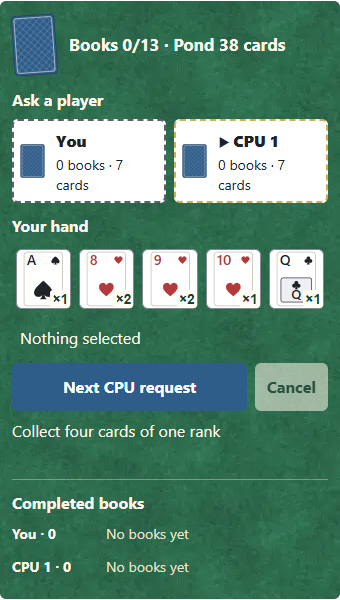
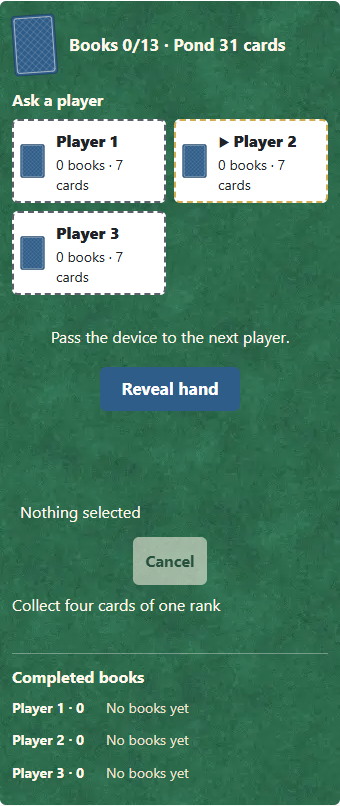
Choose two, three or four players. In CPU mode, you control one seat and the computer controls the others. In pass-and-play mode, everyone uses the same device in turn. The next player receives the device before revealing their hand. Public requests and completed books remain visible, but another player's private hand should not be inspected.
For the standard preset, deal seven cards each to two or three players, and five each to four players. Leave the remaining cards face down as the pond, also called the stock. This page chooses the first player at random and then follows numbered seat order. Any complete four-card book in the initial deal is put aside immediately. You do not keep a completed book in your hand as a way to ask for more cards of that rank.
You may have learned to deal five cards in a three-player game. That is a documented difference, rather than a mistake. The early-ending preset uses seven cards for two players and five for three or four. Check both the deal and the ending rule when comparing instructions.

Asking for cards and receiving every match
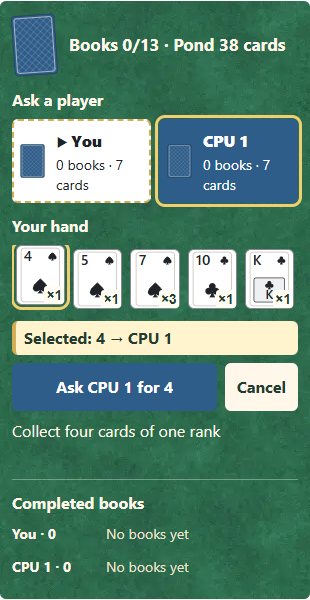
On your turn, choose one opponent and one rank currently in your hand. If you hold a queen, you can ask that opponent for queens. If you have no queens, you cannot ask for them. You are not allowed to bluff by requesting an absent rank. An opponent who holds the requested rank gives you every card of that rank, not just one. The transfer is compulsory and the number of cards received is public.
A successful request lets you ask again. You may keep the same opponent or choose a different one, and you may keep the same rank or switch to any rank still in your hand. Receiving cards can create a new useful request, so inspect the current hand rather than following a plan based only on the opening deal. Whenever four cards of a rank meet in one hand, they immediately become a book and leave that hand.
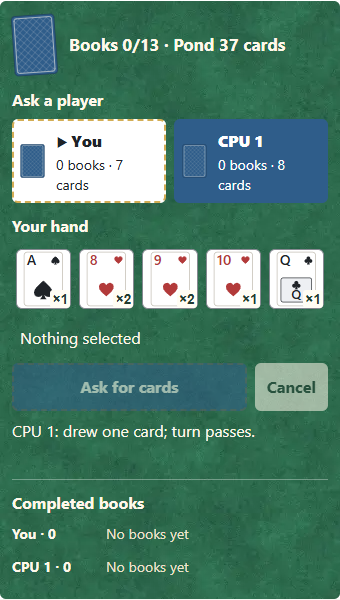
The hand display groups cards by rank. A representative card with a multiplication count shows how many you hold. Open the hand breakdown to inspect individual suits. Grouping makes the possible requests clear without requiring a large fan of tiny cards on a phone.
Go Fish draws and extra turns
If the chosen opponent has none of the requested rank, you go fish: take exactly one card from the top of the pond. If that card has the rank you just requested, reveal the successful catch and ask again. If it has a different rank, keep it privately and pass the turn to the next seat. For example, asking for eights and drawing an eight earns another request. Asking for eights and drawing a king does not, even if you already held another king.
An unsuccessful draw does not reveal its rank to the other players. They know that you gained a card, but they do not know which card it was. That uncertainty is part of the memory game. In the version used here, if an off-rank draw completes a different book, the book is scored immediately but the turn still passes because the requested rank was not caught. A completed book must never remain hidden in the hand.
Once the pond is empty, an unsuccessful request simply passes the turn without a draw. There is no replacement deck and no reshuffle of completed books. Standard play continues through this final stage until all thirteen books are complete.
What happens when a hand is empty?
An empty hand has a precise treatment in the standard preset. If you give away your final cards, you wait until your own turn. If the pond still contains cards then, draw one card and ask for that rank. You do not immediately refill as the target of another player's request. If you complete a book during your own successful turn and that leaves you empty, your continuing turn can refill in the same way.
If the pond is empty as well, skip the empty player's asking turns. Their completed books remain in the score and they can still be a winner. With no pond, you cannot select an opponent with no cards as the target of a request. The remaining players keep exchanging cards until the remaining ranks form books. If only one player holds all remaining cards, every remaining rank is already complete and is collected automatically.
The refill setting can change the empty-hand draw to five cards in standard play. If fewer than five remain, take only the available cards. This changes how quickly the pond is used, so agree on it before starting. It does not change the value of a book or create extra cards. The early-ending preset does not use a refill: an empty hand ends that game instead.
Go Fish variations and regional differences
There is no single household rule sheet that every player follows. The standard preset here follows Bicycle's full thirteen-book ending and its seven-card deal for two or three players. The early-ending preset follows the ending described in Pagat's main Go Fish rules: stop when a hand becomes empty or when the pond runs out. Count the books already collected at that point. Some cards may still be in hands, and a game can end with everyone tied on zero books.
Pagat also records continuing until every card becomes a book and refilling an empty hand with five cards as variations. These choices should not be confused with Australian Fish, a recorded pairs game in which a pair is removed immediately. Removing two cards changes the ranks you can request and the total number of scoring sets. Nor is this the Indonesian Omben version, where a player may draw repeatedly until the requested rank appears and aims to empty their hand first.
Other groups ask for a specific card, including its suit, or pass a failed turn to the player who answered rather than to the next seat. Those rules are not active on this page. A game's name alone does not establish its entire ruleset. Ask about the deal, set size, extra turns, empty hands and ending before playing with a new group.
Five useful Go Fish strategy tips
First, notice ranks of which you hold three cards. Receiving the missing card can complete a book immediately. However, three cards are not a guarantee that your chosen opponent has the fourth: it may still be in the pond. A public clue about the target can matter more than the size of your own group.
Second, remember what other players ask for. A legal request reveals that the asker holds at least one card of that rank. The clue lasts only while their hand could still contain it. A later transfer or completed book can make it obsolete. Third, remember negative answers. Asking the same person immediately after they said Go Fish is usually unhelpful. But a later private draw means the old answer is no longer certain.
Fourth, use successful chains to update your plan. New cards and disappearing books change the legal ranks after every request. You need not finish the same rank before asking about another. Fifth, follow the public books and the remaining pond size near the end. A completed rank cannot be in any hand, and an empty pond makes unanswered requests pass without adding new uncertainty.
Easy CPU tends to stay with one rank, repeating the same legal request while the pond has cards. It does not use negative answers to switch plans. Once the pond is empty it varies its requests. Normal CPU uses recent public requests and responses. Hard CPU considers the full public history and the number of matching cards in its own hand. None of these levels can inspect another player's hidden cards or the order of the pond. Chance still affects every level, especially the opening deal and private fishing draws.


Frequently asked questions and controls
Can I ask for aces if I hold no ace? No. Every requested rank must appear in your current hand. Completed books do not count as cards still held. Can a player keep one matching card after being asked? No. They must give all matching cards. The computer applies that rule automatically. Can someone steal a completed book? No. A book is removed from the hand and stays with its owner.
Is an ace worth more than a two? No. Every book scores one point, regardless of rank. Are ties allowed? Yes. All players tied for the highest book count share the win. There is no special value for the last book and no automatic extra deal to break a tie. Does an empty pond end every Go Fish game? No. It ends the early-ending preset but not the standard full-book game.
To make a request, select an opponent, select a rank in your hand, and press Ask for cards. Selected items have an outline. Tap a selected rank or player again to deselect it. Cancel, Escape or the empty table clears both selections; sliding a finger does not confirm a request. Enter on a focused card or player toggles that selection. Move focus to the Ask button and press Enter to make the request. Computer turns initially wait for the Next CPU request button. Enable automatic CPU play if you prefer; it still stops for your own turn. Opening settings pauses the game, and Resume returns to the existing game rather than starting a new deal.
Progress is saved in this browser on this device, and the start screen offers Resume when a valid saved game exists. It does not transfer to another device or browser. If browser storage is unavailable, the page reports that saving cannot be used. Sound starts switched off. For pass-and-play, reveal the hand only after the next player has received the device, and pass it back whenever the turn changes.
Rule references: Bicycle / Pagat / Go Fish Online