 Yorimichi Games
How to play Euchre online
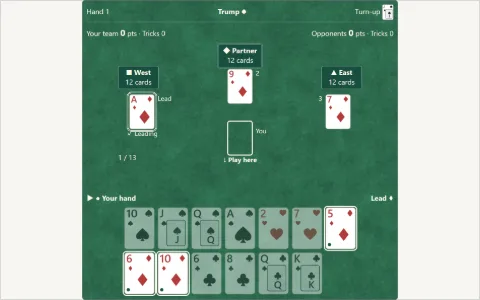
Euchre is a partnership trick-taking game with a small deck and an unusual trump ranking. You sit at the bottom of the table, your computer partner sits opposite, and the two other computers form the opposing team. Play moves clockwise: from your bottom seat to the left seat, then the top seat, then the right seat. Each player receives five cards. A trick is one round of cards, with every active player contributing one card. Five tricks make a hand. The team that names trump becomes the makers and promises to win at least three of those five tricks. Your team score and your current trick count are displayed separately. This free game uses the common North American 24-card, no-joker version. The normal match ends when a team reaches at least ten points. Choose a five-point target for a shorter session. There is no betting, entry fee, or real-money reward. You play your own cards while three computers fill the other seats.

Euchre card rankings: the right and left bowers
The deck contains the nine, ten, jack, queen, king, and ace of each suit. Outside trump, cards rank ace, king, queen, jack, ten, nine. Trump works differently. The jack printed in the trump suit is the right bower and is the strongest card. The jack of the other suit of the same color is the left bower and ranks second. The remaining trumps are ace, king, queen, ten, nine. With hearts trump, the heart jack beats the diamond jack, which beats the heart ace. With spades trump, the club jack becomes the left bower. Red suits pair together, and black suits pair together. Both bowers actually belong to the trump suit for following-suit purposes. The left bower is therefore removed from its printed suit. Look for both jacks before counting your trump cards. The small trump mark beside a card's number helps you recognize a bower in your hand without changing the original suit printed on the card.
Two rounds of bidding and making trump
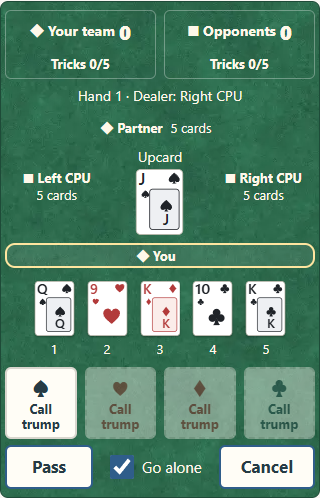
The dealer deals five cards to each player in packets of two and then three, starting with the player to the dealer's left. The next card is turned face up as the upcard. Three remaining cards stay hidden and are not played. Bidding begins to the dealer's left and moves clockwise. In round one, you may order up the upcard suit or pass. The first call settles trump immediately; later players do not get another bidding turn. If everyone passes, a second round begins with the same first bidder. Now you may name any suit except the rejected upcard suit. Under the Standard preset, four more passes produce a redeal with the next dealer and no points scored. Under Stick the dealer, the final bidder in round two must choose a suit. Passing with an unsuitable hand is a normal part of the game, rather than an illegal or incomplete move.
Ordering up, picking up, and discarding
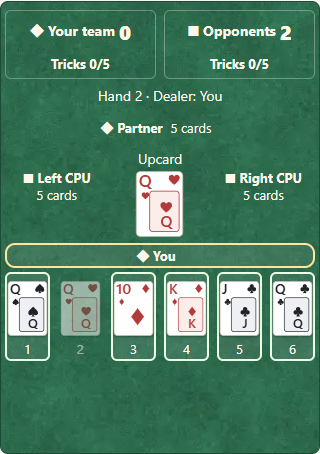
When trump is accepted in round one, the dealer picks up the upcard, even if somebody on the opposing team called it. The dealer briefly holds six cards and discards one of the original five face down, keeping the upcard. If you are the dealer, tap one of the bordered original cards to discard it. Other players cannot see your discard. The discarded card never returns during this hand. In round two there is no pickup or exchange: every player keeps the original five-card hand. Remember that ordering up may strengthen the dealer. Giving a strong trump upcard to an opposing dealer can turn a promising call into a difficult hand. Giving it to your own partner may be helpful. The exchange still takes place if the dealer is the partner of a lone caller and will sit out the actual play. The dealer's responsibilities during bidding and participation during the tricks are separate.
Following suit and the left-bower exception
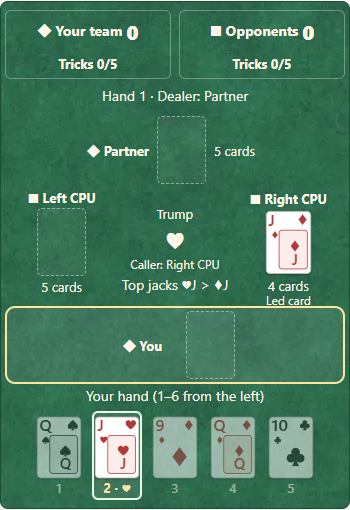
The first card played establishes the suit led. If you hold a card of that effective suit, you must follow it. Effective suit means the suit after moving the left bower into trump. Suppose hearts are trump and the diamond jack is led. This is a heart lead, so anyone holding a heart must play a heart. A printed diamond does not follow that lead unless it is the diamond jack itself. Now suppose a diamond ace is led. A diamond jack in your hand does not count as a diamond, because it belongs to hearts. If the jack is your only printed diamond, you are void in diamonds and may play any legal card. When you have none of the suit led, you may trump or discard another suit. You are not required to trump, and you do not have to beat the current winning card. The bordered cards in your hand show which choices are legal.
Winning a trick and going alone
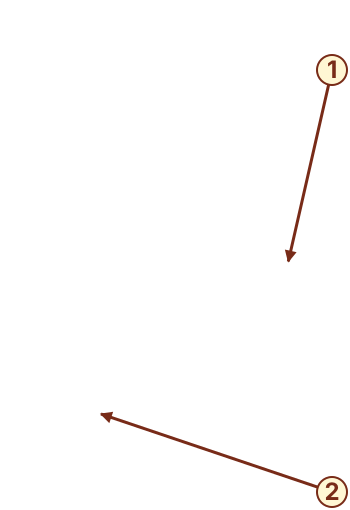
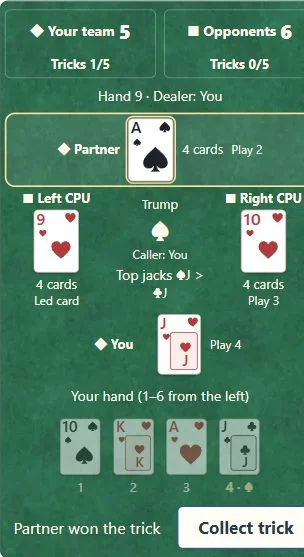
If any trump is played, the highest trump wins the trick. Otherwise the highest card of the suit led wins. An ace in an unrelated suit cannot win simply because it is an ace. The winner leads the next trick. The caller can choose Go alone before naming trump. Their partner then sits out that hand, leaving three active players. A lone hand still contains five tricks. The first lead comes from the dealer's left, skipping that seat if its player is sitting out. A dealer who sits out still makes the required first-round exchange. If your computer partner goes alone, you cannot play a card during the hand, but you can watch the tricks and select Next to continue. This game allows only the caller to declare a loner. Defenders cannot go alone, and partners cannot exchange cards with a lone player. Going alone is a chance to earn a larger sweep bonus, not a guarantee that the caller's team will score.
Euchre scoring and available rule settings
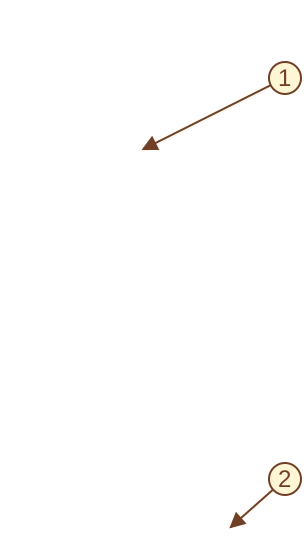
The makers score one point for taking three or four tricks and two points for taking all five. A caller who goes alone and takes all five scores four points for the team. A loner taking three or four still earns one point. If the makers take only zero, one, or two tricks, they are euchred and the defenders score two points. The makers do not lose points from their existing total. Scoring occurs after all five tricks, and reaching or passing the chosen target ends the match. Standard allows a second-round redeal. Stick the dealer removes that final pass. Hold trump + Stick also requires other callers to hold at least one trump; the left bower alone qualifies. The dealer's pickup and forced second-round call are exempt. Custom lets you change these two switches separately. These presets describe the displayed house rules, rather than reproducing an entire federation tournament with its fixed hand counts, time limits, or table rotations.
| Setting | Dealer in round 2 | Hold trump |
|---|---|---|
| Standard | May pass | Not required |
| Stick the dealer | Must call | Not required |
| Hold trump + Stick | Must call | Required; dealer exempt |
Euchre bidding tips for beginners
Count effective trumps before choosing a suit. Check for both bowers, then consider whether your remaining cards can win another trick. Three low trumps are not automatically stronger than two high trumps backed by an outside ace. Look at who is dealing and at the actual upcard. If the dealer is an opponent, your round-one call hands them a potentially useful trump. If the dealer is your partner, their pickup and discard may improve your team's combined chances. Your side needs three tricks together, so your own hand does not have to win three by itself. Think carefully before going alone. Removing your partner can lose the single extra trick needed to make the hand. A possible four-point sweep is attractive when you have exceptional control, but a reliable partnered point can also be valuable. The score matters: when one point will finish the match, a speculative loner offers no extra benefit over making the same hand with help.
Euchre strategy when playing your cards
Avoid overtaking a partner who is already winning unless a later opponent is likely to beat that card. If you are the final player, you can often see that your partner's win is secure and save your stronger card. An outside ace is a useful lead early in the hand, but an opponent who is void in that suit can trump it. Makers with strong trump may lead trump to draw out opposing trumps. This also uses some of the partner's trumps, so it is a choice rather than an automatic rule. Remember which bowers have appeared. Until both are accounted for, the trump ace is not the highest card. Notice when a player fails to follow a suit: that absence can guide a later lead. You still cannot identify every unseen card. Three cards were never dealt, and a first-round discard is also hidden. A missing ace or jack may be outside the active hands entirely.
Controls, saving, and computer difficulty
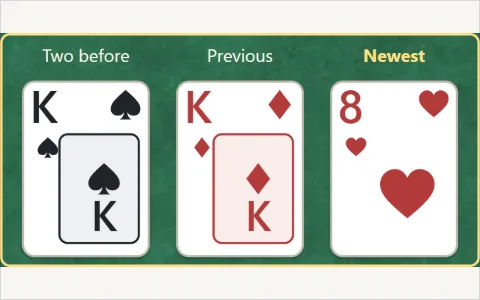
Tap or click a bordered card to play it or discard it. The card numbers, counted from the left, correspond to keys 1 through 6. During bidding, S, H, D, and C select the four suits, X passes, and A toggles Go alone. Space advances a completed trick or a finished hand. P pauses or resumes. You can also use Tab to move through the buttons and Enter to activate one. Completed tricks remain visible until you choose Next, giving you time to understand who won. The match is saved in this browser. Reopen the page and select Continue to resume it. Opening Settings keeps the saved match available; starting with new settings begins a new match. Restart asks for a second press before making a fresh deal. Sound begins off. Difficulty affects the two opposing computers, while your partner stays at a fixed level. Easy leaves more opportunities in card use, Normal provides a balanced challenge, and Hard pays closer attention to played cards and missing suits.
Tap a white-bordered card once to play or discard it immediately. Moving your finger before releasing cancels that tap. Cancel, Escape, or blank table space clears an Alone preparation or a Restart confirmation. Committed cards cannot be taken back.
Euchre FAQ
Why is my diamond jack disabled on a diamond lead? If hearts are trump, that jack counts as a heart; you must play another diamond when you have one. Can I play a losing card instead of trumping? Yes, if you cannot follow the suit led, you may choose any card. Does my team make trump when my partner takes all three required tricks? Yes. Partnership tricks are added together. Can I name the rejected upcard suit in round two? No; only the other three suits are available. Does an unsuccessful loner cost four points? No. The defenders receive two points when the makers fail to take three tricks. Can I move a save to another device? Saves are local to the current browser and are not automatically synchronized. Clearing browser storage also clears the saved match and records. Is money needed to play? No. This is a free card game without wagering or real-money prizes.
Euchre history and regional variations
Euchre has been played for generations in North America and elsewhere. Its origins are discussed in several historical accounts, often connecting it with earlier European trick-taking games. The name bower is associated with the German word used for a jack. There is no single worldwide rule set. Some British games use a joker, called the Benny, above both bowers and play to eleven points. Other traditions use a larger deck. Some groups require the dealer's partner to play alone when ordering up. Tournament organizers may instead use a fixed number of hands or a time limit and have procedures for exposed cards and failures to follow suit. The game on this page is the 24-card, no-joker version with a caller-only loner. When playing with people at a real table, agree on the deck, target score, dealer obligation, and loner conditions before the first deal. The settings table here makes the available choices explicit.